


Blog
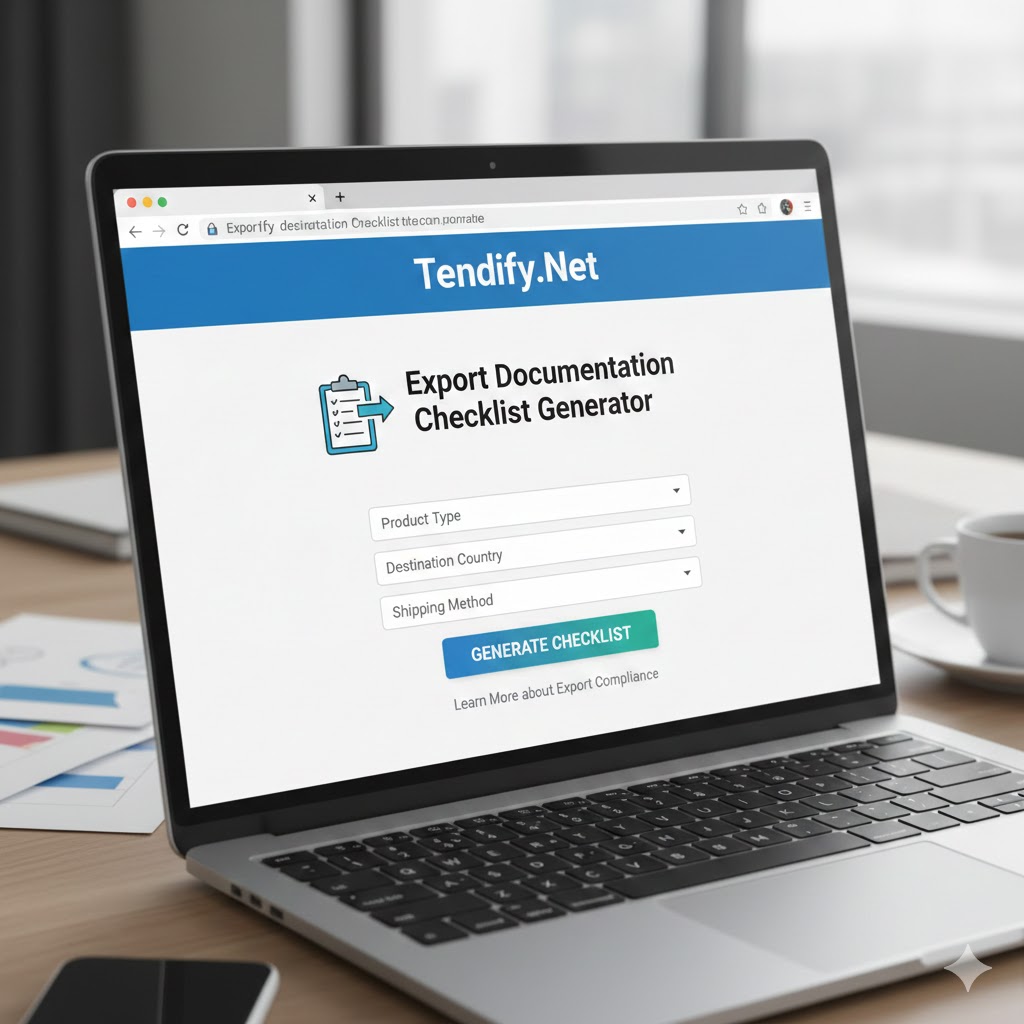
Free Export Documentation Checklist Generator
Tendify ExportPro
Global Compliance Engine
Export Documentation
Checklist Generator
Instantly generate a personalized compliance checklist based on your cargo type and destination country. Reduce customs delays by 40%.
Completion Status
Ensure all mandatory marks are green before booking freight.
Final Step
Enter your business email to receive the white-labeled Tendify report.
By clicking, you agree to Tendify's Terms of Compliance Analysis.
Master Export Documentation Checklists in 2026
I’ve spent decades in international trade, building businesses that ship goods across borders day in and day out. One lesson stands out above all: export documentation isn’t just paperwork—it’s the foundation of smooth, profitable global operations. Get it wrong, and you’re looking at costly delays, fines, or seized shipments. Get it right, and your cargo clears customs quickly, building trust with buyers and boosting your bottom line.
In today’s fast-paced trade environment, incomplete or inaccurate export documents cause up to 80% of customs delays, according to industry reports from logistics experts. That’s lost time, extra storage fees, and frustrated partners. That’s why tools like the Export Documentation Checklist Generator have become essential. This free tool instantly creates personalized checklists based on your destination country and commodity type, helping you avoid those pitfalls.
This guide dives deep into everything you need to know about export documentation checklists. We’ll cover core requirements, country-specific demands, industry variations, and practical steps to implement them effectively. By the end, you’ll understand not just what documents you need, but why they matter—and how to use modern tools to stay ahead.
Why Export Documentation Matters More Than Ever
International trade has exploded in recent years, with global exports reaching trillions annually. Yet, regulations keep evolving. Countries tighten compliance to protect local industries, ensure safety, and track goods accurately.
Miss a single document, and your shipment stalls. Studies from sources like the U.S. International Trade Administration highlight that documentation errors are the leading cause of clearance issues. In high-volume ports, this can add days or weeks to delivery times, eroding margins.
Strong export documentation does more than comply—it protects your business:
- Reduces risk of penalties
- Speeds up customs clearance
- Builds credibility with international buyers
- Minimizes financial losses from delays
I’ve seen companies lose contracts over simple oversights, like forgetting a Certificate of Origin. On the flip side, those who master this process dominate their markets.
Core Export Documents Every Shipper Needs
Certain documents form the backbone of any export shipment. These are nearly universal, required regardless of destination or cargo type.
Essential Commercial Documents
These prove the transaction and describe the goods:
- Commercial Invoice: The primary bill of sale. Includes buyer/seller details, description, HS codes, value, and Incoterms. Customs uses this to assess duties.
- Packing List: Details weights, dimensions, marks, and packaging. Critical for verification without opening containers.
- Certificate of Origin (COO): Certifies where goods were manufactured. Often needed for tariff preferences under trade agreements.
Key Shipping and Transport Documents
These handle logistics and title transfer:
- Bill of Lading (B/L) or Air Waybill (AWB): Issued by the carrier. Acts as receipt, contract, and sometimes title document.
- Insurance Certificate: Proof of coverage, if required by Incoterms.
These core items appear in almost every checklist. Skipping them is like shipping without a tracking number—risky and avoidable.
Country-Specific Export Documentation Requirements
Regulations vary widely by destination. What works for one market can fail in another. Here’s a breakdown of common requirements in key regions as of 2026.
Middle East and Gulf Countries
Strict compliance is the norm here, with electronic systems mandatory.
- Saudi Arabia: SABER Platform certification (PCoC/SCoC) for regulated products, plus SASO conformity for electronics.
- United Arab Emirates: Halal certificates for food, MOCCAE approvals for agri products.
- Other Gulf States: Systems like Bayan (Oman) or Tawtheeq (Qatar) often require pre-registration.
Eurasian Markets
Technical regulations dominate.
- Russia and EAC Countries: EAC Declaration or Certificate for conformity.
- China: CCC marking for many categories like electronics and auto parts.
- India: BIS standards for electronics, FSSAI for food imports.
Western Markets
Focus on safety and origin.
- European Union: CE Marking and Declaration of Conformity.
- United Kingdom: UKCA post-Brexit equivalents.
- United States: FDA Prior Notice for food, EPA for certain goods.
Always check current rules—trade agreements and sanctions change frequently.
Comparison of Key Country Requirements
| Country/Region | Mandatory Certification | Common Additional Docs | Typical Delay Risk if Missing |
|---|---|---|---|
| Saudi Arabia | SABER (PCoC/SCoC) | SASO IECEE | High (electronic rejection) |
| Russia | EAC TR CU | GTIN Registration | Medium-High |
| China | CCC Mark | AQSIQ for certain agri | High |
| EU | CE Declaration | Eur1 for preferences | Medium |
| USA | FDA/EPA as applicable | Lacey Act for wood | Medium (inspections) |
Industry-Specific Documentation Needs
Commodity type adds another layer. Hazardous or regulated goods demand extra proof.
Food and Perishables
- Phytosanitary Certificate: Prevents pest spread.
- Halal Certificate: Essential for many markets.
- Health Certificates: From authorities like MOCCAE.
Hazardous Materials (Petrochemicals)
- Material Safety Data Sheet (MSDS): Details risks and handling.
- IMDG compliance for sea shipments.
Medical and Pharma
- Certificate of Analysis (CoA): Lab verification.
- GMP compliance proof.
Industrial and Electronics
- CE or equivalent markings.
- Test reports for safety.
Matching industry to requirements prevents surprises at customs.
How to Build and Use an Effective Export Documentation Checklist
A static list won’t cut it in dynamic trade. You need a dynamic, personalized approach.
Step-by-Step Process for Creating Your Checklist
- Identify Destination and Commodity: Start here—regulations hinge on these.
- List Core Documents: Always include invoice, packing list, B/L.
- Add Country-Specific Items: Research or use tools for mandates like SABER or EAC.
- Incorporate Industry Requirements: Layer in Halal, MSDS, etc.
- Verify and Update: Cross-check with freight forwarders; review quarterly.
- Track Completion: Mark off as prepared; aim for 100% before booking.
This methodical process has saved my teams countless headaches.
Common Mistakes and How to Avoid Them
- Keyword Stuffing Analogy: Don’t overload invoices with vague descriptions—be precise.
- Outdated Info: Regulations change; tools with updated databases help.
- Assuming Universality: Never assume one checklist fits all shipments.
Introducing the Export Documentation Checklist Generator
This is where modern solutions shine. The Export Documentation Checklist Generator on Tendify is a game-changer I’ve come to rely on.
What It Is and How It Works
This free online tool generates instant, tailored checklists. Select your destination country (from major markets like Saudi Arabia, Russia, EU, USA) and industry/commodity (food, hazardous, medical, etc.). It pulls from an updated database to list:
- Global core documents
- Country-specific mandates
- Industry extras
It categorizes them (Commercial, Shipping, Compliance) and tracks progress with a completion percentage.
Step-by-Step Guide to Using the Tool
- Visit the generator page.
- Choose Destination Country from the dropdown (e.g., Saudi Arabia for SABER needs).
- Select Industry/Commodity (e.g., Food for Halal/Phytosanitary).
- View the dynamic checklist—items appear instantly.
- Check off prepared documents; watch progress bar rise.
- Download a branded PDF report (after quick registration) for your records or sharing.
It’s intuitive, fast, and reduces errors dramatically.
Real-World Benefits I’ve Seen
Users report cutting preparation time by hours and reducing delay risks significantly. In one case, a client avoided a major hold-up by spotting a missing CoC early.
For deeper insights on Gulf market strategies, check out our article on Strategic Business Networking 2026: How to Build a Wealthy Export Circle in the Gulf with Tendify. Or explore Strategic Networking 2026: The “Trust Protocol” for Exporting to the Gulf with Tendify for trust-building tips.
Advanced Tips for Export Compliance Mastery
Go beyond basics:
- Digitize Everything: Electronic submissions speed processes (e.g., SABER is fully online).
- Partner with Experts: Freight forwarders or platforms like Tendify handle complexities.
- Audit Regularly: Review past shipments for patterns.
- Train Your Team: Compliance is everyone’s responsibility.
These habits separate occasional exporters from consistent winners.
The Future of Export Documentation in 2026 and Beyond
Digital tools and AI are transforming compliance. Platforms integrate real-time updates, predictive checklists, and automated submissions. Blockchain for verifiable origins is emerging.
Staying ahead means embracing these—starting with reliable generators.
Export documentation checklists aren’t glamorous, but mastering them is profitable. With the right approach and tools, you turn potential roadblocks into competitive advantages.
Ready to streamline your next shipment? Head over to Tendify’s Export Documentation Checklist Generator today. Generate your free personalized checklist, track progress, and download a professional PDF report. Sign up now—it’s quick, secure, and could save you thousands in delays.
Your next successful export starts here. Register and generate your checklist today.
About Eftekhari
From the Lab to the Global Market My journey began in the world of Chemical Engineering, where precision and optimization are everything. Today, as the CEO of Shayesteh Kar Rad Caspian and the founder of Tendify, I apply that same engineering mindset to the world of digital trade. I’ve transitioned from designing industrial processes to architecting digital marketplaces that serve the GCC and beyond. My expertise lies in blending "Engineering as Marketing" with a deep understanding of geopolitical market shifts. On Tendify, I share my insights and provide a platform designed for transparency and efficiency. I’m not just a developer; I’m a partner in your trade journey, committed to cutting through the noise with actionable, data-backed strategies.
View all posts by Eftekhari
