


Blog
Industrial Automation Ecosystems: China, Germany, Japan & US
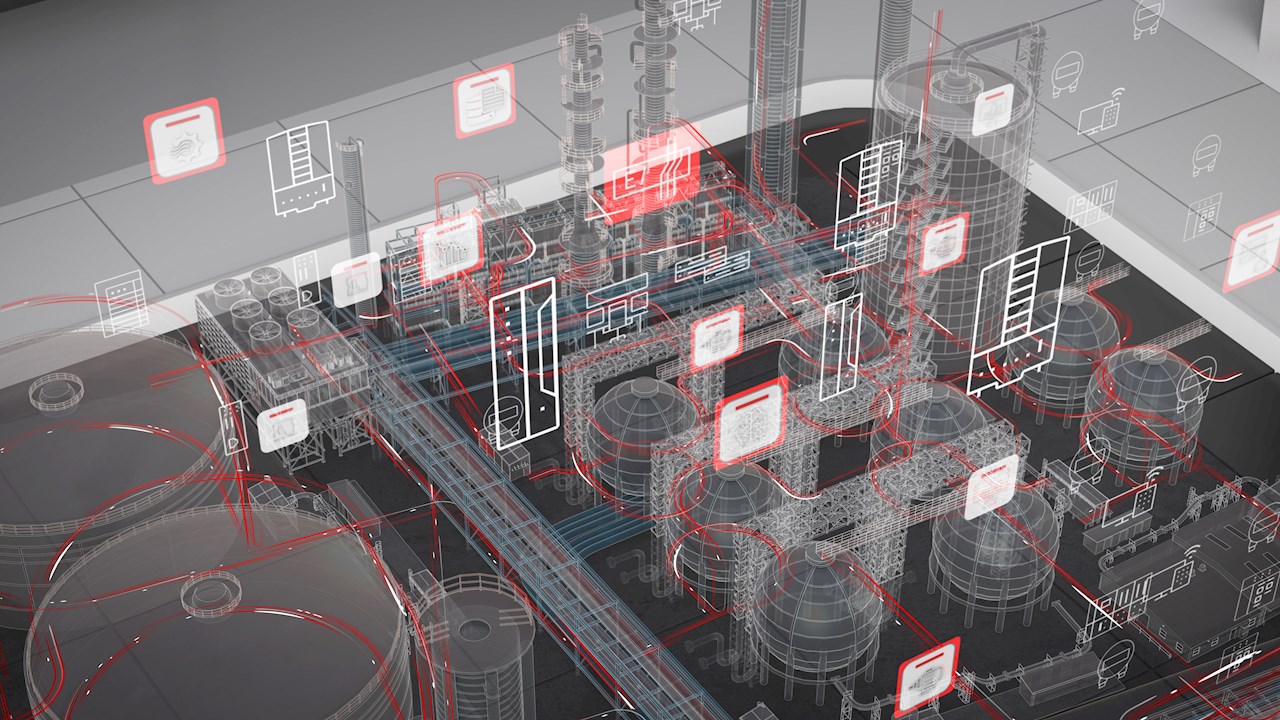
A single data point from recent International Federation of Robotics figures reframes the entire conversation. China now accounts for roughly 54 percent of all new industrial robot installations worldwide. In absolute terms that is hundreds of thousands of units per year—more than the rest of the world combined in some reporting periods. Yet the core technologies that make those robots precise, reliable, and intelligent still largely originate in Germany, Japan, and the United States.
Scale and technological leadership are no longer the same thing. The competition has moved beyond individual companies. It is now a contest between industrial ecosystems. Four stand out clearly: China, Germany, Japan, and the United States. Each dominates different layers of the automation value chain, and the interaction between those layers will decide how global manufacturing operates for the rest of this decade.
The question is no longer who builds the best machine. It is which ecosystem will set the standards, control the software layers, and ultimately determine cost structures, lead times, and resilience across cross-border supply chains.
B2B Cross-Border Payments: Modular Infrastructure & FX Rails
Why Ecosystems Matter More Than Individual Vendors
Industrial automation has always been a systems business. A robot arm is useless without the servo drives, the PLC or motion controller, the vision system, the safety sensors, and the software that orchestrates the entire cell. When those components come from different national innovation systems, the result is not a simple product catalog. It is a set of interlocking capabilities that shape how factories are designed, how suppliers are qualified, and how quickly production can be reconfigured.
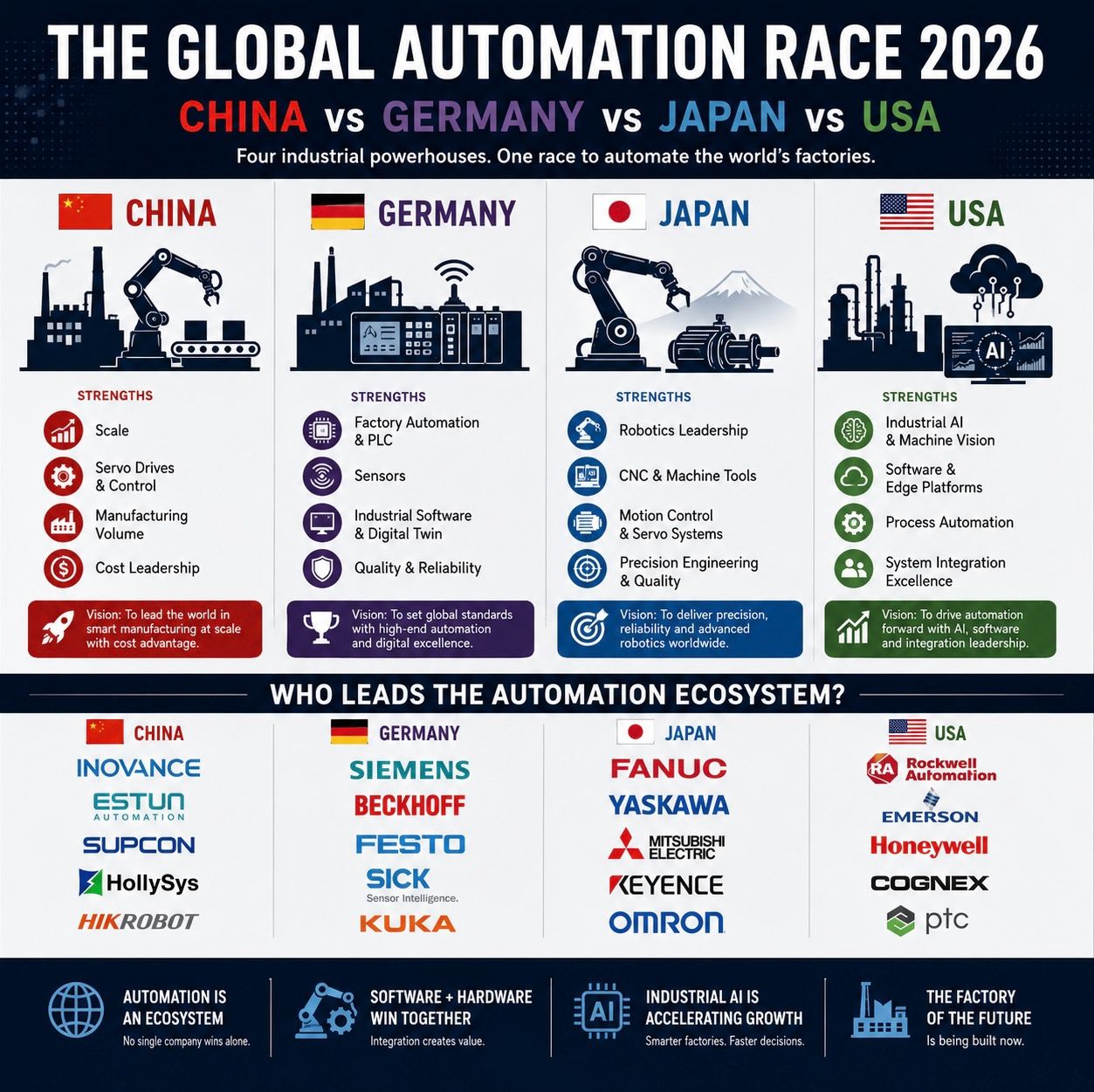
Industrial Automation Ecosystems
In regional supply-chain analyses, the practical consequence is clear. Procurement teams that treat automation as a series of discrete purchases repeatedly run into integration friction, longer commissioning times, and higher total cost of ownership. Teams that map their sourcing against ecosystem strengths—precision motion from Japan, modular control architecture from Germany, industrial AI and vision from the United States, high-volume deployment economics from China—move faster and with fewer surprises.
Germany: Standards, PLCs, and the Factory Backbone
Germany continues to set many of the de-facto global standards in factory automation. The combination of Siemens, Beckhoff, Festo, SICK, and KUKA (now under Midea ownership but still operating from its German engineering base) produces an unusually dense cluster of control, pneumatics, sensing, and robotics capability.
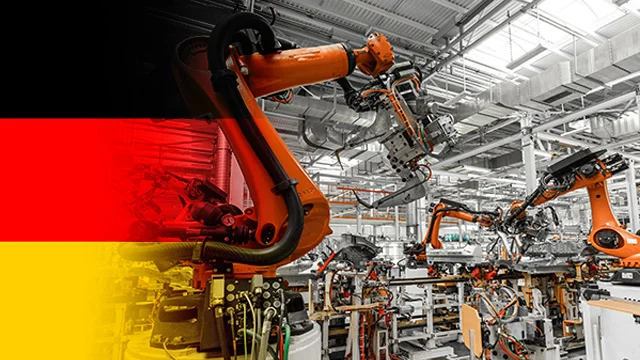
Germany Industrial Automation
Siemens’ industrial software stack and PLC families remain the reference architecture for large-scale discrete and process plants across Europe, the Middle East, and significant parts of Asia. Beckhoff’s PC-based control approach has pushed open, high-performance automation into applications that previously required proprietary hardware. Festo’s pneumatic and electric motion systems, paired with SICK’s sensor intelligence, deliver the reliability expected in regulated and high-uptime environments.
Operational evaluations of multi-plant networks show that German-origin control systems still dominate where long-term maintainability, functional safety certification, and seamless integration with MES and ERP layers matter most. The ecosystem’s strength is not the lowest unit cost. It is the predictability of the entire automation stack over a 10- to 15-year equipment life cycle.
For cross-border manufacturers serving European or high-specification Middle Eastern markets, this remains the default choice for the control layer. Lead times and engineering support are mature. The trade-off is price and, in some cases, less aggressive software innovation cycles compared with pure-play U.S. industrial software firms.
Japan: Robotics, Motion Control, and Precision Engineering
Japan’s contribution sits at the mechanical and motion core of automation. Yaskawa Motoman, Mitsubishi Electric, KEYENCE, and Omron continue to define performance benchmarks in articulated robots, servo systems, and high-speed inspection.
Yaskawa and Mitsubishi’s robot controllers and servo packages remain the preferred solution in electronics, automotive body-in-white, and high-precision assembly lines where cycle time and path accuracy are non-negotiable. KEYENCE’s sensors and vision systems, together with Omron’s machine automation controllers, close the loop between sensing and actuation with minimal latency.
Japan Industrial Automation
In supply-chain audits of electronics and automotive tier suppliers, Japanese motion and robotics components frequently appear as the specification of record even when the mechanical structure or end-effector is sourced elsewhere. The reason is straightforward: decades of cumulative reliability data and tight integration between motor, drive, and controller reduce commissioning risk.
Japan’s ecosystem is less focused on pure software platforms and more on the physical performance envelope. That focus has protected its position even as Chinese manufacturers expand unit volumes. Precision remains a differentiator that volume alone does not erase.
United States: Industrial AI, Machine Vision, and Software Layers
The U.S. ecosystem leads where software, data, and adaptive intelligence create the greatest leverage. Rockwell Automation, Emerson, Honeywell, Cognex, and PTC represent a concentration of control software, process automation, machine vision, and digital-thread platforms that increasingly sit above the hardware layer.
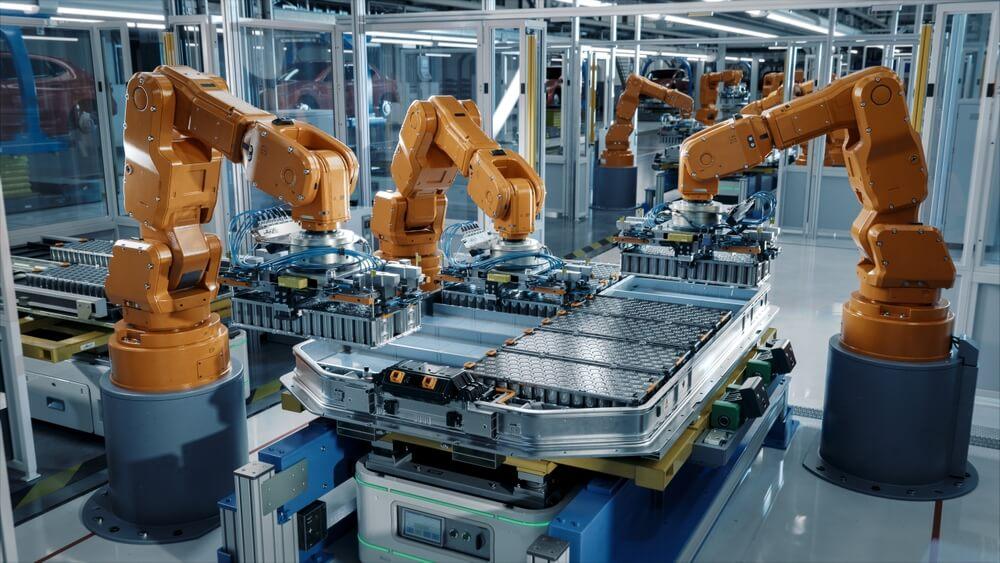
United States Industrial Automation
Rockwell’s FactoryTalk and Allen-Bradley installed base remains the standard in many North American plants and in facilities designed to North American specifications. Cognex continues to push the frontier of industrial machine vision, particularly in high-mix inspection and robot guidance. PTC’s industrial IoT and digital-twin capabilities, combined with Emerson and Honeywell’s process expertise, give U.S. vendors a strong position in software-defined automation and AI-assisted optimization.
Experiences from multi-site deployments show that the real advantage appears when production mixes change frequently or when quality data must be fed directly into enterprise systems. Hardware can be standardized; the differentiation moves into the ability to reconfigure cells through software and to extract predictive insights from sensor streams. That is where the U.S. cluster currently holds the edge.
Edge AI, Chipmakers, and Embedded Compute at the Factory Floor
While U.S. software platforms like Cognex and PTC dominate high-level vision and IoT layers, a fundamental shift is occurring at the Silicon layer. The integration of Edge AI hardware—led by semiconductor titans like NVIDIA (Jetson platform), Intel, and Qualcomm—is moving real-time inference directly onto robotic arms and inspection cells, bypassing cloud latency entirely.
China: Volume, Cost, and Accelerating Capability
China’s position is defined by deployment scale and rapidly improving cost-to-performance ratios. Companies such as Inovance, Estun Automation, HollySys, SUPCON, and Hikrobot have moved from domestic followers to credible global suppliers in servo systems, industrial robots, process DCS, and mobile robotics.
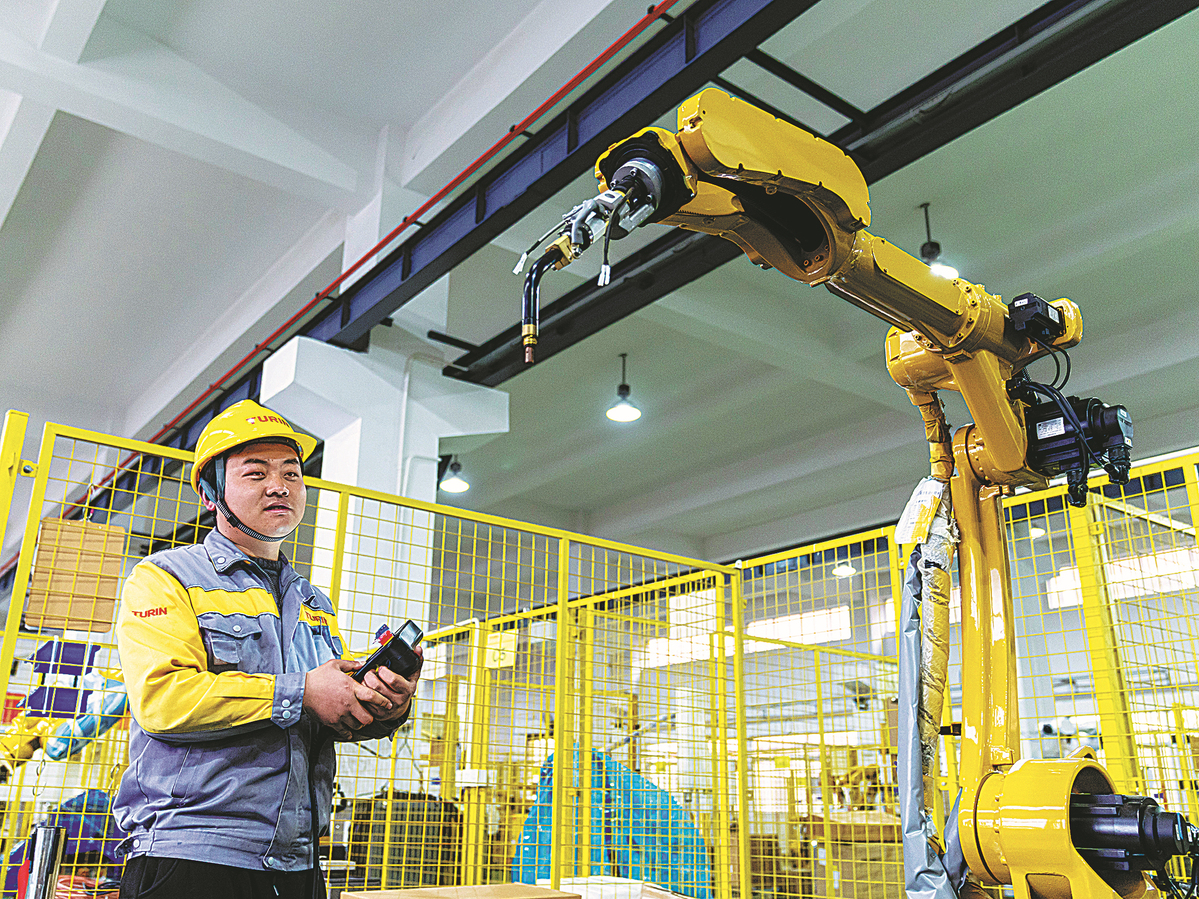
China Industrial Automation
The 54 percent share of new industrial robot installations is not an anomaly. It reflects both the size of the domestic manufacturing base and deliberate policy support for automation intensity. Domestic suppliers now capture a growing share of that volume. In several mid-range robot and servo categories, Chinese manufacturers have closed enough of the performance gap that total cost of ownership calculations favor them for high-volume, lower-mix applications.
The practical implication for international buyers is twofold. First, Chinese automation components and complete cells can compress CapEx significantly when the application does not demand the absolute highest precision or the longest certified life cycle. Second, the same ecosystem is building export capacity. Components and systems that once stayed inside China are increasingly available for cross-border projects, particularly in Southeast Asia, the Middle East, and parts of Latin America.
The remaining gap is most visible at the high end of motion accuracy, functional safety certification for certain markets, and the deepest layers of industrial software platforms. That gap is narrowing, but it has not closed.
Sensing & Vision vs. Mobile Logistics: Cognex & Hikrobot
To fully evaluate the modern industrial stack, special attention must be given to two critical specialized layers that bridge physical automation and data processing: Machine Vision and Autonomous Logistics.
🇺🇸 USA
Industrial Vision & Quality Control: Cognex defines high-precision machine vision, industrial barcode reading, and deep-learning inspection. Their systems provide the critical visual data required for robotic guidance and defect detection in adaptive, high-speed production lines.
🇨🇳 China
AMRs & Warehouse Automation: Hikrobot leads the expansion of Autonomous Mobile Robots (AMR) and Automated Guided Vehicles (AGV). They bring deployment scale to internal plant logistics, enabling rapid material handling automation at a highly competitive total cost of ownership.
Strategic Risk Factor
Geopolitical Friction, Tariffs, and Industrial Data Sovereignty
Cross-border automation sourcing can no longer be evaluated on technical specifications and CapEx alone. The convergence of industrial software, AI, and connected hardware has placed automation directly at the center of global trade restrictions and national security policies.
Scale Versus Leadership: Lessons from Automotive
The parallel with the automotive industry is instructive but incomplete. In vehicles, scale eventually enabled Chinese manufacturers to move from cost leadership into technology parity in several segments. In industrial automation the layers are more interdependent. A high-volume robot still depends on high-performance servos, reliable controllers, and validated safety systems. Software platforms that manage entire factories sit above national robot production numbers.
Regional supply-chain analyses indicate that pure volume advantages translate fastest into mid-tier discrete manufacturing and logistics automation. They translate more slowly into process industries, regulated environments, and applications that require long-term software support and global service networks. The German, Japanese, and U.S. ecosystems retain structural advantages precisely because their strengths sit in those higher-value layers.
Implications for Cross-Border Procurement and Supply Chain Design
Manufacturers and system integrators operating across regions now face a practical decision framework:
- Control and safety architecture: still heavily influenced by German and, in North America, U.S. platforms.
- Precision motion and robotics: Japanese suppliers remain the reference for the most demanding applications.
- Machine vision, industrial AI, and digital twins: U.S. vendors lead.
- High-volume deployment and cost-sensitive cells: Chinese suppliers offer increasingly competitive options.
Hybrid architectures are becoming the norm. A plant might run Siemens or Rockwell as the supervisory layer, Japanese robots and servos on critical stations, Cognex or KEYENCE vision for inspection, and Chinese mobile robots or mid-range arms for material handling. The integration work and the total cost of ownership then depend on how cleanly the interfaces are managed.
For companies building or expanding manufacturing capacity in the Gulf, Southeast Asia, or other growth corridors, the ability to source and qualify across these ecosystems has become a core capability. Lead times, export controls on certain dual-use technologies, and after-sales support networks all vary by origin. Mapping those variables early reduces risk later.
Platforms that aggregate qualified suppliers across automation categories can compress the search and qualification cycle. One such resource is Platform.Tendify.Net, which connects buyers with verified industrial technology providers across regions without forcing a single-origin commitment.
Procurement Decision Framework for Cross-Border Sourcing
Technical Deep-Dive
The Interoperability Bottleneck: Multi-Protocol Integration
Building a multi-origin automation cell—combining a Chinese AMR, a German PLC backbone, a Japanese servo motor, and U.S. AI machine vision—presents a critical operational hurdle: fieldbus and protocol fragmentation. Proprietary communication barriers frequently result in integration delays, packet loss, and high engineering overhead during system commissioning.
Operational Risk
Spare Parts Logistics & Regional Support Networks
A lower initial CapEx on Chinese industrial robotics can quickly be eroded by unscheduled downtime if spare parts and specialized field support are not regionally accessible. While European and Japanese vendors maintain mature, decades-old distribution centers across the Gulf, Southeast Asia, and Latin America, emerging suppliers are still building out their cross-border aftermarket infrastructure.
Workforce Dynamics
The Human Capital Bottleneck: System Integrators & Skills Gap
Procuring world-class automation hardware is only half the battle; deploying and maintaining it requires specialized engineering talent. As hybrid multi-origin architectures become complex, the availability of qualified System Integrators (SIs) and field service engineers has become a primary bottleneck in project execution timelines.
What the Next Decade Likely Looks Like
Three trends appear durable from current installation and investment data.
First, Chinese manufacturers will continue to expand their share of unit volume and will improve performance in successive generations of robots and drives. Cost pressure on mid-range automation will intensify.
Second, German, Japanese, and U.S. suppliers will defend the high-value layers—advanced motion, certified safety systems, industrial software platforms, and AI-enabled optimization—by deepening software capabilities and by forming selective partnerships or acquisitions that bring volume manufacturing advantages into their ecosystems.
Third, the winning factories will not be those that bet exclusively on one national ecosystem. They will be those that treat automation as a multi-layered stack and deliberately source each layer according to performance, cost, and risk requirements.
The automotive industry demonstrated that scale can eventually challenge technological leadership. Industrial automation is more layered and more software-intensive. Leadership at the systems and software level still carries disproportionate weight. Whether that remains true through 2030 depends on how quickly Chinese suppliers close the remaining gaps in precision, software, and global service infrastructure—and how effectively the established ecosystems convert their technological positions into integrated, software-defined offerings.
Practical Next Steps for Decision Makers
Procurement and operations teams evaluating automation investments should start with a clear mapping of application requirements against ecosystem strengths rather than with a single preferred vendor list. Critical questions include:
- Which layer of the stack (control, motion, sensing, software, mobile logistics) carries the highest performance or risk requirement?
- What is the expected equipment life and the availability of long-term support in the target geography?
- How will the chosen components interface with existing plant systems and future digital initiatives?
- What is the total cost of ownership under realistic utilization and maintenance scenarios, not just the initial CapEx?
Answering those questions with current market data reduces the chance of locking into an architecture that becomes expensive to evolve.
For deeper operational guidance on structuring resilient cross-border technology supply chains, see related analysis on industrial component sourcing strategies and on logistics automation in regional manufacturing hubs available through the Tendify knowledge base.
The factories of the next decade will be defined less by the nationality of any single machine and more by the coherence of the ecosystem stack that surrounds them. The race is already underway. The organizations that treat it as an ecosystem competition rather than a product catalog exercise will be better positioned to control cost, quality, and adaptability as manufacturing continues its global reconfiguration.


What I appreciate most is that this article presents industrial automation as a strategy for improving consistency rather than simply replacing human work. The real value of automation lies in creating processes that remain reliable even under increasing production demands
Beyond Labor Replacement: Automation as an Engine for Operational Resilience
You have highlighted a crucial point that lies at the core of modern industrial strategy. The paradigm shift from viewing automation as a mere labor-saving tactic to valuing it as a stabilization and capability-enhancer is a defining principle of Industry 4.0 and 5.0.
In complex, multi-tiered manufacturing environments, the true ROI of integrated automation ecosystems manifests in three key dimensions:
Process Determinism & Precision: Human performance naturally fluctuates due to fatigue and environmental variables. Multi-layered automation—combining high-precision Japanese motion systems, deterministic German PLCs, and U.S. machine vision—reduces output variance to near-zero, maintaining tight tolerances regardless of batch size.
First-Time Yield (FTY) Under Scale: When production demands spike, pushing manual assembly lines leads to higher defect rates, safety hazards, and downtime. Automated architectures sustain consistent First-Time Yield rates, absorbing demand shocks without compromising quality standards.
The Augmentation Paradigm: The modern industrial model is not about eliminating workforce participation, but shifting human capital toward high-value cognitive tasks—such as process optimization, predictive maintenance oversight, and cross-system integration—while delegating hazardous, high-repetitive tasks to machines.
Your insight perfectly encapsulates why leading manufacturers adopt hybrid automation stacks: the ultimate goal is not just faster production, but creating predictable, resilient, and highly adaptable manufacturing ecosystems.