


Blog
Saudi Crude Logistics: Unpacking Eastern & Western Export Bottlenecks
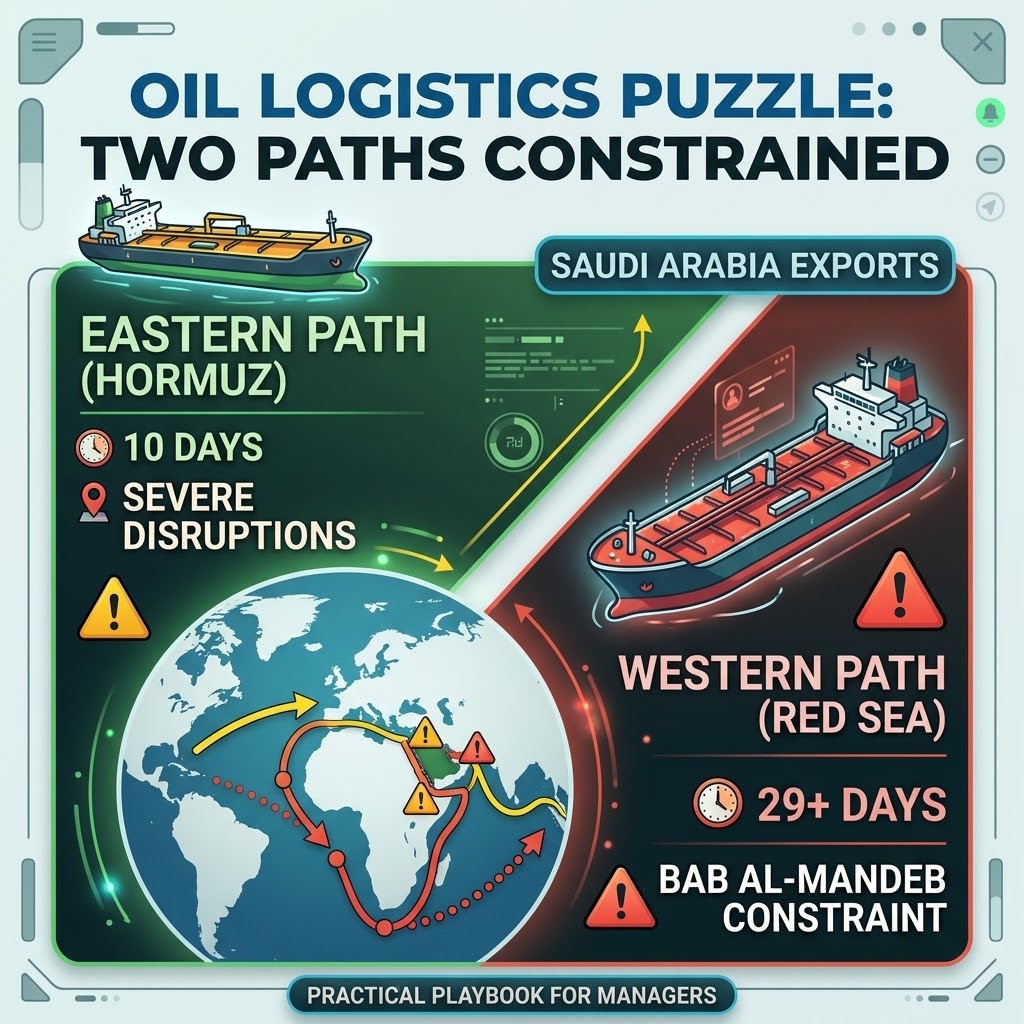
When a single pipeline outage can force the world’s largest oil exporter to rewrite its entire logistics map in days, the message is clear. Saudi Arabia’s crude no longer moves on autopilot. Both of its primary coastal corridors—the eastern path through the Strait of Hormuz and the western path via the Red Sea—are simultaneously constrained. That dual pressure is reshaping transit times, freight costs, insurance premiums, and contract structures for every buyer, trader, and freight forwarder tied to GCC energy flows.
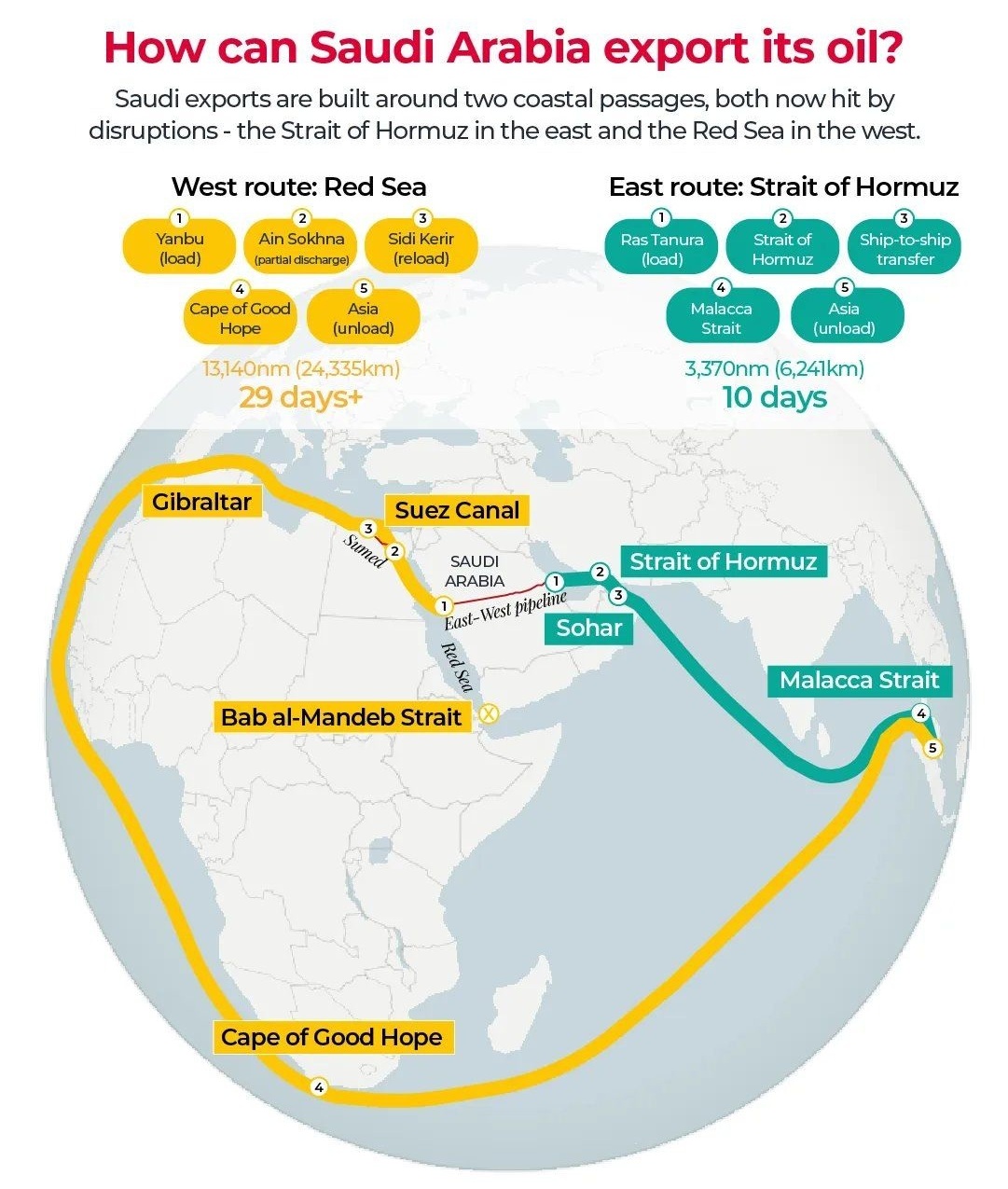
Saudi Arabia’s oil has exactly 2 ways out right now
Operational assessments across shipping trackers and terminal data show Saudi crude loadings swinging sharply between Ras Tanura on the Gulf and Yanbu on the Red Sea as conditions change. What used to be a straightforward 7–8 million barrel-per-day machine has become a high-stakes routing puzzle. Understanding the exact mechanics of each route, the current workarounds, and the cost implications is now essential for any B2B operator managing energy or energy-adjacent supply chains into Asia or Europe.
The Eastern Corridor: Ras Tanura, Hormuz, and the Ship-to-Ship Workaround
The traditional eastern route begins at Ras Tanura and nearby Gulf terminals. Crude is loaded onto tankers that must pass the Strait of Hormuz before continuing through the Malacca Strait toward Asian refineries. Under normal conditions the voyage clocks in around 10 days and roughly 3,370 nautical miles.
Since early 2026 the strait has operated under severe restrictions. Traffic volumes have collapsed far below pre-disruption averages. In response, operators have shifted to a shuttle-and-transfer model. Smaller or mid-size vessels load inside the Gulf, transit the strait under heightened security protocols, then transfer cargo ship-to-ship in safer waters off Sohar, Oman. From there, larger VLCCs complete the journey to Asia.
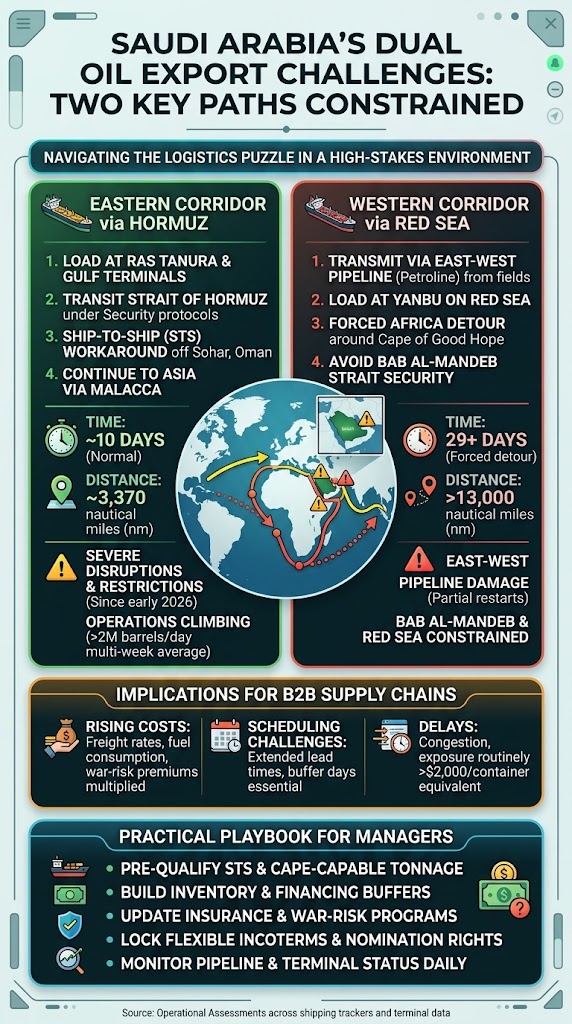
Saudi Crude Exports
This system works, but it adds complexity and cost. Ship-to-ship operations require precise scheduling, specialized equipment, and additional insurance layers. War-risk premiums have multiplied. Delays at the transfer point quickly cascade into demurrage exposure. Recent data show Gulf loadings climbing again—pushing past 2 million barrels per day on multi-week averages—precisely because the western pipeline option was temporarily unavailable. The eastern route remains the faster option when it is open, yet it carries continuous operational friction.
For logistics teams the practical takeaway is straightforward: build buffer days into every schedule, lock in STS-capable vessels early, and treat the Sohar transfer zone as a critical node rather than an afterthought. Freight contracts that ignore these variables are already generating avoidable losses.
Regional Hub Dynamics
Fujairah & Sohar: The Strategic Bypass Outlets
As Strait of Hormuz transit risks multiply, regional trade dynamics have shifted dramatically toward alternative maritime hubs positioned outside the Gulf’s immediate choke point:
Fujairah & Habshan-Fujairah Pipeline
The Port of Fujairah (UAE) serves as the primary direct bypass for Arabian Gulf crude via the 1.5 million bpd Habshan–Fujairah pipeline. Sitting directly on the Gulf of Oman, Fujairah allows operators to bypass Hormuz entirely for UAE grades while acting as a massive bunkering and blending hub for regional energy flows.
Sohar & Omani Offshore Transfers
Further south, Oman’s Port of Sohar has seen a severe surge in Ship-to-Ship (STS) transfer operations. Shuttle tankers exiting the Gulf merge with open-ocean VLCCs in Omani anchorage zones, making Sohar and Fujairah the two mandatory safety valves for eastbound energy logistics.
Marine Insurance & Liability
STS Environmental & Marine Pollution Liability
While security threats and war-risk surcharges dominate headlines, high-volume Ship-to-Ship (STS) transfers off Sohar and Fujairah introduce severe environmental and marine pollution risks. Transferring millions of barrels of crude oil in open or semi-sheltered waters exponentially raises the exposure to potential oil spills and hull damage.
P&I Club Stringency & Premiums
Protection & Indemnity (P&I) Clubs have tightened approval protocols for unanchored offshore STS operations. Underwriters require strict compliance with IMO STS guidelines, certified fenders, and specialized mooring masters, driving up operational compliance costs.
Pollution Exposure & Indemnity
Environmental cleanup liabilities in coastal Omani and UAE waters carry catastrophic financial exposure. Charterparty agreements must explicitly define pollution liability allocation between primary VLCCs and shuttle tankers to prevent uninsurable loss events.
The Western Corridor: Yanbu, the East-West Pipeline, and the Forced Africa Detour
The western alternative was designed as the strategic bypass. The East-West Pipeline (Petroline) runs roughly 1,200 km from the eastern oil fields to Yanbu on the Red Sea. At full design capacity it can move around 7 million barrels per day, of which a substantial portion is available for export after domestic refining needs are met. Once at Yanbu, crude can head north through the SUMED pipeline system in Egypt (Ain Sokhna to Sidi Kerir) and into the Mediterranean, or south through the Bab al-Mandeb Strait toward Asia.
Pipeline Capacity Reality
Petroline Nominal vs. Effective Export Capacity
While the East-West Pipeline (Petroline) has a nominal design capacity of roughly 7 million barrels per day (bpd), the actual volume available for crude exports via Yanbu is significantly lower due to domestic refining commitments along the Red Sea coast.
Domestic Refinery Allocations
Major western refining complexes—including YASREF, SAMREF, and Yanbu Refinery—absorb approximately 2 to 2.5 million bpd of crude directly from Petroline to meet domestic power and refined product obligations.
Realistic Export Ceiling: 4.5 – 5.0M bpd
After subtracting internal refining feedstock, the maximum net crude volume that Petroline can actually deliver to Yanbu’s export berths caps out around 4.5 to 5.0 million bpd, constraining its ability to fully offset a complete Gulf shutdown.
That southern leg is now the problem. Security conditions around Bab al-Mandeb have forced most Saudi-linked vessels to abandon the direct route. The fallback is a full circumnavigation of Africa via the Cape of Good Hope. Distance jumps to more than 13,000 nautical miles and transit time stretches past 29 days—nearly triple the eastern route. Freight costs and fuel consumption rise accordingly. Insurance and charter rates follow.
When the East-West Pipeline itself suffered damage in September and loadings at Yanbu halted, the western option effectively collapsed for several days. Inventories at the terminal could sustain only short-term operations. Operators immediately pivoted back east. Partial restarts of the pipeline have since begun, but full throughput restoration is measured in weeks, not days. Even when the pipeline is flowing, the southern Red Sea exit remains constrained, leaving the long Cape route or the longer northern SUMED-plus-Suez combination as the realistic choices for Asia-bound cargoes.
The net result is that the western corridor, once the reliable backup, now functions as a high-cost contingency rather than a seamless alternative.
Technical Quality Factor
Crude Grade Mismatch & Assay Compatibility Constraints
Rerouting crude between export terminals is not merely a logistical decision—it is a rigid technical challenge. Saudi Arabia’s various crude slates (such as Arab Super Light, Extra Light, Light, Medium, and Heavy) are not uniformly distributed or loaded across both coasts.
Eastern Terminal Slate Concentration
Lighter grades (e.g., Arab Extra Light and Super Light) are heavily concentrated at Gulf terminals like Ras Tanura. Complex Asian refineries specifically tuned to these API gravities and sulfur profiles cannot easily substitute them with western-stream alternatives without altering product yields.
Refinery Assay Discrepancies
A 1-to-1 terminal swap from Ras Tanura to Yanbu often forces buyers to accept different crude grades. For B2B traders and refiners, unaligned crude assays lead to operational bottlenecks, reduced refinery margins, or the need for expensive secondary blending.
Transit Time, Cost, and Risk Comparison
A side-by-side view of the two routes under current conditions makes the trade-offs visible:
| Route Corridor | Transit Time & Distance | Freight & Fuel Costs | Insurance & War Risk | Operational Risk & Complexity |
|---|---|---|---|---|
| Eastern Route Ras Tanura → Hormuz → Sohar (STS) → Malacca | ~10 Days 3,370 nm | Baseline to Moderate Lower fuel burn; added STS transfer fee & shuttle costs | High Elevated war-risk premiums inside Gulf & Hormuz | High Friction Security choke point; STS scheduling & demurrage exposure at Sohar |
| Western Route (Cape) Yanbu → Cape of Good Hope → Asia | 29+ Days 13,140 nm | Extremely High ~3x bunker consumption & long charter durations | Moderate Bypasses Bab al-Mandeb risk zone entirely | Capital & Timing Risk Working-capital tie-up; LC expiry exposure & ETA volatility |
| Western Route (SUMED) Yanbu → SUMED (Ain Sokhna → Sidi Kerir) → Med | Intermediate Optimal for Europe | Moderate to High Pipeline transit tariffs & Med charter rates | Moderate Northern Red Sea exposure subject to regional status | Capacity Bottlenecks SUMED terminal throughput & Mediterranean vessel availability |
Fuel & Logistics Bottleneck
Cape Bunkering Capacity & Southern Africa Delays
While the 29-day transit via the Cape of Good Hope accounts for extended sailing distances, it omits a critical operational bottleneck: bunkering availability in Southern Africa. Tripling the voyage distance creates massive additional fuel burn, forcing heavy reliance on regional refueling hubs.
Port Congestion at Durban & Saldanha Bay
Key refueling hubs such as Durban, Saldanha Bay, and Algoa Bay face unprecedented vessel queues. Limited barge availability and infrastructure constraints in South Africa regularly result in multi-day waiting times just to receive bunker fuel.
Realistic Lead Time: 32 to 35 Days
When 3 to 6 days of bunkering delays, off-hire waiting times, and adverse weather off the Cape are added to the baseline sailing schedule, actual delivery windows to Asia extend to 32–35 days, further straining supply chain reliability.
These differentials are no longer theoretical. Asian refiners are already adjusting nomination windows and destination options. European buyers using the northern Red Sea path face their own set of SUMED capacity and Mediterranean tanker availability constraints. Every additional day on the water translates into higher working-capital requirements and greater price-risk exposure for the cargo itself.
Sector Deep-Dive
Petrochemical Bottlenecks: Beyond Crude Oil
While crude oil flows draw global headlines, the dual-corridor disruption strikes an equally severe blow to the downstream petrochemical and fertilizer sectors. Key industrial hubs—primarily Al-Jubail on the Arabian Gulf and Yanbu on the Red Sea—serve as vital export nodes for global polymers, methanol, urea, and specialty chemicals.
Asian Supply Chain Impact
Asian manufacturers relying on Saudi polymers and building-block chemicals face extended lead times and volatile freight surcharges via the Strait of Hormuz route. Transfer delays at Sohar directly affect just-in-time manufacturing schedules across East and Southeast Asia.
European & Mediterranean Exposure
With the Bab al-Mandeb corridor constrained, chemical shipments out of Yanbu bound for Europe must undertake the 29+ day circumnavigation around Africa. The resulting working-capital tie-ups and container rate spikes leave European buyers scrambling for regional substitutes.
Financial Metrics
Quantifiable Cost Impacts & Financial Exposure
Evaluating the routing crisis requires looking beyond operational delays at the direct financial metrics hit by simultaneous choke-point constraints:
VLCC and Suezmax spot rates have surged, with Cape rerouting and STS shuttle operations driving daily hire costs significantly higher.
Surged from baseline levels (~0.05%), adding up to $500,000 to $1,000,000 in additional insurance costs per transit through active risk zones.
The Cape detour locks up tens of millions of dollars in floating capital per VLCC cargo, drastically expanding working capital requirements for refiners.
Operational Implications for B2B Supply Chains
Energy is the backbone, but the ripple effects hit every adjacent sector. Construction materials, petrochemicals, fertilizers, and bulk commodities that share the same vessels or the same ports feel the congestion and the rate spikes. Demurrage and detention charges that once seemed manageable now routinely exceed $2,000 per container-equivalent exposure in GCC terminals when schedules slip.
Contract language has to catch up. Force-majeure clauses written for single-chokepoint scenarios are insufficient when both exits are stressed simultaneously. Delivery windows need explicit flexibility language. Payment terms benefit from escrow or staged-release mechanisms that protect both sides against extended transit. Freight forwarders who still quote static transit times are exposing their clients to unnecessary risk.
Digital visibility tools have become non-negotiable. Real-time vessel tracking, predictive ETA modeling, and automated alerts on chokepoint status allow teams to re-route or re-nominate before a vessel is already committed. Platforms that integrate maritime intelligence with commercial workflows reduce the lag between a pipeline incident and a commercial decision.
Practical Playbook for Exporters, Importers, and Logistics Managers
- Map dual-route exposure for every cargo. Identify which barrels or products can realistically use either corridor and which are locked into one path by grade or destination.
- Pre-qualify STS and Cape-capable tonnage. Maintain relationships with operators who can execute transfers off Oman or who already run regular Cape services.
- Build inventory and financing buffers. The 19-day difference between the two routes is not a rounding error; it is a working-capital event.
- Update insurance and war-risk programs. Policies that treat the entire region as a single risk zone miss the distinct premium structures now applying to Hormuz versus Bab al-Mandeb.
- Lock flexible Incoterms and nomination rights. CIF or CFR terms that give the seller routing discretion can protect the buyer from being forced onto the longer path without compensation.
- Monitor pipeline and terminal status daily. Loadings at Yanbu and Ras Tanura now move in opposite directions depending on the latest infrastructure or security development.
Teams that treat these steps as routine rather than crisis response are already protecting margins that others are losing.
Legal & Trade Documentation
LC Deadlines, Bill of Lading & Maritime Clauses
Operational detours create immediate legal and trade finance friction. Contracts and payment instruments structured under standard conditions risk severe non-compliance during multi-week transit extensions:
Letter of Credit (LC) & B/L Discrepancies
A 19-day Africa detour regularly causes Bill of Lading (B/L) presentation dates and LC expiry windows to lapse before cargo arrives. To prevent stalled bank settlements, buyers and sellers must proactively negotiate extended presentation windows and flexible final shipment dates under UCP 600 rules.
Charterparty & Maritime Law Provisions
Standard charterparty agreements often leave freight allocation during forced rerouting ambiguous. Charterers should incorporate standard BIMCO Rerouting Clauses and specialized security provisions (e.g., BIMCO Guardcon) to explicitly define fuel cost-sharing, demurrage liability, and transit deviations.
Broader Market Consequences
Global oil markets have absorbed the dual-chokepoint reality with higher price volatility and wider regional differentials. Asian buyers face the largest timing risk; European buyers face capacity constraints on the northern Red Sea path. Spot freight rates for VLCCs on both corridors have moved sharply. The secondary effect on non-oil cargoes sharing the same infrastructure is less visible but equally material for B2B operators moving bulk or project cargo through the same ports.
The structural lesson is larger than any single incident. Over-reliance on any single maritime corridor—even one as historically reliable as Hormuz—creates systemic exposure. Diversification of export infrastructure, whether through additional pipeline capacity, expanded west-coast terminals, or deeper commercial relationships with alternative loading points, is no longer optional strategy. It is operational hygiene.
For companies whose supply chains touch Saudi crude or the ports that handle it, the current environment rewards those who treat routing as a dynamic variable rather than a fixed assumption. The data streams exist. The contractual tools exist. The operators who combine both will move cargo with fewer surprises and lower total landed cost.
In a market where both of Saudi Arabia’s coastal exits can be stressed at the same time, the difference between a smooth delivery and a costly delay is no longer measured in days of sailing time. It is measured in the quality of the preparation that preceded the first barrel leaving the terminal.

