


Blog
Fertilizer Compliance Guide for DAP, NPK & Bulk Exports
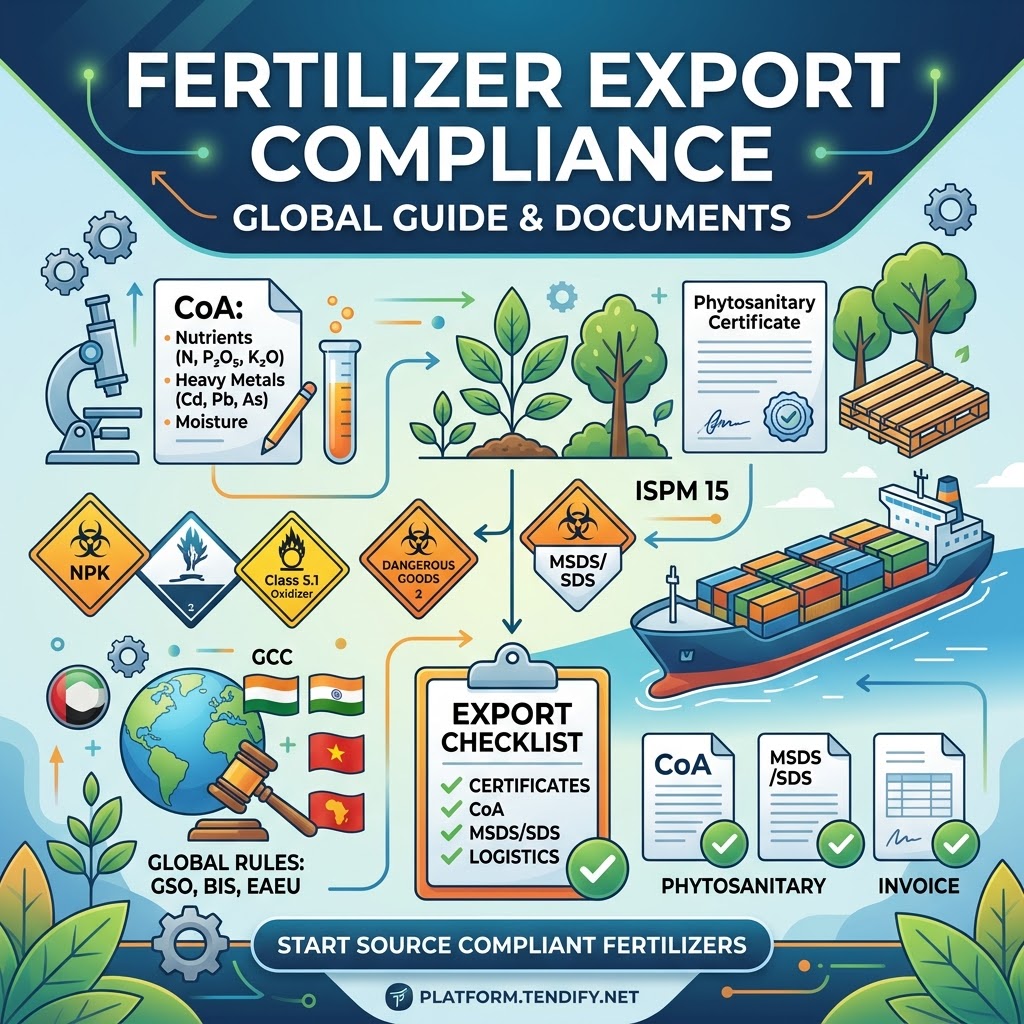
A single container of DAP rejected at a GCC port over cadmium levels or missing phytosanitary paperwork can erase months of margin. Operational reviews across Gulf and Asian trade lanes show that quality mismatches and incomplete documentation remain the leading causes of demurrage, forced re-export, or outright destruction of fertilizer consignments. For bulk traders and suppliers moving NPK compounds, diammonium phosphate (DAP), and triple superphosphate (TSP), compliance is not a paperwork exercise—it is the difference between reliable cash flow and repeated write-offs.
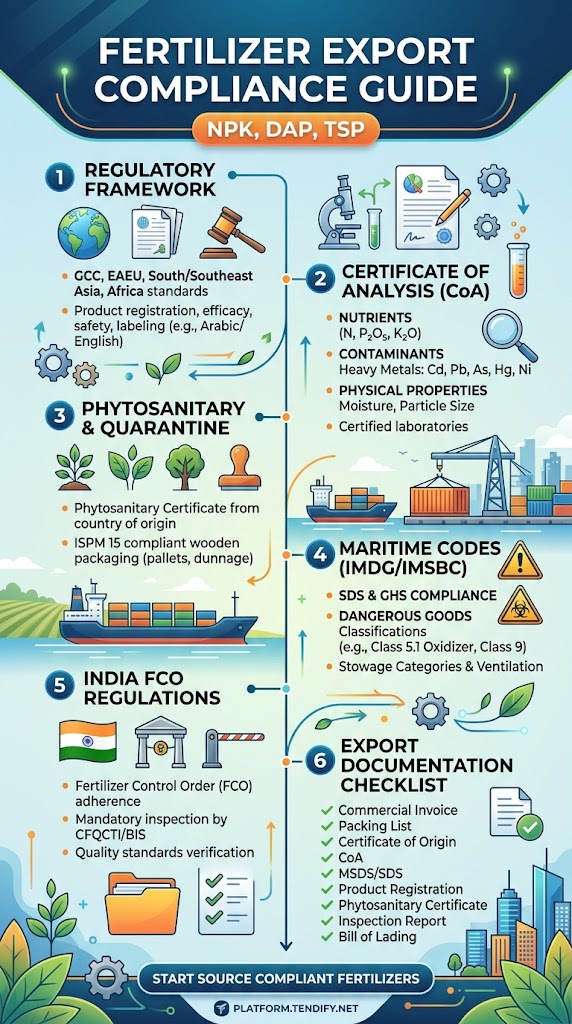
This guide walks through the practical requirements that determine whether a shipment clears or stalls. It covers Certificate of Analysis (CoA) specifications, phytosanitary rules, market-entry standards in key corridors, dangerous-goods classification, packaging, and the exact document set buyers and customs expect.
Why Fertilizer Compliance Matters in Global Trade Corridors
Chemical fertilizers underpin yield stability in high-demand agricultural zones. NPK grades deliver balanced nitrogen, phosphorus, and potassium; DAP supplies high-analysis nitrogen and available phosphate; TSP concentrates water-soluble P₂O₅ for soil correction programs. Primary demand corridors include GCC markets, Eurasian Economic Union (EAEU) members, South and Southeast Asia, and parts of Africa.
Fertilizer Compliance Guide for DAP, NPK & Bulk Exports
Rejection risk is real. Cadmium or arsenic above destination limits, moisture exceeding declared levels, wooden pallets without ISPM 15 treatment, or absence of product registration frequently trigger holds. Each day of delay multiplies storage and demurrage costs while eroding buyer confidence. Successful exporters treat compliance as a front-end process: specifications locked before production, independent testing scheduled early, and destination rules mapped before booking space.
Certificate of Analysis: The Core Quality Document
Every serious buyer and most customs authorities require a batch-specific CoA issued by an accredited laboratory. The document must confirm nutrient content against the label claim and quantify contaminants that could trigger rejection.
NPK formulations
Common commercial grades include 20-20-20, 15-15-15, and high-phosphorus variants such as 10-52-10. CoAs typically report total nitrogen (nitrate, ammoniacal, and urea forms), available P₂O₅, water-soluble K₂O, secondary nutrients where claimed, micronutrients, water solubility, and insoluble residue. Moisture is usually capped at 1–2 % for granular products to prevent caking.
DAP
Standard specification calls for minimum 18 % nitrogen and 46 % P₂O₅. Moisture content is tightly controlled (often ≤1.5 %), and particle size distribution is verified to ensure free-flowing granules suitable for bulk handling or bagging. Free acid and water-insoluble phosphate fractions are also checked.
TSP
The key metric is available P₂O₅, typically minimum 46 %. Free phosphoric acid content and moisture (commonly ≤4 %) appear on most destination specifications. Granulometry matters for blending and spreading equipment.
Heavy metals and contaminants
Phosphate rock sources introduce cadmium, lead, arsenic, mercury, and nickel. Destination limits vary:
- European markets apply strict cadmium ceilings (historically 60 mg/kg P₂O₅, with progressive tightening).
- Many African and Asian standards set absolute or P₂O₅-proportional limits for As, Cd, Pb, Hg, Ni, and Cr.
- GCC buyers and regulators monitor total salt content and heavy metals alongside nutrient guarantees.
Independent testing by laboratories accredited to ISO 17025 and using AOAC or ISO methods (SGS, Bureau Veritas, Geo-Chem, and equivalents) carries far more weight than in-house certificates. Request the full contaminant panel early; switching rock sources mid-contract is expensive.
🧪
Moisture Control, Anti-Caking Agents & Physical Condition Protocols
Chemical fertilizers like NPK, DAP, and TSP are highly hygroscopic. In high-humidity tropical corridors (such as Southeast Asia) or high-temperature sea lanes (GCC and Indian Ocean routes), moisture absorption during sea transit triggers moisture bridges, causing severe product caking, lump formation, and loss of free-flowing properties.
| Technical Factor | Quality Standard & Treatment | CoA Mandate & Inspection Check |
|---|---|---|
| Anti-Caking Agent (Coating) | Amine-based or fatty-acid oil coating (0.05% – 0.15% by weight) | Must be explicitly stated on the Certificate of Analysis (CoA) under “Conditioning Treatment” or “Anti-caking Agent Applied”. |
| Critical Relative Humidity (CRH) | Monitored threshold (< 70% RH at 30°C) | Verifies the product’s thermal and humidity tolerance inside vessel holds or container liners during extended voyages. |
| Hardness & Crushing Strength | Minimum 2.5 kg/granule (DAP/TSP) | Ensures granules resist degradation into fine dust during mechanical discharge, bulk bagging, or mechanical spreading. |
Phytosanitary and Quarantine Requirements
Although NPK, DAP, and TSP are chemical products, many destination authorities treat them as potential vectors for weed seeds, soil residues, or pests carried on packaging or residual organic matter. GCC regulations explicitly require a phytosanitary certificate issued by the competent authority in the country of origin confirming the consignment is free from weed seeds and harmful micro-organisms.
The certificate is typically obtained from the national plant protection organization after inspection or based on production records and sampling. Timing is critical: many agencies need several working days, and some require the certificate to be issued close to the shipping date.
Wooden packaging falls under ISPM 15. Pallets, dunnage, and crates must be debarked and either heat-treated (minimum 56 °C core temperature for 30 continuous minutes) or fumigated with an approved agent, then permanently marked with the IPPC stamp showing country code, producer code, and treatment method (HT or MB). Non-compliant wood is one of the fastest ways to have a container ordered off the vessel or held for treatment at the importer’s expense. Plastic or processed-wood pallets avoid the requirement entirely and are increasingly preferred for fertilizer shipments.
Destination Market Entry Standards
GCC (UAE, Saudi Arabia, Oman, Qatar, Kuwait, Bahrain)
Fertilizers require registration with the competent agricultural authority before commercial import. The GCC Fertilizers and Soil Conditioners framework mandates product evaluation for efficacy and safety, bilingual (Arabic and English) labeling, and a phytosanitary certificate for every consignment. GSO standards cover compound fertilizers, packaging, and test methods. Labels must display nutrient guarantees, net weight, batch number, manufacturer details, and handling instructions. Some markets request additional heavy-metal or radioactivity statements.
Eurasian Economic Union
Mineral fertilizers fall under TR EAEU 039/2016 technical regulations. State registration is required for products listed in the annexes. Compliance with GOST specifications for nutrient content, particle size, and contaminants is verified. Border inspections can include sampling. Exporters should confirm the product appears in the unified register and that the accompanying documentation matches the registered formulation.
South and Southeast Asia (India, Vietnam, Malaysia, Indonesia)
Import permits or registration with the local ministry of agriculture are standard. Phosphate fertilizers face heightened scrutiny on free acid, heavy metals, and exact nutrient guarantees. Indonesia and several ASEAN markets publish explicit cadmium, lead, arsenic, and mercury ceilings. Pre-shipment certificates of conformity or inspection reports from authorized bodies are frequently demanded. Labeling must meet local language and format rules; batch traceability is increasingly enforced.
Critical Trade Compliance
India Fertilizer Control Order (FCO) Regulations
As India stands as one of the world’s largest importers of Diammonium Phosphate (DAP) and NPK fertilizers, strict adherence to national quality frameworks is non-negotiable for exporters targeting the South Asian market.
Mandatory Compliance Requirements:
- FCO Quality Standards: All imported cargo must strictly comply with the chemical composition, moisture limits, and particle size distribution specified in the Fertilizer Control Order (FCO).
- Mandatory Pre-Shipment & Destination Inspection: Cargoes are subject to mandatory testing and sampling by government-authorized agencies, including the Bureau of Indian Standards (BIS) and the Central Fertilizer Quality Control and Training Institute (CFQCTI).
- Customs Clearance Clearance Gate: Non-compliance with FCO parameters will result in immediate rejection, detention of the vessel at port, or mandatory re-exportation at the supplier’s expense.
🇪🇺
European Union Access: REACH Registration & Strict Cadmium Ceilings
Exporters targeting the European Union face two non-negotiable regulatory hurdles: mandatory EU REACH compliance for chemical substances and progressive heavy-metal limits under the EU Fertilising Products Regulation (FPR) 2019/1009.
| Regulatory Standard | Mandatory Requirement | Operational Impact on Exporters |
|---|---|---|
| EU REACH Registration | Registration per chemical substance (>1 metric ton/year) | Non-EU manufacturers must register through an EU-based Only Representative (OR). Unregistered chemicals are automatically barred at port customs. |
| Cadmium (Cd) Thresholds | Max 60 mg Cd/kg P₂O₅ (CE-marked fertilizers) | Phosphate rock origin must be verified. High-cadmium rock sources require expensive decadmiation processing to enter EU supply chains. |
| Green Labeling (Low-Cd) | Voluntary label: <20 mg Cd/kg P₂O₅ | Products meeting the sub-20 mg threshold qualify for “Low Cadmium” status, commanding premium margins in EU agricultural sectors. |
⚖️
Incoterms 2020: Allocation of Regulatory & Certification Responsibilities
Misunderstanding trade terms often leads to costly demurrage and delayed customs clearance. Under Incoterms 2020 rules, clear boundary lines govern which party bears the cost and operational obligation for obtaining certificates, inspections, and import authorizations:
| Compliance Document / Action | FOB / CFR / CIF Rules | DDP Rules | Responsible Party & Key Context |
|---|---|---|---|
| Certificate of Analysis (CoA) | Seller | Seller | Seller must issue a batch-specific CoA from an accredited lab prior to loading. |
| Phytosanitary Certificate | Seller | Seller | Issued by origin plant protection authority. Essential for export clearance and vessel loading. |
| Pre-Shipment Inspection (PSI/SGS) | Seller (Execution) | Seller | Costs allocated per contract, but physical coordination at origin port rests with Seller. |
| Destination Product Registration | Buyer | Buyer / Local Representative | Agricultural ministries in target markets require local entity registration (e.g., GSO / EAEU). |
| Import Permits & Customs Clearance | Buyer | Seller | In FOB/CFR/CIF, buyer handles destination customs. DDP places full import responsibility on seller. |
Dangerous Goods Classification, Packaging, and Pre-Shipment Inspection
Most standard DAP and TSP grades are not classified as dangerous goods under the IMDG Code when free of significant ammonium nitrate content. NPK blends containing ammonium nitrate can fall into Class 5.1 (oxidizer, UN 2067) or Class 9 (miscellaneous, UN 2071) depending on composition and the trough test for self-sustaining decomposition. Always verify the exact formulation against the current IMDG Dangerous Goods List and the shipper’s Safety Data Sheet. Misclassification leads to refused bookings or fines.
Standard packaging options include:
- 25 kg or 50 kg woven polypropylene bags with polyethylene liners for moisture barrier and UV resistance.
- Flexible Intermediate Bulk Containers (FIBC / jumbo bags) of 500–1 250 kg capacity, often with inner liners and discharge spouts suited to bulk terminals.
Bags must withstand multiple handling stages and protect against humidity common in tropical and Gulf climates. Clear marking of product name, nutrient analysis, net weight, batch number, and handling pictograms is mandatory.
Pre-shipment inspection (PSI) by an independent agency is frequently buyer- or destination-mandated. Inspectors verify quantity, sampling for CoA confirmation, packaging integrity, labeling, and sometimes container cleanliness. Coordinate the inspection window with production and stuffing schedules so the report is available before documents are finalized.
Export Documentation Checklist
A complete set reduces the chance of holds at origin or destination:
- Commercial Invoice stating product description, HS code, quantity, unit price, total value, Incoterms, and payment terms.
- Packing List detailing bag counts, net and gross weights, and container numbers.
- Certificate of Origin (preferential or non-preferential as required by the trade agreement).
- Certificate of Analysis from an accredited laboratory covering nutrients, moisture, particle size, and heavy metals.
- Material Safety Data Sheet (MSDS/SDS) in the format accepted by the destination (GHS 16-section preferred).
- Product Registration Certificate or import permit issued by the destination competent authority.
- Phytosanitary Certificate.
- Independent inspection report (SGS, BV, or equivalent) when contractually required.
- Bill of Lading or Sea Waybill correctly describing the cargo and any IMDG details.
For complex multi-destination programs, maintain a living matrix of required documents per market. Related operational guidance on document preparation appears in the platform’s coverage of international document preparation for global trade. Logistics cost and route considerations for Gulf movements are examined in the Gulf logistics multimodal guide.
🏷️
Customs Tariff & HS Code Classification
Accurate Harmonized System (HS) code classification is critical for global fertilizer shipments. Customs authorities and border inspection laboratories conduct sampling, tariff assessment, and regulatory testing strictly based on these designated tariff lines:
| Fertilizer Type | HS Code | Standard Description & Primary Nutrient Claim |
|---|---|---|
| NPK Compounds | 3105.20 | Mineral or chemical fertilizers containing the three fertilizing elements nitrogen, phosphorus, and potassium. |
| DAP (Diammonium Phosphate) | 3105.40 | Ammonium dihydrogenorthophosphate (monoammonium phosphate) and mixtures thereof with diammonium hydrogenorthophosphate. |
| TSP (Triple Superphosphate) | 3103.11 / 3105.30 | Concentrated superphosphates ($46\%\, P_2O_5$) under 3103.11, or other phosphate compositions dependent on local customs sub-headings. |
🏦
Letters of Credit (L/C) & UCP 600 Compliance: Mitigating Banking Discrepancies
In high-value bulk fertilizer trade, Letters of Credit (L/C at sight or usance) are governed strictly by ICC UCP 600 rules. Under documentary credit law, banks deal solely with documents—not physical goods. Even a minor mismatch between the Certificate of Analysis (CoA) or Phytosanitary Certificate and the Bill of Lading (B/L) results in formal bank rejections, dishonored drafts, and severe liquidity delays.
| Common L/C Document Mismatch | Banking Impact (Discrepancy) | Mandatory Corrective Measure |
|---|---|---|
| Phytosanitary Date Post-B/L Date | Immediate Refusal of Payment | The Phytosanitary Certificate date must be on or prior to the Bill of Lading (B/L) “Shipped on Board” date. Inspection cannot legally occur after loading. |
| CoA Specification Variance | Technical Discrepancy | Nutrient content (e.g., DAP 18-46-0) on the lab report must match or exceed the exact wording in Clause 45A of the L/C. Do not use shorthand notation. |
| Product Description Mismatch | Commercial Invoice Rejection | Under UCP 600 Article 18(c), the description of goods on the Commercial Invoice must correspond strictly with that appearing in the credit. |
| Port / Vessel Name Discrepancy | Transport Document Refusal | Ensure Phytosanitary, Certificate of Origin, and SGS Inspection Reports cite the exact same vessel name and port of discharge as stated on the B/L. |
Safety & Maritime Transport Standard
GHS SDS Alignment with IMDG & IMSBC Maritime Codes
While adhering to the standard 16-section GHS format for Safety Data Sheets (SDS/MSDS) is mandatory, international fertilizer shipments require critical maritime-specific operational protocols—particularly for storage and handling in high-temperature or tropical port environments.
Essential SDS Requirements for Maritime Logistics:
- Stowage & Segregation Category (IMDG / IMSBC): Section 7 (Handling & Storage) and Section 14 (Transport Information) must explicitly specify the applicable Stowage Category (e.g., Category A/B) and segregation requirements to avoid heat-induced decomposition or hazardous reactions.
- Ventilation Protocols in Tropical Ports: For shipments passing through or discharging in high-humidity and hot climate zones (such as GCC, Southeast Asia, or West Africa), the SDS must state specific mechanical or natural ventilation requirements to prevent moisture absorption and self-heating.
- Emergency Port Operations: Fire-fighting measures (Section 5) and accidental release controls (Section 6) must align with the Emergency Response Procedures for Ships Carrying Dangerous Goods (EmS Guide).
Operational Sequence That Reduces Rejection Risk
- Confirm the exact grade and destination specifications before contracting.
- Source phosphate rock or intermediate materials that meet the tightest heavy-metal limits among target markets.
- Schedule accredited laboratory testing on production samples; retain reserve samples.
- Obtain or renew product registrations well ahead of the first shipment.
- Arrange phytosanitary inspection and ISPM 15-compliant packaging.
- Book pre-shipment inspection if required and complete stuffing under supervision.
- Assemble the full document set and share draft copies with the buyer and freight forwarder for pre-clearance review.
Traders who follow this sequence consistently report fewer claims and stronger long-term buyer relationships. Platforms that aggregate verified suppliers and standardized documentation workflows further compress cycle times; one such resource is available at Platform.Tendify.Net for qualifying counterparties.
Closing the Loop on Sustainable Trade Relationships
Quality transparency and complete regulatory documentation convert one-off transactions into repeat supply contracts. Buyers in the GCC, EAEU, and Asian markets increasingly treat compliance history as a primary supplier-selection criterion. Suppliers who invest in accredited testing, early registration, and disciplined paperwork protect both margin and reputation.
Accelerate Your Global Sourcing
Streamline Your Fertilizer Trade & Verification Process
To accelerate sourcing of compliant NPK, DAP, or TSP volumes, or to connect with verified exporters who already maintain the required certifications and inspection relationships, register and submit requirements directly through the platform at
tendify.net/my-account. Clear specifications and ready documentation remain the fastest route from inquiry to loaded vessel.
✓ Pre-Inspected Cargoes
✓ Faster Vessel Loading

