


Blog
B2B Networking: The Hard Truth About Myths That Kill Deals

The Hard Truth About B2B Networking: Myths That Kill Deals and What Actually Builds Trust in Global Trade
Walk into any trade event or scroll LinkedIn long enough and the same advice repeats: collect more connections, smile harder, hand out cards, chase the C-suite. The result is a profession full of people who treat relationships like a numbers game and then wonder why their pipeline stays cold.
In cross-border trade the cost of that mistake is concrete. A weak introduction does not just waste time. It delays containers, freezes payments, and leaves suppliers or buyers exposed when something goes wrong at the border or in the bank. Operational experience across Gulf and wider MENA corridors shows that the traders who move volume consistently are not the ones with the largest contact lists. They are the ones who treat relationships as infrastructure.
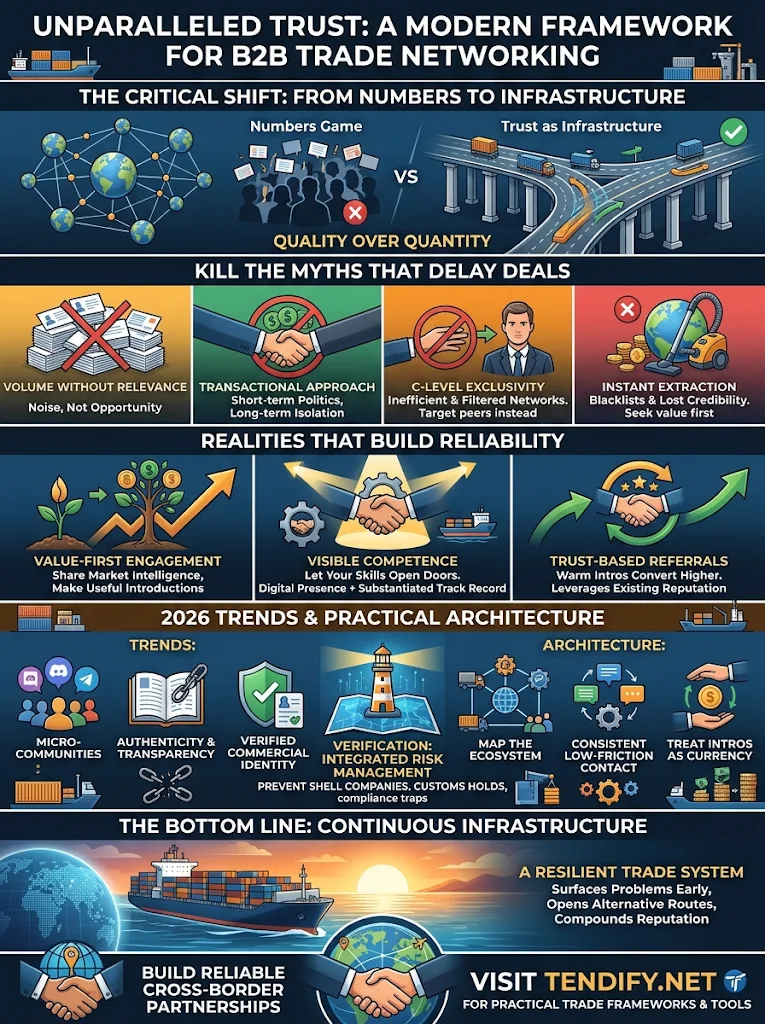
B2B Networking
This is not motivational fluff. It is a practical breakdown of the myths that still dominate, the realities that actually generate opportunities, the mistakes that quietly destroy credibility, and the shifts that matter in 2026.
The Myths That Still Waste Time and Capital
Myth 1: More connections equal more opportunity.
A profile with thousands of contacts looks impressive until you need one reliable introduction for a high-value shipment or a payment problem. Volume without relevance produces noise. Most of those contacts will not remember your name, let alone open a door when a real deal is on the line. Quality of the relationship—shared context, demonstrated competence, and mutual usefulness—outweighs raw numbers by a wide margin.
Myth 2: Networking is just polished favor-seeking or soft politics.
Short-term flattery can open a single door. It rarely keeps it open. Professionals who operate at scale notice the pattern quickly and disengage. Sustainable networks rest on professional respect, consistent delivery, and the ability to solve problems for the other party. In trade, where reputation travels faster than any email, the transactional approach is self-limiting.
Myth 3: Only senior decision-makers matter.
Chasing C-level executives exclusively is inefficient. Senior people have limited bandwidth and already-filtered networks. The most productive relationships often form at peer level—operations managers, logistics coordinators, compliance specialists, and mid-level commercial teams who actually move the work. Those peers become the next generation of decision-makers. Building sideways is usually more durable than reaching only upward.
Myth 4: The goal is to extract value as quickly as possible.
Opening a conversation with “Do you have any opportunities for me?” or an immediate pitch is the fastest way onto a mental blacklist. People respond to those who first demonstrate usefulness. The pure extractive mindset is easy to detect and hard to recover from.
What Actually Works: The Realities That Move Trade
Networking is closer to farming than hunting. You plant value first—share relevant market intelligence, make a useful introduction between two other parties, flag a practical risk, or simply follow through on a small commitment. Only later do you harvest. Accounts that never deposit rarely allow withdrawals.
A large share of high-quality commercial opportunities never appear on public job boards or open RFQs. They move through existing relationships before they are formalized. Referrals and warm introductions consistently convert at higher rates and with lower friction than cold outreach. That is not a romantic claim about “hidden markets.” It is an observed efficiency difference: referred candidates and partners move faster through evaluation, face fewer compliance questions, and start with higher baseline trust.
Regional Reality Check: The GCC & MENA Trust FactorWhile digital platforms accelerate discovery, cross-border trade across the GCC and wider MENA corridors—from the UAE to Oman and Iraq—still operates on an unwritten layer of face-to-face trust (Majlis culture) and generational commercial reputation. Modern networking in these markets does not replace traditional pedigree; it amplifies it. The most resilient trade networks successfully bridge digital velocity with localized, relationship-driven credibility, proving that in regional commerce, structured modernization must respect established heritage.
Networking does not manufacture competence. It makes existing competence visible. Skilled operators who remain invisible lose deals to less skilled but better-connected ones. Visibility without substance eventually collapses. Substance without visibility stays underutilized. The combination is what compounds.
The Mistakes That Quietly Destroy Credibility
Emergency networking.
Reaching out only when cash is tight or a contract is lost is transparent and usually ineffective. Relationships built under pressure carry the smell of desperation. Consistent contact during calm periods is the only approach that works when urgency appears.
Self-centered conversations.
Talking exclusively about your achievements, products, or needs without asking a single informed question about the other party’s constraints signals low interest. In trade, the person who understands the counterpart’s logistics bottlenecks, payment cycles, or regulatory pressure points is the one remembered.
Aggressive or low-respect follow-up.
Spamming inboxes, sending repeated messages without new information, or treating every interaction as a sales step erodes goodwill quickly. Professional restraint is noticed and appreciated.
Relying solely on digital signals.
Liking posts or sending connection requests is not a relationship. Real connection still requires conversation, shared context, and often some form of in-person or high-bandwidth interaction. Digital tools accelerate discovery; they do not replace depth.
2026 Trends That Are Changing How Networks Form
The loud, performative LinkedIn style is losing effectiveness. Professionals are migrating toward smaller, higher-signal groups—specialized Discord or Telegram channels, closed WhatsApp circles, invite-only forums, and industry micro-communities. These environments reward demonstrated knowledge over polished branding. A short, accurate analysis shared inside the right group often carries more weight than a long public post.
Authenticity has become a practical filter. People are quicker to detect manufactured success narratives. Sharing real operational friction, what failed, and what was learned builds more durable trust than perpetual highlight reels. In trade, where counterparties evaluate risk, transparency about constraints is often more credible than claims of perfection.
Value-first entry remains the clearest signal. Instead of asking to join a group or requesting an introduction, offer something concrete first: a relevant data point, a practical workaround for a common clearance issue, or a connection that helps the other person without immediate benefit to you. That approach consistently opens doors that pure requests close.
Consider a polymer exporter in Dubai targeting the wider GCC market. Instead of blasting generic cold emails to a hundred procurement lists, the operator spent a week answering complex customs and compliance queries for mid-sized buyers in a specialized logistics micro-community. By actively solving a bottleneck regarding regional tariff classifications for one struggling importer, they bypassed cold outreach entirely—securing a recurring supply contract that standard sales pitches failed to unlock for months.
Platforms that combine verified commercial identity with practical tools reduce some of the traditional friction. When counterparties can see documented activity and relevant operational history in one place, initial trust forms faster. Tools available through Platform.Tendify.Net can support that verification layer when used as part of a broader relationship strategy rather than as a substitute for it.
In domestic commerce, a bad handshake usually costs a single transaction. In cross-border trade, an unverified connection can expose your supply chain to shell companies, unspecialized brokers, and compliance traps. Building a network without systematic due diligence is an operational gamble; interacting with intermediaries whose actual track records, regulatory standing, or financial health remain hidden often leads to frozen payments, customs holds, or legal disputes at the port of entry.
True trade networking does not replace risk management—it integrates with it. Utilizing platforms and verification tools that anchor commercial identity to documented operational history allows traders to separate genuine manufacturing partners from transactional middlemen before committing capital or cargo.
Practical Architecture for a Working Trade Network
Start with a clear map of the ecosystem you actually need: freight partners who handle specific corridors, compliance specialists familiar with key destinations, peer exporters facing similar product or payment issues, and a smaller set of strategic buyers or distributors. Prioritize depth with a limited number of high-relevance contacts over breadth.
Maintain the network with low-friction consistency. A short note sharing an observation about a market shift, a timely introduction between two contacts who can help each other, or a follow-up on a previous conversation keeps the relationship alive without requiring constant intensity.
Treat introductions as a form of currency. Making useful connections for others is one of the highest-leverage activities available. It compounds reputation faster than most direct asks.
When expanding into new markets or product lines, use existing relationships as the primary filter. A warm introduction into a new geography or sector routinely shortens the trust-building cycle by months compared with pure cold entry.
For deeper operational frameworks on building these kinds of networks inside Gulf trade corridors, see the practical approaches outlined in related analysis on strategic networking architecture and relationship-driven growth in regional markets.
Why This Matters More in Cross-Border Trade
In domestic markets a weak relationship may only cost a deal. In international trade the same weakness can create cascading operational risk: delayed documentation, payment disputes, cargo holds, or damaged reputation that travels across borders. Strong networks function as early-warning systems and informal insurance. They surface problems before they become formal claims and open alternative routes when primary ones close.
The traders who treat networking as continuous infrastructure rather than periodic campaign activity consistently show higher resilience when markets shift. They receive better information, faster introductions, and more patience when something goes wrong.
Networking is not a soft skill layered on top of real commercial work. In global trade it is part of the commercial work itself. Done poorly it burns time and credibility. Done with discipline it becomes one of the few durable advantages that cannot be easily copied by competitors with bigger marketing budgets.
Build the relationships the same way you would build any other critical system: with clear purpose, consistent maintenance, and a bias toward mutual usefulness. The opportunities that follow tend to arrive with less friction and higher quality than those chased through volume alone.
If you are ready to structure your commercial relationships with the same rigor you apply to logistics and compliance, the practical next step is straightforward. The difference between a static contact list and a resilient, working trade network is measured exclusively in closed deals and avoided operational problems—not in the raw volume of names stored.

