


Blog
Cheap Chinese Imports: Why Low Unit Prices Cost More
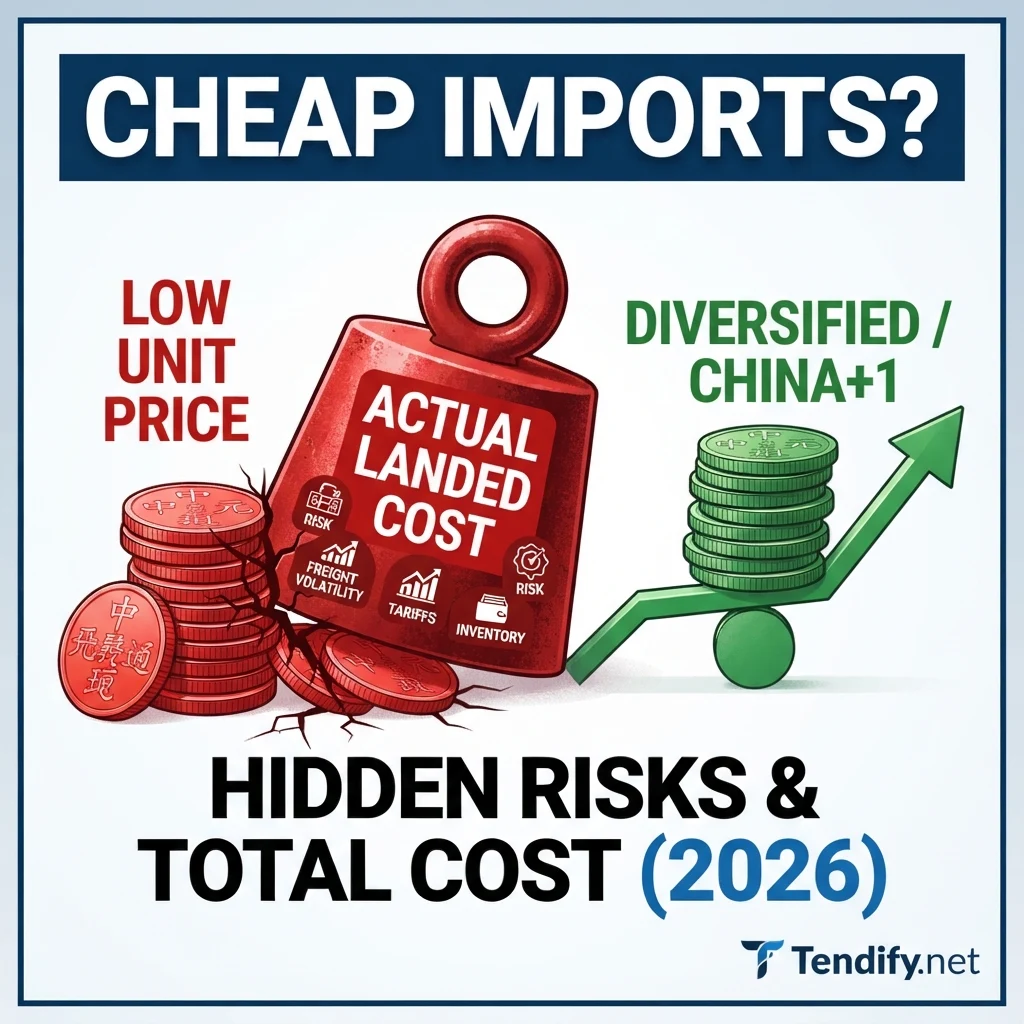
A procurement manager at a mid-sized European industrial distributor recently faced a familiar calculation. A Chinese supplier quoted components 22 percent below the nearest alternative. On paper the decision was obvious. Within nine months the same firm was dealing with delayed containers, a sudden licensing requirement on a critical input, and a two-week production halt that erased the original savings three times over. That experience is no longer an outlier. It is becoming the pattern.
Western governments are operating under rising debt burdens and higher financing costs. IMF projections show several major economies carrying debt ratios above 100 percent of GDP in 2026, with average government financing costs climbing from earlier lows toward 3.7 percent by the early 2030s. Developed-market fiscal deficits have reached levels not seen outside recession since the Second World War. In this environment, cheaper imported goods look like a practical way to contain inflation and protect household purchasing power. The unit price on the invoice is seductive. The full cost of that dependency is not.
Cheap Chinese Imports
This article examines the real economics of heavy reliance on low-cost Chinese production for B2B buyers, manufacturers, and traders. It moves past the factory-gate quote to the total cost and risk equation, the erosion of industrial capabilities, strategic concentration in critical sectors, and the practical middle path of de-risking rather than isolation. A balanced counter-view is included because one-sided protectionism carries its own costs. The goal is operational clarity for companies that must keep goods moving while protecting long-term competitiveness.
The Short-Term Temptation: Debt Pressure Meets Price Relief
Public balance sheets in advanced economies have deteriorated. U.S. federal debt has passed the $40 trillion mark, with net interest payments approaching or exceeding $1 trillion annually in recent fiscal periods. Similar pressures appear across parts of Europe and elsewhere. When interest costs consume a larger share of revenue, governments face tighter room for fiscal support or stimulus. Importing lower-priced consumer and intermediate goods can ease measured inflation and reduce the cost of living in the near term. That dynamic is real and politically attractive.
For private firms the same logic applies at a smaller scale. A lower unit price improves gross margin on paper, supports competitive retail or wholesale pricing, and can delay the need for price increases to customers. In categories where Chinese manufacturing still holds scale and process advantages—many standardized components, certain electronics assemblies, basic chemicals, and high-volume consumer goods—the price differential remains material. Ignoring that advantage would be commercially naïve.
The problem begins when the comparison stops at the unit price. Operational assessments across regional supply chains show that many firms still treat the factory quotation as the primary decision metric. Freight, insurance, duties, quality variance, inventory buffers, compliance overhead, and the probability of disruption are treated as secondary or “someone else’s problem.” That approach worked better in a lower-volatility, lower-interest-rate environment. It works less well when financing costs are elevated, shipping routes face intermittent stress, and policy measures can change with limited notice.
Beyond the Invoice: The Hidden Cost Stack in Cross-Border Sourcing
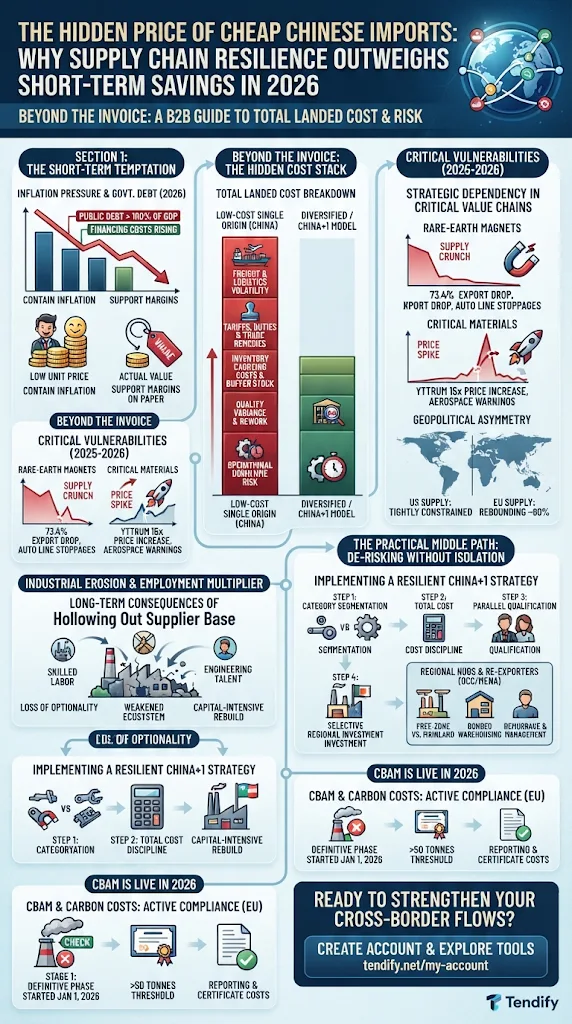
A complete landed-cost and risk model includes several layers that rarely appear on the initial quotation:
- Ocean or air freight, including fuel surcharges, destination terminal handling, and inland haulage. Rate volatility and capacity constraints can erase a 10–15 percent unit-price advantage in a single quarter.
- Duties, anti-dumping measures, and other trade-remedy instruments that can be adjusted with relatively short lead times.
- Quality and compliance costs: higher inspection intensity, potential rework, rejected lots, and the working-capital cost of holding extra safety stock while new suppliers stabilize.
- Currency and payment-term effects. Longer payment cycles or deposit requirements increase financing expense precisely when interest rates are higher.
- Operational downtime risk. A delayed critical input can idle higher-value domestic or regional production. The cost of a stopped line often dwarfs the annual savings on the component itself.
- Geopolitical and regulatory exposure. Export-licensing regimes, end-use restrictions, or sudden changes in preferential treatment add both direct cost and planning uncertainty.
McKinsey analysis has highlighted that roughly a quarter of global goods imports face elevated exposure on at least two of three dimensions: product criticality, supplier concentration, and geopolitical distance. Electronics, certain critical minerals, and related intermediate goods figure prominently. When a single origin dominates processing or intermediate stages, the system becomes brittle even if mining or basic production is more dispersed.
Trade Finance, Banking Compliance & Settlement Friction
Cross-border sourcing rarely fails on product specs alone; it often stalls in payment rails. Heightened KYC/AML screening, correspondent-bank scrutiny, sanctions and dual-use checks, and slower currency clearances mean funds can be delayed or held for compliance review—especially when onboarding new suppliers or routing payments across unfamiliar corridors.
Choosing between Letters of Credit (L/C) and Telegraphic Transfers (T/T) also carries real financial trade-offs. While an L/C adds issuance, amendment, and discrepancy fees—and can slow dispatch if documents are questioned—unsecured T/T terms with an unproven vendor expose cash flow to non-delivery or late shipment. When interest rates and working-capital costs are elevated, payment terms and banking friction directly affect real margin.
CBAM Is Live in 2026: Active Compliance & Carbon Costs for EU Trade
For supply chains serving the European Union, the Carbon Border Adjustment Mechanism (CBAM) is no longer a distant regulatory risk—its definitive phase entered into force on January 1, 2026. Importers above the more than 50 tonnes threshold must operate as authorized CBAM declarants, with certificate purchases beginning in February 2027 and the first annual declaration due by September 30, 2027.
For exporters, intermediaries, and regional traders shipping covered goods to Europe, this is already an active commercial and customs constraint rather than a hypothetical future cost. High-emission production or incomplete emissions documentation translates directly into compliance friction, buyer scrutiny, and real financial exposure on top of the factory invoice price.
For B2B operators the practical implication is straightforward.. Compare suppliers on total cost of ownership and risk-adjusted availability, not on the first number in the email. Tools that surface tariff exposure, route reliability, and alternative origin options help, but the discipline has to sit inside the procurement process itself.
Key takeaway for B2B operators: Build a simple multi-column comparison that includes factory price, freight and insurance under current routing assumptions, estimated duties under prevailing and stress-case scenarios, quality/inspection allowance, and a quantified downtime risk factor. Update the model at least quarterly. The lowest unit price is often not the lowest total cost once these elements are included.
Industrial Erosion and the Employment Multiplier
Not all imports carry the same strategic weight. Finished consumer goods that compete with domestic production can displace local output and associated jobs. Intermediate goods, capital equipment, and specialized components have a different effect: they can hollow out the supplier base that supports higher-value domestic manufacturing.
When local producers of intermediate inputs lose volume, several second-order effects follow. Specialized skills atrophy. Tooling and process knowledge become harder to maintain. Engineering talent migrates to other sectors or locations. Downstream manufacturers then face a thinner domestic ecosystem when they need rapid design changes, small-batch runs, or collaborative problem-solving. The result is gradual loss of optionality. Firms become more dependent on the very concentrated supply chains they hoped to use only for cost advantage.
This dynamic is visible in sectors where process know-how and tightly integrated supplier networks matter more than pure labor cost. Once capacity and expertise leave, rebuilding them is capital-intensive and slow. The employment impact is not limited to the factory floor; it extends to engineering, quality, logistics, and technical sales roles that support industrial activity.
Concrete Example: Precision Instruments, Lab & Medical Hardware
Consider a manufacturer of analytical, laboratory, or medical instruments that outsources machined housings, fluidic manifolds, and sensor sub-assemblies to a lower-cost overseas supplier. Over time, local machine shops and precision molders lose repeat volume and scale down specialized tooling or metrology capabilities. When the company later needs a rapid design revision, custom calibration fixture, or small-batch engineering run, domestic co-engineering partners are no longer readily available—turning routine product iteration into a slow, costly cross-border project.
Strategic Dependency in Critical Value Chains
Certain categories carry systemic risk because of extreme concentration at specific stages. Rare-earth processing and permanent-magnet production, battery materials and cells, selected semiconductor inputs, and certain specialized chemicals illustrate the pattern. China has built dominant positions in midstream and downstream stages even where primary resources are more widely distributed. Export-control measures and licensing regimes introduced or expanded in recent years have shown that these positions can be activated as policy instruments.
When a single origin controls the processing step or the specialized intermediate, alternative capacity cannot be stood up quickly. Qualification cycles for aerospace, defense, medical, and high-reliability industrial applications are measured in months or years. Inventory can bridge short disruptions; it cannot substitute for missing process capacity. The same logic applies to medical devices, laboratory equipment, and certain renewable-energy components where dual-use or dual-sourcing options remain limited.
2025–2026 Reality Check: Critical Minerals, Rare-Earth Magnets & Political Asymmetry
Concentration risk in critical materials is no longer hypothetical—it has produced measurable industrial shocks across 2025 and 2026. Following export-control measures on rare-earth magnets, shipments dropped by roughly 73.4%, forcing automotive assembly line stoppages in both Europe and North America where traction motors and sub-assemblies rely on specialized permanent magnets.
Similar bottlenecks hit specialized inputs: in February 2026, yttrium prices surged roughly 15-fold alongside industrial shortage warnings across aerospace supply chains, where qualification timelines and material specifications leave little room for rapid substitution.
Crucially, trade data also exposed sharp political asymmetry. Even after restrictions were eased in November 2025, magnet flows to the United States remained tightly constrained while shipments to Europe rebounded by roughly 60%. For B2B procurement and trade teams, the lesson is clear: geopolitical alignment and policy friction are not abstract macro headlines—they are real, priceable commercial risks that directly alter availability by destination market.
The asymmetry is important. Many economies source a high share of their most vulnerable imports from one dominant supplier, while the reverse dependency is usually lower. That imbalance amplifies the impact of any disruption or policy shift.
The Practical Middle Path: De-Risking Without Isolation
Complete self-sufficiency is neither feasible nor desirable for most product categories. Comparative advantage, scale economies, and specialized ecosystems still deliver real efficiency. The operational response that has gained traction is structured diversification—commonly labeled China+1 or multi-sourcing—combined with selective investment in higher-value domestic or regional capabilities.
Successful programs share several characteristics:
- Category segmentation. High-complexity, high-qualification items stay with proven sources longer; standardized or less critical items move first.
- Total landed-cost discipline rather than unit-price chasing.
- Parallel qualification and gradual volume transfer so that the primary source remains viable during transition.
- Explicit recognition of transition costs: second tooling, dual inventory, higher early inspection intensity, and management bandwidth.
- Investment in process innovation, automation, and higher-value segments where local or regional producers can sustain competitive advantage without competing solely on labor cost.
The China+1 Trap: Rules of Origin, Transshipment & Customs Scrutiny
A frequent mistake in poorly executed China+1 strategies is treating a third country—such as Vietnam, Malaysia, or Mexico—as a quick pass-through or minimal assembly stop to bypass tariffs. Customs authorities in major destination markets (including the U.S. and EU) enforce strict Rules of Origin (RoO), substantial-transformation tests, and anti-circumvention audits.
If a shipment relies on minor finishing, simple kitting, or insufficient local value addition while critical components or core manufacturing remain concentrated in a restricted origin, importers risk retroactive duty assessments, shipment holds, compliance penalties, and audit delays. True de-risking requires verifiable origin documentation, genuine value-added operations, and bill-of-materials (BOM) traceability—not just a different port of loading on the bill of lading.
Why This Matters Even More for Regional Hubs & Re-Exporters
For traders and distributors operating across the Gulf (GCC) and broader MENA region, supply-chain concentration carries an added operational layer. Many regional businesses act as intermediaries, re-exporters, or light assemblers serving both local demand and neighboring markets—meaning a single upstream bottleneck can trigger cascading delivery delays and contractual penalties across multiple borders.
Sustaining resilient regional flows depends on deliberate structural choices: selecting between free-zone, mainland, and bonded warehousing setups based on actual trade routes, keeping customs and origin documentation airtight, and actively managing port demurrage and detention exposure when transit schedules slip. Multi-sourcing here is not just about lower unit prices—it is about protecting working capital and turnaround speed in high-velocity trade hubs.
Key takeaway for B2B operators: Treat diversification as risk management with a measurable cost, not as a pure cost-reduction project. Track both the steady-state landed cost of the dual-source network and the avoided cost of past or potential disruptions. Firms that only measure the unit-price delta often abandon the program before the resilience benefit materializes.
The Other Side of the Ledger: Why Blanket Protectionism Also Carries Costs
An exclusive focus on domestic production and strategic autonomy can create its own problems. In categories where scale and process intensity create large cost advantages for specialized producers, forcing local manufacture of every intermediate raises input costs for the entire downstream economy. Export-oriented manufacturers and smaller firms lose competitiveness in global markets when their material or component costs rise. Heavy tariff walls, if not paired with productivity gains and innovation, can shield inefficiency rather than build capability. The resulting higher prices are paid by households and by businesses that use those inputs.
The real challenge is therefore not to choose between open trade and closed self-sufficiency. It is to locate the point at which security of supply and competitive cost can coexist. That point differs by product, by firm size, and by the strategic importance of the end market. For many intermediate goods the optimal posture is a diversified supply base plus selective capability retention or rebuilding in critical nodes. For pure commodities and highly standardized items the pure cost calculus may still dominate, provided concentration risk is monitored.
Automotive Landed Cost: China to GCC Import Guide
Decision Framework for 2026 and Beyond
Operational teams can use a short checklist when evaluating any significant sourcing decision:
- Map the full cost stack under base-case and stress-case assumptions (freight spikes, duty changes, quality variance).
- Identify concentration risk at the processing or intermediate stage, not only at the finished-goods level.
- Quantify the cost of a two-to-four-week supply interruption for the specific line or customer commitment.
- Test whether a second origin can be qualified within a realistic commercial timeline and at acceptable transition cost.
- Align the sourcing decision with the firm’s actual risk tolerance and with customer requirements for continuity.
Platforms that aggregate supplier options, tariff data, and logistics visibility can compress the time required for the first two steps. One practical example is the set of trade-intelligence and documentation tools available through Platform.Tendify.Net, which some operators use to surface alternative origins and compliance checkpoints without building every data feed in-house.
Long-term prosperity rests on the ability to produce, innovate, and compete—not solely on access to the lowest possible unit price today. Cheap imports can and should remain part of the toolkit. They should not become the entire foundation. Firms that treat total cost, concentration risk, and supply continuity as first-order metrics will be better positioned when the next disruption arrives. Those that continue to optimize only the invoice price will keep rediscovering the same expensive lesson.
For traders, manufacturers, and distributors navigating these trade-offs, the practical next step is to stress-test the current supply base against the checklist above and to begin building qualified alternatives where concentration is highest. Secure, diversified, and efficient cross-border operations remain achievable. They simply require a more complete accounting of cost and risk than the lowest factory quote provides.
Turn Resilience From Theory Into an Operational Routine
For traders, manufacturers, and distributors navigating these trade-offs, resilience does not happen by accident. Secure, diversified, and efficient cross-border operations remain achievable—they simply require a more complete accounting of landed cost, compliance exposure, and continuity risk than the lowest factory quote provides.
Immediate Action Priorities for Your Supply Base:
1. Stress-Test Current Lanes: Run your top-spend SKUs and high-concentration origins through the five-point checklist above under freight, tariff, and lead-time stress scenarios.
2. Qualify Backup Capacity Early: Start parallel supplier vetting and origin/documentation checks where single-source exposure or disruption cost is highest—before a crisis forces a rushed switch.
3. Price In Full Friction: Factor payment terms, customs rules, and regional hub/logistics choices into every sourcing renewal, not just unit price.
Ready to strengthen the resilience of your own cross-border flows? Create an account and explore the tools designed to support practical cost, compliance, and sourcing decisions:
Create Account & Explore Tools →
tendify.net/my-account

