


المدونة
GCC Life Sciences Market 2026: Biotech, IVD, Biomanufacturing & Customs Tariff Guide
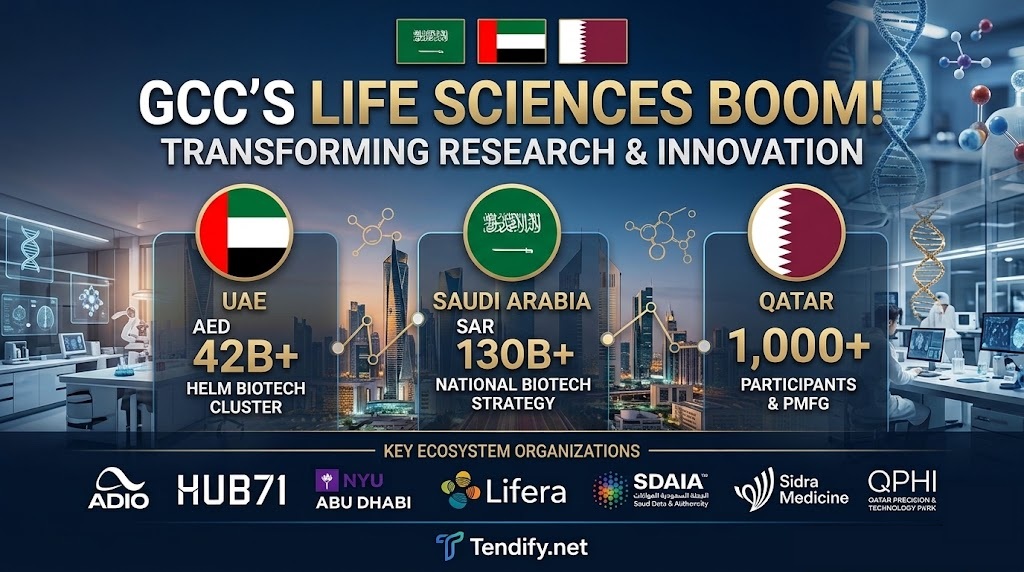
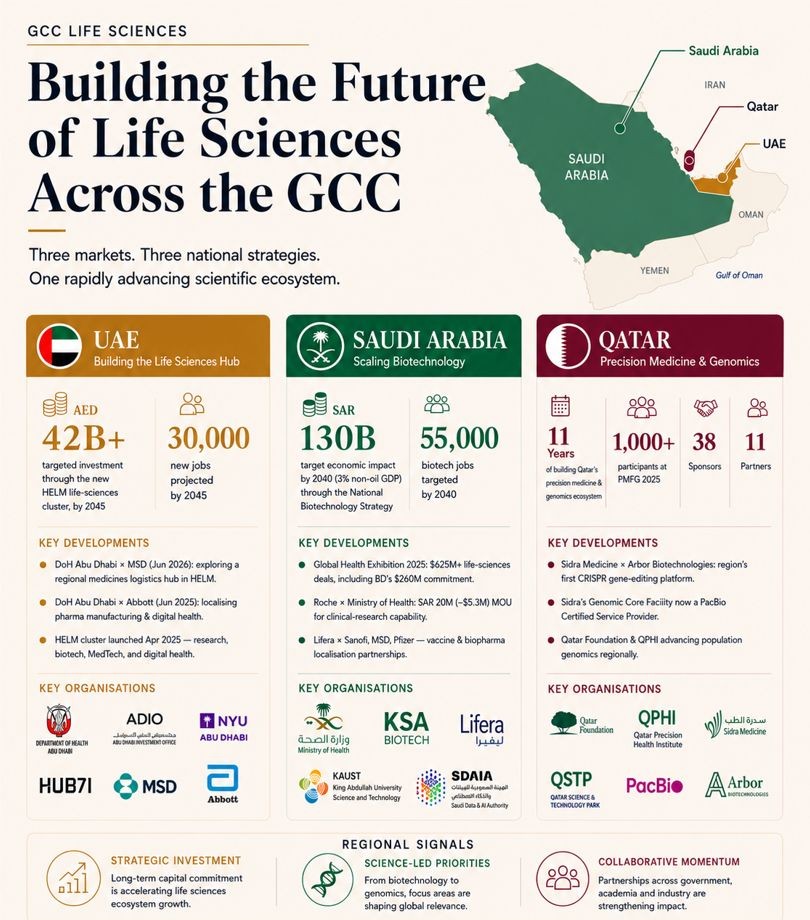
Abu Dhabi’s HELM cluster is targeting more than AED 42 billion in investment and around 30,000 jobs by 2045. Saudi Arabia’s National Biotechnology Strategy projects a SAR 130 billion cumulative economic impact and roughly 55,000 biotechnology jobs by 2040. Qatar continues building depth in genomics, precision medicine and translational research. These numbers signal a structural shift, not a temporary funding cycle.
GCC Life Sciences Market 2026
🚀
Executive Summary: GCC Life Sciences Market 2026
The GCC life sciences market is undergoing a structural shift from an import-dependent end-market to a regional hub for biotech manufacturing, advanced research, and local supply chain resilience. High-value B2B opportunities are expanding across capital equipment, biomanufacturing consumables, cold-chain logistics, and compliance support.
Key Strategic Takeaways
- Abu Dhabi HELM Cluster: AED 42B+ targeted investment driving demand for GMP bioreactors, cold-chain infrastructure, and AI-driven clinical technologies.
- Saudi National Biotech Strategy: SAR 130B economic impact target with aggressive localization mandates (SFDA, Lifera) favoring suppliers with local technical support and ICV integration.
- Qatar Precision Medicine: High-density genomic research infrastructure requiring advanced Next-Generation Sequencing (NGS) platforms, bioinformatics, and LIMS.
- B2B Execution Imperative: Margin protection depends heavily on precise 8-to-10 digit HS code alignment, GDP-compliant cold chain, and strict GS1 DataMatrix barcoding.
For years the GCC functioned primarily as a high-value end market for global life sciences companies. That position is changing. Governments are funding research infrastructure, local manufacturing capacity and specialized talent pipelines. The result is rising demand for laboratory equipment, biomanufacturing systems, cold-chain logistics, regulatory support services and specialized reagents—exactly the categories where experienced B2B suppliers and logistics operators can capture durable contracts.
This article maps the commercial reality behind the headlines. It focuses on what suppliers, manufacturers and logistics providers need to know to participate in the region’s life sciences build-out without repeating the usual mistakes of over-estimating speed or under-estimating compliance requirements.
Why the GCC Is Building Local Life Sciences Capacity Now
Three forces are driving the acceleration.
First, supply-chain resilience. The pandemic exposed the risks of depending almost entirely on distant manufacturing hubs for vaccines, biologics and critical medical devices. Localization targets—especially in Saudi Arabia and the UAE—are explicit responses to that vulnerability.
Second, economic diversification. Both the UAE and Saudi Arabia treat life sciences as a high-value industrial sector that creates skilled employment and exportable intellectual property rather than pure consumption.
Third, clinical and demographic demand. High rates of diabetes, cardiovascular disease and genetic conditions create sustained need for advanced diagnostics, biologics and precision therapies. Governments are simultaneously expanding hospital capacity and pushing for earlier detection and localized treatment options.
The commercial consequence is straightforward: capital is flowing into facilities that require imported capital equipment, continuous reagent supply, specialized logistics and technical service partners. Import dependency remains high—often 70-90% for advanced equipment and consumables—yet policy is steadily shifting preferential procurement toward companies that demonstrate local content, technology transfer or regional presence.
Abu Dhabi’s HELM Cluster: The Integrated Platform Model
The Health, Endurance, Longevity and Medicine (HELM) cluster, launched under the Abu Dhabi Investment Office and Department of Health, is designed as an end-to-end platform covering research, development, manufacturing and commercialization of biotechnology, MedTech and digital health solutions.
Official projections show the cluster contributing more than AED 94 billion to Abu Dhabi’s GDP, attracting over AED 42 billion in investment and generating approximately 30,000 jobs by 2045. Focus areas include advanced therapies (cell and gene), biologics manufacturing, MedTech production and AI-enabled digital health.
For B2B suppliers the practical implications are concrete:
- Demand for GMP-compliant bioreactors, single-use systems, purification equipment and fill-finish lines.
- Need for validated cold-chain solutions capable of handling advanced therapy medicinal products.
- Opportunities in laboratory fit-out, cleanroom construction support and analytical instrumentation.
- Growing requirement for regulatory consulting that understands both local Department of Health pathways and export registration for regional markets.
Clinical trial activity in Abu Dhabi has increased substantially in recent years, shortening approval timelines relative to many other jurisdictions. Suppliers that can support rapid site set-up, validated equipment installation and ongoing technical service gain an advantage.
UAE (Abu Dhabi HELM Cluster):
- DoH Abu Dhabi × MSD: Exploring a specialized regional medicines logistics hub within the HELM cluster.
- DoH Abu Dhabi × Abbott: Strategic initiative focusing on localizing pharmaceutical manufacturing and digital health technologies.
- Ecosystem Anchor: Backed by active participation from ADIO, Hub71, and NYU Abu Dhabi.
Saudi Arabia’s National Biotechnology Strategy: Scale and Localization Mandates
Saudi Arabia’s strategy, launched in 2024, sets four priority directions: vaccines, biomanufacturing and localization, genomics, and plant optimization. The quantitative targets are ambitious—approximately 3% contribution to non-oil GDP, SAR 130 billion cumulative impact and 55,000 quality jobs by 2040, with an intermediate target of 11,000 jobs by 2030.
The biomanufacturing pillar is particularly relevant for equipment and logistics providers. Policymakers are actively encouraging GMP facilities for biologics, biosimilars, monoclonal antibodies and vaccines. Localization preferences in public tenders are already influencing purchasing decisions.
Key commercial entry points include:
- Supply of biopharmaceutical manufacturing equipment (bioreactors, downstream processing systems, aseptic filling lines).
- Reagents, cell culture media and single-use consumables under multi-year framework agreements.
- Cold-chain and specialized warehousing for temperature-sensitive biologics.
- Technology-transfer partnerships and local technical service capacity, which often tip the balance in competitive tenders.
Saudi Arabia already accounts for the largest share of the GCC pharmaceutical market. Its combination of scale, sovereign capital and explicit localization goals makes it the highest-volume opportunity in the region for suppliers prepared to meet documentation and local-content requirements.
- Lifera Partnerships: Sovereign-backed Lifera leads biopharma localization in collaboration with global giants Sanofi, MSD, and Pfizer.
- Clinical Research Deals: Roche × Ministry of Health MOU (~$5.3M) for clinical-research capabilities alongside $260M+ commitments like BD at Global Health Exhibition.
- Key Entities: Institutional backing from KAUST, SDAIA, and KSA Biotech.
Biopharma Production
Biopharma Contracting: Fill-Finish, Viral Vectors, and Biosimilar Manufacturing in GCC
The GCC biopharmaceutical sector is rapidly advancing from fill-finish assembly to full-scale contract development and manufacturing (CDMO) operations. Driven by regional healthcare sovereignty goals, sovereign wealth funds—led by Saudi Arabia’s Lifera (a PIF company) and Abu Dhabi’s healthcare investments—are catalyzing tech-transfer deals with global biopharma leaders to localize advanced therapeutic manufacturing.
Aseptic Fill-Finish & Vials
Rapid expansion of localized sterile filling capacity for prefilled syringes (PFS), lyophilized cartridges, and biological vial packaging under strict GMP and SFDA validation protocols.
Viral Vectors & Plasmid DNA
Emerging investments in upstream single-use bioreactors for viral vector production and plasmid DNA synthesis, fueling regional clinical trial pipelines and advanced gene therapies.
Biosimilars & Monoclonal Antibodies
High-volume public procurement shifts favor localized biosimilar platforms, driving steady demand for cell culture media, chromatography purification resins, and single-use tubing assemblies.
Qatar’s Precision Medicine and Genomics Focus
Qatar has invested more than a decade in building foundational infrastructure through the Qatar Genome Programme and Qatar Biobank. The Qatar Precision Health Institute is now translating that data into clinical application, with ongoing sequencing programs and research into pharmacogenomics and multi-omics approaches.
While absolute market size is smaller than Saudi Arabia or the UAE, the technical sophistication is high. Demand concentrates on:
- Next-generation sequencing platforms and related reagents.
- Bioinformatics and laboratory information management systems.
- Specialized diagnostics and companion diagnostics.
- Secure data infrastructure and AI-enabled analysis tools.
Suppliers with proven capability in genomic workflows and regulatory experience in high-compliance research environments find receptive partners.
- Sidra Medicine × Arbor Biotechnologies: Establishing the region’s first CRISPR gene-editing platform.
- Sequencing Infrastructure: Sidra’s Genomic Core Facility certified as an official PacBio Service Provider.
- Institutional Drivers: Programs led by Qatar Foundation, QPHI, and Qatar Science & Technology Park (QSTP).
Emerging GCC Life Sciences Markets: Oman, Kuwait & Bahrain
Beyond the high-volume hubs of Saudi Arabia, the UAE, and Qatar, adjacent GCC economies are accelerating specialized healthcare procurement and life science infrastructure under national diversification visions.
Oman (Vision 2040)
Focusing on pharma manufacturing localization and pharma-grade logistics hubs at Khazaen Economic City و Sohar Free Zone.
- Centralized Ministry of Health (MOH) public tenders.
- Demand for analytical lab instrumentation and active pharmaceutical ingredients (APIs).
- Growth in medical consumables import requirements.
Kuwait (New Infrastructure)
Multi-billion-dollar expansion of public hospital networks, including New Jahra Hospital and Sabah Medical District modernization.
- High per-capita spending on advanced IVD diagnostic platforms.
- Strict MOH centralized drug & equipment registration.
- Expanding demand for LIMS and hospital automation tech.
Bahrain (Gateway & NHRA)
Positioned as a cost-effective regional distribution gateway leveraging the Bahrain Logistics Zone and fast-track regulatory pathways.
- Streamlined approvals via National Health Regulatory Authority (NHRA).
- EDB incentives for healthcare and cold-chain startups.
- Strategic cross-border access to Saudi Arabia’s Eastern Province.
Market Focus
GCC In Vitro Diagnostic (IVD) & Molecular Diagnostics Market Growth
Driven by rising chronic disease prevalence, centralized public health initiatives, and localized biomanufacturing mandates, the GCC In Vitro Diagnostics (IVD) and molecular testing landscape is evolving rapidly. Regional healthcare providers are shifting from traditional, centralized lab testing toward high-throughput automated platforms, multiplex molecular assays, and localized CDMO/OEM production agreements.
Advanced IVD Reagents & Kits
High demand for RT-PCR assays, immunofluorescence kits, liquid biopsy panels, and next-generation sequencing (NGS) consumables across clinical and research hubs.
Clinical Lab Infrastructure
Procurement priorities are pivoting toward fully automated immunoassay analyzers, molecular transplant diagnostics, and integrated LIMS software solutions.
IVD Contract Manufacturing
Expansion of OEM partnerships and localized fill-finish contract manufacturing to meet SFDA and MOHAP in-country value (ICV) procurement thresholds.
Advanced Omics & Data
Genomics, Biochips & Laboratory Informatics (LIMS) Expansion
National population genome initiatives—such as the Emirates Genome Council و Qatar Precision Health Institute (QPHI)—are transforming the GCC into a global powerhouse for high-density genomic research. This multi-year pipeline is triggering unprecedented demand for high-throughput sequencing platforms, functional biochips, gene expression analysis tools, and enterprise-grade Laboratory Information Management Systems (LIMS).
Whole Exome & Genome Sequencing
WES and WGS platforms are becoming routine clinical diagnostic tools for rare pediatric diseases, pharmacogenomics, and population-scale risk profiling.
Biochips & Microarrays
High-density SNP microarrays and tissue biochips drive targeted population screening, gene expression analysis, and oncology biomarker discovery.
Enterprise LIMS Integration
Transition from manual workflows to HIPAA/GDP-compliant LIMS for automated sample tracking, biobanking custody, and multi-omics bioinformatic pipelines.
Required Genomics Software & Bioinformatic Infrastructure (QPHI & UAE Initiatives)
B2B vendors offering integrated bundles—combining NGS reagents, specialized LIMS software licenses, and local bioinformatic technical support—achieve higher conversion rates in public health research tenders across Qatar and the UAE.
GCC Life Sciences Market Comparison Matrix
At a Glance
Market Size Context and Import Reality
The broader GCC pharmaceutical market was valued at roughly USD 23.7 billion in 2024 and is projected to approach USD 37 billion by 2030 at a CAGR near 7.6%. Medical devices sit around USD 9 billion in 2026 with continued growth. Laboratory equipment and manufacturing systems form a growing sub-segment as new facilities come online.
Import dependency remains elevated across categories. This creates both risk and opportunity. Risk appears in the form of logistics delays, currency exposure and regulatory documentation requirements. Opportunity appears for suppliers that can offer reliable regional stock, validated cold-chain, rapid technical support and clear HS classification and customs documentation.
Practical B2B Entry Pathways
1. Equipment and Capital Systems
New biomanufacturing and research facilities require bioreactors, chromatography systems, freeze dryers, isolators and analytical instruments. Procurement cycles are long and documentation-heavy. Success depends on early engagement with project developers, EPC contractors and end-user technical teams, plus the ability to support installation, validation and ongoing maintenance.
2. Consumables and Reagents
Once facilities are operational, continuous demand for media, resins, filters, single-use assemblies and diagnostic kits becomes the steadier revenue stream. Framework agreements and consignment stock models are common. Suppliers that can demonstrate consistent quality, regional inventory and responsive logistics outperform pure transactional exporters.
3. Specialized Logistics and Cold Chain
Advanced therapies and many biologics require strict temperature control and rapid transit. The combination of high-value cargo and regulatory scrutiny rewards logistics providers that already operate validated cold-chain networks across the GCC and can integrate with free-zone warehousing. Understanding demurrage risks, customs valuation and temperature-mapping requirements is non-negotiable.
❄️
GCC Cold-Chain & GDP Compliance Playbook
Good Distribution Practice, excursion safeguards, and airport hub analysis.
4. Regulatory and Compliance Support
Navigating SFDA, MOHAP, Department of Health – Abu Dhabi and other pathways requires specialized knowledge. Companies that combine product supply with regulatory consulting or dossier preparation services often secure longer-term relationships.
5. Free-Zone and Mainland Positioning
Free zones in the UAE and emerging industrial clusters elsewhere offer customs advantages and simplified company setup for regional distribution. Mainland presence can be advantageous for public tender eligibility in certain markets. The optimal structure depends on the specific product category and target customers.
Regulatory Pathway & Customs Clearance Framework
Compliance Guide
Securing market access across the GCC requires navigating distinct regulatory clearinghouses and customs validation protocols for medical devices, reagents, and biopharmaceuticals:
Actionable B2B Execution Checklist: SFDA, MOHAP & Customs Clearance
Bridging macro-economic targets with ground-level execution requires medical device exporters, biopharma suppliers, and cold-chain operators to fulfill four core regulatory checkpoints before shipping to the GCC:
Saudi Arabia: SFDA & GHAD Listing
- Appoint a licensed Saudi Authorized Representative (AR) holding a valid MDEL license.
- Submit technical dossiers, ISO 13485, and Free Sale Certificates via the SFDA GHAD system.
- Secure SFDA Medical Device Marketing Authorization (MDMA) prior to port dispatch.
UAE: MOHAP Classification & Pre-Import Approval
- Classify lab consumables, reagents, and diagnostic kits with MOHAP (Medical Device vs. Chemical).
- Apply for pre-approved MOHAP import permits for active biological samples and reagents.
- Leverage Abu Dhabi DoH regulatory sandboxes within the HELM cluster for fast-track clinical trials.
HS Code Alignment & Customs Portals (SABER / Fasah)
- Map equipment to precise 8-to-10 digit Unified GCC HS Codes (e.g., 8479.82 for bioprocess bioreactors).
- Generate mandatory Certificates of Conformity (CoC) via SABER for Saudi customs clearance.
- Account for standard 5% GCC unified customs duty when moving goods from Free Zones to Mainland.
GDP Cold-Chain Validation & Track-and-Trace
- Equip shipments with continuous calibrated IoT temperature dataloggers (2–8°C / Dry Ice).
- Enforce GS1 DataMatrix barcoding on outer secondary packaging for batch-level trace-and-track compliance.
- Attach batch-specific Certificates of Analysis (CoA) matching exact lot numbers on physical invoices
📄
GCC Regulatory Dossier & Compliance Checklist
Step-by-step SFDA, MOHAP & MOPH approval roadmap and eCTD requirements.
📊
GCC Life Sciences HS Code & Customs Tariff Directory
Harmonized Tariff Schedule, duty exemption criteria, and landed cost model.
GCC Life Sciences HS Code & Tariff Lookup Directory
Unified GCC Duty: 0% – 5% Standard
Harmonized System (HS) classifications, GCC unified customs duty rates, and required port-entry regulatory mandates for biomanufacturing equipment, IVD reagents, genomics tools, and digital health software entering mainland GCC markets:
Logistics and Documentation Realities That Determine Margins
Life sciences cargo is unforgiving. A single temperature excursion or incomplete certificate of analysis can result in rejection or costly re-testing. Operational assessments across regional routes consistently show that the highest losses occur not from freight rates but from:
- Incomplete or mismatched HS classifications leading to customs delays.
- Inadequate temperature monitoring or chain-of-custody documentation.
- Failure to align Incoterms with actual risk-bearing capacity.
- Underestimation of last-mile requirements into hospital or research campuses.
Suppliers who treat documentation and logistics as core product features rather than afterthoughts protect both margins and reputation. Tools that support accurate HS code selection, duty calculation and export documentation checklists reduce friction at the operational level.
For companies already managing complex cross-border flows, platforms that consolidate trade tools, compliance screening and logistics visibility can shorten the learning curve when entering highly regulated categories. One such operational environment is available at Platform.Tendify.Net for teams that need integrated trade utilities without building everything from scratch.
Compliance and Quality Expectations
GCC regulators have raised the bar. GMP, GDP and increasingly ISO and specific local standards apply. For advanced therapies the requirements tighten further. Buyers—especially public hospitals and research institutions—routinely audit suppliers on quality systems, change control and technical service capability.
Practical steps that improve success rates:
- Maintain full technical dossiers and certificates of analysis ready for rapid submission.
- Invest in local or regional technical service capacity rather than relying solely on remote support.
- Align packaging and labeling with local language and regulatory requirements from the outset.
- Track regulatory updates from SFDA, MOHAP and Department of Health – Abu Dhabi as core commercial intelligence.
Operational Fine Print
Critical Success Factors in GCC Procurement Tenders
- In-Country Value (ICV) & Local Content Weighting: Public health tenders in the UAE and Saudi Arabia prioritize vendors with high ICV scores or certified Saudi Local Content targets. Foreign suppliers must partner with compliant local entities to gain technical evaluation margins.
- Free-Zone to Mainland Duty Calculations: While stocking reagents in free zones offers tax deferral, movement into hospital networks (mainland) triggers the standard 5% GCC unified customs duty unless specific GCC origin certificates apply.
- GS1 DataMatrix & Dual-Language Labeling: SFDA and MOHAP strictly enforce GS1 DataMatrix barcoding for batch tracking, alongside mandatory Arabic/English dual-language technical inserts for imported reagents and diagnostic consumables.
🏛️
GCC Public Tenders & Local Content (ICV) Guide
Saudi LCGPA and UAE ICV evaluation formulas, buyer lists, and tech-transfer terms.
Risk Management in a High-Stakes Category
Currency exposure, payment terms, force majeure and intellectual property protection all require explicit contractual treatment. Letters of credit remain common for larger equipment deals, while escrow and other hybrid structures appear more frequently in mid-sized transactions. Clear war-risk and delay clauses matter on certain routes.
Diversifying customer base across public and private buyers, and across UAE, Saudi Arabia and Qatar, reduces concentration risk. Building relationships with local distributors who already hold the necessary licenses can accelerate market entry while the foreign supplier develops direct channels.
Targeting Guide: Key Ecosystem Gatekeepers
B2B Directory
For B2B exporters, laboratory suppliers, and tech partners, navigating the GCC life sciences market requires direct engagement with the key institutional buyers, incubators, and regulatory bodies shaping regional procurement:
- ADIO (Abu Dhabi Investment Office): Primary gateway for sovereign incentives, foreign direct investment, and setup support within Abu Dhabi’s HELM cluster.
- Hub71: Abu Dhabi’s global tech ecosystem supporting early-stage and scaling HealthTech, BioTech, and digital health startups with capital and market access.
- KAUST (King Abdullah University of Science and Technology): Saudi Arabia’s premier R&D hub for bio-innovation, deep-tech research equipment procurement, and academic-industrial pilots.
- SDAIA (Saudi Data & AI Authority): The central authority overseeing AI integration, health data governance, and smart diagnostics initiatives across the Kingdom.
- QSTP (Qatar Science & Technology Park): Free-zone anchor for tech-based enterprises in Doha, offering incentives and specialized infrastructure for R&D and precision medicine companies.
- PacBio Technology Hubs: Key industry reference standard for Next-Generation Sequencing (NGS) and genomic core facilities integrated across regional medical research centers.
🔑 Primary B2B Gatekeepers & Government Tender Portals
To secure public health and research procurement contracts in the GCC, foreign and local suppliers must register directly through these official procurement pathways:
🇸🇦 Saudi Arabia Procurement & Tenders
- Etimad Portal (منصة اعتماد): The central electronic portal for all Ministry of Health (MOH) and public hospital tenders. Requirement: Local CR and Saudi Authorized Representative (AR).
- NUPCO (National Unified Procurement Company): Handles unified tenders for pharmaceuticals, medical equipment, and lab consumables across all government sectors.
- Lifera & KAUST Procurement: Sovereign-backed portals for biotech localization, research lab fit-outs, and biomanufacturing equipment.
🇦🇪 UAE & Abu Dhabi HELM Cluster
- Department of Health (DoH) / Abu Dhabi Health Services (SEHA): Handles all public medical device and cold-chain logistics procurement in Abu Dhabi.
- MOHAP Supplier Portal: Federal Ministry portal for listing medical consumables, diagnostic reagents, and obtaining import pre-clearance.
- Hub71 & ADIO Marketplace: Direct gateway for tech transfer, BioTech startup support, and joint-venture funding within the HELM cluster.
🇶🇦 Qatar Precision Medicine Hub
- MOPH Procurement & Hamad Medical Corporation (HMC): Main buyers for high-throughput Next-Generation Sequencing (NGS) reagents and clinical diagnostic platforms.
- Qatar Foundation (QSTP / Sidra Medicine): Direct tender pathways for specialized genomic core facilities, LIMS software, and advanced R&D consumables.
How to Prioritize Action in the Next 12–24 Months
- Map specific facility pipelines in Abu Dhabi, Riyadh and related clusters against your product portfolio.
- Identify the two or three product categories where your technical advantage is clearest (equipment, reagents, logistics services).
- Secure or strengthen regional inventory and technical support capability.
- Audit your documentation and cold-chain processes against current GCC expectations.
- Engage early with project developers and procurement teams rather than waiting for open tenders.
- Build relationships with free-zone operators and logistics partners that already handle regulated cargo.
Internal resources that support these steps include practical guides on multimodal transport costs across Gulf routes and free-zone selection criteria for regulated goods. Relevant reading appears in the Tendify blog under logistics and free-zone analysis.
Frequently Asked Questions (B2B Procurement & Compliance)
Overseas suppliers must first appoint a licensed Saudi Authorized Representative (AR) to obtain a Medical Device Establishment License (MDEL) before listing products on the SFDA’s GHAD system and clearing customs via SABER.Q2: Do free-zone established companies in the UAE enjoy duty-free status when selling to mainland hospitals?
No. While free zones allow tax-deferred warehousing, transferring goods into mainland UAE (e.g., public health networks) triggers the standard 5% GCC unified customs duty unless specific GCC local content origin criteria are met.
The Longer-Term Commercial Logic
The GCC is moving from pure market to partial production base in life sciences. That transition creates multi-year demand for the physical and service inputs that make biomanufacturing and advanced research possible. Suppliers who treat the region as a strategic industrial customer—rather than a pure import destination—will capture the higher-margin, stickier contracts.
The capital commitments are already public. The facilities are being designed and built. The question for B2B operators is whether their commercial, logistics and compliance systems are ready to participate at the required standard.

