


المدونة
UAE FMCG Retail Margins : The 2026 Strategy & Pricing Guide
Entering the UAE FMCG market without a clear view of the margin architecture is one of the fastest ways for a new brand to lose money. Shelf space in Dubai and Abu Dhabi is treated as a high-value asset. Hypermarkets and distributors extract value from both the front end (the margin they take on every unit sold) and the back end (listing fees, volume rebates, and promotional contributions). Brands that arrive with only an EXW or CIF cost calculation almost always discover too late that their landed cost leaves no room for these layers.
UAE FMCG Retail Margins
Operational reviews of recent listings across major modern-trade chains show a consistent pattern: the total cost of access frequently exceeds the visible retail margin. Understanding the full pricing waterfall — from recommended retail price back to the maximum acceptable landed cost — is therefore non-negotiable.
Front-End Margins Expected by UAE Hypermarkets
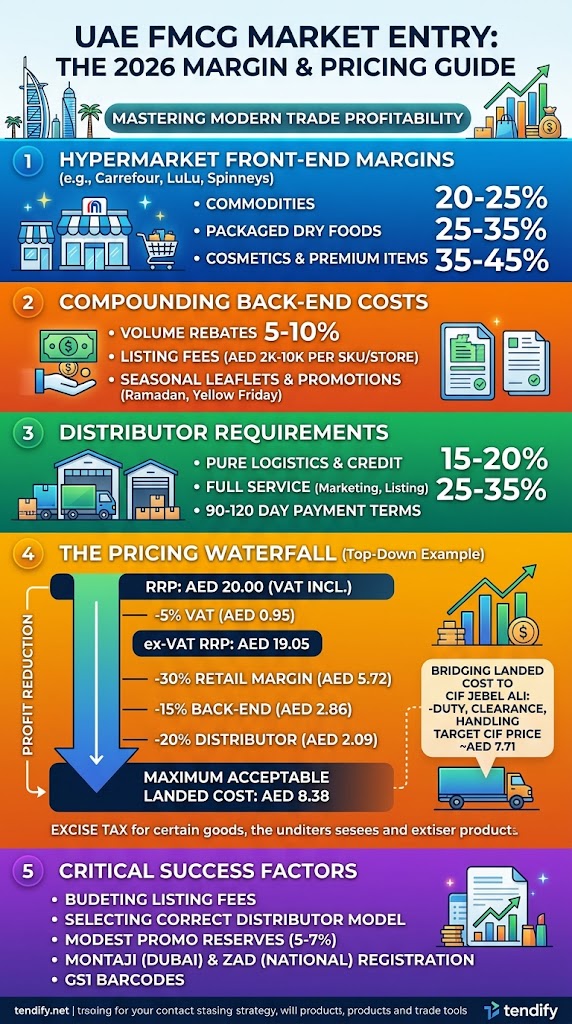
Modern-trade operators (Carrefour, Lulu, Spinneys, Nesto and similar chains) typically apply the following front-end margin ranges on the VAT-exclusive retail price:
- Basic commodities and high-volume staples: 20–25 %
- Packaged dry foods, snacks and beverages: 25–35 %
- Personal care, cosmetics, organic and premium items: 35–45 %
These percentages are not theoretical. They appear in the commercial terms negotiated during the listing process and are used to calculate the sell-in price the retailer will accept from the distributor.
Back-End Costs That Compound the Pressure
Front-end margin is only the visible layer. Back-end deductions commonly include:
- Volume rebates: 5–10 % of net sales, paid at year-end or on achievement of agreed volume thresholds.
- Listing / slotting allowances: AED 2,000–10,000 per SKU per store for major chains. Multiplied across a national footprint, this becomes a significant one-time or annual cost.
- Trade-marketing and promotional support: 5–10 % of sales value, covering gondola ends, catalogue features, BOGO mechanics and in-store displays.
Commercial Extras: Seasonal Leaflets & Premium Placement
Promotional Participation & Shelf Space Assets
Beyond basic annual trade marketing budgets, major modern-trade operators leverage key promotional events and high-visibility store zones to extract additional commercial contributions throughout the retail calendar:
When these elements are stacked, the effective margin the retailer extracts can easily exceed 40–50 % of the VAT-exclusive shelf price on many categories.
Contractual Risk
Unsellable Goods & Expiry Reserve: The 100% Risk Transfer Clause
In UAE Modern Trade contracts, retailers operate under a strict zero-risk policy for damaged or expired inventory. Retailers automatically pass 100% of the financial burden for short-expiry or damaged goods back to the distributor, who in turn contractually transfers it directly to the brand owner.
- Short-Expiry Penalty Window: Most major hypermarkets (e.g., Carrefour, LuLu) mandate a 30-to-90-day rejection window before the official expiration date. Stock reaching this threshold is automatically debited from the distributor’s account.
- Mandatory Damage Reserve (2% – 5%): Distributors typically deduct a fixed 2% to 5% off-invoice or quarter-end allowance from the brand to cover handling damage, shrink, and near-expiry liquidations.
- Disposal & Return Logistics: Brands are frequently required to pay destruction fees or cover return freight costs for rejected batches, adding unbudgeted operational overhead.
Distributor Margin Requirements
Distributors in the UAE perform far more than simple logistics. They typically manage import clearance, warehousing, last-mile distribution to stores, credit collection (90–120 day payment terms are standard), and often the initial trade-marketing execution.
Typical distributor margins, calculated on the price they charge the retailer (sell-in price):
- Pure logistics and credit management: 15–20 %
- Full-service model that also absorbs listing fees and promotional costs: 25–35 %
Because retailers pay distributors on extended credit terms, the distributor’s margin must cover the cost of capital tied up for three to four months. Brands that attempt to compress distributor margins below these ranges frequently face reluctance to list or aggressive push-back on payment terms.
The Liquidity Trap: Payment Terms & Working Capital Gap
Financial Structure & Cash Flow Reality
While standard retail contracts specify credit terms of 90 days, the practical payment cycle across major UAE hypermarkets routinely stretches much longer, creating a severe liquidity burden for brand owners:
Digital Channels: E-Grocery & Online Marketplace Dynamics
E-Commerce Commission Structures & Q-Commerce Costs
Entering the UAE FMCG market via online platforms (Amazon.ae, Noon, Talabat Mart, Careem, Instacart) provides faster market exposure but comes with a distinct digital margin structure and operational cost dynamics:
Practical Pricing Waterfall: From Shelf Price Back to Landed Cost
The only reliable way to set a viable cost structure is to work backwards from the target recommended retail price (RRP). Below is a realistic worked example for a packaged food or premium beverage SKU with a VAT-inclusive shelf price of AED 20.00.
| Layer | Calculation Basis | Rate | Amount (AED) | Remaining Value (AED) |
|---|---|---|---|---|
| Shelf price (incl. VAT) | Target RRP | — | — | 20.00 |
| VAT extraction | RRP ÷ 1.05 | 5 % | 0.95 | 19.05 (ex-VAT RRP) |
| Retailer front-end margin | 30 % of ex-VAT RRP | 30 % | 5.72 | 13.33 |
| Retailer back-end costs (rebate + trade marketing) | 15 % of ex-VAT RRP | 15 % | 2.86 | 10.47 (gross sell-in) |
| Distributor margin | 20 % of sell-in price | 20 % | 2.09 | 8.38 |
| Maximum acceptable landed cost | — | — | — | 8.38 |
A second, tighter example for a lower-priced commodity item with a AED 10.00 VAT-inclusive shelf price and more aggressive margins produces a landed-cost ceiling closer to AED 5.20. Brands that ignore this reverse calculation routinely discover their product is uncompetitive once all layers are applied.
Critical Import Note
Unlocking the Landed Cost: Bridging Landed Cost to CIF Jebel Ali
A common pitfall for emerging brands entering the UAE FMCG market is stopping the waterfall calculation at the AED 8.38 Landed Cost ceiling. To determine the true factory margin (CIF/EXW), you must account for the mandatory customs clearance, handling, and duty layers required to move goods from Jebel Ali Port to a local Dubai warehouse.
| Cost Component | Calculation Basis | Rate / Impact | Amount (AED) |
|---|---|---|---|
| Landed Cost Ceiling (In-Warehouse Dubai) | Waterfall Stage 7 Result | — | 8.38 |
| Port Handling, Manifest & Local Clearance | DP World fees, inspection, local transport | ~3.5% of Landed Cost | -0.29 |
| GCC Base Customs Duty | 5% standard duty applied on CIF Value | 5% of CIF | -0.38 |
| Maximum Acceptable CIF Jebel Ali Price | Target price payable to factory/exporter | Net Export Value | AED 7.71 |
What Hypermarkets and Distributors Actually Demand from New Brands
Beyond the pure numbers, commercial buyers and distributors apply a clear set of practical filters:
- Marketing commitment
Unknown brands are expected to fund both above-the-line and below-the-line activity. Buyers routinely ask for evidence of a dedicated trade-marketing budget (often 5–10 % of projected sales) before approving a listing. Without visible consumer demand generation, shelf space is considered high-risk. - Supply continuity guarantees
Out-of-stock situations trigger contractual penalties and damage the brand’s standing with the buyer. Distributors and retailers expect rolling forecasts, safety stock commitments and clear contingency plans for production or logistics disruption. - Regulatory readiness
Full Montaji (Dubai Municipality) registration is mandatory for food, beverage, personal care and cleaning products sold in Dubai. Parallel requirements exist under other emirates’ systems. Incomplete or non-compliant labelling is one of the most common reasons for delayed or rejected listings. - Financial capacity to absorb the cash-flow gap
The combination of listing fees, promotional contributions and 90–120 day retailer payment terms creates a working-capital requirement that many new entrants underestimate. Distributors will often refuse to proceed if they perceive the brand cannot fund the initial pipeline.
Critical Tax Factor
The Excise Tax Trap: Major Margin Shift for Beverages & Special Goods
Applying a standard FMCG pricing waterfall to excisable goods without factoring in the UAE Federal Tax Authority (FTA) Excise Duty will instantly destroy profitability. Under UAE law, selective products face high tax rates calculated directly on the higher of the local retail selling price (RSP) or FTA standard price lists:
Operational & Compliance Impact for Importers:
- FTA Brand Registration: Excisable products cannot clear UAE Customs without prior clearance and registration on the FTA portal (EmaraTax).
- Cash-Flow Requirement: Excise Tax is payable at the point of import or release from a customs warehouse, creating a significant upfront capital burden long before retail collection.
- Waterfall Adjustment: For a AED 10.00 sweetened beverage, 50% excise tax reduces the acceptable landed cost ceiling dramatically, requiring brands to radically adjust EXW pricing or target higher retail price tiers.
Supply Chain Mandatory
Barcode & Traceability: Non-Negotiable GS1 Standards
In the UAE modern trade ecosystem, automated inventory management and Point of Sale (POS) efficiency make GS1-compliant barcoding mandatory. Major hypermarket networks (including Carrefour, LuLu, Spinneys, and Nesto) strictly reject any SKU that uses internal, non-registered, or duplicate barcode sequences.
Key Barcode Verification Rules in UAE Retail:
- Global Location Number (GLN): Brand owners must possess a verified GS1 company prefix. Retailer procurement systems cross-check barcode prefix legitimacy during contract onboarding.
- Regulatory Portal Integration: كلاهما Montaji (Dubai) و ZAD (Federal) map product safety approvals directly to your GS1 GTIN (Global Trade Item Number).
- Traceability & Recall Management: GS1 standards allow instant lot/batch tracking across the UAE supply chain in the event of quality inspections or health authority recalls.
Montaji Registration: Costs, Timeline and Practical Requirements
Montaji registration under Dubai Municipality is the legal gateway for most FMCG categories in Dubai. Key points observed in recent successful registrations:
- Official government fees typically range from AED 200–700 per SKU for food and beverage and AED 500–1,000 for cosmetics and detergents. Specialty supplements can reach AED 1,500–2,500.
- Laboratory testing, when required, adds AED 500–1,500.
- Label artwork must be bilingual (Arabic/English) and compliant with GSO standards. Translation and redesign commonly cost AED 100–300 per SKU.
- Processing time under normal conditions is 7–21 working days once a complete dossier is submitted. Incomplete ingredient lists, missing Free Sale Certificates or non-compliant claims are the primary causes of rejection and re-submission.
A valid UAE trade licence (or a local distributor holding one) is a prerequisite. Foreign brand owners cannot register products directly without a local entity or authorised agent.
Federal Expansion
Beyond Dubai: National Distribution via ZAD (ZADS) Portal
While Montaji governs product registration specifically for the Emirate of Dubai, relying on it alone restricts a brand from selling across the full UAE footprint. To list SKUs in major hypermarket hubs across Abu Dhabi, Al Ain, Sharjah, or the Northern Emirates, registration on the national federal system is mandatory.
- MOCCAE Jurisdiction: Managed under the Ministry of Climate Change and Environment (MOCCAE), the ZAD platform provides unified federal product approvals valid across all 7 emirates.
- National Hypermarket Requirement: Chains operating nationwide (such as LuLu Group, Carrefour UAE, and Nesto) require ZAD approval to transfer inventory from central warehouses to Abu Dhabi or Sharjah stores without facing municipal impoundment.
- Unified Barcode & Compliance Integration: ZAD links directly with federal import clearance systems, ensuring that GS1 barcodes, health claims, and Halal certificates are verified for nationwide entry.
Building a Viable Entry Model
Successful new brands treat the margin structure as a design constraint rather than a negotiation afterthought. Practical steps that reduce friction include:
- Running the full pricing waterfall for every SKU before committing to production volumes.
- Selecting a distributor whose service model matches the brand’s capability (pure logistics versus full-service) and pricing the relationship accordingly.
- Budgeting listing fees and year-one promotional support as non-negotiable launch costs rather than optional extras.
- Completing Montaji registration and label compliance before approaching major retailers, so commercial discussions can focus on volume and positioning rather than regulatory gaps.
- Maintaining a modest reserve (5–7 %) inside the cost structure specifically for BOGO and temporary price reductions, which remain popular promotional mechanics in the UAE.
For brands already operating in other GCC markets, the UAE structure is generally more expensive on the back-end than smaller markets but offers higher absolute volume potential once scale is reached. The key is to model the cash-flow impact of the first 12–18 months accurately rather than focusing solely on gross margin percentages.
Related reading on practical UAE market entry includes detailed guidance on selling into major hypermarket chains and the current directory of active FMCG operators. Brands evaluating free-zone versus mainland logistics structures can also review comparative cost analyses available on the platform.
Accurate margin modelling and regulatory readiness remain the two factors that most consistently separate brands that achieve stable listings from those that exhaust capital before reaching meaningful volume. Working the numbers backwards from the shelf price, securing the correct distributor partnership, and completing Montaji registration early form the practical foundation for any serious 2026 UAE FMCG launch.

