


المدونة
Land Freight Arbitrage: The Hidden Trucking Trick Draining Your Margins
📌
Executive Summary: What Procurement Leaders Must Know
Key Takeaways for C-Suite & Procurement
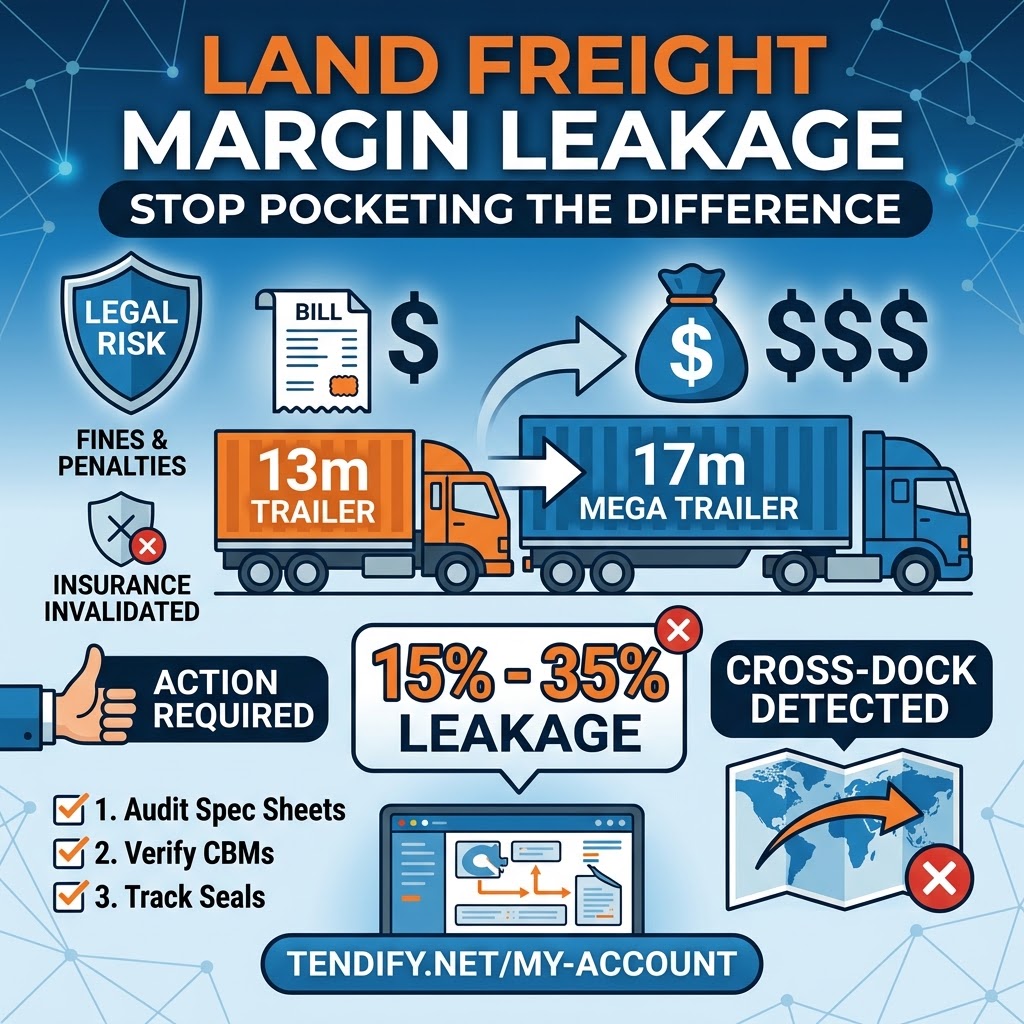
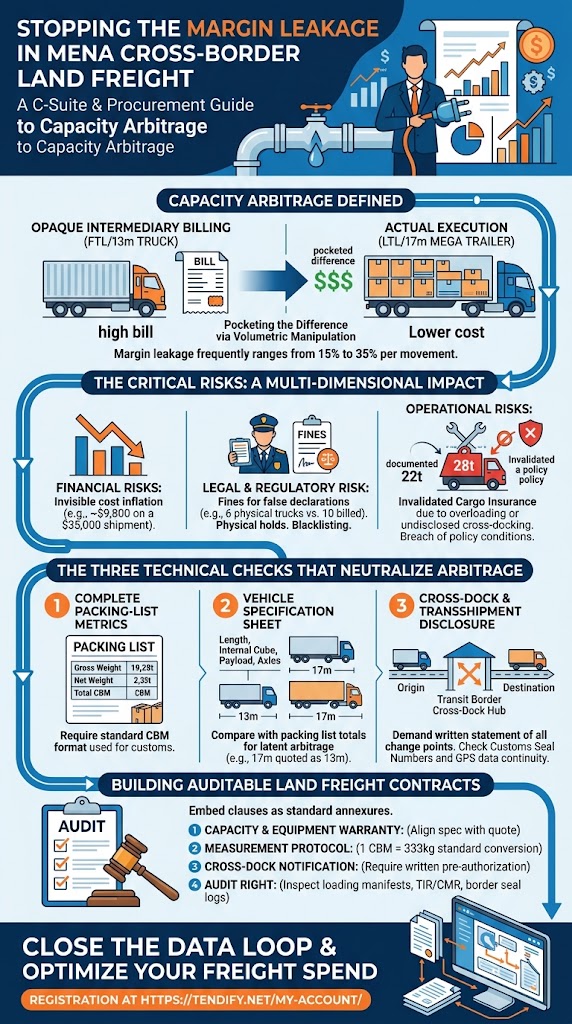
In cross-border land freight across the MENA region, the primary source of margin leakage is rarely transparent rate markups. Instead, it is capacity arbitrage—an operational practice where opaque intermediaries bill buyers for smaller or additional vehicle capacity (e.g., standard 13m trucks or dedicated FTL) while executing shipments using high-volume, consolidated units (e.g., 17m Mega trailers or shared LTL runs) without disclosure.
•
•
•
A mid-sized industrial buyer in the Gulf recently reviewed three land-freight quotes for the same shipment of machinery parts. All three intermediaries offered nearly identical door-to-door rates. Only one disclosed the actual truck configuration. When the cargo arrived, the “cheapest” quote had used larger-capacity vehicles than billed, consolidating what should have been six high-volume runs into four and pocketing the difference. The buyer paid for ten truckloads of capacity while the carrier moved the freight on six. The margin loss was not a market fluctuation. It was volumetric manipulation.
This pattern appears repeatedly in cross-border land logistics across the MENA region and beyond. Transparent premium pricing from established forwarders is rarely the real problem. The larger and more persistent risk is the quiet arbitrage of axle-load limits, cubic capacity, and cross-dock points that never appear on the commercial invoice.
The Math of Volumetric Manipulation: A Real-World Scenario
Financial Case Study
Consider a 220-tonne (or 780 CBM) machinery component shipment moving across regional land corridors. The trader receives quotes based on 10 standard 13m truckloads (75 CBM / 22t capacity each). In reality, the intermediary utilizes high-capacity 17m trailers (130 CBM capacity) at origin, consolidating the entire shipment into just 6 physical runs while billing for 10.
Why Capacity Arbitrage Beats Open Overcharging
In formal freight markets and on professional platforms, rates are built from measurable inputs: gross weight, volumetric weight (CBM), axle-load regulations, transit corridors, and Incoterms. A licensed carrier or NVOCC that quotes high is still operating inside a framework that can be audited. The invoice, the packing list, and the truck specification can be matched.
Social-media and informal cargo brokers operate under different incentives. Marketing language emphasizes speed and “special rates.” Technical variables—actual cubic capacity of the vehicle, permitted axle load on each leg of the journey, and whether the load will be cross-docked—are omitted or left deliberately vague. The intermediary loads to the highest legal capacity available at origin, bills the client on a lower notional capacity, and retains the difference. The client experiences the transaction as ordinary market pricing. In reality the cost structure has been inverted.
Land Freight Arbitrage
Operational reviews of regional land corridors show that the gap between billed capacity and actual payload frequently ranges between 15 % and 35 % on multi-country trucking moves. The loss compounds when border formalities force a change of vehicle: the cargo may leave origin on a 28-tonne configuration and continue after the border on a 22-tonne unit, yet the client is charged as if every leg ran at the lower capacity.
Service Model Misrepresentation: FTL (Full Truckload) vs. LTL (Less-than-Truckload)
A foundational mechanism in capacity arbitrage is the deliberate confusion between Full Truckload (FTL) و Less-than-Truckload (LTL / Consolidation) services. Shippers pay a premium for FTL to secure dedicated space, point-to-point speed, and zero intermediate handling risks.
- Charter Model: 100% dedicated vehicle volume & payload
- Transit Profile: Direct point-to-point without cross-docking
- Commercial Value: Premium pricing for speed, security, & isolation
- Shared Model: Freight co-loaded with third-party cargo
- Transit Profile: Multi-stop routes & hub consolidation
- Commercial Value: Pro-rata cubic/weight cost sharing
The Phantom-FTL Arbitrage: The intermediary bills the shipper for a dedicated FTL charter rate, but actually loads the cargo into a high-capacity unit alongside third-party freight as an LTL co-load. The shipper pays for exclusivity and dedicated capacity that was never provided, while the broker collects multiple full-freight revenues on a single physical trailer movement.
Professional Platforms Versus Visual Social Networks
Specialized B2B environments and professional networks tend to host carriers, licensed freight forwarders, and logistics engineers who price against published standards. Quotes reference gross weight versus chargeable weight, state the truck type (13 m or 17 m trailer, for example), and usually specify whether the move is direct or involves transshipment. Documentation is expected to survive customs audit.
Visual social platforms reward different behavior. Attention is won by lifestyle imagery and urgency. Detailed capacity tables reduce conversion rates, so they disappear. The intermediary’s commercial model shifts from transparent margin to information asymmetry. The client who cannot calculate CBM or does not know the axle-load differences between origin, transit, and destination jurisdictions becomes the profit center.
This is not a cultural preference. It is a structural feature of any market where verification costs exceed the perceived value of the shipment for the average trader.
The Mechanics of Capacity Manipulation on Land Corridors
International trucking costs are not a simple per-kilometer figure. They are a function of three interlocking constraints:
- Axle-load limits that change at every border.
- Cubic capacity of the vehicle body.
- Whether the cargo remains on the same chassis or is cross-docked.
An intermediary who controls the loading plan can exploit each variable.
Optimization arbitrage
is the most common technique. Origin regulations may permit a 17-meter trailer with roughly 130 CBM or a higher axle load. Transit or destination rules may restrict the same corridor to 75 CBM or 22 tonnes. The intermediary loads to the higher standard, bills the client on the lower standard, and consolidates multiple client shipments into fewer physical runs. The client pays for capacity that was never required.
Equipment Engineering: The 13m vs. 17m Trailer Capacity Gap
For low-density, high-volume cargo (such as machinery enclosures, insulation, FMCG, or packaged components), volumetric capacity (CBM) dictates freight efficiency rather than weight. The primary structural lever in volumetric manipulation is the tactical substitution between standard 13-meter trailers and 17-meter high-cube units:
- Volumetric Capacity: ~75 CBM
- Typical Payload Limit: ~22 to 24 Tonnes
- Common Usage: Standard regional freight billing baseline
- Volumetric Capacity: ~130 CBM (+73% Volume)
- Typical Payload Limit: ~28 Tonnes
- Common Usage: Origin loading & high-density consolidation
The Arbitrage Strategy: Intermediaries bill buyers based on the unit rate of a 13m trailer (~75 CBM), but dispatch 17m high-cube units (~130 CBM). By capturing 55 CBM of extra capacity per physical vehicle, they aggregate multiple shipments or reduce total vehicle deployments while collecting the unearned freight markup.
Undisclosed cross-docking
multiplies the effect. At the border the cargo is transferred to a different fleet whose capacity and cost structure are unknown to the shipper. The commercial invoice continues to reflect the original, lower-capacity assumption. No line item shows the efficiency gain captured by the intermediary.
Chargeable-weight inflation
appears when volumetric weight is calculated on an exaggerated CBM figure while the actual loaded cube is lower. The difference is pure margin for the party controlling the measurement.
Volumetric Conversion Engineering: Gross Weight vs. Chargeable Weight
In land freight logistics, carriers price cargo based on whichever is greater: Actual Gross Weight أو Volumetric Weight. The standard volumetric ratio factor for road transport is typically established as 1 CBM = 333 kg (or a 1:3 ratio, where 3000 CBM = 1000 tonnes equivalent, though regional corridors may vary between 250 kg and 333 kg per CBM.
The Conversion Manipulation Hazard: Informal brokers often adjust or misapply this conversion factor—for instance, inflating the ratio to 1 CBM = 400 kg on light cargo or under-reporting actual CBM on heavy cargo. By manipulating the volumetric ratio factor, intermediaries artificially expand the chargeable weight on the commercial quote without physically adding a single kilogram to the trailer.
None of these practices require falsifying documents in the legal sense. They require only the omission of operational detail that most buyers never request.
The Hidden Risk: Automatic Invalidation of Cargo Insurance & Legal Liability
Beyond direct financial losses, capacity arbitrage creates catastrophic legal and insurance risks. Marine and inland cargo insurance policies strictly require that transport documents, vehicle registrations, and actual physical payloads align with stated policy terms. When an intermediary overloads a vehicle past its legally registered axle-load limit (e.g., loading 28 tonnes onto a unit documented for 22 tonnes) or performs undisclosed cross-docking midway through transit, the carrier breaches basic policy conditions. In the event of damage, rollover, or total loss, underwriters routinely invalidate coverage due to misrepresentation of transit conditions and vehicle specifications, leaving the buyer fully exposed to the loss.
The Three Technical Checks That Neutralize the Arbitrage
Before any land-freight contract is signed, three pieces of data must be obtained in writing and matched against the packing list.
- Complete packing-list metrics
Gross weight, net weight, and total CBM must be stated for every package or unit load. Without these three numbers the intermediary can redefine chargeable weight after the fact. Request the packing list in the same format that will be presented to customs. Any subsequent change should trigger a rate review clause. - Vehicle specification sheet
Ask for the exact truck or trailer type proposed: length, internal cube, maximum payload, and number of axles. Compare the stated capacity against the packing-list totals. If the proposed vehicle can legally carry significantly more than the billed quantity, the quote contains latent arbitrage. A 17-meter trailer quoted as if it were a standard 13-meter unit is a red flag. - Cross-dock and transshipment disclosure
Require a written statement of every point at which the cargo will leave one chassis and enter another. Direct truck moves eliminate the opportunity for capacity reconfiguration mid-route. If cross-docking is unavoidable, the capacity and cost structure of the second-leg vehicle must be disclosed and priced separately.
Audit Mechanics: Detecting Unauthorized Cross-Docking via Customs Seals & GPS Data
Undisclosed cross-docking midway through a transit corridor breaks the physical continuity of the shipment. Tracing this operational shift does not require physical presence at remote border check-points; it relies on two verifiable data points:
Every sealed vehicle movement registers a unique Customs Seal Number on the consignment note (CMR or transit declaration). If the seal number recorded at destination or transit entry does not match the origin departure manifest, an unauthorized door-opening, cargo transfer, or vehicle swap has occurred.
Requiring live or post-transit GPS telematics data verifies whether the chassis remained motionless at border cross-dock hubs for extended offloading intervals, or if the shipment ID transitioned to a secondary tractor-trailer unit mid-route.
Enforcement Rule: Contractually require the freight intermediary to provide the origin seal numbers and vehicle registration plates prior to dispatch, and mandate that any seal replacement at border inspection points be certified by official customs endorsement on the transport document.
These three checks take less than an hour when the intermediary is professional. Resistance to providing them is itself diagnostic.
Building Contract Language That Survives Audit
Commercial terms should convert the three checks into enforceable obligations.
- Capacity warranty: the carrier warrants that the vehicles used will match the specifications stated in the quotation. Any material deviation entitles the shipper to a proportional refund.
- Measurement protocol: CBM and weight will be verified at loading by a mutually agreed surveyor or by sealed weighing. Discrepancies above a defined tolerance trigger automatic adjustment.
- Route and equipment change clause: any unplanned cross-dock or change of vehicle type must be notified in advance and re-priced before the cargo moves.
- Audit right: the shipper or its appointed agent may inspect loading manifests and vehicle registration documents for the specific movement.
Model Contract Terms: Enforceable Land Freight Clauses for RFPs & Agreements
Procurement teams can eliminate capacity arbitrage by incorporating the following standardized, legally binding clauses directly into carrier master agreements and rate confirmations:
“Carrier warrants that the vehicle specification (CBM capacity, trailer length, and axle configuration) dispatched for transit shall strictly match the quotation. Any material deviation resulting in unapproved vehicle consolidation shall entitle Shipper to an immediate, proportional rate adjustment matching actual utilized capacity.”
“Chargeable weight shall be determined solely based on verified packing-list metrics (Gross Weight and CBM) applying a standard conversion factor of 1 CBM = 333 kg. Discrepancies between billed and physical dimensions exceeding 3% shall trigger automatic invoice re-calculation prior to payment release.”
“Unplanned cross-docking or chassis swaps are strictly prohibited unless authorized in writing 24 hours prior to border arrival. In the event of cross-docking, Carrier must disclose secondary vehicle registration details, updated customs seal numbers, and re-verify policy compliance with Shipper’s cargo underwriters.”
“Shipper or its designated agent reserves the right to inspect origin loading manifests, customs transit declarations (TIR/CMR), and border seal logs for any movement. Failure to provide matching transport documents within 5 business days shall authorize Shipper to withhold final payment pending audit resolution.”
Implementation Tip: Embed these clauses as standard annexures in your land-freight tender documents to filter out informal brokers during the quotation stage.
These clauses do not increase freight rates when the intermediary operates transparently. They simply remove the information asymmetry that makes capacity arbitrage profitable.
How Digital Tools Reduce Exposure Without Adding Bureaucracy
Modern trade platforms now allow shippers to generate packing lists, calculate CBM, and match vehicle specifications in a single workflow. When the same system also stores the commercial quote and the final transport document, discrepancies become visible before payment is released. One practical approach is to treat every land move as a closed data loop: packing list → vehicle sheet → route disclosure → signed rate confirmation. Tools that keep these four documents linked reduce the window in which volumetric manipulation can hide.
Platforms that already integrate HS classification, duty estimation, and document generation further compress the verification cycle. A trader who can generate an accurate packing list and then immediately test it against published axle-load tables for the relevant corridor is no longer dependent on the intermediary’s narrative.
Regional Patterns That Amplify the Risk
In corridors that cross multiple regulatory regimes, capacity rules change more frequently than freight rates. A vehicle legal at origin may be over-axle after the first border. Informal intermediaries exploit the lag between regulatory change and client awareness. Formal forwarders and carriers operating under published tariffs absorb the same regulatory friction into a single, auditable rate. The price difference between the two models is often smaller than the hidden capacity margin extracted by the opaque quote.
Regional Corridor Context: Key Cross-Border Bottlenecks in the MENA Region
Capacity arbitrage is particularly prevalent across major regional land corridors due to distinct enforcement standards for gross vehicle weight, axle loads, and trailer lengths across borders:
Strict enforcement of axle-load limits by Saudi Transport Authorities (often enforcing 40 to 45-tonne Gross Vehicle Weight caps) forces consolidation shifts against Levant corridors that permit different trailer weight distributions.
High-volume trade between GCC hubs frequently involves swapping 17m Mega trailers for standard 13m regional chassis at border bonded zones to comply with local road transport regulations.
Mandatory offloading or trailer swapping (back-to-back cross-docking) at border terminals creates prime opportunities for intermediaries to conceal vehicle capacity re-configurations from the buyer.
Corridor Compliance Rule: Always verify whether your quotation includes corridor-specific border transshipment fees or relies on silent cross-docking at border terminals.
Demurrage and detention rules at destination ports and inland terminals add another layer. When capacity has already been inflated, any delay multiplies the cost of the excess billed units. Clear visibility into the actual number of physical movements therefore protects both the freight invoice and the subsequent storage or detention exposure.
Regulatory Vulnerability: Customs Discrepancies & Border Clearance Fines
Discrepancies between the physical transit fleet and commercial documentation create severe customs compliance hazards. When an intermediary bills a shipper for 10 vehicles based on an arbitrary freight quote, but origin customs manifests or border transit documentation (such as TIR Carnets, CMR consignment notes, or cross-border transit declarations) record only 6 physical trucks, a direct documentation mismatch occurs. Customs authorities at transit borders and points of entry flag these discrepancies as potential false declarations, tax evasion, or cargo misreporting. This can lead to administrative holds, mandatory physical offloading at the importer’s expense, severe regulatory fines, or blacklisting of the importer’s commercial record.
Practical Next Steps for Procurement and Logistics Teams
- Mandate the three technical checks as a non-negotiable gate in every land-freight RFP.
- Train commercial teams to read vehicle registration and capacity plates, not only rate sheets.
- Insert capacity-warranty and measurement-protocol language into standard terms.
- Prefer counterparties who publish or readily supply equipment specifications and route plans.
- Close the data loop by linking packing lists, quotes, and transport documents in one system.
Transparent pricing, even when higher on paper, is almost always cheaper once capacity arbitrage is removed. The intermediaries who refuse to disclose cube, axle load, and cross-dock points are not competing on service. They are competing on the client’s incomplete information.
For traders who move regular volumes across the Gulf and wider MENA corridors, the cost of implementing these checks is measured in hours. The cost of ignoring them is measured in repeated, invisible margin leakage on every truck that leaves the loading bay.
When the next set of quotes arrives, request the packing-list metrics, the vehicle specification, and the cross-dock statement before comparing the numbers. The lowest headline rate will often cease to look competitive once the real capacity is visible. That single discipline restores the commercial relationship to what it should be: payment for measured, verifiable movement of goods rather than payment for an unverified story about how the goods will move.
Related Article :
Methanol Trade & Logistics: The Complete B2B Execution Guide

