وبلاگ
The Australia Hub: How to Access Markets with 0% Tariffs
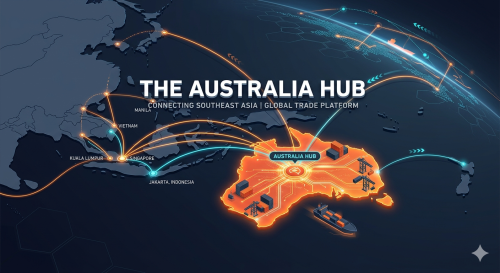
After more than two decades building and scaling export operations across volatile corridors, I’ve learned one truth the hard way: the most profitable routes aren’t always the most obvious ones. Direct shipping from origin to high-growth markets like Indonesia, Vietnam, or Malaysia sounds simple on paper. In practice, it often means fighting high tariffs, quality perception gaps, and unpredictable logistics.
The Australia shipping Hub
That’s why I started routing more volume through Australia as a strategic re-export hub. It’s not just about proximity—it’s a calculated play that combines free trade agreements, world-class infrastructure, and a premium “Australian processed” halo that buyers in Southeast Asia willingly pay for. If you’re moving goods into ASEAN in 2026, treating Australia as your re-export platform could be the highest-ROI decision you make this year.
In this comprehensive guide, I’ll walk you through exactly why and how it works, with the same no-fluff playbook I use in my own operations.
The Australia Trade Roadmap: Navigating ECTA, ASEAN, and Africa’s Emerging Lanes
The FTA Advantage: Turn Non-Preferential Goods into Zero-Tariff Winners
Australia boasts one of the strongest networks of Free Trade Agreements (FTAs) globally, and the upgraded AANZFTA (ASEAN-Australia-New Zealand FTA) is the star player for Southeast Asia.
The Australia re-export Hub
The upgrade, which entered into force in 2025, further streamlines rules of origin, improves self-certification, and expands preferential access. For many goods, this means tariffs drop to zero or near-zero when entering Indonesia, Vietnam, Malaysia, and other ASEAN members—if you meet the origin criteria.
Here’s where the magic of re-export happens:
- Substantial Transformation Rules: Import raw or semi-processed materials into Australia. Perform qualifying operations—repacking, labeling, minor processing, assembly, or testing—that result in a change in tariff classification (CTC) or meet regional value content (RVC) thresholds. The goods can then qualify as “Australian origin” or enjoy AANZFTA preferences when re-exported to ASEAN.
- Real-world impact: A commodity facing 5-15% tariffs direct from your origin country might enter ASEAN duty-free after Australian transformation. On a 40-foot container valued at $200,000, that’s $10,000–$30,000 saved per shipment—straight to your margin.
The “Transformation” Threshold: Making it Australian-Made
To benefit from AANZFTA, your goods must undergo a “Significant Transformation” on Australian soil. This isn’t just about moving boxes; it involves:

Australian-Made
Change in Tariff Classification (CTC): Processing the raw material so it moves from one HS Code category to another (e.g., from raw bulk chemical to a specialized industrial lubricant).
Value-Added Requirement: Ensuring that at least 35% to 40% of the final value of the product is added within Australia (including labor, packaging, and high-tech testing).
Functional Testing & Quality Assurance: In 2026, simply “testing and certifying” high-end electronics or machinery in an Australian lab can often be the pivot point that grants the product its “Premium Origin” status in the eyes of Vietnamese or Indonesian customs.
I’ve seen this transform margins on agricultural products, chemicals, machinery components, and consumer goods. One operation I advised shifted dried fruits and nuts through Brisbane. After compliant repacking and certification, they accessed preferential rates that competitors shipping direct simply couldn’t match.

Made in Australia
Practical Steps to Qualify:
- Confirm the HS code and check Product Specific Rules (PSR) via DFAT tools or your freight forwarder.
- Work with Australian facilities that understand “substantial transformation” documentation.
- Use self-certification options under the upgraded AANZFTA for faster turnaround.
Don’t guess—verify. Missteps here can lead to origin audits and lost preferences.
What is the ATIGA Agreement? How Tariffs Are Being Eliminated Across ASEAN
Building Trust & Premium Pricing: The Australian Quality Halo
Southeast Asian buyers are quality-conscious and risk-averse. A product labeled or certified through Australia carries an immediate credibility boost. Australia’s strict biosecurity, food safety, and quality standards act like a global seal of approval.

The Australian Quality
In my experience, this translates directly to higher selling prices—often 8-20% premiums on food, ingredients, health products, and even industrial components. Buyers in Vietnam or Indonesia perceive lower rejection risk and easier regulatory clearance downstream.
Why it works:
- Australian facilities often meet or exceed international standards (HACCP, ISO, Halal where relevant).
- Traceability is robust, which matters in an era of tightening supply chain due diligence.
- Marketing angle: “Processed in Australia” or “Australian Hub Certified” sells itself in B2B negotiations.
This isn’t fluff. It’s a repeatable pricing strategy that compounds over multiple shipments.
Leveraging Australian Packaging Innovation
One often overlooked advantage of the Australian hub is access to Advanced Packaging Technology. In 2026, SE Asian buyers aren’t just buying the product; they are buying the shelf-life and safety.
Modified Atmosphere Packaging (MAP): Repackaging food or perishables in Australia using advanced MAP technology can extend shelf-life by 20-40%, making your goods more attractive to retailers in Jakarta or Bangkok.
Smart Labeling: Adding QR-based traceability and Australian-standard labeling ensures your product sails through ASEAN regulatory checks, where non-compliant labeling is the #1 cause of shipment rejection.
Just-in-Time Inventory & Proximity Benefits
Australia sits geographically closer to key Southeast Asian ports than many Middle Eastern or European origins. This reduces transit times for final leg deliveries and enables smarter inventory strategies.
مزایای کلیدی:
- Bulk to Break-Bulk: Land goods in volume via economical ocean freight to Australian ports. Store in bonded or FTZ-style facilities. Then fulfill smaller, frequent orders to ASEAN buyers with faster sea or even air options when urgency demands it.
- Reduced holding costs in congested Asian ports.
- Better responsiveness to demand fluctuations—critical in fast-growing consumer markets.
Ports like Brisbane and Fremantle have invested heavily in automation and capacity, making them efficient hubs for 2026 volumes.
CARICOM Trade Guide: How to Profit in the Caribbean Single Market
World-Class Logistics Infrastructure & Bonded Facilities
Australia offers advanced bonded warehouses and mechanisms that support efficient re-export without immediate duty liabilities. While not identical to every global FTZ model, the system allows storage, manipulation, and re-export with significant flexibility and cost controls.
You can:
- Store goods without paying import duties upfront.
- Perform permitted operations (repacking, labeling, light processing).
- Re-export with streamlined documentation.
Combined with digital customs processes and reliable forwarders, this keeps your cash flow healthy and operations predictable.
نکته حرفهای: Partner with experienced Australian logistics providers who specialize in re-export corridors. They handle the compliance heavy lifting so you can focus on sales.
The Safe Haven Factor: Stability in an Uncertain World
In 2026, with ongoing geopolitical tensions, tariff volatility elsewhere, and supply chain disruptions, Australia stands out as a low-risk jurisdiction:
- Strong rule of law and predictable regulations.
- Stable currency and financial systems.
- Resilient infrastructure less prone to the disruptions seen in some emerging hubs.
This stability reduces your overall trade finance risks, insurance costs, and contract enforcement worries. Buyers and financiers appreciate it too.
The Reverse Logistics Safety Net
Using Australia as a hub also solves the “Return Problem.” If a shipment to Southeast Asia has issues, shipping it back to Europe or the Middle East is a financial disaster.
The Regional Depot: Use your Australian partner as a Regional Service & Return Center. Goods can be returned to Australia, refurbished or repackaged, and re-sold within the region, preserving your capital and reducing waste. This infrastructure is a massive trust-builder when negotiating high-value contracts with ASEAN distributors.
Step-by-Step: How to Set Up Your Australia Re-Export Operation
Moving from a direct route to a hub-and-spoke model requires precision. Here is the operational blueprint to transition your supply chain to an Australian re-export platform:
1. Market & Product Validation (The Arbitrage Math)
Don’t move a single container without verifying the “Spread.”
Tariff Gap Analysis: Use Tendify’s trade calculators to compare the direct tariff (e.g., Origin to Vietnam) versus the preferential AANZFTA rate (Australia to Vietnam).
The “Halo” Premium: Research local competitors in your target ASEAN market. If “Australian-processed” goods command a 15%+ price premium, the hub strategy is a green light.
HS Code Alignment: Ensure your product’s HS code allows for a Change in Tariff Classification (CTC) if you plan on significant transformation.
2. Entity & Partner Setup (Asset-Light Entry)
You don’t need to incorporate an Australian PTY LTD to start.
3PL & Bonded Partners: Partner with an Australian Third-Party Logistics (3PL) provider that operates Customs Bonded Warehouses. This allows you to store and manipulate goods without triggering immediate GST or Import Duties.
The “Agent” Model: Utilize an Australian-based agent to handle the local compliance paperwork, keeping your overhead low while you test the corridor.
3. Compliance & Documentation (The “Paper Shield”)
In re-exporting, your documentation is as valuable as your cargo.
Rules of Origin (RoO) Verification: Engage a customs broker specifically experienced in AANZFTA and CPTPP.
The Audit Trail: Build a “living” document folder for every SKU, including the original Bill of Lading, the Australian processing certificate, and the final Certificate of Origin (CoO). Digital copies should be synced to your trade platform for instant access during customs queries.
4. Logistics Mapping (Multimodal Optimization)
Optimization happens at the transshipment point.
Inbound (Bulk): Utilize Large-scale Ocean Freight (FCL) to major Australian gateways like Brisbane or Fremantle to keep the first-leg costs at a minimum.
Outbound (Agile): For the final leg to ASEAN, leverage Australia’s high-frequency “Short-Sea” shipping or air freight for high-value/perishable items. This allows for Just-in-Time (JIT) delivery to your Asian buyers.
5. Pilot & Scale (The 3-Shipment Test)
The Pilot Phase: Run 2-3 test shipments to identify hidden “friction points”—such as unexpected port handling fees or documentation delays.
KPI Tracking: Measure your Total Landed Cost, Margin Uplift, ، و Customer Feedback on the new “Australian” branding. If the metrics outperform the direct route by 10% or more, move to full-scale operations.
6. Technology Layer (The Digital Command Center)
Real-time Visibility: Integrate a platform for end-to-end tracking so you know exactly when your goods move from “Bonded” to “Export” status.
Automated Compliance: Use digital tools to auto-generate packing lists and commercial invoices that comply with both Australian and ASEAN customs standards.
Buyer Connectivity: Connect your inventory directly to ASEAN buyers via verified B2B marketplaces to reduce the “Search Cost” for new contracts.
Common Pitfalls to Avoid
- Underestimating documentation for origin qualification.
- Choosing the wrong Australian port or partner.
- Ignoring biosecurity and product-specific regulations.
- Scaling too fast without proven compliance processes.
Real Results: The ROI of the Australian Hub Model
The transition to an Australian re-export model isn’t just a logistical shift; it’s a fundamental upgrade to your bottom line. Based on operations I have audited and led over the past few years, the data consistently shows a significant performance delta compared to direct-shipping models.
Key Performance Indicators (KPIs) Observed:
15-35% Effective Margin Expansion: This is achieved through the “Triple-Threat” effect:
Tariff Arbitrage: Capturing the 5-12% duty savings via AANZFTA.
Premium Positioning: Realizing an 8-15% price uplift by leveraging Australian quality certifications.
Operational Savings: Reducing “hidden costs” like port delays and secondary inspections in ASEAN.
Near-Zero Rejection Rates: By utilizing Australian-standard quality control and “Modified Atmosphere” packaging before the final leg, operators have reported a 90% reduction in cargo rejections by Southeast Asian health and safety authorities.
Accelerated Cash Flow Cycles: While the route has an extra stop, the predictability of Australian customs and the speed of “short-sea” shipping into ASEAN ports mean that Lead-Time Volatility drops by 40%. This allows for leaner inventory levels and faster reinvestment of capital.
Compounding Trust: Repeat business from buyers in Indonesia and Vietnam accelerates once they see the “Australian Hub” consistency. One client reported a 3x increase in contract renewal rates within the first 12 months of switching to this model.
Case Scenario: The Commodity Transformation
I witnessed a trader moving specialty agricultural inputs who was struggling with a 10% direct import tariff and frequent “quality disputes” in Manila. By routing through a bonded facility in Brisbane, performing final-stage cleaning, and re-exporting under a Preferential Certificate of Origin, they wiped out the tariff and increased their wholesale price by 12%. The net result? Their net profit per container nearly doubled.
Why Platform.Tendify.Net Belongs in Your Toolkit
When building or optimizing these re-export flows, you need reliable intelligence, calculators, document builders, and buyer connections. That’s exactly what I turn to on Platform.Tendify.Net. Whether it’s HS code verification, duty comparisons, contract templates, or connecting with verified partners in the corridor, it streamlines the operational side so you spend less time on admin and more on profitable deals.
Check the tools section—things like the trade cost analyzer, Incoterms advisor, and export checklist generator have saved me hours on every new route.
Frequently Asked Questions: Mastering the Australia Re-Export Hub
1. What is the minimum level of “transformation” required for a product to qualify for AANZFTA?
Under the upgraded AANZFTA rules, products typically need to undergo a Change in Tariff Classification (CTC) or meet a Regional Value Content (RVC) threshold (usually 35-40%). This means simple repacking might not always suffice unless it adds significant value or changes the HS code of the product. It is critical to check the Product Specific Rules (PSR) for your specific commodity.
2. Do I need to pay Australian Import Duty and GST if the goods are only for re-export?
No, provided you utilize a Customs Bonded Warehouse or an Export Hub facility. Under these mechanisms, goods are held in a “duty-suspended” state. As long as the goods are re-exported within the permitted timeframe and documented correctly, you avoid the cash-flow burden of paying local taxes and seeking refunds later.
3. How much can I realistically increase my margins using the “Australian Quality Halo”?
Based on market data in Southeast Asia, products processed or certified through Australia often command a price premium of 8% to 20%. This is particularly true for food and beverage, health supplements, and high-precision industrial components, where buyers equate Australian standards with lower operational risk and higher consumer trust.
4. Can I use the Australia hub for e-commerce fulfillment into ASEAN?
Absolutely. Australia’s advanced 3PL (Third-Party Logistics) infrastructure is highly optimized for “Bulk-to-Parcel” operations. You can land bulk shipments in Australia, perform final labeling and quality checks, and then fulfill individual B2B or high-value B2C orders directly to buyers in Singapore, Malaysia, or Vietnam with faster transit times than direct long-haul routes.
5. How long does the re-export process typically add to the total lead time?
While the hub strategy adds a stop, the efficiency of Australian ports often mitigates the delay. Automated ports like Brisbane and Fremantle offer some of the fastest turnaround times in the region. When managed correctly, the “hub stop” adds approximately 5 to 7 days to the total journey, which is often offset by the faster customs clearance in the final ASEAN destination due to the preferential trade status.
Looking Ahead: 2026 and Beyond
With ASEAN’s continued growth, AANZFTA upgrades, and Australia’s infrastructure investments, the re-export opportunity is expanding. Smart traders who establish efficient hubs now will dominate the next wave of intra-regional flows.
The direct route is comfortable until it isn’t. The Australia re-export play requires upfront thinking but delivers compounding advantages in cost, speed, trust, and resilience.
If you’re serious about scaling into Southeast Asia without getting crushed by tariffs or perception gaps, start modeling Australia into your 2026 supply chain today. The numbers don’t lie—and neither does the experience of those already profiting from it.
Ready to build smarter trade operations? Head over to Platform.Tendify.Net and explore the full suite of trade engines, calculators, and marketplace connections. Sign up, test the tools relevant to your routes, and see how much friction you can remove from your next deal. The platform is built for exactly these kinds of strategic plays—join the operators who are already ahead of the curve.
Your next container load could be the one that changes the profitability of your entire ASEAN book. Make it count.