


وبلاگ
Maritime Risk Clauses: How to Avoid Costly Charterparty Disputes

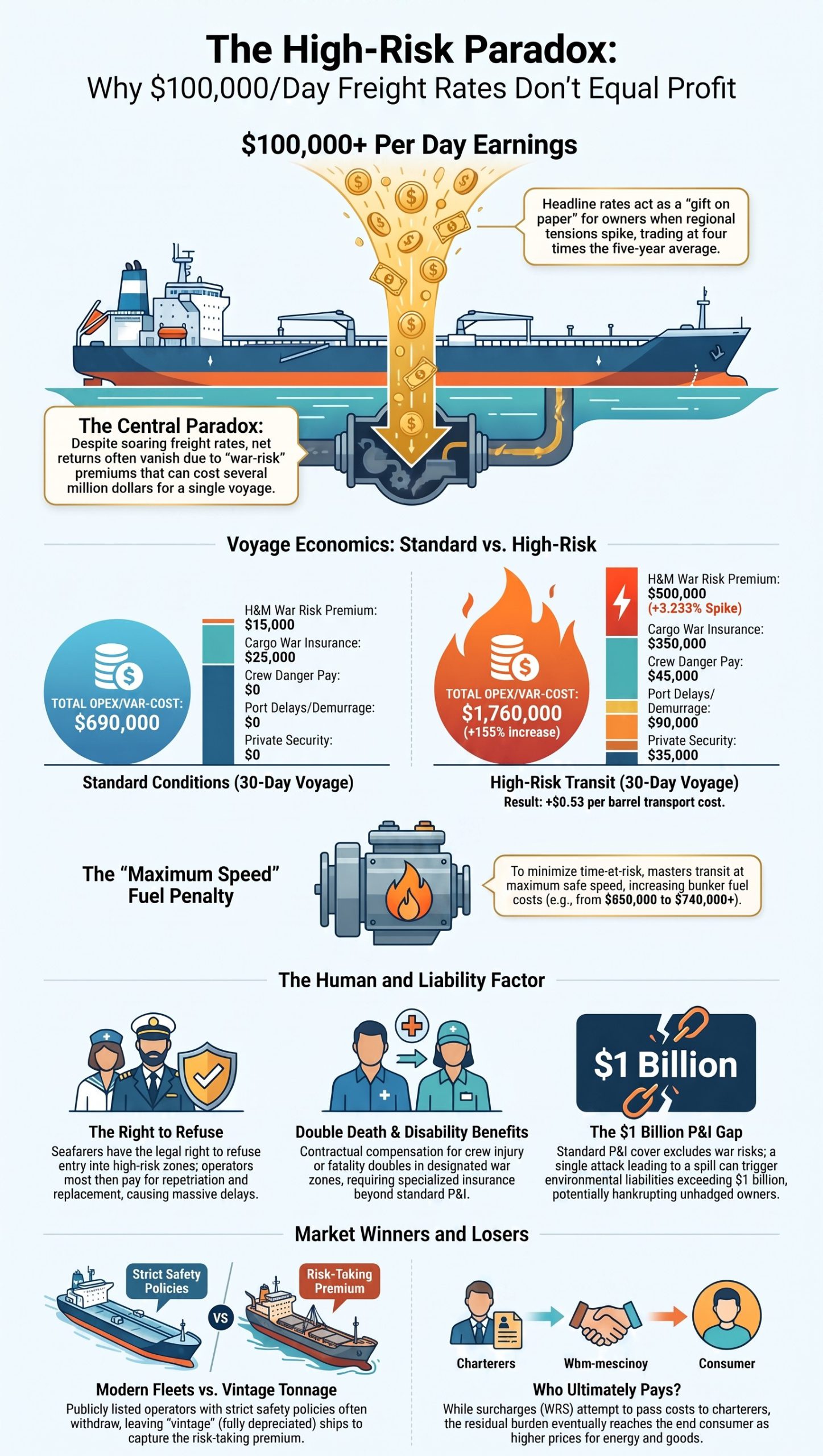
A VLCC loading in the Persian Gulf can post time-charter equivalent earnings above $100,000 per day when regional tensions spike. Spot freight on certain Gulf-to-Asia crude runs has traded four times the five-year average. On paper the numbers look like a gift. In practice a large share of that cash never reaches the owner’s bottom line.
The difference is war-risk insurance. Premiums that once sat near 0.25 percent of hull value have routinely moved into the 3–10 percent range for a single transit. For a $100–150 million tanker that single-voyage cover can cost several million dollars. Add elevated crew costs, higher bunker bills from maximum-speed transits, and the administrative friction of listed areas, and the apparent windfall shrinks or vanishes. This is the central paradox of high-risk Gulf shipping: headline freight rates soar while net returns for many operators remain constrained or even negative once every risk layer is priced.
Shipping has always been cyclical. Long-run industry data show average returns clustered around high single digits with volatility frequently exceeding 30–35 percent. Classical finance would label such an asset class unattractive for permanent capital. Yet capital continues to flow because the extremes create temporary, asymmetric opportunities. The current phase in the Strait of Hormuz and adjacent waters is one of those extremes. Understanding where the money actually goes, who captures residual profit, and how costs ultimately travel through the supply chain is essential for any company moving bulk, energy, or containerized goods through the region.
How War Risk Premiums Rewrite Voyage Economics
Standard hull and machinery cover excludes war, strikes, and related perils. Owners therefore buy separate war-risk cover, usually structured as an annual policy with the right for underwriters to reprice or cancel on short notice when a corridor is reclassified. The Joint War Committee’s listing of the Arabian Gulf and approaches triggers that mechanism almost immediately.
Shipping Economics High-Risk Paradox
Recent market data illustrate the scale. Pre-escalation levels around 0.25 percent of insured value have risen at peaks to 7.5–10 percent for Hormuz transits. Even after temporary de-escalations, rates have settled in ranges several times the peacetime baseline. A single VLCC transit can generate an additional insurance bill measured in millions of dollars. Container and product-tanker operators face similar step-ups, frequently expressed as per-TEU or per-voyage surcharges that carriers then attempt to recover.
These costs are not theoretical. Operators report that insurance and related risk charges have become the dominant variable expense on affected voyages, sometimes exceeding bunker costs. The old efficiency tools—slow steaming, weather routing optimization, just-in-time arrival—lose relevance. Masters are instructed to transit at maximum safe speed to minimize exposure time. Fuel consumption rises. The economic calculation shifts from minimizing operating expense to minimizing time-at-risk.
Surcharge mechanisms exist precisely for this situation. War risk surcharges, emergency contingency surcharges, and related emergency fuel adjustments appear on invoices. The legal and commercial question is allocation. Under most voyage charter parties the charterer bears the additional war-risk premium once the vessel is ordered into a listed area. Time-charter structures can differ. In practice the incidence depends on bargaining power, the exact wording of the charter, and the speed with which markets reprice. When capacity is tight and alternatives scarce, more of the cost sticks with the cargo interest. When spare tonnage exists or rerouting options improve, owners absorb a larger share.
VLCC Cost Structure Comparison: Normal vs. High-Risk Transit
The table below outlines a hypothetical cost breakdown for a 30-day voyage of a VLCC (Value: $100M, Cargo: 2,000,000 barrels of crude) transiting from the Persian Gulf to East Asia, contrasting standard conditions with a high-risk operational environment (7-day War Risk Area breach).
| Expense Category | Standard Conditions (USD) | High-Risk Transit (USD) | Cost Driver / Notes |
|---|---|---|---|
| H&M War Risk Premium | $15,000 | $500,000 | Spikes from annual base rate to 0.50% AP for a 7-day breach. |
| Cargo War Insurance | $25,000 | $350,000 | Based on cargo value of ~$140M (0.25% premium surcharge). |
| Crew Danger Pay (Bonus) | $0 | $45,000 | Mandatory 100% basic pay bonus for 7 days in ITF war zone. |
| Bunker Fuel (VLSFO / MGO) | $650,000 | $740,000 | Includes high-speed transit during breach and minor rerouting. |
| Port Delays / Demurrage | $0 | $90,000 | Estimated 2 days of security & convoy delays ($45k/day). |
| Private Maritime Security (PCASP) | $0 | $35,000 | Armed security team onboarding and specialized equipment. |
| TOTAL VOYAGE OPEX & VAR-COST | $690,000 | $1,760,000 | +155% Total Increase |
The Missing Layer: P&I Clubs and War Risk Liabilities
While soaring Hull & Machinery (H&M) premiums capture headlines, they only cover physical damage to the vessel. The secondary—and often far more catastrophic—financial exposure lies within third-party liabilities covered by Protection & Indemnity (P&I) Clubs.
Vintage Tonnage and the Risk-Taking Premium
Newbuilding prices for tankers and bulkers remain elevated. Ordering a modern VLCC or Suezmax at the top of the cycle locks in high capital cost for years. In contrast, older vessels—those whose book value has already been largely written down—offer a different risk-return profile. Their residual capital cost is low. If they can still obtain insurance and crew, every dollar of freight after variable costs is closer to pure contribution.
VLCC
Market behavior confirms the pattern. Larger, publicly listed operators with strict ESG and safety policies often reduce exposure or withdraw from the highest-risk legs. Smaller or more opportunistic owners, frequently operating older tonnage, step in. They accept higher war-risk premiums and potential reputational exposure in exchange for multi-fold freight rates. Some owners simply sell the vessel at the elevated second-hand values that risk periods produce—an asset play timed to the peak—and exit the trade altogether.
This is not new. Shipping history is littered with periods when older, fully depreciated ships earned outsized returns precisely because modern fleets stayed away. The current environment in the Gulf corridor repeats the pattern. The owners capturing the residual profit after insurance are often those whose balance sheets already treated the hull as a sunk cost.
Crew Danger Pay & The Human Factor in High-Risk Transit
Behind insurance figures lies a critical operational hurdle: the crew. When corridors are designated as High-Risk Areas (HRAs) or War Operations Areas by bodies like the International Transport Workers’ Federation (ITF) and the International Maritime Employers’ Council (IMEC), human resource costs rise exponentially.
Operational Bottlenecks
Demurrage, Port Diversions & Friction Expenses
Beyond direct war-risk premiums and elevated crew wages, high-risk transits trigger a cascade of secondary operational frictions. These logistical disruptions severely erode charterers’ margins and distort supply chain timelines.
Financial Case Study
Comparative Voyage Cost Model: Standard vs. High-Risk Transit
To illustrate the financial gravity of operating in high-risk zones, the table below compares a baseline 30-day voyage for a VLCC (Very Large Crude Carrier – $100M insured hull value, carrying 2M barrels of crude) against the same voyage during heightened regional tension.
| عنصر هزینه | Baseline Voyage (Standard Risk) | High-Risk Corridor Voyage | Impact / Variance |
|---|---|---|---|
| Hull & Machinery (H&M) War Premium | $15,000 (0.015% Annual base) | $500,000 (0.50% 7-day breach) | +3233% |
| Crew Hazard Bonus (Danger Pay) | $0 (Standard wage) | $45,000 (+100% basic pay / 7 days) | +$45,000 |
| Bunker Fuel & Routing Deviations | $650,000 (Direct passage) | $780,000 (Speed alteration/minor rerouting) | +20% |
| Port Delays & Demurrage (2 Days) | $0 (On schedule) | $90,000 ($45,000/day delay rate) | +$90,000 |
| Armed Guards / Security Protocols | $0 | $35,000 (3-4 man security team) | +$35,000 |
| Total Variable Voyage Cost | $665,000 | $1,450,000 | +118% Increase |
Who Ultimately Pays: Surcharges, Contracts, and the Final Consumer
Emergency and war-risk surcharges are designed to allocate incremental cost along the contractual chain. In theory the mechanism works. In practice the ability to pass costs depends on three factors: contract rigidity, market power, and the elasticity of final demand.
Long-term supply contracts with fixed pricing or limited escalation clauses leave the seller or the logistics provider absorbing the spike until the next renegotiation window. Spot cargoes and shorter-term arrangements reprice faster. Large energy traders and commodity houses with strong balance sheets and diversified sourcing can absorb temporary hits and later recover through wider margins. Smaller industrial buyers or retailers further down the chain often lack that flexibility.
Empirical observation from recent disruptions shows the cost rarely stops at the first or second tier. Elevated freight and insurance feed into CIF prices. Refiners, manufacturers, and distributors adjust selling prices where competitive conditions allow. Where competition is intense or contracts are sticky, margins compress and the cost is shared. Over successive cycles the residual burden reaches the end consumer in the form of higher delivered prices for energy, petrochemicals, metals, and manufactured goods that rely on Gulf-origin or Gulf-transiting cargoes.
The alternative—systematic avoidance of the Strait—adds its own costs. Longer routes increase ton-mile demand, raise bunker consumption, and reduce effective fleet productivity. Those costs also appear in freight rates and, eventually, in landed prices. There is no free option. The choice is between paying the risk premium to keep the shorter route open or paying the distance and time premium of avoidance.
The Invisible Landed Cost: Marine Cargo War Risk Premiums
While vessel owners manage hull and freight risk, cargo owners (shippers and charterers) face an equally direct margin compression through Marine Cargo War Risk Insurance. Standard marine cargo policies automatically exclude war, strike, and terrorism risks in listed JWLA corridors, forcing cargo interests to purchase specialized add-ons or absorb carrier-imposed surcharges.
Practical Steps for Cargo Interests and Operators
Companies that move goods through or from the region can reduce exposure with disciplined process rather than perfect foresight.
First, map every active contract for war-risk and emergency surcharge clauses. Identify which party bears the cost under different trigger conditions and the notice periods required. Where gaps exist, negotiate clearer allocation language at the next renewal.
Second, treat insurance as a live input rather than a fixed overhead. Maintain relationships with specialist brokers who can provide real-time indications for specific vessels and routes. Build contingency budgets that assume elevated premiums for a defined period rather than hoping for rapid normalization.
Third, diversify routing and inventory buffers where commercially feasible. Holding modest additional stock or qualifying alternative supply origins reduces the pure leverage of any single chokepoint. The carrying cost of inventory is measurable; the cost of a multi-week disruption is often larger.
Fourth, evaluate counterparty risk carefully. Operators willing to accept higher war-risk exposure may offer attractive freight, but their insurance capacity, P&I club standing, and crew management quality matter. A vessel that cannot obtain cover or whose crew refuses the voyage is of little use.
Platforms that aggregate verified carrier and service-provider options can shorten the search for suitable capacity under stress. One such resource is available at Platform.Tendify.Net for operators seeking structured visibility into available tonnage and service terms.
Structural Implications for Cross-Border Supply Chains
Repeated activation of war-risk pricing in the Gulf and adjacent corridors is changing baseline assumptions. Underwriters have indicated that a sustained period of incident-free transits—measured in years rather than weeks—is required before premiums fully revert. Some market participants now treat a higher structural risk premium as the new normal for certain energy and container lanes.
This has second-order effects. Inventory strategies shift from pure just-in-time toward more resilient positioning. Financing costs rise because lenders and insurers price the elevated operational risk. Trade finance documentation increasingly requires explicit war-risk cover evidence. For companies whose supply chains depend on Gulf energy, petrochemicals, or intermediate goods, the cost of capital and working-capital intensity both increase.
At the same time, the volatility creates selective opportunity. Owners with fully depreciated tonnage, flexible insurance arrangements, and operational discipline can generate returns that more than compensate for the risk during the elevated phase. Traders with strong balance sheets can arbitrage temporary dislocations in regional product balances. The key is recognizing that the headline freight rate is only the starting point of the calculation.
Closing the Loop on Risk Allocation
The question posed by current conditions is straightforward: can surcharges and contractual mechanisms fully internalize the regional risk premium, or does residual cost inevitably migrate to the final consumer? Experience across successive disruptions shows partial recovery through surcharges is achievable when markets are tight and contracts allow. Full insulation of any single party is rare. Over the full cycle the delivered cost of goods that transit high-risk corridors rises. That increase is the market’s way of pricing the probability of interruption.
Operators and cargo interests that treat war-risk cost as a permanent planning variable rather than a temporary anomaly will make better capital and inventory decisions. Those who continue to budget on peacetime assumptions will face repeated margin shocks.
Strategic Takeaway: The Mastered Cost Stack
The Strait of Hormuz will remain a critical artery for global energy and maritime trades. The paradox of high freight rates existing alongside disappearing margins is not an anomaly; it is the direct expression of how operational risk is priced when a strategic chokepoint becomes contested.

