


Blog
BCL vs LC vs SBLC: The Real Difference Every Trader Must Know
Understanding BCL, RWA, POF, LC, and SBLC: A Complete Guide to Financial Instruments in International Commodity Trade
In international commodity trading, especially for bulk shipments of oil, grains, metals, fertilizers, and other raw materials, financial instruments play a critical role in building trust between buyers and sellers before a formal contract is signed. Among the most frequently requested documents are BCL (Bank Comfort Letter), RWA (Ready, Willing and Able), POF (Proof of Funds), LC (Letter of Credit), and SBLC (Standby Letter of Credit). Understanding the precise nature, legal weight, and practical use of each instrument is essential for both buyers and sellers to manage risk effectively and avoid costly misunderstandings.
Financial Instruments in International Commodity Trade
This comprehensive guide explains each instrument in clear, practical terms, highlights their differences, and shows how they fit into the standard sequence of international trade documentation. The focus is on helping traders, compliance officers, and corporate treasury teams make informed decisions while operating within established banking and trade finance rules.
Important Note: None of the “soft” instruments (BCL, RWA, POF) constitute a payment guarantee or create a legally binding obligation on the issuing bank. They serve only as preliminary comfort or evidence of financial capacity.
What is a BCL – Bank Comfort Letter?
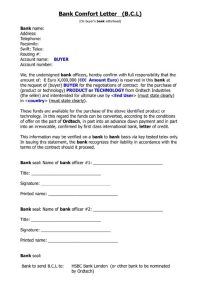
A Bank Comfort Letter (BCL), also known as Bank Confirmation Letter or Bank Capability Letter, is a soft financial instrument issued by the buyer’s bank to provide initial assurance to the seller in international commodity trading.
Typically transmitted via SWIFT MT799, a BCL confirms three key points without creating any payment obligation:
- The buyer maintains an account with the issuing bank
- The account has been maintained in a satisfactory manner
- The buyer has sufficient funds or credit lines to support a transaction of the indicated approximate value
Important: A BCL is not legally binding and does not guarantee payment or performance. It only serves as preliminary comfort that the buyer is serious and financially capable.
Real BCL vs Fake BCL: How to Spot Scams in Commodity Trade
In high-value deals involving oil, grains, metals, or fertilizers, fake or non-verifiable BCLs are common. Always verify authenticity through official banking channels. Legitimate BCLs come from reputable Tier-1 or well-known banks and avoid overly promotional language.
Typical Use: Requested after LOI/ICPO but before Full Corporate Offer (FCO).
For traders operating in complex or sanctioned environments, understanding when a BCL is sufficient versus when a harder instrument is required can prevent costly delays.
What is a BCL – Bank Comfort Letter?
For a broader understanding of financial instruments used in high-risk trade corridors, see our guide on Post-Traditional Sanctions Financial Mechanisms: Strategic Integration with CBDCs and Single-Window Platforms for Compliant Regional Settlements.
Key Differences Between BCL and RWA in Practice
In international commodity trading, many sellers now prefer an RWA over a standard BCL because it carries a stronger tone of commitment. While a BCL mainly confirms the buyer’s banking relationship and general financial standing, an RWA explicitly states that the buyer is “Ready, Willing and Able” to proceed with the specific transaction, including approximate quantity and value.
Both are transmitted via SWIFT MT799 and remain soft instruments with no legal payment obligation. However, an RWA often signals higher seriousness and can help move the deal forward faster in competitive commodity markets such as oil, grains, or fertilizers.
- BCL: Focuses on banking relationship and capacity
- RWA: References the actual deal and buyer’s intent
Pro Tip for Traders: Always request the SWIFT message number and verify authenticity through official banking channels to reduce the risk of fraudulent soft instruments.
What is RWA – Ready, Willing and Able?
RWA (Ready, Willing and Able) is a slightly stronger variation of a Bank Comfort Letter (BCL). While a standard BCL speaks generally about the buyer’s financial standing, an RWA explicitly states that the buyer is “ready, willing, and able” to proceed with a specific commodity transaction, often mentioning product type, approximate quantity, and value.
Like BCL, RWAs are sent via SWIFT MT799 and remain a soft instrument — they create no binding obligation on the bank.
Key Advantage over BCL: Because it references a particular deal, many sellers view RWA as carrying higher seriousness and intent.
When to Use RWA in Commodity Trading
RWAs are commonly requested in mid-to-large volume deals (e.g., petroleum, grains, fertilizers) where the seller needs clearer confirmation of buyer capacity before investing time and resources in preparing a formal offer.

What is RWA – Ready, Willing and Able?
POF – Proof of Funds in International Trade
Proof of Funds (POF) is not a single document but a general requirement where the seller asks the buyer to demonstrate sufficient financial resources to complete the transaction.
A well-drafted BCL or RWA issued via SWIFT MT799 is often accepted as credible POF. Other acceptable forms include recent certified bank statements or controlled MT799 messages.
Strong vs Weak POF: What Sellers Actually Accept
- Strong POF: SWIFT MT799 BCL/RWA from reputable international banks
- Medium POF: Certified bank statements or audited financials
- Weak POF: Simple screenshots, buyer-declared letters, or documents from unknown offshore banks
In serious commodity trading, experienced sellers rarely accept weak POF and will insist on moving directly to hard instruments like LC or SBLC before shipment.
Common Forms of Proof of Funds (POF) and Their Strength Ranking
When a seller requests POF in commodity trade, the strength of the evidence matters significantly. Not all POFs are equal.
| Type of POF | Strength Level | Notes |
|---|---|---|
| SWIFT MT799 BCL / RWA | Strong | Bank-issued, verifiable |
| Recent Certified Bank Statement | Medium | Shows balance but not intent |
| Buyer’s Own Letter | Weak | Not recommended for large deals |
In serious commodity trade finance, a well-drafted BCL or RWA via SWIFT is usually accepted as the strongest form of POF.
LC vs SBLC: The Hard Financial Instruments in Commodity Trade
Unlike soft instruments (BCL, RWA, POF), Letter of Credit (LC) and Standby Letter of Credit (SBLC) are hard instruments that create a legally binding payment obligation on the issuing bank.
Documentary Letter of Credit (LC / DLC)
A Documentary Letter of Credit is the most secure and widely used payment method in international commodity trading. The buyer’s bank irrevocably undertakes to pay the seller upon presentation of compliant documents (invoice, bill of lading, certificate of origin, etc.).
LCs are primarily governed by UCP 600 rules published by the ICC.
Standby Letter of Credit (SBLC)
A Standby Letter of Credit (SBLC) functions as a bank guarantee or safety net. It is typically used as backup payment security. The seller can draw on the SBLC by presenting a simple demand statement if the buyer fails to pay under the main contract.
SBLCs are most commonly governed by ISP98 (International Standby Practices), though UCP 600 can sometimes apply.
Common Types of Documentary Letters of Credit (LC)
Understanding the different types of Letter of Credit helps traders choose the right instrument for their commodity transaction:
- Sight LC: Payment is made immediately upon presentation of compliant documents (most common in spot commodity trades).
- Usance / Deferred Payment LC: Payment occurs at a future date (30, 60, 90 or 180 days), giving the buyer time to resell the goods.
- Transferable LC: Allows the first beneficiary (often a trader) to transfer all or part of the credit to their supplier.
- Revolving LC: Automatically renews for multiple shipments without issuing a new LC each time – ideal for ongoing supply contracts.
All LCs are governed by UCP 600 rules issued by the International Chamber of Commerce (ICC). Sellers should also pay attention to ISBP 745 for examination of documents to minimize discrepancy risks.
Key Differences: LC vs SBLC
| Feature | Documentary LC | Standby LC (SBLC) |
|---|---|---|
| Primary Function | Payment mechanism for the actual transaction | Backup guarantee / performance security |
| Trigger for Payment | Compliant shipping and commercial documents | Proof of buyer’s default (simple demand usually sufficient) |
| Usage in Commodity Trade | Main payment method (oil, grains, metals) | Performance or financial guarantee |
| Risk for Seller | Low if documents comply | Only drawable upon default |
SBLC is often governed by ISP98 or UCP 600 and acts as a safety net, while a standard LC is the primary payment tool.
Key Differences: LC vs SBLC (2026 Guide)
| Feature | Documentary LC | Standby LC (SBLC) |
|---|---|---|
| Purpose | Primary payment mechanism | Backup guarantee / safety net |
| Trigger | Presentation of compliant documents | Buyer default or non-performance |
| Governing Rules | UCP 600 | ISP98 (preferred) or UCP 600 |
| Usage Frequency | Regular trade transactions | Only in case of default |
Typical Costs (2026 estimates): LC issuance/confirmation fees usually range 0.5%–2% depending on tenor, country risk, and bank. SBLC fees are often 1%–3% per annum.
BCL vs RWA vs POF vs LC vs SBLC: Complete Comparison Table
Understanding the differences at a glance helps traders choose the right instrument for each stage of the deal.
| Instrument | Type | Binding? | Legal Basis | Risk Level for Seller | Typical Stage |
|---|---|---|---|---|---|
| BCL | Soft | No | None | High | Early comfort |
| RWA | Soft | No | None | Medium-High | Pre-offer |
| POF | Soft | Varies | Varies | High | Financial proof |
| LC (Documentary) | Hard | Yes | UCP 600 | Low | Payment security |
| SBLC | Hard | Yes | ISP98 | Low | Performance / backup |
The Standard Sequence in Commodity Trading
In large commodity transactions, documents usually follow this logical sequence:
- LOI or ICPO from the buyer
- BCL or RWA from the buyer’s bank
- FCO (Full Corporate Offer) from the seller
- Negotiation and signing of the sales contract
- Issuance of LC or SBLC as payment security
Understanding this sequence helps both buyers and sellers manage expectations and reduce the risk of misunderstandings or fraudulent proposals.
Best Practices for Buyers and Sellers
For Buyers:
- Work only with reputable banks when requesting BCL or RWA
- Be precise about the transaction details to avoid ambiguity
- Understand that BCL/RWA do not guarantee the seller will accept your offer
For Sellers:
- Always verify the authenticity of BCL/RWA through official banking channels
- Never ship goods or incur significant costs based solely on soft instruments
- Insist on proper LC or SBLC before commencing shipment
Both parties benefit from working with experienced trade finance advisors and using clear, standardized documentation procedures.
Common Risks and How to Mitigate Them
Even experienced traders face risks with financial instruments in commodity trade:
- Fraudulent soft instruments (fake BCL/RWA) – Always verify via SWIFT and bank-to-bank channels.
- Document discrepancies in LC – Up to 70% of first presentations are rejected; work with experienced document checkers.
- Country and bank risk – Consider confirmed LC or SBLC from a top-tier bank when dealing with high-risk jurisdictions.
Engaging a professional trade finance advisor early in the process significantly reduces these risks.
Conclusion
BCL, RWA, POF, LC, and SBLC each serve distinct purposes in international commodity trade. Soft instruments (BCL/RWA/POF) provide initial comfort and evidence of financial capacity, while hard instruments (LC/SBLC) create binding payment obligations. Understanding the differences and proper sequence of these documents is essential for conducting secure, professional, and efficient international trade.
By using these instruments correctly and insisting on proper verification and escalation procedures, both buyers and sellers can significantly reduce risk and build sustainable trading relationships in the global commodity markets.

