


Blog
Procurement Management Guide: Mastering Direct, Indirect, OPEX & CAPEX
I’ve spent years building and scaling operations in competitive global markets, where one weak link in the supply chain could halt production or drain cash reserves overnight. Procurement management isn’t just “buying stuff.” It’s the strategic heartbeat of any organization—balancing immediate needs with long-term growth while juggling competing priorities across departments.

Procurement Management
Whether you’re running a manufacturing plant, scaling a trading business, or optimizing a distribution network, understanding the four core types of purchasing—direct, indirect, OPEX, and CAPEX—is non-negotiable. Get any one wrong, and the entire operation suffers. Nail them all, and you unlock efficiency, cost savings, and competitive advantage.
In this comprehensive guide, we’ll break down exactly what each category means, why the distinctions matter, real-world challenges, actionable strategies, and how to build a procurement system that actually drives results. By the end, you’ll have a clear framework to assess your own operations and start making smarter decisions today.
The Asset-Light Trader: How the Gig Economy is Rewriting Global Trade
What Is Procurement Management, Really?
Procurement management is the end-to-end process of acquiring goods, services, and works needed to keep your business running and growing. It goes far beyond issuing purchase orders. It involves supplier selection, negotiation, risk management, compliance, cost control, and continuous improvement.

Types of Purchasing
At its core, it’s about aligning spending with business objectives. In today’s volatile environment—marked by supply disruptions, inflation pressures, and rapid technological change—effective procurement can be the difference between thriving and merely surviving.
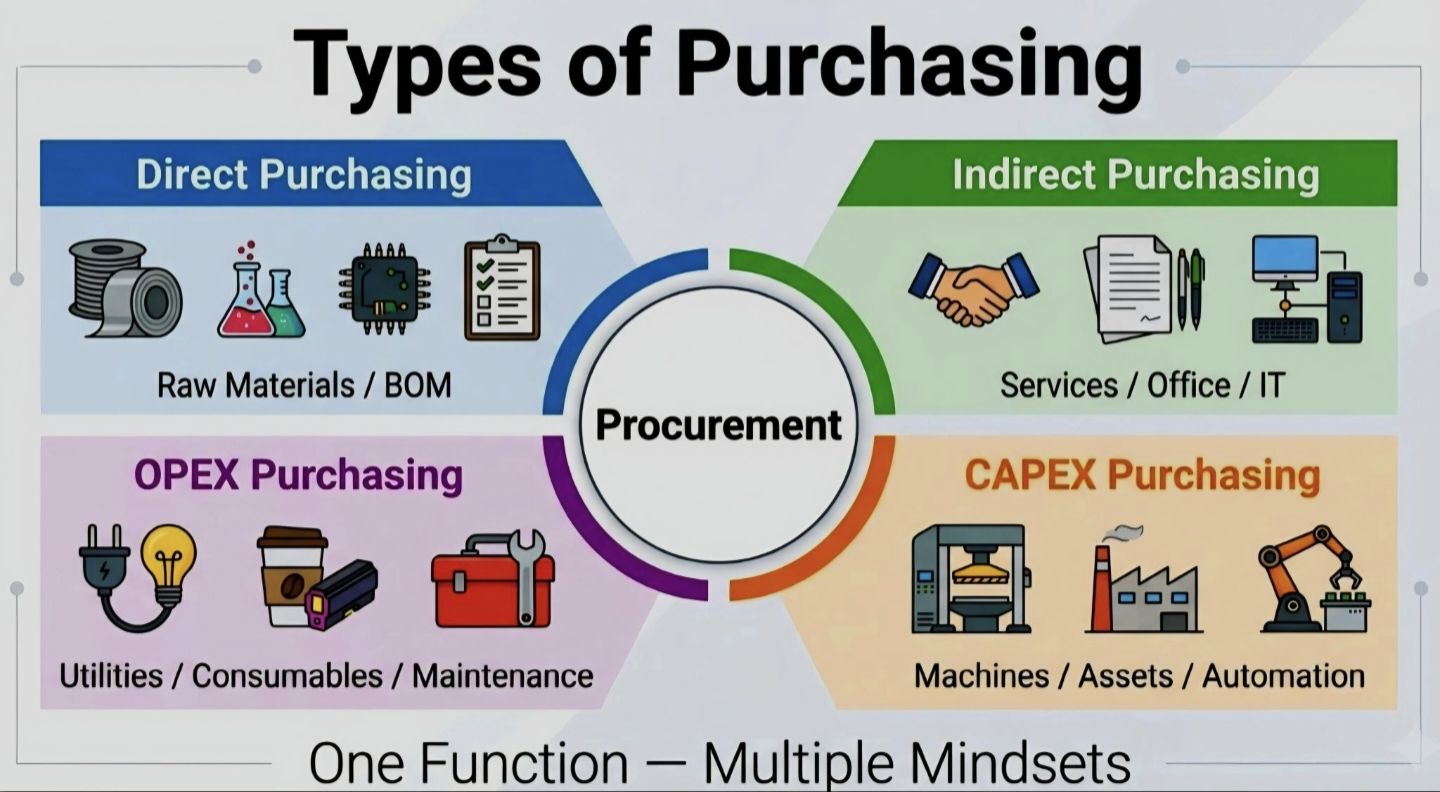
The image many of us have seen (and the one that sparked this discussion) captures it perfectly: procurement sits at the center, with four quadrants representing distinct mindsets and priorities. One function, multiple mindsets. Let’s dive into each.
🌐 Cross-Border & Regional Logistics Realities
While discussing procurement in the abstract is useful, real-world supply chains operate under intense geopolitical and regulatory pressures. In high-growth trade corridors across the GCC, MENA, and ECO regions, procurement management faces a completely different layer of complexity: navigating shifting customs regulations, volatile transit hubs, and sudden corridor disruptions.
💡 The International Procurement Shift
When sourcing internationally, your purchasing types change shape. For Direct Procurement, locking down unit prices is no longer enough—securing tier-one freight forwarding and establishing robust compliance buffers are absolute non-negotiables to protect your assembly lines and continuous distribution networks from costly border delays.
1. Direct Purchasing: Fueling the Core of Production
Direct purchasing involves acquiring raw materials, components, and items that go straight into your finished products or services. Think Bill of Materials (BOM) items like steel coils for manufacturing, chemicals for processing, or semiconductors for electronics.

Direct Purchasing
This is the “make-or-break” category. Delays or quality issues here directly impact your ability to produce and deliver to customers. It’s high-volume, often high-value, and tightly tied to production schedules.
Why Direct Purchasing Demands Precision
- Volume and Predictability: Demand is driven by sales forecasts and production plans.
- Supplier Dependency: Fewer, strategic suppliers mean deeper relationships but higher risk if one fails.
- Cost Sensitivity: Even small price fluctuations can erode margins significantly.
🏭 Heavy-Duty Trade Example: Bulk Commodities
In large-scale trade, direct purchasing involves bulk commodities like bitumen, cement, or grain wheat. For an infrastructure developer, securing an exclusive, long-term allocation with a reliable refinery or milling complex isn’t just about unit price—it prevents catastrophic downstream halts. A single supply gap or off-specification batch can freeze multi-million dollar construction projects, trigger severe contractual penalties, and permanently damage sovereign-level trade relationships.
🧠 2026 Shift: AI-Driven Predictive Analytics
In 2026, relying on manual demand forecasting or legacy spreadsheets in Direct Purchasing is an operational liability. Advanced predictive analytics and machine learning models have officially replaced reactive planning. By processing thousands of global variables simultaneously—including real-time shipping data, macroeconomic indicators, weather anomalies, and historical consumption patterns—AI allows procurement teams to accurately anticipate market tightening and supply chain bottlenecks weeks before they manifest. Moving from a reactive posture to predictive purchasing ensures your production lines never run dry.
Actionable Strategies for Direct Procurement Excellence
- Implement Supplier Scorecards: Track on-time delivery, quality, and responsiveness. Review quarterly.
- Adopt Just-in-Time (JIT) with Buffers: Balance lean inventory with strategic safety stocks for critical items.
- Leverage Long-Term Contracts with Flexibility: Include escalation clauses for raw material price changes.
- Use Digital Forecasting Tools: Integrate ERP systems with market data for better demand planning.
- Diversify Strategically: Maintain primary and secondary suppliers without overcomplicating the supply base.
Focus here on total cost of ownership (TCO), not just unit price. A slightly higher-priced supplier with superior reliability often saves money overall.
2. Indirect Purchasing: The Invisible Backbone of Operations
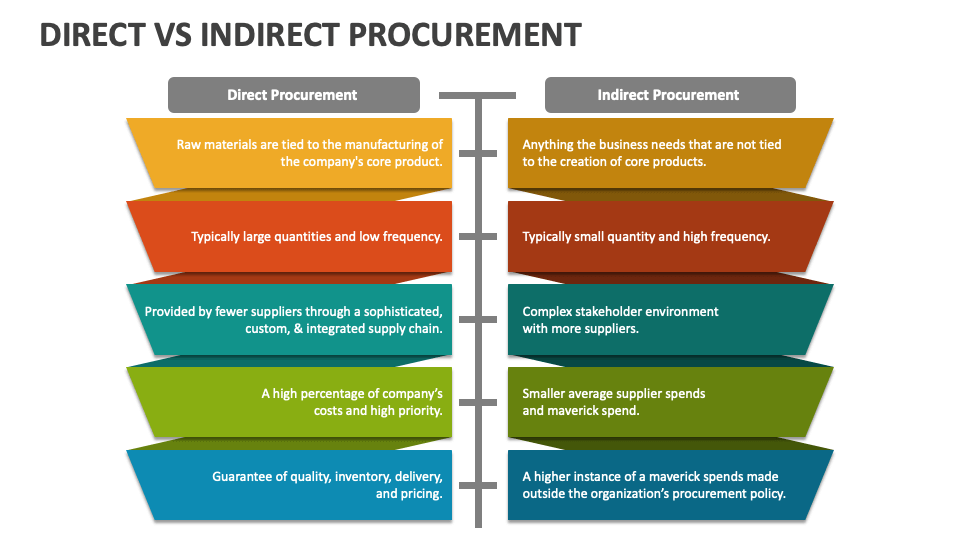
Indirect purchasing covers everything that supports the business but doesn’t go directly into the product—office supplies, IT services, marketing tools, facility management, and professional services.
Direct VS Indirect Procurement
This category is often decentralized, spread across departments, and managed with less rigor than direct spend. That’s a mistake. While individual purchases may seem small, they add up to massive leakage.
Key Characteristics and Challenges
- Fragmentation: Many stakeholders, many suppliers, maverick buying (unauthorized purchases).
- Lower Visibility: Harder to track and control.
- Opportunity for Savings: Studies show organizations can reduce indirect spend by 20-35% with better management.
Common Pitfalls: Employees ordering premium software subscriptions they don’t fully utilize, or multiple departments buying the same office equipment from different vendors at varying rates.
Best Practices to Tame Indirect Spend
- Centralize Where Possible: Use procurement policies and approved vendor lists.
- Implement E-Procurement Platforms: Make compliant buying the easiest option.
- Conduct Spend Analysis: Categorize and identify consolidation opportunities.
- Negotiate Enterprise Agreements: For software, travel, or facilities services.
- Regular Audits: Review usage and eliminate waste.
In a global trade context, indirect procurement might include logistics software, compliance consulting, or exhibition services—areas where tools like those on Platform.Tendify.Net can streamline vendor discovery and contract management.
3. OPEX Purchasing: Keeping the Lights On Day-to-Day
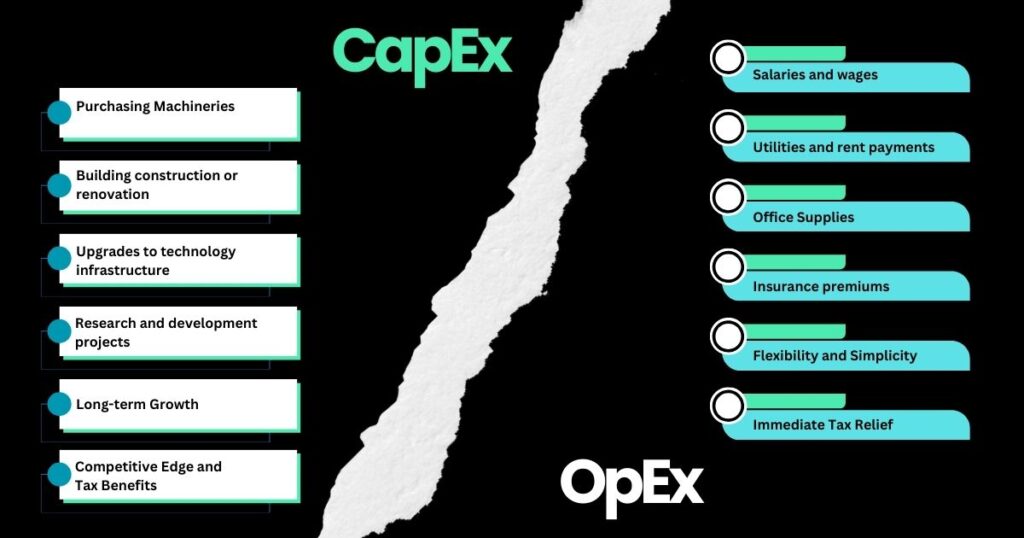
OPEX (Operating Expenses) refers to recurring costs needed to run the business daily: utilities, consumables, maintenance, repairs, and routine services.
CapEx vs. OpEx
These are expensed immediately in the income statement. The goal is efficiency and predictability.
OPEX Mindset: Optimization Over Innovation
- Predictable but Variable: Energy costs fluctuate; maintenance needs arise unexpectedly.
- High Frequency: Many small transactions.
- Impact on Cash Flow: Poor management ties up working capital.
Examples from the visual: power plugs and utilities, coffee supplies, toolkits for maintenance.
Strategies:
- Energy Audits and Contracts: Lock in favorable utility rates.
- Preventive Maintenance Programs: Reduce breakdowns and emergency repairs.
- Inventory Management for Consumables: Avoid overstocking or stockouts.
- Vendor Consolidation: One supplier for janitorial and office consumables.
Track metrics like cost per unit produced or maintenance cost as a percentage of asset value.
4. CAPEX Purchasing: Investing in Future Capacity
CAPEX (Capital Expenditures) involves acquiring long-term assets like machinery, equipment, buildings, or automation systems. These are capitalized on the balance sheet and depreciated over time.
This is strategic spending for growth, efficiency, or competitive edge. Decisions here have multi-year implications.
📈 Strategic CAPEX Example: Regional Expansion
Consider a trading and logistics firm expanding its footprint to align with major macroeconomic initiatives like the Dubai Economic Agenda (D33). Here, Capital Expenditure (CAPEX) transcends simple asset buying. It involves high-stakes investments in automated industrial robotics for cross-border fulfillment, heavy-duty transit fleets, and specialized laboratory testing equipment to guarantee strict regional quality compliance. These are multi-year financial commitments that permanently reshape an enterprise’s competitive capacity.
Proven CAPEX Procurement Framework
- Needs Assessment: Align with strategic business plans.
- Detailed Specifications: Involve technical experts early.
- Rigorous Vendor Evaluation: RFPs, site visits, reference checks.
- Total Cost of Ownership Analysis: Include installation, training, maintenance, and disposal.
- Financing Options: Leasing vs. buying, government incentives.
- Post-Purchase Review: Measure actual vs. projected performance.
In 2026, with automation accelerating, CAPEX decisions increasingly involve AI integration and sustainability features.
💳 Modern Trade Settlement & Financial Tech
Managing risk in international procurement involves more than just hedging against currency fluctuations; it requires rethinking how transactions are secured. Traditional trade finance, heavily reliant on slow and paperwork-intensive legacy Letters of Credit (LCs), is shifting rapidly to accommodate the speed of global trade.
🚀 The Evolution of Secure Sourcing
When handling high-stakes Direct and CAPEX procurement, forward-thinking operations are moving beyond traditional methods toward digital escrow systems, smart contracts, and secure B2B marketplace transaction layers. These advanced fintech solutions protect both buyers and suppliers by tying automated, multi-tiered disbursements directly to verifiable shipping and customs milestones.
Comparing the Four: A Quick Reference Table
| Aspect | Direct | Indirect | OPEX | CAPEX |
|---|---|---|---|---|
| Purpose | Production inputs | Business support | Daily operations | Long-term assets |
| Frequency | High/Recurring | Variable | High/Recurring | Infrequent |
| Risk Level | High (supply disruption) | Medium | Medium | High (investment) |
| Approval | Operational | Often Decentralized | Routine | Executive/Board |
| Metrics | On-time delivery, quality | Savings %, compliance | Cost per unit | ROI, Payback period |
Integrating the Four Pillars: Building a World-Class Procurement Function
The real power comes from treating these as interconnected parts of one system:
- Technology Enablement: Centralized platforms for visibility, automation, and analytics.
- Cross-Functional Collaboration: Procurement shouldn’t operate in a silo.
- Risk Management: Supplier diversification, contract clauses for force majeure, compliance with international standards.
- Sustainability Integration: Evaluate suppliers on ESG criteria across all categories.
- Performance Measurement: KPIs like savings achieved, supplier performance, cycle times.
Case Study Insight: Companies that excel here often see 10-20% overall cost reductions while improving resilience. One manufacturer I observed shifted indirect and OPEX to a centralized model, freeing capital for strategic CAPEX investments that boosted output by 30%.
Common Challenges and How to Overcome Them
- Maverick Spending: Enforce policies with user-friendly tools.
- Supplier Risk: Regular audits and contingency planning.
- Data Silos: Invest in integrated systems.
- Talent Gaps: Train teams on strategic sourcing, not just transactional buying.
⚠️ Global Complexities, Sanctions & Rigid Compliance
Navigating cross-border procurement within the GCC, MENA, and ECO corridors requires managing strict regulatory frameworks, international sanctions, and complex compliance layers. To successfully mitigate high-stakes risks in Direct Purchasing, strict validation of trade documentation—such as verified Certificates of Origin—is vital. Furthermore, integrating independent, third-party inspection protocols (like SGS or Intertek) directly into your procurement workflow is non-negotiable. This guarantees quality compliance, ensures legal transparency, and protects your entire enterprise from severe operational and financial penalties before cargo ever clears port.
The Future of Procurement Management
In 2026 and beyond, AI-driven predictive analytics, blockchain for traceability, and digital marketplaces are transforming the field. Procurement leaders who embrace data and technology while maintaining human judgment on relationships will dominate.
Platform.Tendify.Net offers practical utilities—from tariff calculators to contract builders and market explorers—that can support your team in managing these purchasing types more effectively, especially in cross-border scenarios. Checking it out could reveal quick wins for your specific challenges.
❓ Frequently Asked Questions (FAQ)
What is the main difference between OPEX and CAPEX in procurement?
OPEX (Operating Expenses) covers short-term, recurring costs required for day-to-day business operations, such as utilities and consumables. CAPEX (Capital Expenditures) involves long-term investments in high-value physical assets, like industrial machinery or automation robotics, which are capitalized on the balance sheet and depreciated over time.
Why is Direct Procurement considered high-risk in international trade?
Direct procurement deals with core raw materials and bulk commodities (like bitumen or grain wheat) essential for production. In international trade, it is highly sensitive to cross-border logistics, customs delays, and geopolitical shifts. Any single supply gap here instantly halts production, causing immense downstream financial and contractual losses.
Maverick spending (unauthorized or decentralized buying) can be controlled by centralizing operations, implementing strict approved-vendor lists (AVLs), and deploying user-friendly e-procurement platforms. Making compliant buying the easiest path for employees drastically eliminates rogue expenditures.
Modern B2B fintech solutions replace slow, paper-heavy traditional Letters of Credit with digital escrow and automated smart contracts. These systems mitigate risk by securely holding funds and releasing them dynamically only when verifiable shipping, customs verification, or quality compliance milestones are met.
Taking Action: Assess Your Procurement Maturity Today
Start by mapping your current spends into these four categories. Identify your biggest pain point. Is it raw material volatility (Direct)? Uncontrolled software subscriptions (Indirect)? Rising utility bills (OPEX)? Or stalled equipment upgrades (CAPEX)?
Prioritize one area, implement two or three strategies from this guide, and measure results in 90 days. Small, consistent improvements compound into massive gains.
Procurement isn’t a cost center—it’s a profit driver and strategic enabler. Master these four mindsets, and you’ll position your business for sustainable success no matter what the market throws at it.
Ready to streamline your global procurement and trade operations? Head to Platform.Tendify.Net to explore tools and resources designed for real-world traders and procurement teams. Sign up today and start turning insights into measurable results. Your next competitive edge is just a few clicks away.

