


Blog
Red Sea Security: How the Makkah Pact Impacts B2B Landed Costs & Logistics
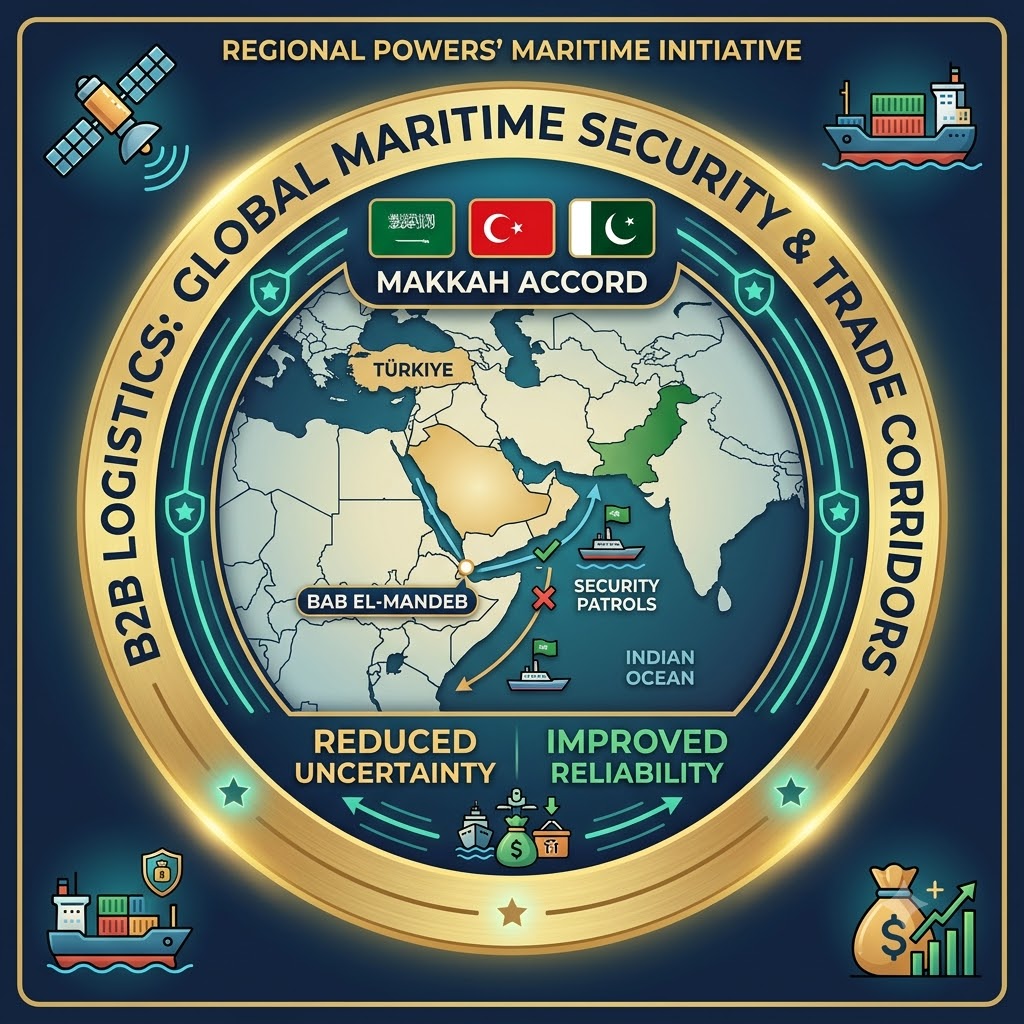
When three major regional powers formalize a collective-defence commitment, the immediate headlines focus on military posture. For B2B operators moving containers, bulk liquids, and project cargo through the Red Sea and Bab el-Mandeb, the real question is narrower and more urgent: what does this do to transit times, war-risk premiums, insurance availability, and the reliability of the maritime corridors that feed Gulf ports?
The Makkah Joint Defence Agreement, signed in August 2026 by Saudi Arabia, Türkiye, and Pakistan, establishes that an armed attack on any one of the three states is to be treated as an attack on all. Officials have consistently described the arrangement as purely defensive and open to additional participants that share its principles. For traders, the practical value lies less in the collective-defence clause itself and more in the secondary effects on maritime domain awareness, naval coordination, and the commercial risk pricing that follows.
At a Glance: Geopolitical Impact & B2B Logistics Action Plan
| Geopolitical Risk Factor | Logistics & Supply Chain Impact | Actionable Step on Tendify |
|---|---|---|
| Makkah Joint Defence PactSaudi-Türkiye-Pakistan security coordination in the Red Sea & Bab el-Mandeb. | Short-term escalation spikes war-risk insurance; long-term deterrence stabilizes transit schedules and lowers premiums. | Audit Landed Costs:Use Tendify Tariff & Duty Calculators to recalculate CIF/DDP buffers under fluctuating war-risk surcharges. |
| Cape Diversions & Chokepoint BottlenecksVessels avoiding Red Sea face 10–14 days extra transit around Africa. | Spot freight spikes, container equipment dislocation in Asia, and severe capital lockup in floating inventory. | Standardize Trade Terms:Utilize Tendify Contract & Proforma Builders to update Incoterms, demurrage, and Force Majeure clauses. |
| Overland Landbridge ExpansionGCC bonded trucking corridors (Oman/UAE to KSA) and Türkiye-GCC road connections. | Provides a resilient multimodal alternative to ocean freight for time-critical and high-value project cargo. | Verify HS & Compliance:Leverage Tendify HS Classification tools to ensure seamless overland customs clearing across GCC borders. |
Maritime Security and the Cost of Moving Goods Through Critical Chokepoints
Bab el-Mandeb and the southern Red Sea remain among the highest-sensitivity segments in global liner and bulk trades. Disruptions in these waters quickly translate into higher war-risk premiums, longer routings via the Cape, and elevated fuel and time costs that feed directly into CIF and DDP pricing.
Enhanced coordination among the three signatories offers complementary capabilities that matter for commercial shipping:
- Türkiye brings advanced unmanned systems, electronic-warfare platforms, and a growing surface fleet experienced in eastern Mediterranean and Black Sea operations.
- Pakistan contributes naval manpower, operational experience in the northern Arabian Sea, and established logistics relationships with Gulf partners.
- Saudi Arabia provides coastal infrastructure, port access, and the financial depth required to sustain longer-duration maritime presence.
When these assets operate with improved information-sharing and joint tasking, the effect on commercial operators is measurable in reduced uncertainty. Underwriters respond to lower perceived attack frequency and higher response capacity by adjusting premiums. Even modest declines in war-risk rates compound across high-volume trades—refined products, containers, project cargo for infrastructure programs, and agricultural bulk.
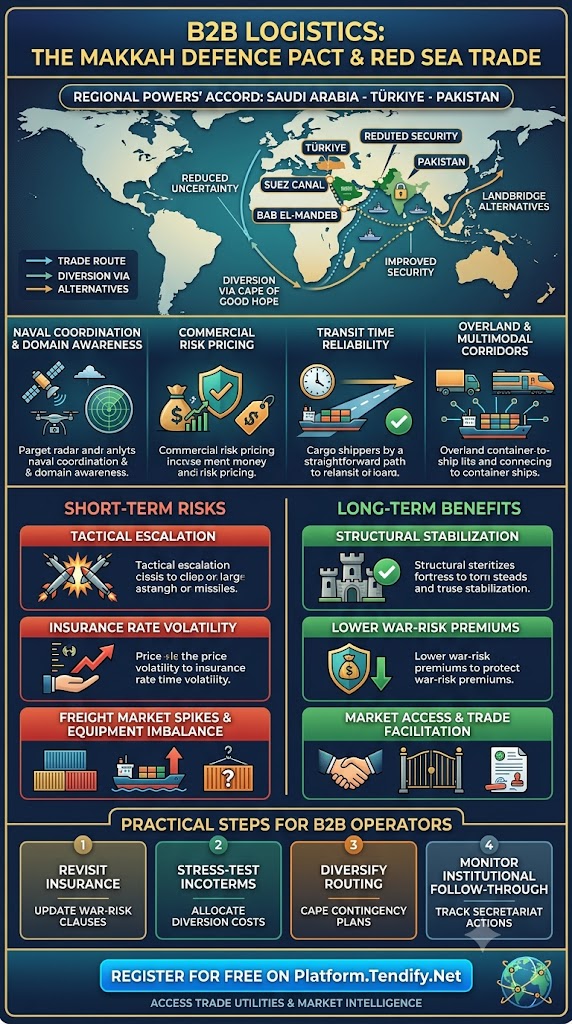
Makkah Defence Pact
Operational assessments of similar coordination arrangements show that improved maritime domain awareness and predictable response protocols reduce the frequency of prolonged diversions. For GCC importers and regional exporters, that translates into more stable inventory planning and fewer force-majeure claims.
Flag-State Hierarchy in Naval Coverage & Convoy Support
A critical operational distinction for B2B logistics operators lies in naval protection priority. Direct escort protocols, close-range anti-drone coverage, and active convoy scheduling under the Makkah framework primarily prioritize flagged vessels or beneficially owned assets of Saudi Arabia, Türkiye, and Pakistan.
- General Maritime Area Security: Third-party foreign-flagged liners (e.g., Panama, Liberia, Marshall Islands flags) benefit indirectly from broader corridor surveillance, ocean patrol density, and shared threat intelligence.
- Direct Protection Gaps: Cargo shipped via independent regional feeder networks or non-signatory mainlines may not receive dedicated naval escorting. Logistics managers using multi-carrier feeder strategies must verify whether their specific vessel operators maintain formal security coordination agreements with GCC or joint task force command units.
Direct Implications for GCC Import and Export Cost Structures
Supply-chain cost models for Gulf buyers and sellers already incorporate multiple layers of risk pricing. The Makkah framework intersects those models at several points.
War-risk insurance and hull & machinery rates. Premiums for Red Sea and Bab el-Mandeb transits remain sensitive to incident frequency and perceived naval coverage. Greater visible presence and faster coordination among the three partners can compress the risk premium over successive underwriting cycles. Traders operating on thin margins—especially those moving mid-value manufactured goods or time-sensitive project components—feel these changes first.
Short-Term Friction: Tactical Escalation vs. Long-Term Stabilization
Commercial traders must avoid assuming a linear or immediate drop in transit risk following security pacts. In the immediate operational window (3–6 weeks post-deployment), the visible military presence of Türkiye and Pakistan may trigger retaliatory signaling and asymmetric testing from Ansar Allah (Houthi) forces.
- Phase 1 (Short-Term Flare-Up): Initial friction and heighten threat perceptions can prompt insurance committees to briefly increase war-risk premiums or broaden Joint War Committee (JWC) listed areas, temporarily raising voyage costs for GCC-bound assets.
- Phase 2 (Structural Stabilization): Premium rates will only begin their downward trajectory once joint patrol protocols demonstrate sustained deterrence and reduce successful incident rates over consecutive underwriting cycles.
Transit-time reliability. Diversions around the Cape add 10–14 days and substantial bunker costs. When the primary corridor regains predictability, the opportunity cost of capital tied up in floating inventory declines. For high-volume commodity flows and just-in-time manufacturing inputs, the difference is material.
Incoterms allocation of risk. Under FOB, CFR, or CIF terms, the party bearing transit risk has strong incentive to monitor corridor security. Clearer collective naval posture reduces the ambiguity that previously forced buyers or sellers to over-insure or build large contingency buffers into landed-cost calculations.
Fuel and operational overhead. Extended routing increases bunker consumption and crew costs. Restoring confidence in the shorter route improves the competitiveness of Gulf-origin and Gulf-destined cargo relative to longer alternative corridors.
Spot Freight Volatility and Regional Equipment Imbalance
Beyond direct war-risk surcharges and bunker fuel consumption, corridor instability profoundly impacts container line network economics. Long-term vessel diversions around the Cape of Good Hope tie up global container capacity, driving spot freight rate spikes and structural equipment shortages across Asian and Gulf origin ports.
- Container Dislocation & Shortages: Extended voyage loops delay empty container returns to major manufacturing hubs in Asia and Türkiye, forcing carriers to implement Peak Season Surcharges (PSS) and Container Equipment Imbalance Surcharges.
- Ocean Freight vs. Security Premium: Even if naval coordination under the Makkah framework successfully lowers war-risk insurance premiums, overall ocean freight rates will remain elevated until regular liner schedules through Suez and Bab el-Mandeb are fully restored.
- Action for Logistics Planners: Importers should negotiate equipment release guarantees and extended free-time allowances (demurrage/detention) with carriers rather than focusing solely on base spot freight rates.
These effects are not automatic. They depend on the actual operationalization of joint maritime tasking, information-sharing protocols, and sustained presence. Early institutional steps—establishment of a secretariat and formation of political-military coordination mechanisms—signal intent to move beyond political declaration into executable arrangements.
Potential Spillovers into Trade Facilitation and Market Access
Defence cooperation frequently creates institutional pathways that later support commercial facilitation. The three partners already maintain layered economic relationships: energy and investment flows between Saudi Arabia and Pakistan, defence-industrial and infrastructure links between Türkiye and Gulf states, and expanding logistics connectivity across the northern Arabian Sea and eastern Mediterranean.
A durable security arrangement can lower the political risk premium that previously constrained deeper economic integration. Practical outcomes worth monitoring include:
- Accelerated progress on bilateral or trilateral trade facilitation measures, including simplified customs procedures and mutual recognition of standards for priority product groups.
- Expanded use of preferential logistics corridors or priority berthing arrangements for vessels flagged or owned by the three partners.
- Greater willingness among regional banks and trade-finance providers to underwrite longer-tenor instruments for intra-bloc trade once political and security risk is perceived as more manageable.
- Joint investment in dual-use maritime infrastructure—port security systems, vessel-traffic management, and coastal surveillance—that simultaneously serves defence and commercial efficiency goals.
None of these outcomes is guaranteed by the defence text alone. They require deliberate parallel commercial diplomacy. Traders and logistics managers should treat the security agreement as a necessary but not sufficient condition for improved market access and lower friction costs.
The UAE Pivot: Maritime Ambitions, Transshipment Hubs, and Strategic Hedging
Any commercial analysis of Red Sea security is incomplete without accounting for the United Arab Emirates. While not a signatory to the Makkah defense framework, the UAE remains a central force in Southern Arabian maritime security and Arabian Sea transshipment logistics.
- Influence over Southern Yemen Ports: Through its political and maritime ties in Southern Yemen (Sokotra, Aden, and Mukalla), the UAE maintains a distinct security footprint at the entrance of the Bab el-Mandeb, independent of the Saudi-led framework.
- Transshipment Safeguards (Jebel Ali & Fujairah): UAE ports serve as primary safe harbors for ocean carriers avoiding deep Red Sea transits. Commercial operators frequently leverage Fujairah (bunkering) and Jebel Ali (bonded warehousing) as clearing hubs before deploying feeder lines or overland routes into the GCC.
- Strategic Hedging: Traders should monitor whether Abu Dhabi aligns its naval tasking with the Makkah bloc or maintains parallel maritime security initiatives. A coordinated approach between the UAE, Saudi Arabia, and Türkiye would significantly increase the reliability of Arabian Sea-to-Red Sea feeder services.
Emerging Landbridge Alternatives and Overland Transit Logistics
While joint naval taskforces aim to secure maritime passages, resilient B2B supply chain strategies increasingly leverage overland trade corridors to bypass the Bab el-Mandeb chokepoint altogether during high-risk periods.
- GCC Coastal Landbridge (Oman/UAE Ports to Saudi Arabia & Beyond): Discharging cargo at Eastern Arabian Sea ports (e.g., Sohar, Salalah, or Jebel Ali) and utilizing bonded overland trucking across Saudi highways cuts transit risk while avoiding Red Sea entry.
- Türkiye-GCC Overland Connections: The defense and economic alignment between Ankara and Riyadh accelerates road/rail customs integration, enabling direct cross-border freight movements from Southeastern Europe and Türkiye into the Arabian Peninsula.
- Multimodal Cost-Benefit Balance: While road freight carries a premium compared to ocean maritime tariffs, the savings in war-risk premiums, 10–14 days shorter transit relative to the Cape route, and reduced capital lockup make overland options highly viable for time-critical project cargo.
Practical Steps for B2B Operators and Logistics Managers
Operators cannot control geopolitical developments, but they can adjust contracting, routing, and risk-management practices in response.
- Revisit war-risk clauses and insurance programs. Engage underwriters early on any observed changes in naval posture or incident frequency. Request updated premium indications tied to specific voyage windows rather than blanket annual rates.
- Stress-test Incoterms and force-majeure language. Ensure contracts clearly allocate diversion costs, demurrage arising from security delays, and the right to re-route. Ambiguous clauses become expensive when corridors become contested.
- Diversify routing options without abandoning the primary corridor. Maintain Cape contingency plans while continuing to book Red Sea capacity. The goal is optionality, not permanent diversion.
- Strengthen supplier and buyer communication protocols. Real-time visibility into vessel positions, security advisories, and alternative port options reduces the information asymmetry that amplifies commercial disputes.
- Monitor institutional follow-through. Track whether the secretariat and joint committees produce concrete maritime coordination mechanisms. Declarations matter less than sustained operational presence and information-sharing.
Tools that improve HS classification accuracy, duty estimation, and end-to-end cost modeling become more valuable when corridor risk is in flux. Platforms that consolidate trade-utility functions—tariff calculators, documentation generators, and market-intelligence modules—help operators convert geopolitical uncertainty into quantified commercial decisions. One such operational environment is available at Platform.Tendify.Net for teams that need consolidated visibility across documentation, cost, and compliance workflows.
Longer-Term Structural Effects on Regional Logistics Architecture
Over a multi-year horizon, sustained collective maritime capacity can influence the competitive positioning of Gulf ports and free zones. Ports that sit behind more reliable approaches gain relative advantage in attracting mainline services and transshipment volume. Free-zone operators and logistics parks that can demonstrate lower disruption risk become more attractive for inventory positioning and light manufacturing.
At the same time, the agreement may encourage greater intra-regional inventory buffering and near-shoring of certain intermediate goods. When transit risk is elevated, the economic case for holding safety stock closer to end markets strengthens. This dynamic supports demand for modern warehousing, bonded facilities, and multimodal connectivity inside the GCC and adjacent markets.
For exporters targeting Gulf buyers, the implication is clear: reliability of delivery windows and transparency of landed cost become differentiating factors. Buyers under pressure to protect production schedules will preferentially source from suppliers who can demonstrate robust contingency planning and accurate risk pricing.
Balancing Opportunity and Residual Risk
No security arrangement eliminates risk. Residual threats to commercial shipping persist from non-state actors, asymmetric capabilities, and the inherent complexity of congested chokepoints. The value of the Makkah framework for traders lies in its potential to raise the cost and reduce the frequency of successful disruption, not in guaranteeing uninterrupted passage.
Commercial operators who treat the agreement as a binary “safe or unsafe” signal will misprice risk. Those who treat it as one additional variable in a dynamic risk model—alongside underwriting cycles, fuel prices, port congestion, and geopolitical signaling—will make better decisions on routing, insurance, and contracting.
The most useful posture is continuous monitoring paired with contractual flexibility. When naval coordination improves and incident rates decline, capture the benefit through lower premiums and tighter delivery commitments. When conditions deteriorate, activate pre-negotiated diversion and cost-allocation mechanisms without delay.
Bunker Fuel Crisis 2026: How Rising Shipping Costs Threaten B2B Margins
Frequently Asked Questions (FAQ)
What is Total Landed Cost and why is it critical for GCC trade?
Total Landed Cost includes the purchase price of goods, freight, insurance, customs duties, GCC VAT, port handling fees, and inland transportation. Accurate calculation prevents unexpected margin erosion when shipping into GCC and MENA markets.
How does Platform.Tendify.Net help optimize cross-border logistics?
Platform.Tendify.Net provides a consolidated environment featuring trade utilities, tariff schedules, customs duty calculators, and documentation tools. It allows traders to model landed costs and compliance requirements across various regional corridors without using multiple fragmented systems.
Are the trade utilities on Tendify suitable for both SMEs and enterprise traders?
Yes. The platform is designed to scale—offering intuitive tools for small-to-medium enterprise (SME) exporters needing quick documentation and tariff checks, as well as structured data modeling for larger logistics and procurement teams.
How do I get started with Tendify trade utilities?
You can create a free account at tendify.net/my-account to access operational utilities, custom tools, and market visibility features immediately.
Positioning Your Trade Operations for Corridor Uncertainty
Cross-border trade through the Red Sea and adjacent waters will continue to reward operators who combine operational agility with disciplined risk quantification. The Makkah Joint Defence Agreement introduces a new institutional layer into an already complex security environment. Its commercial significance will be determined less by the text of the collective-defence clause and more by the sustained operational choices the three partners make in the months ahead.
Optimize Your Gulf Trade Logistics & Landed Cost Modeling
Teams that maintain clear visibility into total landed cost, maintain flexible contractual terms, and stay current on corridor risk indicators will be better positioned to protect margins and delivery reliability.
For those seeking a consolidated environment to model duties, documentation requirements, and logistics scenarios across GCC and broader MENA markets, the suite of trade utilities and intelligence tools at Platform.Tendify.Net offers practical support without requiring multiple fragmented systems.
“Secure, efficient trade depends on accurate information, disciplined contracting, and the ability to adapt when conditions change.”

