


Blog
Islamic Trade Finance: A Guide for GCC SMEs
Cross-border trade in the GCC continues to expand rapidly, driven by diversification initiatives, infrastructure megaprojects, and growing SME participation in regional supply chains. Yet many small and medium-sized enterprises face persistent barriers when seeking conventional financing. Religious considerations, regulatory preferences, and a preference for asset-backed structures lead a significant portion of businesses—particularly in Saudi Arabia and Oman—to favor Sharia-compliant solutions. These mechanisms align ethical principles with operational needs, enabling SMEs to finance imports, exports, inventory, and working capital without interest-based structures.

Islamic Trade Finance
This guide examines the core mechanisms of Islamic trade finance active in the GCC today. It outlines how they function in practice, their advantages for regional traders, implementation steps, and strategic considerations for 2026 and beyond. Operational insights from market evaluations show these tools reduce certain risks while supporting compliance and long-term partnerships.
Why Sharia-Compliant Trade Finance Matters for GCC SMEs
Islamic finance assets in the Middle East demonstrate strong momentum, with Saudi Arabia holding a dominant share. Vision 2030 initiatives amplify demand for structures that fund non-oil sectors, SMEs, and cross-border activity. In Oman, similar emphasis on economic diversification and SME empowerment drives adoption of compliant instruments.
Key drivers include:
- Regulatory and cultural alignment: Many SMEs and family businesses prioritize structures vetted by Sharia boards, especially in sectors like manufacturing, logistics, agriculture, and construction materials.
- Risk-sharing and asset-backing: Unlike debt with fixed interest, these tools tie returns to real economic activity, often requiring banks or financiers to assume ownership risk temporarily.
- Access for underserved segments: Traditional collateral or credit history requirements can exclude growing SMEs. Islamic products frequently emphasize asset or transaction backing.
- Cross-border efficiency: Instruments like syndicated Murabaha facilitate regional and international deals while maintaining compliance.
Evaluations of regional operations indicate that businesses using these mechanisms often report smoother approvals in faith-sensitive markets and better alignment with buyer expectations in GCC supply chains.
Suriname Trade Guide: Logistics, Oil & Gas, and Strategic Exports
Core Sharia-Compliant Instruments for Trade Finance
1. Murabaha (Cost-Plus Financing)
Murabaha remains the workhorse of Islamic trade finance in the GCC. The financier purchases the required goods (machinery, raw materials, commodities) on behalf of the client, takes ownership and possession, then sells them at an agreed markup for deferred payment. The profit margin is disclosed upfront.

Murabaha (Cost-Plus Financing)
Practical application in trade:
- Importer needs steel or packaging materials: Bank buys from supplier, sells to importer with markup payable in installments.
- Exporter financing working capital for fulfillment.
- Cross-border variants support letters of credit where the bank acts as principal in the purchase.
Advantages:
- Fixed, transparent cost provides payment certainty—critical for budgeting in volatile commodity trades.
- Asset-backed nature reduces pure credit risk for the financier.
- Widely accepted and scalable for both small shipments and larger syndicated facilities.
Implementation steps:
- Client submits purchase order and supplier details.
- Financier verifies goods, pricing, and Sharia compliance.
- Purchase executed; title transfers.
- Sale agreement signed with markup and repayment schedule.
- Goods delivered; client makes scheduled payments.
In Saudi Arabia and Oman, banks integrate Murabaha with digital platforms for faster processing, especially for repeat traders.
Cost Structure Analysis: Murabaha vs. Conventional Finance
To address the common market perception that Sharia-compliant financing carries higher costs, the table below breaks down how a Murabaha markup fundamentally differs from conventional interest-based mechanisms for SME traders.
| Feature | Murabaha (Cost-Plus) | Conventional Trade Finance |
|---|---|---|
| Pricing Mechanism | Fixed profit markup disclosed upfront based on the actual asset cost. | Interest rate charged on the principal loan amount over time. |
| Volatility Risk | Zero Risk. The markup is completely locked at contract signing and cannot change, protecting margins. | Subject to market rate fluctuations (e.g., SOFR or SAIBOR shifts) if structured as floating rates. |
| Late Payment Penalties | No compounding interest. Flat administrative fees or pre-agreed charity donations only; prevents debt spirals. | Compounding interest and compounding late fees accumulate dynamically over time. |
| Hidden Fees | None. Strict Sharia compliance mandates absolute transparency of all embedded costs. | Potential maintenance, utilization, or processing fees added over the cycle. |
Note: While the initial Murabaha markup might occasionally mirror conventional baseline rates, its fixed, non-compounding nature offers superior long-term budgeting safety for cross-border B2B supply chains.
Bridging the Gap: How Islamic Letters of Credit (LCs) Work in Cross-Border Trade
While conventional trade relies heavily on interest-bearing credit lines for Letters of Credit, Sharia-compliant trade finance utilizes specialized asset-backed or agency structures. In the GCC corridors—especially between Saudi Arabia, Oman, and global hubs—two dominant frameworks govern Islamic LCs: Murabaha LC and Wakalah LC.
1. Murabaha LC (The Two-Contract Model)
In this structure, the issuing bank does not merely extend credit; it acts as the principal buyer. The bank opens the LC to purchase the goods from the foreign supplier. Once the shipping documents clear customs and the bank takes constructive possession of the cargo, a second contract is executed: the bank sells the goods to the SME importer at a cost-plus profit rate (deferred payment terms).
2. Wakalah LC (The Agency Model – Most Common for SMEs)
Under a Wakalah framework, the SME appoints the bank as its agent (Wakeel) to open the LC, manage compliance, and clear the transaction using the bank’s capital pool. The bank charges a predetermined, flat agency fee (Ujrah) for its operational services rather than a markup on the goods. This provides maximum flexibility for multi-commodity trades where fast customs clearance is non-negotiable.
The Operational Customs & Banking Workflow:
- Application & Agency Appointment: The SME applies for the LC. In a Wakalah model, an agency agreement is signed defining the exact specifications of the import cargo.
- LC Issuance & Supplier Notification: The GCC issuing bank transmits the Sharia-compliant LC via SWIFT to the exporter’s advising bank. The supplier ships the goods based on these terms.
- Document Presentation & Constructive Possession: The shipping documents (Bill of Lading, Certificate of Origin, Commercial Invoice) are presented to the issuing bank. Legally, the bank takes “constructive possession” of the cargo while it is still on the water or at the port.
- Customs Clearance & Title Transfer: The bank issues an endorsement or delivery order. The SME acts as the bank’s agent at the port (e.g., King Abdulaziz Port or Port of Salalah) to clear customs. Simultaneously, the title of ownership officially transfers to the SME.
- Deferred Settlement: The supplier is paid at sight by the bank, while the SME settles its balance with the issuing bank over an agreed 30, 60, or 90-day cycle using local currency pairs (SAR/OMR/AED).
2. Musawamah (Negotiated Sale)
Similar to Murabaha but without mandatory disclosure of the financier’s cost. Parties negotiate the final selling price directly. This flexibility suits complex or time-sensitive deals where exact cost breakdown is impractical.
Core Sharia-Compliant Instruments for Trade Finance
When to use:
- Spot purchases of variable-priced commodities.
- Situations requiring quicker negotiation without full cost transparency.
Musawamah offers greater commercial pragmatism while retaining core Sharia principles of genuine sale and risk transfer.
3. Mudarabah and Musharakah (Partnership and Profit-Sharing)
These equity-like structures embody risk-sharing:
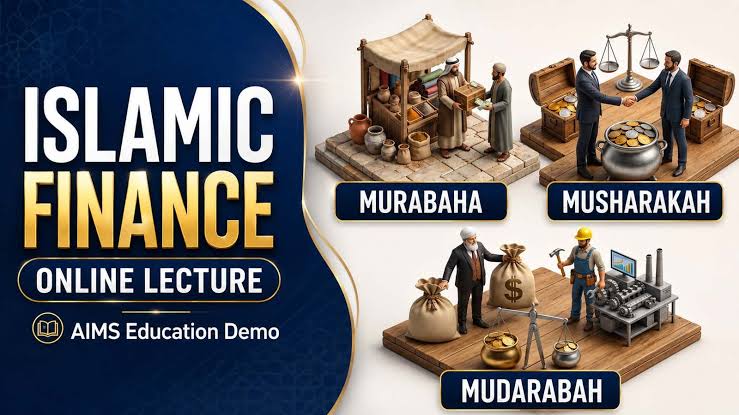
- Mudarabah: Financier provides capital; entrepreneur manages operations. Profits shared per agreed ratio; losses borne by capital provider (unless negligence by manager).
- Musharakah: Joint partnership with capital and management contributions from both sides. Losses shared proportionally.
Trade applications:
- Funding export ventures or new market entry where the SME contributes expertise.
- Joint ventures for warehousing or distribution in target GCC countries.
- SME growth capital tied to specific trade cycles.
These promote alignment and are increasingly used alongside guarantees like Kafalah in Saudi programs to de-risk for financiers.
4. Ijarah (Leasing)
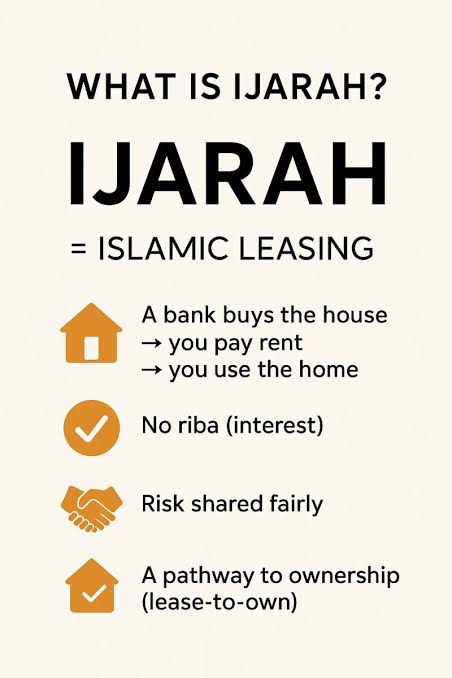
The financier acquires an asset (equipment, vehicles, facilities) and leases it to the client for fixed rentals. Variants like Ijarah wa Iqtina allow purchase at lease end.
Ijarah (Leasing)
Relevance:
- Capital-intensive imports such as machinery or transport fleets without large upfront outlays.
- Supports Vision 2030 infrastructure and industrial projects.
5. Salam and Istisna (Forward Contracts)
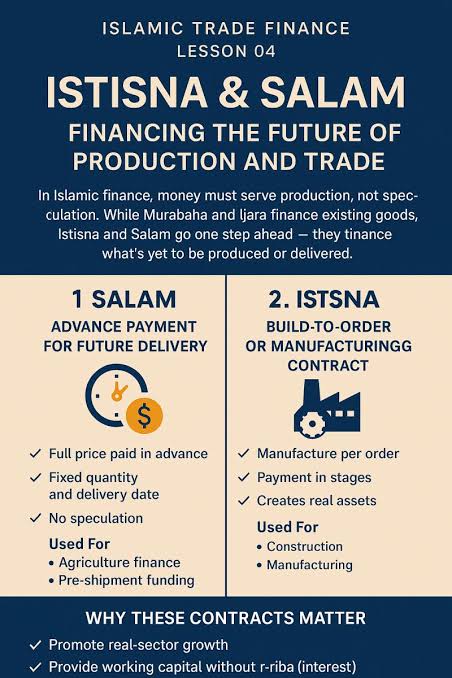
- Salam: Prepayment for future delivery of fungible goods (e.g., agricultural produce, commodities). Useful for exporters securing upfront liquidity.
- Istisna: Contract for manufacturing or construction of specified assets. Ideal for custom machinery or project-based trade.
Salam and Istisna (Forward Contracts)
These enable financing of production and future delivery while maintaining compliance.
💡 Strategic Application: Agrofood & Seasonal Commodities
While industrial goods often dominate trade finance discussions, these Sharia-compliant mechanisms offer powerful alignment for the agrofood and bulk agricultural sectors—a cornerstone of regional diversification and cross-border trade networks.
Practical Example (Bay’ al-Salam)
Under a Salam (Forward Delivery) contract, an international B2B buyer can provide immediate upfront liquidity to a GCC-based agricultural producer for seasonal crops or processed agro-commodities. The financier pays today, securing a fixed volume of the harvest at a predetermined rate for future delivery, effectively mitigating seasonal cash flow gaps while remaining strictly interest-free.
The Gulf-to-CARICOM Corridor: Unlocking New Maritime Trade Lanes
6. Sukuk and Structured Facilities
Asset-backed Sukuk securitize receivables or projects, providing liquidity for larger trade programs. Green and sustainable Sukuk gain traction amid ESG focus in regional megaprojects.

Sukuk and Structured Facilities
Comparison of Key Instruments
| Instrument | Risk Profile | Best For | Transparency | Typical Use Case in GCC Trade |
|---|---|---|---|---|
| Murabaha | Asset-backed sale | Inventory, imports/exports | High (cost disclosed) | Working capital, LC alternatives |
| Musawamah | Negotiated sale | Flexible spot purchases | Medium | Commodity trades |
| Mudarabah | Profit-loss sharing | Ventures, growth | Project-based | Export expansion, new markets |
| Musharakah | Joint partnership | Collaborative projects | Shared | Joint distribution, warehousing |
| Ijarah | Leasing | Equipment, vehicles | Fixed rentals | Machinery imports |
| Salam | Forward delivery | Commodities, agriculture | Prepaid | Securing raw materials |
🔄 Currency Diversification & Digital Settlement
A major macro trend reshaping GCC cross-border corridors is the shift toward local currency settlement and de-dollarization. Regional businesses are increasingly moving away from exclusive US Dollar invoicing to mitigate conversion costs and geopolitical risks.
The Sharia Advantage
Because Sharia-compliant mechanisms like Murabaha and Musawamah are fundamentally anchored in real economic assets rather than pure monetary debt, they are natively currency-agnostic. Modern B2B digital platforms seamlessly embed these trade instruments using local bilateral pairs—such as the Saudi Riyal (SAR), UAE Dirham (AED), or Omani Rial (OMR). This allows automated, interest-free underwriting and escrow execution completely insulated from dollar-pegged liquidity constraints.
Step-by-Step Implementation for SMEs
- Needs Assessment: Map trade cycle (import, production, export, payment terms) and identify Sharia-preferred options.
- Partner Selection: Engage banks or fintech platforms with strong Sharia boards and GCC expertise. Review AAOIFI compliance where applicable.
- Documentation: Prepare detailed purchase orders, supplier contracts, feasibility studies. Digital tools accelerate approval.
- Approval and Structuring: Sharia review, due diligence, contract execution. Include force majeure and dispute resolution clauses suited to cross-border deals.
- Execution and Monitoring: Track delivery, payments, performance. Use dashboards for compliance and cash flow.
- Post-Transaction Review: Evaluate costs, efficiency, and relationship outcomes for future optimization.
Practical experience shows early engagement with financiers during deal structuring yields better terms.
Beyond the AI Hype: Building Systems That Actually Work in Global Trade
Operational Challenges and Mitigation Strategies
- Standardization: Variations in Sharia interpretations across jurisdictions. Solution: Work with institutions aligned to international standards (AAOIFI, IFSB) and prefer unified documentation.
- Liquidity and Secondary Markets: Addressed through growing Sukuk issuance and cross-border initiatives.
- Cost Perception: Markup structures may appear higher initially but deliver predictability and lower overall risk premiums in compliant ecosystems.
The Default Dilemma: How GCC Islamic Banks Handle Late Payments Without Riba
In conventional trade finance, default risks and delays are mitigated through compounding late interest rates. Under Sharia principles, charging interest on delayed debt is strictly forbidden (Riba). This leaves experienced B2B traders asking: What stops an undercapitalized SME from delaying payments to a GCC Islamic financier?
To solve this without violating compliance, central banks and Sharia boards in Saudi Arabia and Oman implement a specialized dual-action mechanism:
- The Charity Commitment Clause (Commitment to Tasadduq): Every Murabaha or Wakalah trade contract includes a legally binding clause forcing the buyer to pay a fixed penalty per day of delay. However, to keep it Sharia-compliant, the bank cannot absorb this penalty as income. Instead, 100% of these funds are audited and funneled directly into independent, government-approved charity funds.
- Actual Compensation for Damages: In specific jurisdictions overseen by modern frameworks like AAOIFI, institutions are permitted to retain a small, strictly audited portion of the penalty that matches the actual administrative loss caused by the default—excluding any missed opportunity cost or projected profit.
Operational Takeaway: For a GCC trader, late payment penalties remain heavily punitive and legally binding, protecting the financier’s liquidity pool, while the non-profit nature of the penalty ensures the pure asset-backed integrity of the supply chain.
- SME-Specific Barriers: Limited track record. Leverage government programs like Saudi Kafalah guarantees or Omani SME support schemes.
- Digital Integration: Fintech enhancements in Saudi Arabia and across the GCC streamline onboarding and monitoring.
Regional analysis confirms that businesses investing in robust documentation and relationship banking navigate these effectively.
🛡️ Takaful: Sharia-Compliant Risk Mitigation in Transit
In cross-border B2B trade, securing assets during transit is non-negotiable. Traditional marine and cargo insurance involves elements of conventional risk-transfer that conflict with Sharia principles. To bridge this gap, Marine and Transit Takaful operates on the basis of mutual assistance (Takaful) and donation (Tabarru’).
Logistics & Maritime Coverage
Traders contribute to a shared pool managed by a Takaful operator. This pool directly covers shipping risks—such as hull damage, cargo loss, port delays, and transit theft along critical GCC shipping lanes and overland transport corridors. Any surplus remaining in the fund after claims are settled can be distributed back to the participants, offering a highly transparent, ethical, and cost-effective alternative to conventional commercial insurance.
Cow Bones Export: Turning Slaughterhouse Waste into Millions
Case Insights from GCC Markets
In Saudi Arabia, Murabaha and Tawarruq structures support Vision 2030 projects and SME lending growth. Banks integrate them with digital platforms for faster trade cycles. Oman emphasizes partnership models for diversification into logistics and manufacturing, facilitating smoother regional flows.
Traders handling construction materials, food commodities, or machinery frequently combine Murabaha for procurement with Ijarah for equipment, achieving end-to-end compliance.
Strategic Recommendations for 2026 and Beyond
- Hybrid Approaches: Layer instruments (e.g., Murabaha for trade + Mudarabah for expansion) to optimize funding.
- Technology Leverage: Adopt platforms offering compliant calculators, document builders, and compliance checkers to reduce friction.
- Relationship Focus: Build long-term ties with Islamic banks for preferential terms and advisory support.
- Risk Management: Incorporate strong contracts covering geopolitical, currency, and delivery risks. Consider Takaful for insurance needs.
- Market Intelligence: Monitor regulatory updates, especially around digital assets and sustainable finance.
For traders navigating these ecosystems, tools that simplify documentation and compliance can provide meaningful operational edge. One such contextual resource is available through the broader platform ecosystem at Platform.Tendify.Net for supporting trade workflows.
Related Reading:
- Trade Credit Crunch: How MENA Exporters Can Unlock Working Capital
- Etihad Rail Abu Dhabi–Fujairah: Cutting GCC Logistics Costs
- China’s Export Leadership: How Did It Scale to the Global Stage?
Conclusion: Building Resilient Trade Operations
Sharia-compliant trade finance equips GCC SMEs with ethical, robust tools that support sustainable growth amid regional ambitions. By focusing on real assets, shared risk, and transparency, these mechanisms foster trust and stability in cross-border dealings—particularly valuable in Saudi Arabia and Oman’s evolving landscapes.
Success depends on practical execution: matching the right instrument to the transaction, maintaining strong documentation, and partnering with experienced providers. Businesses that embed these approaches into their operations gain not only compliance but competitive resilience.
To facilitate, secure, and accelerate your trade processes with integrated tools and networks, register an account today at https://tendify.net/my-account/. Explore how structured solutions can support your next expansion.

