


Blog
Electronic Manifest 2026: Avoid $5,000 Fines & Customs Holds

A vessel sits at anchorage outside a major Gulf port. The cargo is ready. The buyer is waiting. Yet clearance stalls for 48 hours because a single seal number on the electronic manifest does not match the physical container. That delay costs more than the freight itself.
Electronic manifest submission—often called e-Manifest, advance cargo information, or pre-load cargo declaration—has moved from optional best practice to non-negotiable operational control. Customs authorities across the Gulf Cooperation Council, the European Union, and major trading corridors now treat pre-arrival data as the primary filter for security risk and the trigger for release decisions.
End-to-End Electronic Manifest Data Flow & Risk Processing
The diagram below illustrates how advance commercial cargo data travels securely from supply chain origin through national single-window gateways into automated customs risk engines for immediate clearance decisions.
STAGE 1: ORIGIN DATA CREATION
Shipper / Exporter
Generates commercial invoice, packing list, and raw itemized descriptions with initial 6-digit WCO HS code.
STAGE 2: DATA AGGREGATION & PRIVACY FIREWALL
Freight Forwarder / NVOCC
Maps items to 10-digit national tariff lines, applies identity masking on Master B/L, and prepares direct House B/L payload.
STAGE 3: NATIONAL INGESTION
National Single Window Gateway (FASAH / MPCI)
Ingests Master B/L (Carrier) and House B/L (Forwarder) via EDI/API, matching manifests 48–72h prior to vessel arrival.
STAGE 4: AUTOMATED SCREENING
Customs AI Risk Engine (ZATCA / GCC Customs)
Evaluates 10–12 digit national HS validity, regulatory permit matching (SABER/SFDA), valuation, and security blacklists.
GREEN LANE: Pre-Clearance
PASS
Manifest validated without discrepancy. Immediate customs pre-clearance issued; direct gate-out release upon vessel discharge.
RED LANE: Hard Hold
REJECT
Triggered by tariff line mismatch, missing SASO/SFDA permit, or data error. Manifest flagged for manual inspection and SAR 5,000 fine.
This guide breaks down exactly what data must travel digitally, how the filing workflow operates in practice, the hard cut-off times that trigger penalties, and the concrete steps traders and logistics teams can take to keep cargo moving without demurrage or inspection holds.
In regional supply-chain assessments, the majority of avoidable port delays now originate in the advance-data layer rather than physical inspection capacity. The organisations that treat electronic manifest accuracy as a primary control point consistently outperform peers on both landed-cost and on-time metrics.
What Electronic Manifest Submission Actually Means
An electronic manifest is a structured digital declaration that describes the vessel or aircraft, the bills of lading, and every cargo line before the goods physically arrive or, in many regimes, before they are even loaded. It replaces paper manifests and serves as the first formal contact between the carrier (or its agent) and the customs risk engine.
Authorities use the data for two simultaneous purposes: security screening against restricted parties and prohibited goods lists, and commercial facilitation through risk-based release. When the data is complete and accurate, low-risk shipments move through green channels. When it is incomplete or inconsistent, the system flags the shipment for documentary or physical examination.
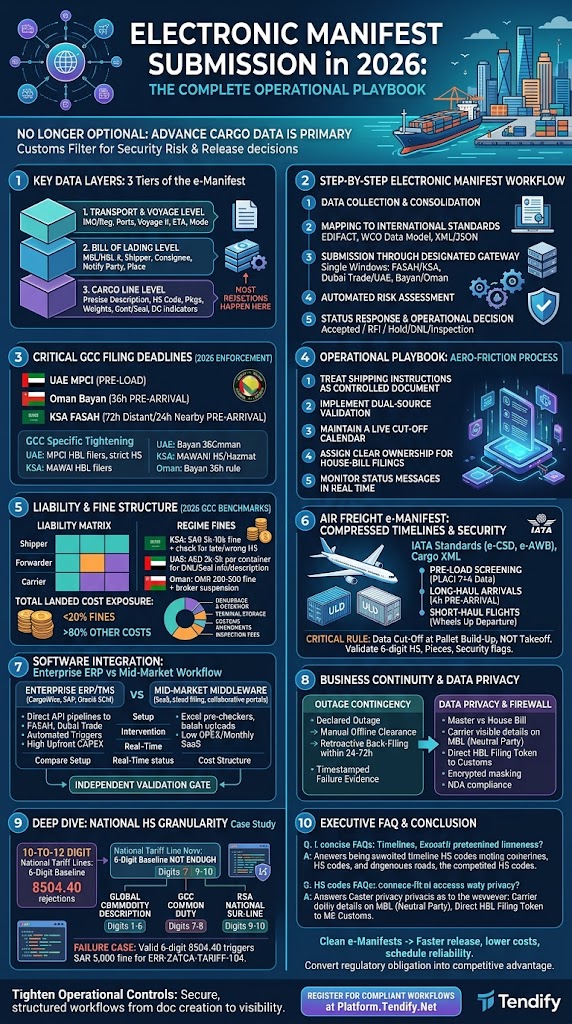
Electronic Manifest Submission
In operational terms, the electronic manifest is the single source of truth that customs systems compare against the eventual goods declaration, packing lists, and physical inspection results.
For B2B shippers moving regular volumes into or through Gulf ports, the practical implication is straightforward: every booking, every house bill, and every commercial invoice must be designed from the outset to feed a clean electronic declaration. Retrofitting incomplete data after the vessel has sailed is the most expensive way to solve the problem.
The Three Data Layers Every e-Manifest Must Contain
Modern electronic manifests follow a consistent three-tier structure. Missing or mismatched elements at any layer trigger rejection or hold messages.
1. Transport and Voyage Level
This layer identifies the conveyance and the journey itself:
- Voyage or flight number and carrier SCAC or ICAO code
- Vessel IMO number or aircraft registration
- Port or border of loading and port or border of discharge
- Estimated time of arrival (ETA) at the first point of entry
- Mode of transport and any intermediate transshipment points
2. Bill of Lading Level
Each commercial document is declared with full party details:
- Master bill of lading (MBL) number and, where applicable, house bill of lading (HBL) numbers
- Shipper (consignor) full legal name and address
- Consignee full legal name and address
- Notify party details
- Place of receipt and place of delivery when different from load and discharge ports
3. Cargo Line Level
This is where most rejections originate. Every line item must carry:
- Precise cargo description (generic terms such as “parts” or “general cargo” are routinely rejected)
- Harmonized System (HS) code—minimum six digits, often required at eight or twelve digits in GCC systems
- Number of packages, package type, and marks and numbers
- Gross and net weight, and where required, volume or measurement
- Container numbers and corresponding seal numbers
- Dangerous goods indicators (IMDG, IATA, or UN numbers) when applicable
Air Freight e-Manifest: IATA Standards, Security, and Compressed Timelines
While ocean freight handles the vast majority of global volume, air cargo is the backbone of high-value, time-critical B2B supply chains. Unlike maritime shipping—where transit times allow hours or days for post-sailing corrections—air freight advance cargo information operates under severely compressed execution windows. A single missing security flag or incorrect House Air Waybill (HAWB) line will result in immediate flight grounding or re-screening holds at the destination airport.
IATA COMPLIANCEe-CSD Integration and Digital Cargo Security Standards
In modern air logistics, advance cargo declarations are intrinsically tied to flight safety and security screening. Customs authorities and aviation security agencies require advance proof that air cargo has been audited under authorized secure supply chain protocols prior to loading.
- Electronic Consignment Security Declaration (e-CSD): The global IATA standard providing digital proof of how, when, and by whom cargo was screened (e.g., X-ray, ETD, or Regulated Agent status). Modern e-manifest gateways require the e-CSD payload embedded directly alongside the Electronic Air Waybill (e-AWB) data.
- Cargo XML Standards: Electronic manifests in air transport rely on standardized
XFWB(Master Air Waybill) andXFZB(House Air Waybill) messages, replacing legacy CargoIMP protocols to feed single-window customs engines seamlessly.
Air Cargo Cut-Off Windows vs. Ocean Freight Benchmarks
Critical Air Cargo Rule: Because air cargo is built into consolidated Unit Load Devices (ULDs) hours before departure, data cut-offs for air freight forwarders occur at Pallet Build-Up rather than takeoff. Ensure that precise 6-digit HS codes, piece counts, and e-CSD security flags are validated in your system prior to locking the physical ULD container.
Step-by-Step Electronic Manifest Workflow
The operational sequence is consistent across most modern customs regimes, even if the technical gateway differs.
Step 1 – Data Collection and Consolidation
Carriers and freight forwarders pull shipping instructions, commercial invoices, packing lists, and booking confirmations into a single dataset. At this stage the critical control is consistency: the same HS code, weight, and party names must appear across all source documents. Operational teams that skip this reconciliation step later face amendment fees and inspection delays.
Step 2 – Mapping to International Message Standards
Data is transformed into the required electronic format. The two dominant standards remain UN/EDIFACT CUSCAR (Customs Cargo Report) and messages built on the World Customs Organization Data Model. Many Gulf Single Window platforms accept XML or JSON payloads that map to the same core data elements. The technical choice is secondary; the accuracy of the mapped values is primary.
Step 3 – Submission Through the Designated Gateway
Submission occurs via the national Single Window, a dedicated advance cargo portal, or an accredited service provider. In the United Arab Emirates this is the National Advance Information Centre (NAIC) under the Maritime Pre-load Cargo Information programme. In Oman the Bayan system is mandatory. In Saudi Arabia the FASAH platform receives the pre-arrival data that feeds both customs and port operations.
Step 4 – Automated Risk Assessment
Before the vessel or aircraft arrives, the customs system runs the submitted data against restricted-party lists, prohibited-goods databases, valuation parameters, and historical risk profiles. The result is a status message returned to the declarant.
Step 5 – Status Response and Operational Decision
Three primary outcomes determine the next physical action:
- Accepted / ACT – The shipment is cleared for loading (in pre-load regimes) or for discharge and green-channel release.
- Request for Information / RFI – Additional or corrected data must be supplied within a short window.
- Hold / Do Not Load / Inspection – The cargo cannot proceed until documentary clarification or physical examination is completed.
10-to-12 Digit National Tariff Granularity: Beyond the 6-Digit WCO Baseline
While the World Customs Organization (WCO) harmonizes international trade up to the 6-digit HS subheading level, modern GCC customs platforms—most notably Saudi Arabia’s ZATCA (FASAH) and UAE Customs—reject declarations submitted with generic 6-digit codes. In 2026, single-window risk engines validate declarations strictly against national 10-to-12 digit Integrated National Tariffs.
Anatomy of National Tariff Expansion (GCC 10-Digit Standard)
Digits 1–6 govern global commodity description. Digits 7–10 determine national duty rates, SASO/SFDA regulatory hold conditions, and VAT rates inside FASAH.
How a Globally Valid 6-Digit Code Triggers FASAH Hard Rejection
An international trader shipped industrial power inverters from Shanghai to King Abdulaziz Port (Dammam), declaring WCO HS Code 8504.40 (“Static Converters”).
Root Cause & Operational Breakdown:
- Generic Padding Attempt: The declarant added dummy zeros (
8504.40.00.00) to meet field length requirements. - National Regulatory Mismatch: In Saudi Arabia’s 10-digit tariff,
8504.40is split into sub-lines:8504.40.10.00: Uninterruptible Power Supplies (UPS) – Requires SASO Quality Mark.8504.40.20.00: Solar Power Inverters – Duty-Exempt under Clean Energy Tariff.8504.40.90.10: EV Charging Converters – Requires Saudi Electricity Regulatory Authority (SERA) pre-clearance.
- Consequence: The manifest failed automated advance clearance, leading to an immediate manifest hold, mandatory manual port inspection, and SAR 5,000 demurrage penalties.
WCO 6-Digit vs. National 10-Digit Compliance Matrix
| HS Digit Level | Governing Authority | FASAH / Customs Gateway Impact |
|---|---|---|
| Digits 1–6 | WCO (World Customs Org) | Accepted for global bill of lading baseline; insufficient for customs entry. |
| Digits 7–8 | GCC Customs Union | Determines unified GCC external customs tariff percentage. |
| Digits 9–10 (or 12) | ZATCA (KSA) / Federal Customs (UAE) | Controls automated risk filtering, SFDA/SABER permit matching, anti-dumping duties, and immediate clearance validation. |
Forwarder Action Item: Never pad 6-digit HS codes with trailing zeros when submitting electronic manifests to GCC gateways. Always cross-reference the destination country’s active 2026 Integrated National Tariff Database (e.g., ZATCA Tariff Lookup on FASAH) prior to manifest transmission to ensure exact 10-digit regulatory alignment.
Filing Deadlines That Actually Matter in 2026
Cut-off times are absolute. Missing them converts a routine shipment into a high-cost exception. The following table summarises the current operational windows for the main corridors used by Gulf and Middle East traders.
| Regime / System | Filing Deadline |
| United States (ACE / AMS) | 24 hours before loading at origin port |
| European Union (ICS2 / ENS) – containerised sea | 24 hours before loading at non-EU load port |
| European Union (ICS2) – bulk / short-sea | 4 hours (or 2 hours for short voyages) before arrival at first EU port |
| UAE – Maritime Pre-load Cargo Information (MPCI) | Before loading at origin; full enforcement from 1 Oct 2026 |
| Saudi Arabia – MAWANI / FASAH | 72 hours (distant ports) / 24 hours (nearby ports) before arrival |
| Oman – Bayan System | 36 hours before vessel arrival (mandatory from 3 May 2026) |
Note the shift in the UAE from a 48-hour pre-arrival rule to a full pre-load requirement under the MPCI programme. Cargo data must now be accepted by NAIC before the vessel leaves the last foreign load port. Non-compliant containers risk a Do Not Load instruction.
GCC-Specific Requirements and Recent Tightening
Regional authorities have moved in parallel to raise data quality standards. Three developments dominate the 2026 operating environment.
United Arab Emirates – Maritime Pre-load Cargo Information (MPCI)
From 1 October 2026 the programme is under full enforcement. Shipping lines and freight forwarders must file shipper, consignee, and cargo details with the National Advance Information Centre before loading. NAIC returns one of three decisions: acceptance, request for information, or do-not-load. The earlier 48-hour pre-arrival filing to individual port customs remains in place as a parallel requirement. House-bill filers carry independent responsibility; carriers are not authorised to file HBL data on behalf of customers.
Operational teams report that the most frequent triggers for RFI or Do-Not-Load messages are incomplete consignee addresses, generic cargo descriptions, and missing or incorrect six-digit HS codes on direct bills. Building a pre-submission validation gate that rejects incomplete shipping instructions has proven more effective than relying on post-submission corrections.
Saudi Arabia – MAWANI and FASAH Data Mandates
Effective May 2026, import cargo manifests arriving at Saudi seaports must include a valid six-digit HS code for every commodity line, cargo volume data, and hazardous-goods details where applicable. Incomplete or inaccurate manifests are rejected. Pre-arrival submission windows are tiered: 72 hours for distant ports and 24 hours for nearby ports. The FASAH Single Window remains the primary electronic channel.
Oman – Bayan 36-Hour Rule
From 3 May 2026 all shipping and navigation agents must submit the electronic cargo manifest through the Bayan system at least 36 hours before vessel arrival. The requirement is grounded in the amended GCC Common Customs Law and carries explicit enforcement language for non-compliance.
Operational Benefits That Translate Directly to the P&L
When electronic manifests are filed accurately and on time, the measurable outcomes are consistent across ports:
- Faster release cycles. Risk assessment occurs while the vessel is still at sea. Compliant cargo frequently moves from berth to inland destination within hours rather than days.
- Lower demurrage and detention exposure. Documentary holds are the leading cause of container dwell beyond free time. Pre-cleared manifests remove that variable.
- Reduced amendment and penalty costs. Most Gulf customs systems impose fixed fines for post-arrival amendments. Getting the data right the first time eliminates those line items.
- Improved inventory and cash-flow predictability. When release dates become reliable, working-capital planning and sales commitments become more accurate.
- Security and compliance posture. Consistent high-quality filings build a positive compliance history that can support lower inspection rates over time.
The Real Challenges Operators Face
The technology is mature. The friction lies in data discipline and multi-party coordination.
- Data mismatches. A seal number that differs by one digit, an HS code that does not match the commercial invoice, or a consignee name that varies between master and house bills will trigger a rejection. Each correction costs time and often a formal amendment fee.
- Fragmented regional standards. While the WCO Data Model provides a common semantic core, each national Single Window still imposes unique mandatory fields, code lists, and timing rules. Teams that operate across multiple GCC ports must maintain parallel compliance matrices.
- House-bill versus master-bill responsibility. In pre-load regimes such as the UAE MPCI, the party that issues the house bill carries independent filing obligations. Forwarders who previously relied on the ocean carrier to handle all advance data must now operate their own compliant process.
- Last-minute booking changes. When cargo is rolled or containers are swapped after the original filing, the electronic record must be amended before the new cut-off. Systems that lack real-time amendment capability force manual workarounds that introduce further error risk.
A further structural issue is the split of responsibility across the commercial chain. Shippers often assume the freight forwarder or the ocean carrier will “handle the paperwork.” In practice the party that holds the commercial data—especially the precise HS classification and the correct legal names of the parties—must supply it early enough for the filing party to meet the hard deadline. Contracts that leave this responsibility ambiguous create the largest volume of last-minute failures.
Practical Playbook: Building a Zero-Friction Manifest Process
Experiences from high-volume Gulf corridors point to a small set of operational disciplines that eliminate the majority of delays.
1. Treat Shipping Instructions as a Controlled Document
Require shippers to supply a complete shipping instruction package—HS codes, precise descriptions, full party addresses, weights, and seal numbers—before the booking is confirmed. Incomplete instructions should be rejected at source rather than corrected later under time pressure.
2. Implement Dual-Source Validation
Cross-check every critical field against both the commercial invoice and the packing list before the electronic message is generated. Automated validation rules for weight tolerance, HS-code length, and seal-number format catch the majority of errors before submission.
3. Maintain a Live Cut-Off Calendar
Each trade lane has its own hard deadline. Publish an internal calendar that maps every regular service to the latest acceptable filing time for each destination regime. Build in a buffer of at least four hours for amendment cycles.
4. Assign Clear Ownership for House-Bill Filings
In markets that require separate HBL data, designate a single responsible party and enforce a contractual cut-off for data delivery from the shipper. Ambiguity between forwarder and carrier is the most common root cause of late or missing house-level filings.
5. Monitor Status Messages in Real Time
Do not wait for the vessel to arrive to discover a hold. Configure alerts for every non-acceptance status and assign a rapid-response owner who can supply corrected data within the window granted by the authority.
Standards and Technical Foundations
Two technical frameworks underpin virtually all modern electronic cargo reporting.
UN/EDIFACT CUSCAR remains the classic message type for customs cargo reports. It carries the full hierarchical structure of voyage, bill, and cargo details and is still widely used in older EDI gateways.
The WCO Data Model provides the semantic backbone for Single Window systems. It defines standardised data elements, code lists, and information packages that allow the same commercial data set to satisfy multiple regulatory agencies without re-keying. Most recent Gulf platforms are aligned to later versions of the WCO model.
Traders do not need to become EDI specialists. They do need to ensure that whatever system or service provider they use maps their commercial data accurately into the required structure and returns clear status codes that operations teams can act upon.
In practice, many mid-sized exporters and importers rely on their freight forwarder or a specialised filing service provider to handle the technical transmission. The commercial risk, however, remains with the party whose goods are delayed. That is why the most resilient operations treat the quality of the source data—HS codes, party details, weights, and seals—as an internal responsibility even when the actual electronic message is lodged by a third party.
Where multiple House Bills sit under a single Master Bill, the coordination challenge multiplies. Each HBL party must deliver accurate data in time for the consolidated filing. Teams that run high volumes of LCL or groupage cargo into the Gulf have found that enforcing a strict internal data cut-off—often 48–72 hours before the carrier’s own deadline—dramatically reduces last-minute amendments.
The Cost of Getting It Wrong
Penalties and indirect costs compound quickly. Direct fines for late or inaccurate manifests vary by jurisdiction but are rarely trivial. More damaging are the secondary effects: demurrage that accrues while a container waits for documentary correction, storage charges inside free-zone warehouses, and the commercial cost of missing a delivery window to a downstream buyer.
In high-volume lanes the cumulative effect of even a 5–10 percent rejection rate on manifests can erase the margin on an entire trade programme. The inverse is also true: organisations that achieve near-zero amendment rates gain a measurable cost advantage and more predictable lead times.
Software Architecture & API Integrations: Enterprise ERP vs. Mid-Market Workflows
Understanding WCO data models and EDIFACT standards is theoretical until data moves automatically from a commercial database into a customs risk engine. Manual data re-entry across multiple single-window portals introduces human error, increases operational costs, and risks missing rigid cut-off deadlines. Modern cross-border operations rely on automated software bridges, direct REST API integrations, or agile middleware to ensure error-free data transmission.
Option A: Enterprise ERP / TMS Direct Pipelines
Target: High-volume exporters, multinational forwarders, and enterprise VOCCs.
- Core Systems: CargoWise, SAP Global Trade Services (GTS), Oracle SCM, or custom internal logistics engines.
- Direct Gateway API Hooks: Native RESTful API or AS2/SFTP connectors linking directly to national single windows such as Saudi FASAH API, Dubai Trade (DP World), or Oman Bayan gateways.
- Automated Triggering: Invoices or packing lists generated in the ERP automatically map HS codes, seal numbers, and party data, pushing an automated payload directly to customs upon commercial release.
Option B: Mid-Market Middleware & SaaS Portals
Target: Mid-sized traders, regional NVOCCs, and growing freight brokers.
- Cloud Filing Middleware: Web-based compliance portals that act as an intermediary, converting standard commercial file formats into valid JSON/XML customs payloads without heavy IT infrastructure.
- Batch CSV/Excel Pre-Checkers: Uploading standardized Excel manifests that run through automated validation filters (checking HS code length, seal formats, and required party fields) prior to submission.
- Forwarder Collaborative Portals: B2B platforms providing self-service interfaces where shippers input structured shipping instructions directly, eliminating re-keying by the forwarder.
Integration Technical Comparison
Integration Best Practice: Regardless of whether you deploy direct REST APIs or mid-market SaaS tools, implement an independent Validation Gate before gateway transmission. This pre-submission filter checks field syntax, cross-matches total net/gross weight parameters, and verifies that national-level 6-to-10 digit HS codes exist in destination tariffs prior to locking the manifest.
Business Continuity & Emergency Fallback Protocols
In an era of mandatory advance cargo declarations, a national Single Window portal outage—whether due to scheduled server maintenance, cyber disruptions, or unexpected hardware failures—can threaten to ground flights and freeze vessel discharges. Customs authorities in the Gulf region maintain formal contingency frameworks (Fallback Protocols) to ensure supply chains do not grind to a halt when digital systems go offline.
PHASE 1
System Outage Declaration
When gateways like FASAH, NAIC, or Bayan experience downtime exceeding defined thresholds (typically 30–60 minutes), customs authorities issue an official Outage Announcement. This formally triggers “Fallback Mode” and temporarily suspends automated late-filing fines.
PHASE 2
Manual Offline Clearance
During verified downtime, declarants submit standardized hard-copy manifests or emergency encrypted PDF/XML files directly to local port customs command desks. Provisional release stamps are issued offline to allow physical vessel berthing and unloading.
PHASE 3
Retroactive Electronic Back-Filing
Once portal connectivity is restored, a mandatory reconciliation grace period (24 to 72 hours) opens. Declarants must electronically upload all pending manifest records to maintain audit trails and close open manual releases.
Regional Single Window Contingency Matrix
Trader Action Plan During Outages: Always capture timestamped audit evidence when encountering Single Window failures—including system error logs, 5xx gateway HTTP responses, or server timeout screenshots. This documentation serves as legal immunity against late-filing fines when applying for manual release stamps during emergency operations.
Commercial Data Privacy & Disintermediation Protection
For B2B traders, freight forwarders, and NVOCCs, submitting granular advance cargo declarations introduces a major commercial risk: data exposure. Electronic manifests require full transparency—including exact legal names of actual buyers, sellers, itemized descriptions, and tariff classifications. Without strict data segregation protocols, traders face the risk of disintermediation, where ocean carriers or competing brokers bypass intermediaries to contract directly with end clients.
DATA FIREWALLThe Architectural Firewall: Master B/L vs. House B/L
Modern customs single windows in the GCC (such as UAE MPCI and Saudi FASAH) enforce a strict digital barrier between vessel operating carriers (VOCCs) and freight forwarders to protect commercial confidentiality:
Master Bill Level (Carrier Visible)
The ocean line sees only neutral party details: the Freight Forwarder listed as Shipper and the Forwarder’s overseas destination agent listed as Consignee. Actual commercial buyers and suppliers remain invisible to the carrier.
House Bill Level (Customs-Only Direct Filing)
The forwarder/NVOCC transmits actual buyer and seller data directly to the customs gateway via encrypted API. Customs receives complete risk analysis data while completely masking commercial identities from the carrier.
Core Data Security & Protection Mechanisms
Trader Safeguard Rule: Always verify whether your freight forwarder or logistics software supports Direct House-Level Filing. When shipping into GCC portals like FASAH or NAIC, insist on independent HBL submission tokens so that underlying buyer/seller manifests bypass carrier visibility completely while satisfying 100% of regulatory advance data requirements.
Legal Liability Matrix and 2026 Fine Structures
When an electronic manifest fails validation or triggers a customs hold, legal and financial liability does not fall equally across the supply chain. Modern customs authorities in the Gulf region enforce strict accountability depending on which party generates, consolidates, or transmits the flawed data line. Understanding where primary liability rests—and the exact fine schedules imposed by regional single windows—is critical for protecting trading margins.
PART 1
Legal Liability Allocation Across the Commercial Chain
PART 2
2026 Penalty Schedules and Fine Benchmarks in Primary GCC Corridors
Operational Reality Check: Direct fines from customs authorities typically represent less than 20% of the total landed-cost exposure. The remaining 80% stems from compounding port demurrage, detention, and terminal storage fees accrued while a shipment sits under administrative hold awaiting manual data corrections.
Pre-Filing Checklist for Every Shipment
Use this list before any electronic submission leaves the system:
- Confirm the correct destination regime and its current cut-off time.
- Verify that every HS code is at least six digits and matches the commercial invoice.
- Cross-check container numbers and seal numbers against the packing list and booking confirmation.
- Ensure shipper, consignee, and notify-party names and addresses are complete and consistent across master and house documents.
- Confirm gross and net weights fall within the carrier’s accepted tolerance.
- Flag any dangerous-goods lines and attach the required UN numbers and class information.
- Record the submission reference number and monitor the status message until acceptance is confirmed.
- If an amendment is required, complete it before the secondary cut-off and retain the amendment reference.
Supporting Tools and Process Integration
Most high-volume operators now integrate manifest generation with their existing transport management or booking systems so that the same data set feeds both the commercial documents and the regulatory filing. Dedicated HS-code classification tools and automated validation engines further reduce manual error. For teams that need rapid access to duty calculators, tariff lookups, and document generators while preparing shipments, resources available through Platform.Tendify.Net can sit alongside the core filing workflow without disrupting existing carrier connections.
The decisive factor is not the number of tools but the discipline of a single, validated data set that travels unchanged from commercial documents into the electronic manifest.
What Changes Next
Three trends are already visible. First, pre-load rather than pre-arrival filing is becoming the global default for maritime cargo; the UAE MPCI model is likely to be emulated elsewhere. Second, the required granularity of cargo descriptions and HS codes continues to increase—six digits is no longer sufficient in several GCC markets. Third, house-level filing obligations are expanding, shifting more responsibility onto freight forwarders and NVOCCs.
Organisations that treat electronic manifest accuracy as a core operational KPI rather than a downstream compliance task will absorb these changes with the least disruption. Those that continue to treat the filing as an afterthought will face rising costs and growing unreliability in their delivery performance.
Related Operational Compliance Guides
For trade compliance officers, logistics managers, and NVOCCs building end-to-end GCC supply chain controls on Tendify, expand your operational expertise with these adjacent resources:
⏱️ 6 min read
Demurrage vs. Detention in GCC Ports: How to Save $2,000 per Container
Discover practical, post-manifest cost-control tactics once cargo clears customs. Learn how to manage free-time windows across major hubs (Jebel Ali, Dammam, Khalifa Port) and avoid unexpected equipment penalties.
Key Takeaways:
- Free-time negotiation tactics with ocean lines in KSA and UAE ports.
- Demurrage dispute escalation pathways during customs clearance delays.
- Automated equipment tracking benchmarks to avoid equipment detention.
⏱️ 8 min read
Mastering FASAH for Saudi Customs 2026
A technical walkthrough of Saudi Arabia’s national trade single window operated by ZATCA. Crucial for understanding how electronic manifests, House B/L direct filings, and SABER/SFDA certificates interact within FASAH.
Key Takeaways:
- Configuring direct NVOCC House Bill data submission tokens.
- Resolving ZATCA tariff validation errors (ERR-ZATCA) before vessel arrival.
- Automated certificate mapping for SABER, SFDA, and SASO compliance.
⏱️ 7 min read
GCC Ports 2026: Master Customs Valuation and Dodge Crushing Penalties
Analyze how commercial line-item prices on advance manifest declarations trigger automated valuation risk flags. Master WTO valuation methods to prevent customs reassessments and anti-underinvoicing audits.
Key Takeaways:
- Calculating CIF/FOB adjustments accepted by GCC risk engines.
- Defending commercial invoices during post-clearance audit (PCA) reviews.
- Avoiding valuation-driven holds on high-duty commodity classifications.
Frequently Asked Questions: Electronic Manifest & Advance Cargo Compliance
Q1:What is the mandatory filing deadline for electronic advance cargo manifests in GCC ports?
Under 2026 regulations enforced by ZATCA (Saudi Arabia) and Federal Customs (UAE):
- Deep-Sea Ocean Voyages: Manifest data must be transmitted electronically at least 48 to 72 hours prior to vessel arrival at the first port of call.
- Short-Sea / Intra-GCC Voyages: Transmission is required immediately upon vessel departure from the port of loading, or no later than 24 hours prior to arrival.
Q2:Why does FASAH reject declarations using standard 6-digit WCO HS codes?
While 6-digit HS codes establish international commodity descriptions, GCC single windows validate manifests against national regulatory databases. Digits 7 through 10 (or 12) determine national import duty rates, VAT application, SASO/SABER quality certificate requirements, and SFDA regulatory holds. Entering a generic 6-digit code or padding it with dummy trailing zeros triggers automated validation failures (e.g., ERR-ZATCA-TARIFF-104) and holds the manifest.
Q3:How can freight forwarders protect buyer and seller confidentiality on House Bills of Lading?
Forwarders and NVOCCs should utilize Direct House-Level Filing Tokens provided by national gateways like UAE MPCI and Saudi FASAH. This architecture allows forwarders to transmit sensitive House Bill details (actual consignee, supplier, and itemized commercial values) directly to the customs risk engine. The ocean carrier sees only neutral forwarder details on the Master B/L, completely preventing client disintermediation.
Q4:Who is legally liable for customs fines caused by incorrect manifest filings?
Under the 2026 GCC Customs Liability Framework, statutory liability is decoupled based on filing ownership:
- Vessel Operating Carriers (VOCCs) are strictly liable for Master B/L transmission timelines and vessel arrival data.
- Freight Forwarders / NVOCCs hold sole legal liability for the accuracy of line-item tariff classifications, commercial values, and consignee data submitted under their unique House B/L filing tokens.
Q5:Can an electronic manifest be amended after the vessel has departed?
Yes, but post-departure amendments are subject to strict administrative controls. In Saudi Arabia and the UAE, minor typographic edits submitted prior to 24 hours before berth incurring a standard administrative fee (approx. SAR 200–500). However, critical field amendments (changing consignee identity, reducing cargo quantities, or altering HS codes) after vessel berth trigger automated risk flags, mandatory port physical inspections, and potential misdeclaration penalties up to SAR 5,000 per bill of lading.
💡 Pro Tip: For automated tariff pre-audits and seamless House B/L data segregation, integrate your shipment compliance workflow with Tendify prior to lodging final advance manifest disclosures.
Closing the Gap Between Data and Delivery
Electronic manifest submission is no longer a back-office formality. It is the first operational gate that determines whether cargo moves on schedule or becomes a cost centre. The difference between a clean release and a multi-day hold almost always traces back to the quality and timing of the data that left the declarant’s system.
Traders and logistics teams that institutionalise accurate, early, and complete electronic filings convert a regulatory obligation into a competitive advantage: lower total landed cost, higher schedule reliability, and a cleaner compliance record with the authorities that control the region’s key gateways.
The next step is operational. Map your current filing process against the cut-offs and data requirements outlined above, close the gaps that produce amendments, and treat every status message as a real-time control rather than a post-arrival surprise.
When the process is solid, the cargo moves. When it is not, the clock starts ticking on demurrage, storage, and missed commercial windows. The choice is entirely operational.

