


Blog
Egyptian Fertilizer Export 2026: The B2B Buyer’s Sourcing Guide
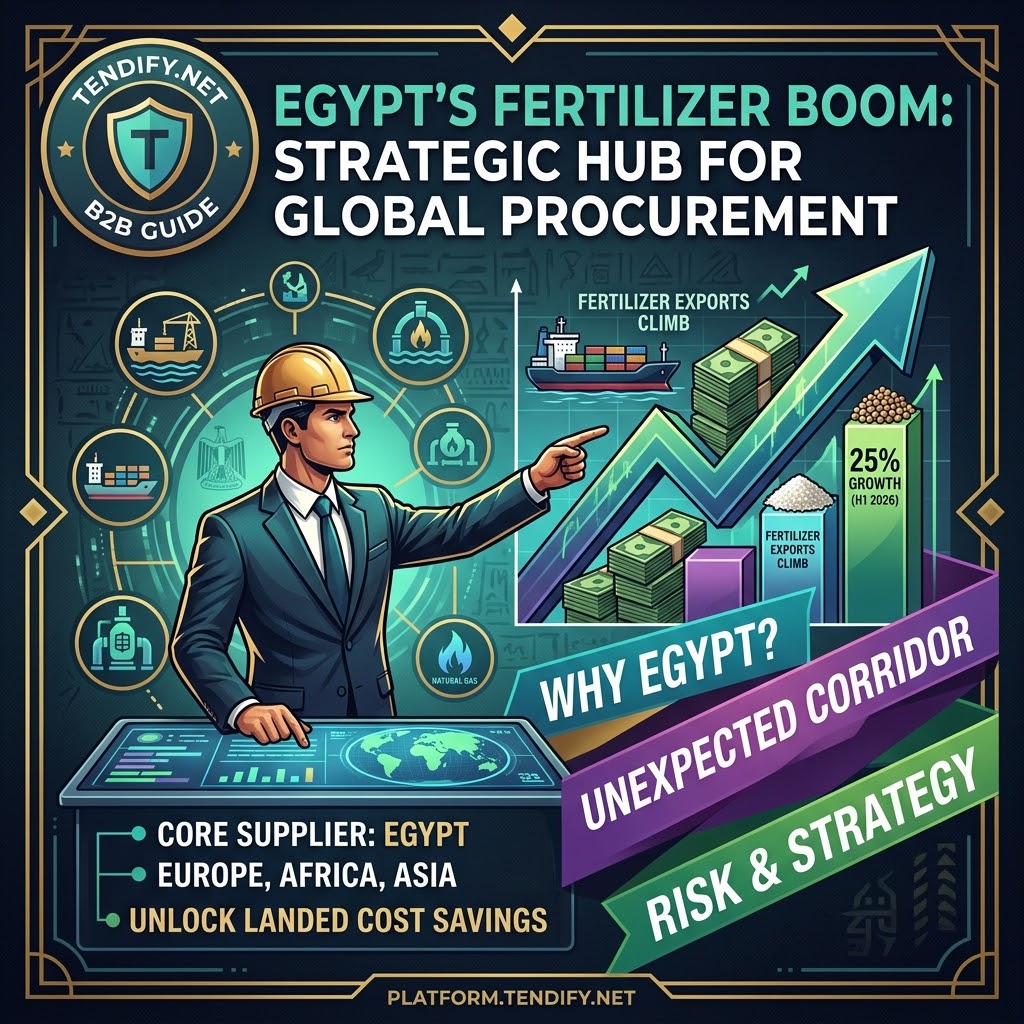
A European distributor recently watched a single delayed urea cargo add more than $40 per tonne in demurrage and opportunity cost. At the same time, phosphate prices in key Asian markets stayed elevated while Chinese export restrictions tightened. The message reaching procurement desks across Europe, Africa, and South Asia is clear: traditional supply corridors are no longer the only reliable option. Egypt has moved from secondary supplier to primary strategic alternative.
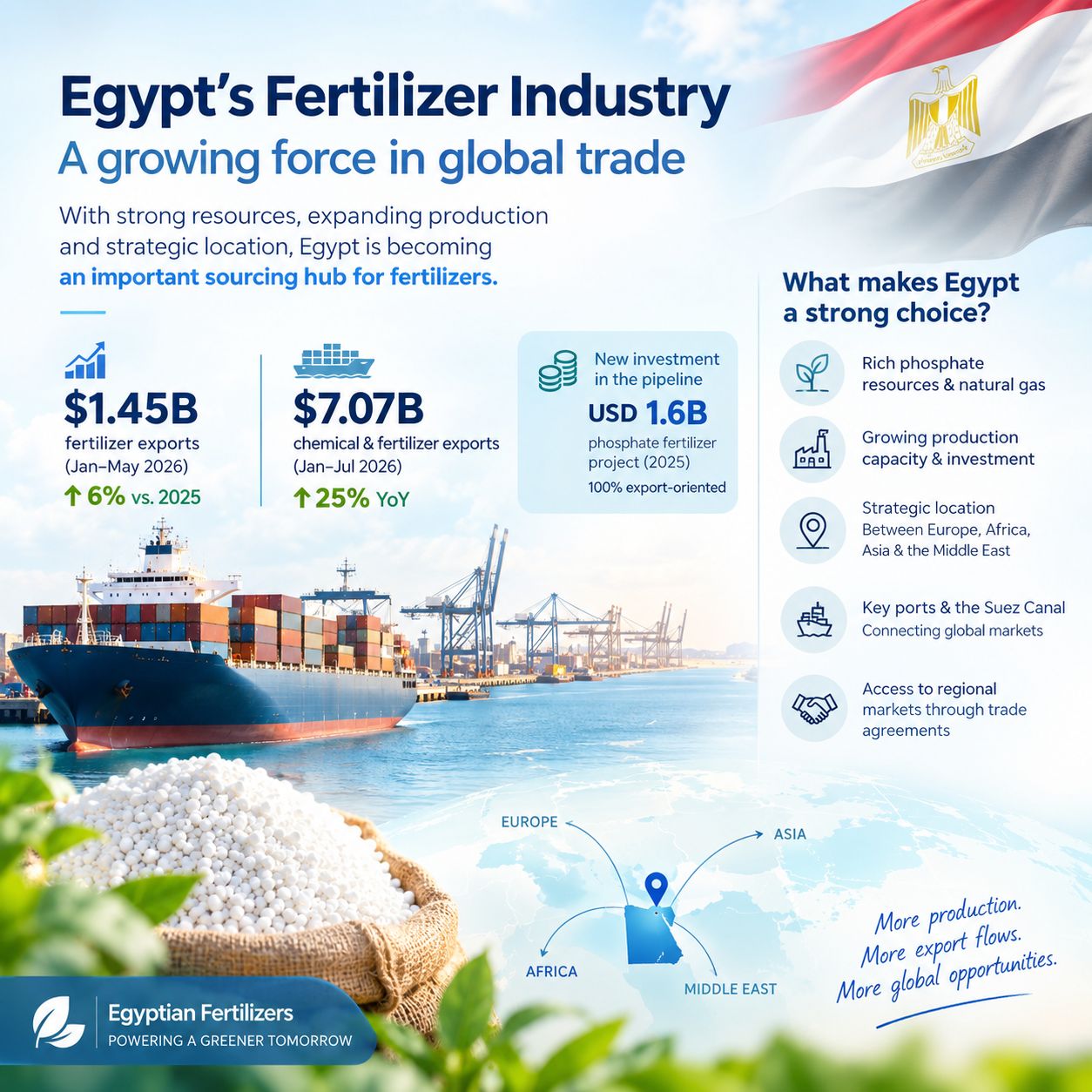
Egyptian Fertilizer Export 2026
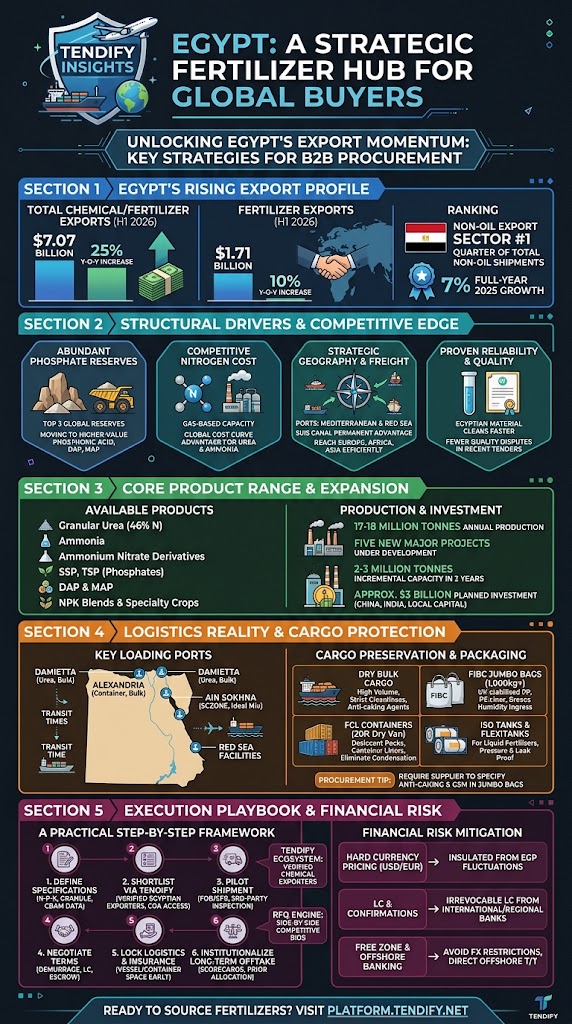
Between January and July 2026, Egypt’s chemical and fertilizer exports reached approximately $7.07 billion, a 25 percent year-on-year increase. Fertilizer shipments alone accounted for a substantial share of that growth, with first-half fertilizer exports climbing roughly 10 percent to around $1.71 billion. The sector already ranks as Egypt’s largest non-oil export category and contributes close to a quarter of total non-oil shipments. These are not speculative projections. They reflect operating plants, signed offtake agreements, and vessels already loading at Mediterranean and Red Sea terminals.
For B2B buyers, traders, and logistics managers, the question is no longer whether Egypt belongs on the shortlist. The practical question is how to structure contracts, select grades, secure freight, and manage documentation so that the shift delivers lower landed cost and higher supply security.
The Structural Drivers Behind Egypt’s Export Momentum
Three forces converge. First, abundant domestic phosphate reserves place Egypt among the top three holders of phosphate rock globally. Producers are moving beyond raw rock exports into higher-value phosphoric acid, DAP, MAP, and compound fertilizers. Second, natural-gas-based nitrogen capacity remains competitive on the global cost curve for urea and ammonia. Third, geography delivers a permanent freight advantage. Ports on both the Mediterranean and the Red Sea, combined with the Suez Canal, allow vessels to reach European, African, and Asian destinations without the transit risks that periodically disrupt Gulf routes.
Operational assessments of regional supply chains show that buyers who treat Egypt as a swing supplier often leave margin on the table. Those who treat it as a core origin—securing multi-month offtake, pre-qualifying laboratories, and locking container or bulk space—capture both price and reliability gains. Experiences from 2025–2026 tenders in India and Mediterranean markets illustrate the point: Egyptian material frequently cleared faster and arrived with fewer quality disputes once documentation protocols were standardized.
Export Performance and Capacity Expansion in Numbers
The 2025 full-year figure for chemicals and fertilizers exceeded $9.4 billion, up roughly 7 percent from the prior year. The 2026 trajectory is steeper. First-half fertilizer exports alone rose more than $160 million year-on-year. Government and industry targets point toward chemical-sector exports approaching $11 billion by the end of 2026, supported by an intended annual growth rate of at least 15 percent in key product lines.
On the production side, Egypt manufactures roughly 17–18 million tonnes of fertilizers annually, including several million tonnes of urea. Five major new projects under development are expected to add 2–3 million tonnes of incremental capacity over the next three years, backed by approximately $3 billion in planned investment. Capital is arriving from Chinese, Indian, and local investors. One high-profile phosphate complex in the Suez Canal Economic Zone carries an initial commitment of around $525 million and targets 600,000 tonnes per year of phosphate fertilizers and related chemicals, with the majority earmarked for export. Parallel developments at Abu Tartour focus on phosphoric acid, while additional complexes aim at DAP, MAP, and specialized grades.
These numbers matter for buyers because they translate into available spot and contract volumes. When global markets tighten, origins with surplus capacity and functioning ports become the ones that can still deliver.
Core Product Range Buyers Actually Need
Egyptian plants produce the full spectrum of nitrogen, phosphate, and compound fertilizers that dominate international trade:
- Granular and prilled urea (46 percent N)
- Ammonia and ammonium nitrate derivatives
- Single superphosphate (SSP), triple superphosphate (TSP)
- Diammonium phosphate (DAP) and monoammonium phosphate (MAP)
- NPK blends and specialty water-soluble grades
- Sulfate of potash (SOP) expansions already under way
Egyptian Fertilizer Export
Nitrogen products remain the volume leaders for export, especially to Europe and the Mediterranean. Phosphate products are the fastest-growing high-value segment as downstream processing capacity comes online. Water-soluble SOP capacity is also expanding, giving specialty crop buyers additional options.
Quality documentation follows international norms. Leading exporters routinely supply certificates of analysis covering nitrogen content, biuret, moisture, granulometry, and heavy-metal limits. Pre-shipment inspection by recognized agencies is standard for most destination markets. Buyers who insist on third-party sampling at load port reduce rejection risk dramatically.
Logistics Reality: Ports, Transit Times, and Cost Levers
Egypt’s export advantage is physical. Major loading points include Damietta (strong for urea and bulk), Alexandria, Ain Sokhna (Suez Canal Economic Zone, ideal for both container and bulk), and other Red Sea facilities. Vessels loading at these ports can reach Northern Europe in competitive transit times compared with longer Gulf routes, and they reach East African and South Asian destinations without the same chokepoint exposure.
Practical cost control starts with three decisions:
- Choose the correct Incoterm. FOB Ain Sokhna or Damietta keeps freight under buyer control when rates are volatile. CFR or CIF can be attractive when the exporter has established liner or charter relationships.
- Match vessel size to parcel. Many Egyptian exporters handle both Handy-size bulk and containerized shipments. Container optimization tools and accurate stowage plans prevent under-utilization that quietly adds $15–30 per tonne.
- Time documentation. Egyptian export procedures are well established, yet incomplete commercial invoices, packing lists, or certificates of origin still cause the majority of avoidable delays. Aligning document templates with the buyer’s customs broker before the first shipment eliminates most friction.
Experiences across Mediterranean and African lanes show that buyers who pre-clear HS codes and obtain any required phytosanitary or chemical registrations in the destination market cut clearance times by days rather than hours.
Cargo Preservation & Packaging
Specialized Fertilizer Packaging, Moisture Control & Caking Mitigation
Selecting the correct shipping mode is not merely a freight rate consideration—it directly dictates product integrity upon arrival. Fertilizers, particularly granular urea and water-soluble specialty grades, are highly hygroscopic and susceptible to ambient moisture, temperature fluctuations, and severe compaction during ocean transit.
Packaging Modes & Cargo Protection Protocols:
- Dry Bulk Cargo: Ideal for high-volume shipments (Handysize to Supramax). Mandates strict load-port hatch cleanliness, weather-tight seals, and the verified application of commercial anti-caking agents (surface coatings) during loading to prevent granule degradation and moisture-induced lump formation.
- FIBC Jumbo Bags (1,000 kg – 1,250 kg): The preferred standard for Breakbulk and FCL containerized shipping. Utilizing UV-stabilized woven polypropylene bags with inner polyethylene liners (PE liners) provides double-layer protection against humidity ingress, physical abrasion, and port-handling degradation.
- FCL Containers (20ft Dry Van): Excellent for small-to-medium parcels or high-value compound blends. Lined container walls (container liners) and desiccant packs eliminate condensation risk (“container rain”) during multi-climate sea transit.
- ISO Tanks & Flexitanks: Reserved for liquid fertilizers, ammonium nitrate solutions, and liquid NPK formulations, ensuring pressurized, leak-proof transport from plant to destination hub.
Procurement Tip: Always require your supplier to specify the anti-caking agent formulation and packaging specifications (including GSM ratings for Jumbo bags) in the contract options to guarantee discharge-port fluidizability.
Investment Pipeline and What It Means for Availability
The current wave of projects is deliberately export-oriented. One complex under construction is designed so that roughly 80 percent of output leaves the country. Another phosphoric-acid facility at Abu Tartour will ship high-concentration acid through Red Sea ports. Parallel expansions in SOP and compound fertilizers add product diversity.
For procurement teams this pipeline changes planning horizons. Instead of treating Egyptian supply as residual volume after domestic demand is met, buyers can now negotiate 6–12 month offtake with confidence that incremental capacity will materialize. Early engagement with producers or verified traders during the construction phase often secures preferential allocation once commercial production begins.
Execution Playbook
A Practical Step-by-Step Framework for Sourcing from Egypt
Step 1 – Define Exact Product Specifications and Destination Requirements
List NPK targets, granule size, biuret, moisture limits, and destination-specific regulations (EU CBAM data, African registrations, or Indian import protocols). Ambiguous specs produce the majority of quality disputes.
Step 2 – Shortlist Producers & Verified Exporters via Tendify
Tendify Ecosystem
Focus on plants with demonstrated export track records to your region. Without requiring costly in-person business trips, traders and international buyers can instantly access audited listings of Verified Egyptian Exporters on Tendify and review their official Certificates of Analysis (COA) prior to requesting formal quotations.
Step 3 – Run a Pilot Shipment Under Controlled Incoterms
Start with a modest parcel under FOB or CFR. Use independent third-party inspection (e.g., SGS, Bureau Veritas) at load and discharge ports. Measure transit times, document accuracy, and any residual quality variance.
Step 4 – Negotiate Terms & Utilize Tendify RFQ Tools for Multi-Port Benchmark
RFQ Engine
Include explicit quality claim procedures, demurrage clauses, and payment security (Irrevocable LC or Escrow). Leverage Tendify’s RFQ (Request for Quotation) Tool to submit standardized requirements and receive side-by-side competitive bids from multiple suppliers across FOB Damietta, Alexandria, and Ain Sokhna ports simultaneously.
Step 5 – Lock Logistics and Cargo Insurance Early
Secure vessel space or container slots before finalizing the commercial contract. Confirm Marine Cargo Insurance covers the full voyage, transshipments, and anti-caking packaging standards.
Step 6 – Institutionalize Long-Term Offtake Relationships
Once performance is proven, move to rolling forecasts and 6–12 month offtake contracts. Maintain scorecards on delivery precision and document turnaround to secure priority allocation during tight market cycles.
Decision Framework: When Egypt Fits and When It Does Not
| Buyer Priority | Strong Fit for Egypt | Weaker Fit |
|---|---|---|
| Freight cost to Europe | High | Lower for purely Pacific destinations |
| Phosphate value-add | High (new processing capacity) | Prefer pure rock if already integrated |
| Nitrogen volume reliability | High | Seasonal domestic allocation pressure |
| Specialty water-soluble | Growing | Limited historical depth |
| Rapid pilot-to-scale | Strong (multiple ports, experienced exporters) | Very large single-parcel needs may still favor other bulk origins |
The table is directional. Actual economics depend on the specific grade, parcel size, and destination port. Running parallel quotations from two origins remains the only reliable way to quantify the difference.
Risk Management and Compliance Considerations
No origin is risk-free. Gas feedstock availability can influence nitrogen production schedules. Currency and local regulatory adjustments occasionally affect export duties or documentation. Destination-market rules—particularly environmental reporting in Europe—require accurate origin and emissions data.
Mitigation is straightforward. Maintain dual-origin flexibility for critical volumes. Require suppliers to provide the data needed for any CBAM or similar reporting. Use recognized inspection companies at both ends of the voyage. Keep force-majeure and price-adjustment clauses proportional rather than one-sided.
Buyers who treat compliance as a shared operational process rather than a post-shipment headache experience far fewer interruptions.
Operational Risk Analysis
Managing Natural Gas Feedstock Interruption & Seasonal Risks
A comprehensive procurement strategy must account for feedstock reliability. Historical events—such as the temporary gas supply curtailments in mid-2024 and early 2025 that briefly affected major nitrogen producers like MOPCO and Abu Qir Fertilizers—highlight the impact of seasonal power demand spikes on domestic natural gas allocation during peak summer months.
Mitigation Strategies for International Nitrogen Buyers:
- Strategic Off-Peak Offtake: Structure multi-month supply agreements to load heavier urea and ammonia volumes during Q1, Q2, and late Q4, avoiding the peak summer gas reallocation period (July–August).
- Feedstock & Force Majeure Clauses: Calibrate contract terms to distinguish between routine gas rationing and genuine Force Majeure, incorporating clear laytime allowance and extension terms for load-port delays.
- Phosphate & Compound Diversification: Note that phosphate processing (DAP, MAP, TSP) relies primarily on rock mining and sulfuric/phosphoric acid synthesis, rendering phosphate lines significantly less vulnerable to natural gas grid fluctuations.
- On-Port Storage Facilities: Partner with suppliers or trading hubs that maintain dedicated port-side warehouse buffers in Damietta or Sokhna to guarantee loading availability even during temporary plant slowdowns.
Procurement Takeaway: Gas-related risks are manageable when built into shipping windows and contract logic. Buyers who schedule shipments with seasonal buffer awareness maintain steady supply lines without experiencing demurrage or delivery bottlenecks.
EGYPTIAN STATUTORY FRAMEWORK
Egyptian Regulatory Framework: Domestic Quotas & Variable Export Levies
To accurately evaluate available export volumes and structure resilient FOB pricing models, international buyers must factor in Egyptian statutory obligations governing nitrogen and phosphate manufacturers. Local regulatory mechanisms are designed to protect domestic agriculture before allocating surplus to global markets.
Key Statutory Mechanisms Impacting Export Availability:
- Domestic Allocation Quotas (~55% Rule): Egyptian nitrogen producers (particularly urea manufacturers) are legally mandated to surrender a fixed quota of their monthly production—typically around 55%—to the Ministry of Agriculture at subsidized domestic price caps. Only the remaining surplus (~45%) is licensed for international export. Failure to account for this quota leads to overestimating a plant’s true export capacity.
- Variable Export Levies (Export Taxes): The Ministry of Trade and Industry applies dynamic export duties on nitrogenous fertilizers to balance domestic availability. Historically fixed levies (e.g., $200/tonne caps) have evolved into indexed variable mechanisms pegged to global FOB benchmarks. International contracts must explicitly state whether the agreed FOB price is inclusive or exclusive of local export levy adjustments at the time of loading.
Strategic Contract Guidance: Always verify that your Egyptian counterparty has cleared its domestic Ministry of Agriculture monthly quota allocations prior to issuing loading instructions. Additionally, ensure contract price clauses clearly allocate the financial risk of sudden export levy policy revisions during peak domestic planting seasons.
Financial Risk Mitigation
Navigating Settlement Currency, Foreign Exchange, and Banking Protocols
Given past macroeconomic volatility and Egyptian Pound (EGP) currency adjustments, international B2B buyers often raise concerns regarding payment security and foreign exchange liquidity. For export transactions, Egyptian chemical and fertilizer suppliers operate strictly under hard-currency mechanisms, insulating international buyers from domestic currency fluctuations.
Standard FX & Payment Frameworks for Egyptian Exports:
- Hard Currency Pricing (USD/EUR): Over 95% of export contracts for bulk urea, DAP, MAP, and phosphate are denominated and settled in USD or EUR. Pricing is anchored to global benchmarks (e.g., Argus, ICIS) rather than local market rates.
- Letters of Credit (LC) & Confirmations: Irrevocable Letters of Credit (ILC) issued by top-tier international banks or confirmed via regional hubs (such as Dubai/GCC banking arms) are widely accepted by primary Egyptian producers.
- Free Zone & Offshore Banking Entities: Entities operating within the Suez Canal Economic Zone (SCZone) or utilizing international trading arms often facilitate direct offshore wire transfers (T/T) and Escrow accounts, bypassing local foreign exchange queue restrictions.
- Documentary Collections (CAD/DP): Reserved primarily for repeat buyers with established trade history, typically paired with trade credit insurance or advance deposit guarantees.
Actionable Advice for Buyers: To maintain seamless liquidity and avoid banking processing delays at load port, ensure that your LC conditions explicitly reference load-port documentation rules and utilize first-class correspondent banks with active credit lines in Cairo or Dubai.
Trade Finance Operations
CBE Regulations, Shipping Document Release & Banking Bottlenecks
While securing an Irrevocable Letter of Credit (ILC) or Escrow payment protects both counterparties, B2B buyers must account for the operational rules set by the Central Bank of Egypt (CBE) regarding export proceeds repatriation and document endorsement cycles. Misalignment between bank presentation deadlines and ocean vessel transit times is a leading cause of avoidable discharge-port demurrage.
Critical Banking & Document Release Mechanics:
- CBE Export Proceeds Repatriation Mandate: Egyptian commercial banks are subject to strict Central Bank monitoring regarding hard-currency inflows from fertilizer exports. Exporters must present complete shipping documents—including original Bills of Lading (B/L) and Certificates of Origin—to their local bank within tight statutory windows to clear export proceeds.
- Document Courier Delays vs. Short Transit Times: For short-sea shipping lanes (e.g., Damietta/Alexandria to Southern European or Mediterranean ports), the physical vessel often arrives at the destination port before the original LC documents pass through CBE-registered negotiating and issuing banks.
- Express Release & Letter of Indemnity (LOI) Protocols: To prevent discharge delays when banking document endorsement is pending, contracts should explicitly allow for Telex / Express Release of B/L or vessel discharge against an approved International Group P&I Club Letter of Indemnity (LOI).
Operational Execution Checklist: Request that your Egyptian supplier submits draft banking documents for pre-check prior to vessel loading. Additionally, ensure your LC terms mandate immediate courier dispatch (DHL/FedEx tracking) of non-negotiable document copies to the buyer’s customs broker simultaneously with bank presentation.
Regulatory Alert
Navigating EU CBAM & Carbon Footprint Verification
For European importers, carbon accounting is rapidly moving from a compliance checkbox to a direct landed-cost factor. As the European Union’s Carbon Border Adjustment Mechanism (CBAM) transitions into full financial implementation, the embedded emissions of gas-based nitrogen fertilizers (urea and ammonia) present both a compliance hurdle and a financial exposure.
Key Procurement Questions for Egyptian Nitrogen Cargoes:
- Actual vs. Default Emission Values: Does the Egyptian producer supply verified installation-specific emissions data, or will your import be penalized using conservative EU default values?
- Decarbonization Roadmap: Is the manufacturer investing in energy efficiency, carbon capture, or green hydrogen blending to mitigate long-term CBAM tariffs?
- Third-Party Verification: Are emissions certificates audited by ISO 14064 / EU-accredited monitoring bodies prior to vessel departure?
Strategic Takeaway: Forward-thinking buyers should not only lock in physical volumes but also contractually mandate the delivery of verified CBAM emissions declarations alongside standard Certificates of Analysis (COA). Early alignment on carbon data prevents costly clearance blockages at European destination ports.
Regulatory Compliance
Target Market Standards & Mandatory Import Certifications
Securing competitive Egypt FOB or CIF pricing is only the first step; full regulatory alignment with the destination port’s legal framework is required to clear customs. Importing Egyptian fertilizers into key global markets requires adherence to strict regional quality, environmental, and chemical safety standards.
Importers bringing chemical goods or synthetic fertilizers into the EU must ensure the manufacturer or Only Representative (OR) holds valid EU REACH Registration (Regulation EC 1907/2006). Additionally, compliance with the EU Fertilizer Regulation (EU 2019/1009) regarding heavy metal limits (e.g., Cadmium thresholds in phosphate fertilizers) and safety data sheets (SDS) in the destination language is mandatory prior to customs lodgment.
For shipments bound for Indian ports (such as Mundra, Kandla, or Vizag), products must strictly comply with the specifications outlined in the Fertilizer Control Order (FCO). Importers must operate through designated State Trading Enterprises (STEs) or authorized entities, ensuring the certificate of analysis matches the exact nutrient tolerance limits (N-P-K ratios, moisture levels, and biuret content for Urea) mandated by the Department of Fertilizers.
Cross-border African commerce relies heavily on Pre-Export Verification of Conformity (PVoC) programs. Exports destined for Kenya require a Certificate of Conformity (CoC) issued under KEBS guidelines, while exports to Nigeria require SONCAP certification. Importers must arrange third-party pre-shipment inspection at Egyptian load ports (Damietta/Alexandria/Sokhna) to obtain these certificates and avoid mandatory re-testing or rejection at the discharge port.
Dispute Resolution, Quality Variance & International Arbitration
Discrepancies in chemical specifications (e.g., nitrogen content loss, caking, or moisture variance) between the load port certificate and destination port sampling are a primary source of commercial disputes in bulk fertilizer shipping. Establishing clear protocol for third-party re-testing and governing arbitration upfront prevents costly legal gridlock.
Contractual Dispute Resolution Framework:
- Load Port vs. Destination Inspection (SGS / Intertek / BV): Contracts must define whether quality and weight are final at load port (e.g., Damietta/Sokhna) based on an independent surveyor certificate (SGS/Bureau Veritas), or subject to joint discharge-port sampling. If destination variance exceeds contractual tolerance, composite referee samples sealed at loading must be dispatched to an agreed neutral laboratory.
- GAFTA Arbitration (Grain and Feed Trade Association): For agricultural inputs, raw trade commodities, and related materials where standard trade rules apply, specifying GAFTA Arbitration Rules (e.g., Form 125) provides an industry-standard, fast-track mechanism for technical and quality dispute resolution.
- ICC International Court of Arbitration: For complex commercial contracts, multi-jurisdictional supply agreements, or LC default claims, incorporating standard ICC Arbitration clauses (seated in neutral forums such as London, Geneva, or DIFC Dubai) ensures enforcement under the 1958 New York Convention.
Recommended Legal Clause Insert: “Any dispute, controversy, or claim arising out of or relating to product quality or specifications shall first be referred to joint re-testing of load-port referee samples by a mutually agreed IFIA-approved surveyor. Failing amicable settlement, the dispute shall be finally settled under the Rules of Arbitration of the International Chamber of Commerce (ICC) / GAFTA.”
Turning Data into a Working Sourcing Strategy
Egypt’s fertilizer sector is no longer a secondary option waiting for better global conditions. Capacity is expanding, export volumes are rising, and logistics infrastructure is already handling meaningful international trade. Buyers who still treat the origin as experimental will continue to pay the price of last-minute scrambling when other corridors tighten.
The operational path is clear: define precise requirements, run controlled pilots, lock documentation and freight early, and convert successful trials into multi-month or multi-year relationships. Tools that simplify HS classification, duty estimation, and supplier verification can remove friction at the front end of this process. One such platform available to trade professionals is Platform.Tendify.Net, which can be used to identify verified chemical and fertilizer exporters without replacing direct commercial due diligence.
The companies that move first will secure preferential allocation and better commercial terms while capacity is still ramping. Those that wait for perfect visibility will find themselves competing for residual volumes at less favorable prices.
Ready to Source Fertilizers Directly from Verified Exporters?
Convert this market analysis into actionable trade opportunities. Streamline your procurement process, request verified Certificates of Analysis (COA), compare FOB/CFR quotes, and connect with audited regional suppliers.
✓ Direct RFQ & Quotation Tools
✓ Secure Documentation Workflow
Secure, documented trade relationships begin with clear demand signals. The market will not wait for perfect information.

