


Blog
GCC Dry Bulk Supply Chains: Managing War Risk, Freight Spikes & BIMCO Clauses
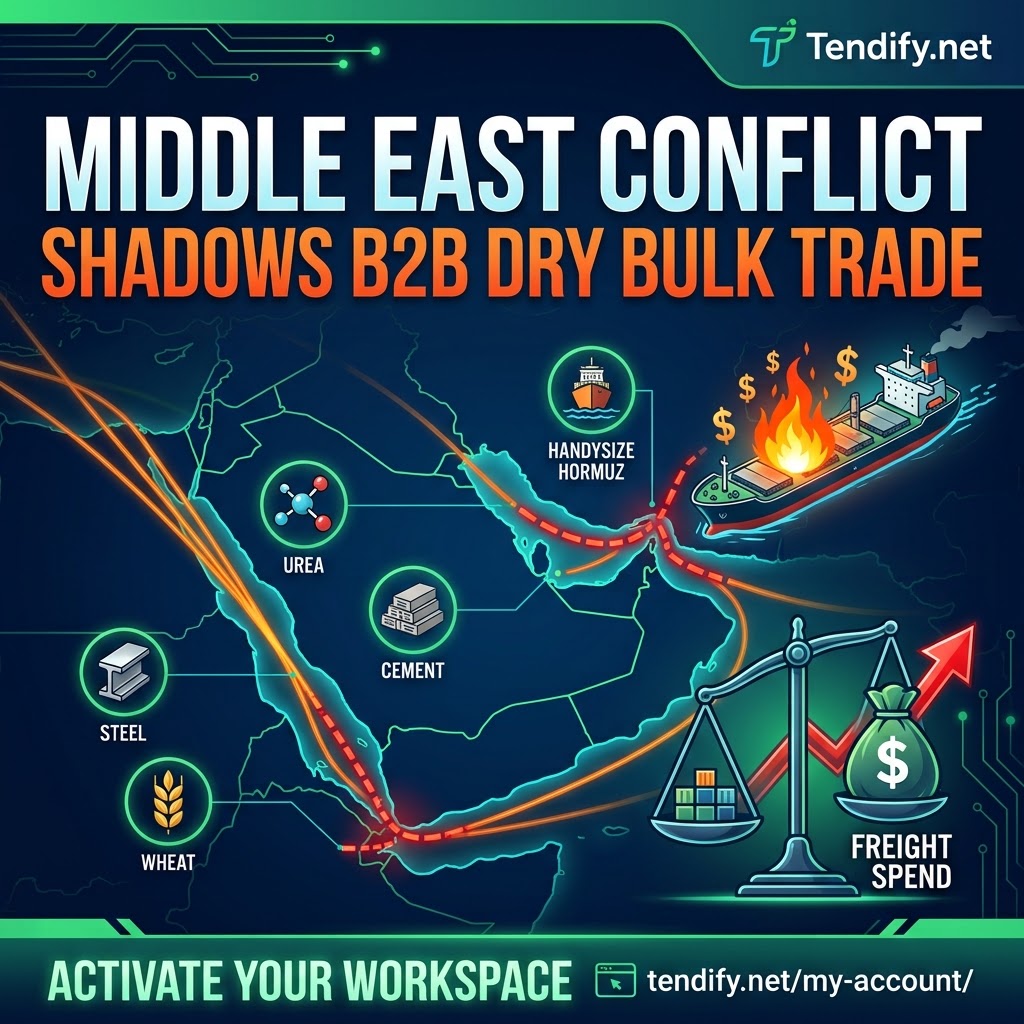
When a single Handysize vessel carrying 35,000 tonnes of clinker sits idle for eleven extra days outside a Gulf port, the demurrage clock does not merely tick. It compounds. At current rates the idle cost alone can erase the entire trading margin on that cargo. Multiply the same pattern across urea, sulphur, rebar and wheat, and the arithmetic becomes structural. Media attention stays fixed on crude and LNG. Operational desks handling low-margin dry bulk have been living a different reality for months.
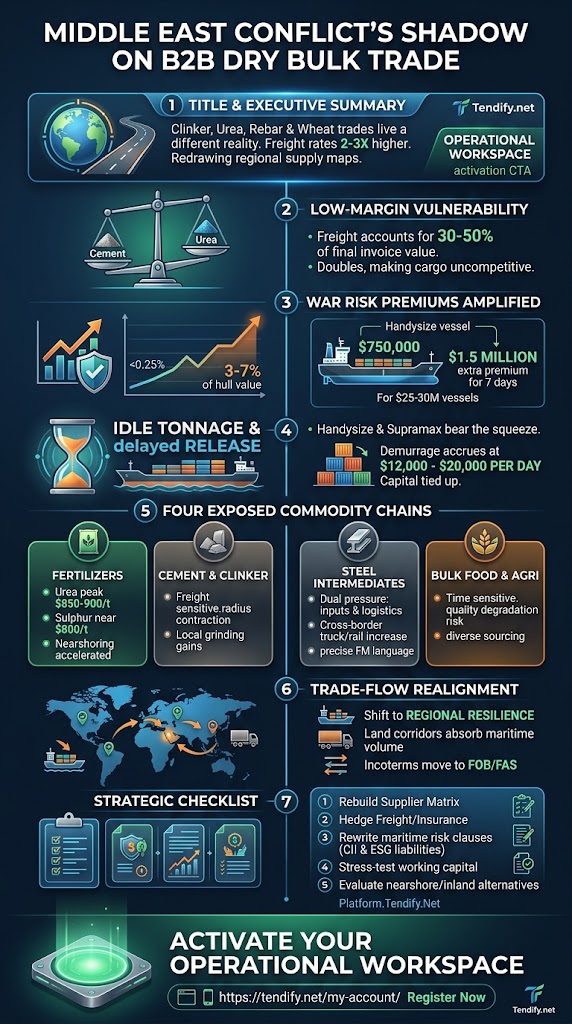
Freight rates on key Middle East–Asia and Middle East–East Africa lanes have doubled or tripled in successive waves. War-risk surcharges that once sat at a few tenths of a percent of hull value now routinely clear 3–7 percent for seven-day exposure windows. Handysize and Supramax vessels—the workhorses of fertilizer, cement and minor-bulk trades—face the sharpest squeeze. The result is not a temporary spike. It is a forced redrawing of regional supply maps.
This analysis examines the transmission mechanism from chokepoint risk into landed costs, then dissects the four most exposed commodity chains. It closes with concrete contract and routing adjustments that trading and procurement teams are already implementing.
Low-Margin Vulnerability: Why Freight Now Dominates the P&L
In high-value bulk such as refined metals or specialty chemicals, ocean freight rarely exceeds 8–12 percent of the delivered price. Cement, clinker, urea, sulphur and many steel intermediates sit at the opposite extreme. On a typical CFR East Africa or CFR South Asia parcel, freight can account for 30–50 percent of the final invoice value. When that component doubles, the cargo crosses the competitive threshold and becomes uncompetitive against nearer-origin alternatives.
War-risk premiums have amplified the effect. Before the latest escalation, additional war-risk premiums for Gulf or Red Sea transits often remained below 0.25 percent of hull value. By mid-2026 quotes for listed areas routinely reached 3–6 percent, and in some southern Red Sea legs approached 7 percent. For a $25–30 million Handysize or Supramax, the seven-day premium alone can exceed $750,000–$1.5 million. Charterers absorb the cost either as a direct surcharge or through higher voyage rates. Either way, the landed price moves.
GCC Dry Bulk Supply Chains
Vessel economics compound the problem. Handysize and Supramax fleets operate with tighter daily cost structures than Capesize or Panamax units. When a vessel is forced to wait outside a high-risk port or divert via the Cape, demurrage accrues at $12,000–$20,000 per day under current market conditions. Capital tied up in idle tonnage and delayed cargo release further erodes working-capital cycles. Traders who previously optimised solely on FOB or CFR price differentials now run daily exposure models that treat time-in-zone as a primary cost driver.
The Credit & Capital Squeeze: Letters of Credit, Cost of Capital, and Cash Surcharges
As maritime rerouting and port congestion add 10 to 25 voyage days, ocean freight is not the only expanding line item on the trading balance sheet. The extended time-in-transit escalates the Cost of Capital and severely stretches working-capital lines. In response to heightened geopolitical risk, international issuing and confirming banks have fundamentally tightened their risk parameters across regional corridors.
Fertilizers and Mineral Inputs: Urea, Sulphur, Phosphates
The Gulf remains one of the world’s largest export platforms for urea, sulphur and phosphate intermediates. Roughly one-third of global seaborne fertilizer trade historically moved through the Strait of Hormuz. When traffic collapses and insurance markets reprice, the impact is immediate and global.
Urea FOB Middle East references moved from the mid-$500s to peaks above $850–$900 per tonne within weeks of the sharpest disruptions. Sulphur followed a similar path, with regional official prices climbing from the mid-$200s into the high $800s over a twelve-month window. Phosphate rock and DAP felt the same logistics premium.
The secondary effect is agricultural. Higher delivered costs for urea and sulphur raise the farm-gate cost of nitrogen and phosphoric acid in South Asia and East Africa. Buyers in those markets have responded in three ways: drawing down stocks, substituting higher-cost but nearer-origin material, and delaying application where possible. Nearshoring has accelerated. East African importers that once preferred Gulf urea on pure price grounds now evaluate North African or Black Sea alternatives more aggressively, even when the FOB differential is unfavourable, because the all-in CFR differential has flipped.
Sulphur deserves separate attention. As the primary feedstock for sulphuric acid plants that feed phosphate fertilizer production, any sustained interruption or cost spike in Gulf sulphur flows directly constrains acid capacity in destination markets. Plants that operate on just-in-time inventories face forced slowdowns or temporary idling. The knock-on effect reaches phosphate fertilizers and, ultimately, crop nutrition programs in deficit regions.
Cost Impact Matrix
Price & Logistics Surge: Middle East Fertilizer & Inputs
Pre-Crisis vs. Crisis Peak
| Commodity / Cost Element | Baseline (Pre-Escalation) | Elevated Risk Peak | Variance (%) |
|---|---|---|---|
| Urea FOB Middle East (Bulk) | $340 – $380 / MT | $850 – $900 / MT | +143% |
| Sulphur Regional Spot Price | $220 – $250 / MT | $820 – $880 / MT | +264% |
| Supramax Freight (Gulf → East Africa) | $22.00 / MT | $52.00 / MT | +136% |
| War-Risk Surcharge (7-Day Premium) | 0.15% hull value (~$0.20/MT) | 3.5% – 6.0% (~$4.80/MT) | +2,300% |
| 20ft Flexibag Box Rate (Gulf → Europe) | $1,450 / FEU | $3,480 / FEU | +140% |
The Containerized Bulk Crunch: Flexibags, Dry Vans, and Relocation Imbalances
While dry-bulk vessels handle large-scale shipments, a substantial volume of chemical fertilizers, polymers, liquid feedstocks, and specialty agri-products moves in 20ft/40ft Dry Vans and Flexibags. The ongoing maritime rerouting around Africa has severely disrupted this segment by triggering a structural Empty Container Relocation crisis.
Cement and Clinker: The Most Freight-Sensitive Chain
Cement and clinker sit at the extreme end of the freight-to-value ratio. A 50,000-tonne clinker cargo valued at $40–50 per tonne can see freight climb from $18–25 per tonne to $45–60 per tonne on longer routes once war-risk and diversion costs are layered in. At those levels, long-haul exports from Gulf and East Mediterranean producers into distant African markets become uneconomic.
The geographic response has been rapid. Producers that previously chased volume into West Africa or the Indian Ocean rim have contracted their radius of economic reach. Intra-regional and short-sea trades within the Gulf and Red Sea basins have absorbed a larger share of available capacity. Simultaneously, local grinding capacity in destination markets has gained relative competitiveness. Even where production costs are higher, the elimination of long ocean freight and associated risk premiums restores margin.
Port congestion and demurrage risk further tilt the balance. Cement terminals often lack the deep-water berths and rapid discharge rates of major iron-ore or grain facilities. Any delay multiplies demurrage exposure. Traders have shortened laytime windows, tightened demurrage clauses, and in some cases shifted to FOB terms so that the buyer, not the seller, carries the maritime risk.
Anatomy of Margin Erosion: 35,000 MT Clinker Parcel (Persian Gulf to East Africa)
To understand why low-margin bulk trading stalls during maritime crises, consider the financial breakdown of a single 35,000 metric tonne clinker shipment. While the baseline FOB price remains unchanged, layered war-risk surcharges, freight spikes, and port demurrage fundamentally reshape landed economics.
| Cost Element | Baseline Baseline Rate | Elevated Risk Rate | Variance / MT |
|---|---|---|---|
| FOB Cargo Value (Clinker) | $38.00 / MT | $38.00 / MT | $0.00 |
| Ocean Freight (Handysize Voyage) | $21.00 / MT | $48.00 / MT | +$27.00 |
| War-Risk Insurance (7-Day Premium) | $0.15 / MT (0.15%) | $4.20 / MT (4.5%) | +$4.05 |
| Demurrage / Idle Delay (6 Days) | $0.00 / MT | $2.57 / MT ($15k/day) | +$2.57 |
| Landed CFR Cost (Port of Destination) | $59.15 / MT | $92.77 / MT | +$33.62 (+56.8%) |
At a baseline margin of $2.50–$3.50 per MT, the additional $33.62/MT cost spike completely destroys trading viability. For a 35,000 MT parcel, total landed cost surges from $2.07 million to $3.24 million—an unbudgeted expense of +$1.17 million per voyage. Unless local African buyers absorb a 56.8% price increase, long-haul sea trade collapses in favor of regional alternatives.
Steel, Billets and Construction Sections
Steel intermediates face a dual pressure: higher energy and input costs plus elevated freight and insurance. Direct-reduced iron (DRI) and pellet supply into Gulf steel plants has been constrained by the same chokepoint risks that affect other dry bulk. Scrap prices in key Gulf markets have reached record levels as alternative feedstocks become scarcer or more expensive.
Export competitiveness has shifted. Gulf rebar and billet exporters competing into Southern Europe or Southeast Asia now face insurance and transit premiums that North African or CIS producers can sometimes avoid. The result is partial market-share erosion on longer routes. In response, a visible increase in cross-border truck and rail movements of finished sections between neighbouring markets has appeared. Where road or rail corridors remain open and relatively secure, the all-in landed cost can undercut ocean routes that carry war-risk exposure.
Contract structures have adapted. More deals move to FOB or even ex-works with the buyer arranging inland and short-sea logistics. Force-majeure and freight-escalation language has become more precise, with explicit triggers for war-risk surcharge thresholds and maximum acceptable diversion days.
The Double-Ended Squeeze: Upstream Inputs vs. Downstream Exports
Analysis that focuses solely on export market losses misses the structural crisis inside regional manufacturing plants. Heavy industrial producers in the Middle East—particularly in steel, clinker, and refractories—are caught in a severe double-ended margin squeeze that impacts both ends of the operational balance sheet.
Bulk Food and Agribusiness
Grain and oilseed trades add a time-sensitivity dimension that pure industrial bulk does not face. Wheat, barley and soybean meal cannot sit indefinitely in a vessel or at anchorage without quality degradation and storage cost accumulation. When vessels divert or wait for clearance, the risk of moisture migration, mould and fumigation failure rises.
Freight indices for grains and oilseeds have registered double-digit percentage increases on routes affected by Red Sea and Gulf risk. Importers into the Gulf and Red Sea basin have responded by lengthening purchase lead times, diversifying origin (Black Sea versus South American versus Australian), and in some cases accepting higher FOB prices from closer origins to reduce voyage exposure. Storage capacity at destination ports has become a strategic asset; operators with underutilised silos can absorb delayed arrivals more gracefully than those running tight just-in-time programs.
Technical Risk Note: Extended Voyages & Bulk Quality Degradation
When maritime diversions around the Cape of Good Hope extend voyage times beyond 35 to 50 days, dry bulk cargoes cross a dangerous thermal and humidity threshold. In bulk Urea, Sulphur, and Phosphate fertilizers, prolonged exposure to high ambient moisture and sea-air condensation causes severe caking, moisture absorption, and granules breakdown.
Similarly, in grain and oilseed parcels, delayed transit severely exacerbates mold proliferation, insect infestation, and heating risks, frequently resulting in substantial post-discharge quality claims and rejection at destination ports.
Trade-Flow Realignment: From Global Sourcing to Regional Hubs
The cumulative effect across all four chains is a measurable shift from pure global cost optimisation toward regional resilience. Contracts that once spanned 8,000–12,000 nautical miles are being shortened. Regional hubs with good inland connectivity and free-zone storage options gain relative advantage. Cross-border trucking and rail corridors between neighbouring markets absorb volume that previously moved by sea.
Incoterms practice has shifted in parallel. Many sellers have moved aggressively to FOB or FAS to transfer maritime risk. Buyers with stronger logistics capability or better insurance access have accepted the transfer and, in some cases, extracted price concessions in return. Freight-escalation clauses that were once considered aggressive have become standard in multi-voyage or annual contracts.
Legal & Maritime Risk
Maritime Documentation & Legal Bottleneck: BIMCO War Clauses, B/L Switch & LOI Exposure
When vessels are forced to reroute via the Cape of Good Hope or face extended anchorage delays outside high-risk Gulf corridors, maritime contracts face immediate friction. Standard trade templates often fail to clarify legal authority over diversions, liability for bunker surges, and title transfer bottlenecks when physical bills of lading are delayed.
BIMCO War Clauses (CONWARTIME / VOYWAR)
Owners routinely invoke CONWARTIME 2004 or VOYWAR 2004 to unilaterally divert or decline dangerous routes. Without pre-negotiated cost-sharing, charterers carry all extra steaming costs.
B/L Switching & LOI Liabilities
As transit times double, original Bills of Lading fail to arrive on schedule. Discharging cargo against Letters of Indemnity (LOI) increases credit risk, legal liability, and title clearance delays.
Bunker Surcharge (BAF) Friction
Adding 3,500 to 5,000 nautical miles consumes hundreds of additional metric tonnes of VLSFO fuel per voyage. Clear BAF formulas are critical to determine whether extra fuel is freight or a war surcharge.
The Hidden Carbon Penalty: Cape Diversions, CII Ratings, and EU Compliance
Beyond direct freight hikes, rerouting maritime traffic around the Cape of Good Hope or enduring prolonged anchorage delays introduces a compounding ESG crisis. Adding 10 to 14 sailing days at standard cruising speeds consumes hundreds of additional metric tonnes of Very Low Sulphur Fuel Oil (VLSFO) per voyage, directly spiking vessel greenhouse gas emissions.
Strategic Checklist for B2B Operators
- Rebuild the supplier-risk matrix. Map every critical bulk input against primary and secondary maritime corridors. Assign explicit probability and impact scores to each chokepoint. Eliminate single-route dependence wherever volume justifies dual-sourcing.
- Hedge freight and insurance exposure. Where volumes are material, negotiate freight-forward agreements or formula-based freight adjustments linked to published indices plus a transparent war-risk adder. Cap the maximum surcharge or define a hard stop that triggers renegotiation.
- Rewrite the maritime risk clauses. Insert clear freight-escalation language that activates at defined war-risk premium thresholds. Specify maximum acceptable diversion days and the cost-allocation formula thereafter. Align demurrage rates with current Handysize/Supramax daily earnings rather than outdated schedules.
- Stress-test working capital. Model the cash impact of an additional 10–15 days of voyage time and demurrage on a representative parcel. Adjust credit terms and inventory buffers accordingly.
- Evaluate nearshore and inland alternatives systematically. For every long-haul lane that has become marginal, run a parallel CFR or delivered cost comparison against the nearest viable alternative origin, including inland logistics. Document the crossover point at which the nearer origin becomes competitive.
- Incorporate BIMCO standard war and route clauses: Mandate the explicit inclusion of updated charterparty terms—such as CONWARTIME 2004 or VOYWAR 2004—alongside transparent Bunker Adjustment Factor (BAF) formulas in both charterparties and underlying B2B sales contracts. Define prior to vessel loading which party bears fuel variance, insurance deductibles, and delays if a vessel is ordered to divert via the Cape of Good Hope or face forced drifting outside designated risk zones. Establish clear operational protocols for Letter of Indemnity (LOI) usage and B/L switching to prevent document-release blockages at destination ports.
Operational desks that treat these adjustments as one-time emergency measures will face repeated margin compression. Those that embed them into standard contract templates and quarterly risk reviews convert volatility into a manageable cost of doing business.
Platform tools that consolidate real-time freight intelligence, HS classification and contract templates can reduce the administrative drag of these changes; one practical option is available at Platform.Tendify.Net for teams that need rapid scenario modelling without building internal systems from scratch.
Deep-Dive Operational Resources & Related Analysis:
For deeper operational detail on demurrage mechanics in GCC ports, see the analysis at
https://tendify.net/demurrage-vs-detention-in-gcc-ports/.
Parallel guidance on Incoterms selection under elevated maritime risk is available at
https://tendify.net/incoterms-selection-assistant/.
Frequently Asked Questions (FAQ)
What is the key difference between Demurrage and Detention in GCC container ports?
Demurrage is charged when a full container remains inside the port terminal beyond the allowed free days (terminal equipment usage fee). Detention occurs after the container is gated out of the terminal, charging for the extra days taken until the empty container is returned to the line’s designated depot.
How do demurrage free-day allocations typically differ between Jebel Ali, Khalifa Port, and Dammam?
Standard carrier free time ranges between 3 to 10 days based on container type (dry vs. temperature-controlled reefer) and contract volume. Hub ports like Jebel Ali (DP World) and King Abdulaziz Port in Dammam apply progressive daily rate escalations once free days expire.
Which Incoterms 2020 rules best mitigate risk during elevated Red Sea/Persian Gulf maritime disruptions?
Under heightened risk, FCA (Free Carrier) or CPT (Carriage Paid To) offer precise risk-transfer boundaries. FCA allows sellers to handle export formalities without assuming long-haul ocean transit risks that occur under CIF or CIP rules.
Who pays demurrage fees when customs clearance or inspection causes port delays?
Financial liability aligns with the Incoterm chosen. Under DDP, the seller assumes all customs delays and demurrage expenses. Under DAP, CFR, or CIF, the buyer (consignee) is responsible for clearance holds, port storage, and demurrage accruals.
Can demurrage charges in Middle Eastern ports be disputed or negotiated after accrual?
While shipping lines strictly enforce tariffs, partial relief can sometimes be negotiated if delays resulted directly from verified port congestion, strikes, or carrier documentation errors. Submitting a formal appeal with vessel tracking records is required.

