


Blog
Medical Device Export to GCC 2026: The Complete Regulatory Guide
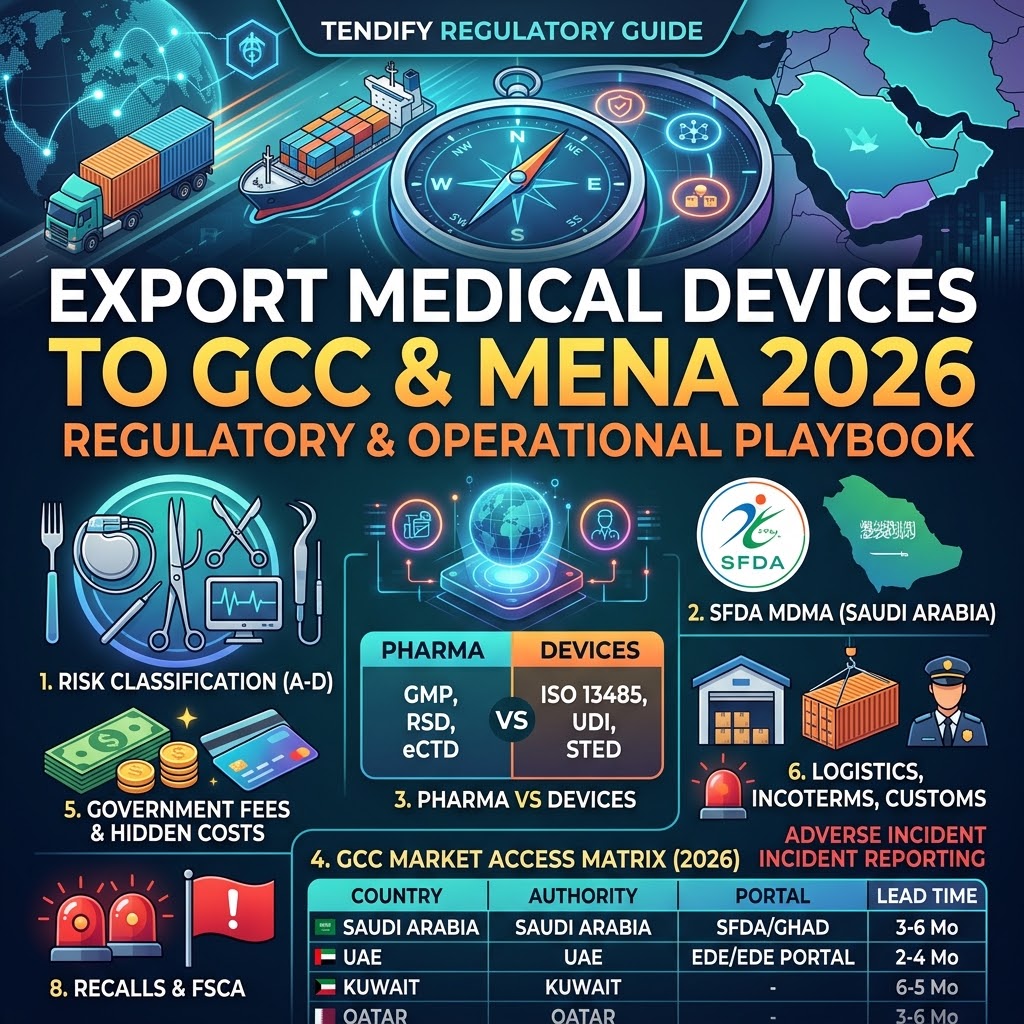
A hospital procurement committee in Riyadh rejected three container loads of surgical consumables last quarter because the packaging lacked Arabic-language UDI barcodes and the Free Sale Certificate had not been properly legalized. The exporter absorbed demurrage, storage, and re-work costs that erased the entire margin on the shipment. Similar friction plays out weekly across the Gulf as demand for medical equipment and hospital supplies accelerates under national health transformation programs.
Saudi Vision 2030 and parallel initiatives in the UAE, Qatar, Oman, and Kuwait continue to drive large-scale hospital construction, digital health adoption, and private-sector expansion. The result is sustained demand for Class I consumables through high-risk implants and life-support systems. Market access, however, is gated by rigorous risk-based registration, local representation, technical documentation, and post-market obligations. This guide walks through the exact sequence required to move devices from manufacturing site to hospital shelf without regulatory rejection or customs hold.
Quick Reference Guide
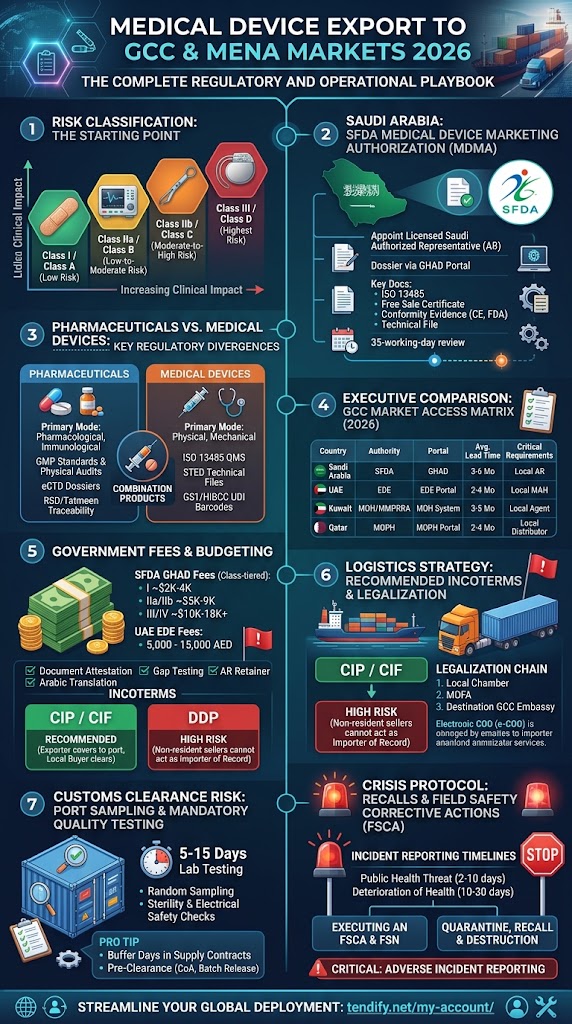
GCC Medical Device Market Access Matrix (2026)
A high-level regulatory comparison for medical device export across primary Gulf markets.
| Country | Authority | Portal | Avg. Lead Time | Critical Requirements |
|---|---|---|---|---|
| 🇸🇦 Saudi Arabia | SFDA | GHAD | 3–6 Months | • Licensed Saudi Authorized Representative (AR) • Full MDMA technical dossier • Mandatory Arabic labeling & UDI barcodes |
| 🇦🇪 United Arab Emirates | EDE | EDE Portal | 2–4 Months | • Local Authorized Representative / MAH • ISO 13485 & Legalized FSC • Bilingual Arabic/English IFU |
| 🇰🇼 Kuwait | MOH / MMPRRA | MOH System | 3–5 Months | • Local agent with medical license • STED technical file format • Accelerated review with SFDA/CE reference |
| 🇶🇦 Qatar | MOPH | MOPH Portal | 2–4 Months | • Mandatory local distributor • Full registration for Class IIb/III/Implants • Import permits for low-risk consumables |
*Note: Lead times indicate average regulatory review duration following a complete dossier submission and may vary based on device risk classification and clinical data completeness.
Risk Classification: The Starting Point That Determines Everything
Every GCC regulator begins with classification. Misclassification is the most common reason for delayed or rejected applications.
Regulators generally follow IMDRF-aligned principles, grouping devices by degree of invasiveness, duration of contact, and potential for harm:
- Class I / Class A (low risk): Non-sterile, non-measuring devices with transient contact or simple barrier function. Examples include examination gloves, non-sterile bandages, basic wheelchairs, and many non-invasive diagnostic aids.
- Class IIa / Class B (low-to-moderate risk): Short-term invasive devices, certain monitoring equipment, and lower-risk diagnostic systems.
- Class IIb / Class C (moderate-to-high risk): Longer-term invasive devices, energy-emitting equipment, and many surgical instruments or monitoring systems with higher clinical impact.
- Class III / Class D (highest risk): Implantable devices, life-supporting or life-sustaining systems, and devices contacting the central circulatory or nervous system.
IVDs follow a parallel A–D or equivalent scale based on individual and public-health risk. Classification is the manufacturer’s responsibility and must be justified by intended purpose, not by marketing claims. The same device can sit in different classes across jurisdictions if the intended use language differs. Secure a formal classification opinion early—either from the local regulator or through a recognized pathway—because documentation depth, clinical evidence requirements, and review timelines scale directly with class.
Medical Device Export to GCC 2026
💊 Pharmaceuticals vs. Medical Devices: Key Regulatory Divergences
While both sectors share overarching health authority oversight in the GCC, the regulatory pathways for pharmaceutical products diverge significantly from medical devices in terms of quality standards, registration lead times, and supply chain serialization.
🔬 Primary Mode of Action (PMOA)
Medical devices achieve their principal intended action through physical, mechanical, or structural means. Pharmaceuticals act via pharmacological, immunological, or metabolic means. For combination products (e.g., drug-eluting stents, pre-filled syringes), classification is determined by the PMOA.
🏭 Quality Standards: GMP vs. ISO 13485
Device manufacturers demonstrate compliance through ISO 13485 quality management systems. Pharmaceuticals require strict adherence to Good Manufacturing Practice (GMP), necessitating mandatory physical site inspections by SFDA or EDE auditors prior to product approval.
📋 Registration Timelines & Dossiers
Pharmaceutical submissions demand eCTD (electronic Common Technical Document) formats, bioequivalence studies, and stability data under Zone IVb climatic conditions. Review timelines for drugs typically span 12 to 18 months, compared to 3 to 6 months for most mid-risk medical devices.
📲 Track & Trace Serialization
Pharmaceuticals face rigorous national serialization mandates—such as Saudi Arabia’s RSD (Drug Track and Trace System) and UAE’s Tatmeen—requiring 2D DataMatrix barcoding at the secondary packaging level before physical customs dispatch.
Regulatory Takeaway: If exporting combination products or biologics-adjacent medical technology, confirm with your local Authorized Representative whether your submission will be routed through the Medical Device Directorate or the Pharmaceutical Evaluation Department, as dossier requirements and audit fees differ substantially.
Saudi Arabia: SFDA Medical Device Marketing Authorization (MDMA)
Saudi Arabia remains the largest and most structured market. The Saudi Food and Drug Authority requires a Medical Device Marketing Authorization (MDMA) for virtually all devices placed on the market. The previous lighter MDNR listing route closed years ago; every device now follows the full technical-file pathway.
Foreign manufacturers without a Saudi legal entity must appoint a licensed Saudi Authorized Representative (AR). The AR holds the establishment license, submits applications through the GHAD electronic portal, and remains the primary point of contact for SFDA correspondence, variations, and post-market surveillance. Choosing an AR with demonstrated regulatory capacity rather than the lowest administrative fee reduces later friction.
Key documentation for an MDMA submission typically includes:
- Valid ISO 13485 certificate covering the manufacturing sites and relevant processes
- Free Sale Certificate issued by the competent authority in the country of origin
- Conformity evidence (CE Mark under MDR/IVDR, US FDA 510(k) or PMA, or equivalent)
- Complete technical file (device description, design and manufacturing information, risk management file per ISO 14971, essential principles checklist, labeling and instructions for use)
- Clinical evaluation report or performance evaluation for higher classes
- Arabic and English labeling, including Unique Device Identification where required
- Post-market surveillance plan
SFDA has published updated bundling guidance (MDS-G028) allowing related devices that share intended purpose, technology, and risk class to be grouped under a single MDMA application when the criteria are met. Review timelines after a complete submission commonly fall in the 35-working-day range for standard assessment, although end-to-end preparation-to-approval often spans three to six months depending on class, completeness, and any additional information requests. Higher-risk devices and novel technologies can take longer.
UDI implementation and GSDP-aligned storage and distribution requirements apply after authorization. Importers and distributors must maintain controlled conditions and traceability systems.
United Arab Emirates: EDE Marketing Authorization
In the UAE the federal responsibility for medical device marketing authorization transferred from the Ministry of Health and Prevention (MOHAP) to the Emirates Drug Establishment (EDE). Applications now run through the EDE portal. Emirate-level authorities (DHA in Dubai, DoH in Abu Dhabi) continue to license healthcare facilities and professionals but do not issue the primary device marketing authorization.
Foreign manufacturers must work through a UAE-licensed Local Authorized Representative or Marketing Authorization Holder—typically a licensed medical warehouse or marketing office. The LAR/MAH submits the dossier, holds the authorization, and carries post-market responsibility.
Core requirements mirror international practice:
- Establishment registration of the local holder
- ISO 13485 evidence
- Free Sale Certificate (embassy-attested)
- Conformity certificates appropriate to class
- Technical documentation, risk management, and clinical or performance evidence scaled to risk
- Bilingual (Arabic/English) labeling and instructions for use
- Post-market monitoring plan
Published service timelines for registration often cite approximately 45 working days once the file is complete. Validity is commonly five years, subject to renewal. Local emirate rules may impose additional facility-level or procurement requirements once the federal authorization is in place.
Other GCC Markets: Kuwait, Qatar, Oman, and Bahrain
These markets maintain national systems that frequently recognize or accelerate review when SFDA, CE, or FDA approvals already exist.
- Kuwait: Ministry of Health / MMPRRA oversees registration under risk-based classification (A–D). Local AR required. Technical file in STED or equivalent format, ISO 13485, Free Sale Certificate, and labeling in Arabic and English.
- Qatar: Ministry of Public Health pathways distinguish full registration (especially for implantables) from import permits for other devices. Local AR mandatory. Reference-market approvals shorten review.
- Oman: Ministry of Health applies risk-based rules; higher classes require mandatory registration. International approvals facilitate faster processing.
- Bahrain: National Health Regulatory Authority framework; registration mandatory above low-risk thresholds.
In each case the practical sequence remains consistent: confirm classification, appoint a qualified local representative, assemble the technical and quality dossier, submit through the national portal or process, and secure authorization before shipment.
Essential Documentation Checklist
Regardless of destination market, the following core package forms the foundation:
- ISO 13485:2016 (or current edition) quality management system certificate covering design, manufacture, and relevant outsourced processes.
- Free Sale Certificate from the competent authority in the country of manufacture, properly legalized or apostilled as required by the destination.
- Conformity evidence—CE Mark, FDA clearance/approval, or equivalent recognized by the target authority.
- Technical documentation / STED-format file including device description, specifications, risk analysis, biocompatibility (ISO 10993 where applicable), electrical safety (IEC 60601 series), software validation, and sterilization validation.
- Clinical Evaluation Report or performance evaluation data scaled to risk class.
- Labeling and Instructions for Use in Arabic and English, incorporating UDI elements, lot/batch numbers, expiry dates, and manufacturer details.
- Declaration of Conformity and any required manufacturer’s authorization letters to the local representative.
- Post-market surveillance plan and vigilance procedures.
Incomplete or inconsistent files are the primary cause of clock stops and rejection. Align every document to the exact intended purpose and classification claimed in the application.
Step-by-Step Export Sequence
- Confirm device classification under the target country’s rules and obtain any formal classification confirmation if available.
- Appoint and contract a qualified Authorized Representative / Local Agent who holds the necessary licenses and has demonstrated regulatory experience with medical devices.
- Assemble and gap-analyze the technical dossier; commission any missing testing or clinical data.
- Prepare bilingual labeling and IFU; verify UDI compliance where mandated.
- Submit the application through the relevant electronic system (GHAD for Saudi, EDE portal for UAE, national systems elsewhere) and pay the applicable fees.
- Respond promptly and completely to any additional information requests.
- Upon authorization, obtain the necessary import permits or shipment clearances.
- Arrange logistics with attention to temperature control, GSDP storage conditions, and customs documentation. Cold-chain or sensitive devices require validated shipping and monitoring.
- Maintain post-market surveillance, adverse-event reporting, and change-control obligations for the life of the authorization.
⚖️ Financial Considerations: Customs Duties, HS Codes & VAT Framework
Navigating regulatory compliance ensures product access, but commercial viability depends heavily on understanding the tariff structures, duty exemptions, and Value Added Tax (VAT) rules applied across GCC customs ports.
🏷️ HS Code Classification & Chapter 90
Medical devices primarily fall under Chapter 90 (Optical, photo, medical, or surgical instruments). Duty rates vary based on exact classification:
- Standard Customs Duty: Generally ranges from 0% to 5% across the GCC Unified Customs Tariff.
- Customs Valuation: Determined using CIF (Cost, Insurance, and Freight) value at the port of entry. Ensure commercial invoices explicitly itemize shipping and insurance to prevent over-assessment.
💰 Value Added Tax (VAT) Dynamics
VAT rates differ across GCC member states and impact cash flow during customs clearance:
- Saudi Arabia (KSA): Standard rate is 15%.
- United Arab Emirates (UAE): Standard rate is 5%.
- Exemptions & Zero-Rating: Essential medical equipment, life-saving devices, and qualifying pharmaceuticals frequently qualify for 0% VAT (Zero-Rated) or specific exemptions, whereas general hospital consumables usually attract the standard rate.
Pro Tip: Verify VAT zero-rating eligibility with your local Authorized Representative prior to shipment. Misclassifying products on import documentation can result in unexpected 15% VAT charges at KSA customs ports, which requires complex administrative appeals to reclaim.
💳 Regulatory Budgeting: Government Fees & Hidden Compliance Costs
Accurate financial planning for GCC market entry requires factoring in mandatory government application fees, annual representation retainers, and dossier maintenance costs. Regulatory body submission fees are strictly non-refundable, regardless of whether an application is approved, delayed, or rejected.
🇸🇦 Saudi Arabia (SFDA)
Official Portal
SFDA applies a class-tiered pricing structure for MDMA evaluation through GHAD:
- Class I (Low Risk): ~$2,000 – $4,000 USD per application.
- Class IIa / IIb (Moderate): ~$5,000 – $9,000 USD.
- Class III / IV (High Risk): ~$10,000 – $18,000+ USD depending on clinical review complexity.
- AR Establishment License: Annual fee of ~$2,600 – $4,000 USD.
🇦🇪 UAE (EDE / MOHAP)
Federal Rates
EDE registration fees scale based on classification and product bundling:
- Device Registration Fee: Ranges from 5,000 AED to 15,000 AED (~$1,360 – $4,080 USD) per submission.
- Import Permit Fees: ~$80 – $300 USD per individual shipment clearance.
- Local MAH Retainer: Independent commercial negotiations with UAE warehouse holders.
⚠️ Common Hidden & Variable Compliance Expenditures:
Financial Risk Strategy: Never submit incomplete technical files to “hold a spot” in the queue. Health authorities like SFDA strictly enforce limits on response cycles (typically 2 to 3 Clock-Stops). If questions are not answered adequately due to missing test data, the file is rejected and all paid government fees are completely forfeited.
🚢 Logistics Strategy: Recommended Incoterms & Document Legalization
Securing regulatory clearance is only half the battle. Managing international freight for medical shipments requires precise Incoterms selection and meticulous document legalization to prevent costly demurrage and border holds across GCC entry ports.
📦 Incoterms Selection for Medical Cargo
Selecting the wrong Incoterm is a frequent cause of customs blockages. Because local laws require a licensed Authorized Representative (AR) or importer of record to clear medical goods, delivery obligations must be structured carefully:
CIP (Carriage and Insurance Paid to) / CIF (Cost, Insurance & Freight)
The exporter maintains control and covers freight/insurance up to the destination port, while the local buyer/AR handles customs clearance under their local medical license.
DDP (Delivered Duty Paid)
Extremely risky for foreign manufacturers. Non-resident sellers cannot act as the Importer of Record or execute medical customs clearance without a resident medical establishment license.
📜 Certificate of Origin (COO) & Legalization Workflow
GCC customs authorities enforce strict authentication requirements for commercial shipping documents. A standard commercial invoice or origin certificate without proper legalization will cause immediate port detention.
Mandatory Legalization Chain:
- Local Chamber of Commerce attestation in the country of origin.
- Ministry of Foreign Affairs (MOFA) authentication.
- Embassy / Consulate legalization of the destination GCC country (e.g., Saudi or UAE Embassy).
*Note: Electronic Certificate of Origin (e-COO) systems are increasingly accepted in KSA (via SABER/FASAH) and UAE, but physical consular attestation remains standard for high-value medical shipments.
Critical Operational Note: Always ensure that the manufacturer name and facility address listed on the Certificate of Origin, Free Sale Certificate, and Packing List match the details registered on the SFDA (GHAD) or EDE portal to the exact letter. Minor typographical discrepancies trigger customs holds and mandatory re-attestations.
🔍 Customs Clearance Risk: Port Sampling & Mandatory Quality Testing
Even with a fully approved MDMA or EDE registration, customs authorities across Saudi Arabia (ZATCA / SFDA) and the UAE (Federal Customs Authority) exercise strict post-arrival quality controls. Shipments of high-risk medical devices, sterile consumables, and diagnostics are routinely flagged for random port inspection and physical sampling.
⏱️ Lab Testing Lead Times (5 to 15 Days)
When a container is flagged for random sampling, customs officers extract physical samples for accredited laboratory verification (e.g., testing sterility, electrical safety, or chemical composition). This process holds the shipment in bonded storage for an additional 5 to 15 business days.
❄️ Temperature Control & Demurrage Exposure
Hold-ups during lab testing trigger port demurrage and storage fees. For temperature-sensitive consumables or cold-chain diagnostics, prolonged holds in port storage yards pose a severe risk to product integrity if temperature-controlled bonded facilities are not pre-booked.
🛠️ Best Practices to Minimize Port Clearance Delays:
- Batch Pre-Clearance (FASAH / SABER): Upload Certificate of Analysis (CoA) and Batch Release Certificates into national customs portals prior to vessel arrival.
- Intact Sterility Seals: Ensure individual packaging displays clear, unaltered sterilization indicators and batch numbers matching the shipping dossier exactly.
- Buffer Days in Contracts: Include a 10-to-14 day operational buffer in delivery schedules under supply agreements with local purchasing healthcare entities.
Pro Tip: Never break original manufacturer seals on master cartons or sample units prior to port inspection. Discrepancies between physical carton labeling and official test reports automatically trigger full batch holds or mandatory re-export orders.
Operational Challenges and Practical Mitigations
UDI and traceability — Several GCC markets have moved or are moving toward mandatory Unique Device Identification. Barcoding and data systems must be ready before commercial shipments.
Storage and distribution (GSDP) — Warehouses and distributors must meet Good Storage and Distribution Practice standards. Temperature excursions or inadequate segregation can trigger recalls or import holds.
Post-market surveillance — Authorization holders are obligated to monitor performance, report serious incidents, and execute field safety corrective actions. Regulators expect written procedures and timely reporting.
🚨 Crisis Protocol: Recalls & Field Safety Corrective Actions (FSCA)
Securing market access is not the end of regulatory compliance. GCC health authorities mandate rigorous Post-Market Surveillance (PMS) systems. In the event of a device malfunction, unexpected adverse event, or technical defect, foreign manufacturers and their local Authorized Representatives (ARs) must execute swift, documented crisis protocols.
⏱️ Incident Reporting Timelines
Regulators enforce strict reporting deadlines for adverse events:
- Serious Public Health Threats / Death: Report within 2 to 10 calendar days.
- Serious Deterioration of Health: Report within 10 to 30 calendar days depending on authority guidelines (e.g., SFDA Vigilance System).
📢 Executing an FSCA & FSN
When a technical flaw is identified, manufacturers must issue a Field Safety Notice (FSN) directly to affected healthcare facilities, hospitals, and distributors. The FSN must outline immediate quarantine steps, risk mitigation, and repair or replacement schedules.
🔥 Quarantine, Recall & Destruction
Physical retrieval of affected lots from hospital supply chains must be coordinated via the local AR. If the regulator orders mandatory destruction of defective goods, it must be executed at certified environmental facilities with an official destruction certificate submitted to the authority.
Compliance Warning: Failure to report adverse incidents or concealing field safety corrective actions can result in severe penalization—including immediate revocation of the MDMA license, blacklisting of the foreign manufacturer, and heavy criminal fines for the local Authorized Representative.
Timeline variability — Low-risk devices with complete files and reference approvals can clear in a few months. High-risk or novel devices frequently require six to twelve months or longer. Build buffer into commercial planning.
Labeling and language — Arabic is mandatory on labeling and IFU in most markets. Inconsistencies between English and Arabic versions create delays.
Cold-chain and logistics — Certain diagnostics, biologics-adjacent devices, and temperature-sensitive products require validated cold-chain solutions from origin through final delivery. Coordinate early with freight forwarders experienced in medical cargo.
Experienced operators treat the regulatory file as a living commercial asset rather than a one-time submission. They maintain a master technical file that can be rapidly adapted for multiple GCC submissions, reduce re-work, and accelerate sequential market entries. Saudi MDMA often serves as a strong reference that shortens subsequent reviews in neighboring markets.
🔄 Refurbished & Used Equipment: Severe Import Restrictions Across the GCC
High-value capital equipment—such as MRI systems, CT scanners, and linear accelerators—frequently trades on the international refurbished market. However, exporting used or refurbished medical technology into the GCC involves rigorous regulatory barriers that differ significantly from new device pathways.
🚫 General Prohibition & Special Authorization Framework
- Saudi Arabia (SFDA): Importation of used or second-hand medical equipment is strictly prohibited by default. Refurbished devices are only permitted under highly restricted conditions where the refurbishment is executed directly by the Original Equipment Manufacturer (OEM) or an OEM-certified facility under an approved MDMA pathway.
- UAE & Broader GCC: Import clearance requires explicit prior approval from the health authority (e.g., EDE/MOHAP). Third-party refurbishers without official OEM authorization routinely face rejection at customs ports.
- Mandatory Certification: Refurbished devices must retain the original intended purpose, carry updated safety testing certificates (e.g., IEC 60601 re-certification), and include full OEM-backed warranties and spare-parts availability guarantees (typically 5 to 10 years).
Warning for Exporters: Never ship used or refurbished medical cargo to GCC ports under standard commercial invoices without explicit, written pre-approval and specialized import permits from the destination authority. Customs holds on unauthorized refurbished equipment almost always result in mandatory re-export or destruction at the exporter’s expense.
For teams managing complex multi-market documentation or needing structured export process support, tools available through Platform.Tendify.Net can help organize checklists and track compliance milestones without replacing professional regulatory counsel.
Cross-border logistics and documentation discipline remain decisive after regulatory approval. Parallel attention to export documentation standards and Incoterms selection for high-value medical cargo reduces the risk of costly holds at the border.
The GCC medical device market rewards manufacturers who treat regulatory compliance as an integrated commercial process rather than a last-minute hurdle. Clear classification, a capable local representative, a complete and consistent technical file, and disciplined post-market systems convert regulatory requirements into predictable market access. The alternative—reactive firefighting after a shipment is detained—continues to erase margins for those who underestimate the process.
Regulatory & Operational Knowledge Base
Frequently Asked Questions (FAQ)
Essential answers for medical device exporters entering Saudi Arabia, UAE, and GCC markets.
Q1: How long is a Saudi SFDA Medical Device Marketing Authorization (MDMA) valid?
An MDMA license issued by the SFDA is typically valid for three (3) years or until the expiration of the foreign reference market approval (e.g., CE Mark or FDA clearance), whichever comes first. Renewal applications should be initiated at least 60 to 90 days prior to expiration through your appointed Saudi Authorized Representative via the GHAD portal.
Q2: Can a foreign manufacturer act directly as the Authorized Representative (AR) in GCC countries?
No. Foreign manufacturers without a legally registered local establishment in the destination country must appoint a resident Authorized Representative (AR) or Marketing Authorization Holder (MAH). The AR must hold a valid establishment license issued by the national health authority (such as SFDA in KSA or EDE in UAE) to submit files and oversee post-market surveillance.
Q3: Are Arabic language labels mandatory for hospital medical consumables?
Yes. Both SFDA (Saudi Arabia) and EDE (UAE) mandate bilingual labeling (Arabic and English) for medical devices and consumables intended for clinical or patient use. Key details—including product description, intended use, storage conditions, warnings, lot/batch numbers, and UDI barcodes—must appear in Arabic either on the primary packaging or the secondary outer box and Instructions for Use (IFU).
Q4: What happens if our Free Sale Certificate (FSC) is not legalized by the embassy?
An un-legalized or improperly attested Free Sale Certificate will result in immediate rejection during file validation or a customs hold at the port of entry. The legalization chain must be completed in order: Chamber of Commerce → Ministry of Foreign Affairs (MOFA) in origin country → Destination GCC Embassy.
Q5: Is Unique Device Identification (UDI) mandatory across all GCC markets in 2026?
UDI implementation is fully enforced in Saudi Arabia (SFDA) for Class B, C, and D devices, with strict GS1 or HIBCC barcode requirements. UAE (EDE) and other GCC members are actively phasing in mandatory UDI compliance. Exporters should ensure all product labels incorporate UDI-DI and UDI-PI barcodes prior to commercial dispatch.
Q6: What is the average regulatory review timeline for Class IIa / Class IIb medical devices?
While official regulatory service standards cite 35 to 45 working days, practical end-to-end timelines (from dossier compilation, gap remediation, local representative submission, to final MDMA approval) typically span 3 to 6 months. Delays usually stem from incomplete technical files, missing biocompatibility data, or unaligned labeling details.
Ready to Accelerate Your Medical Device & Regulatory Workflows?
When launching high-value medical shipments across Saudi Arabia, UAE, and the broader MENA region, execution errors cost time and margin. Build your centralized operating base to manage regulatory compliance, trade documentation, and supply chain milestones with total transparency.
STED Technical Dossiers
Organize and track SFDA, EDE, and MOH compliance checklists.
Cross-Border Trade Tools
Access specialized B2B trade calculators and document generators.
Logistics Visibility
Maintain strict control over Incoterms, attestation, and port clearances.
Manage your account and deployment tools directly at tendify.net/my-account/

