


المدونة
Dubai Shahin Compliance Guide 2026: SIRA & Tracking Rules
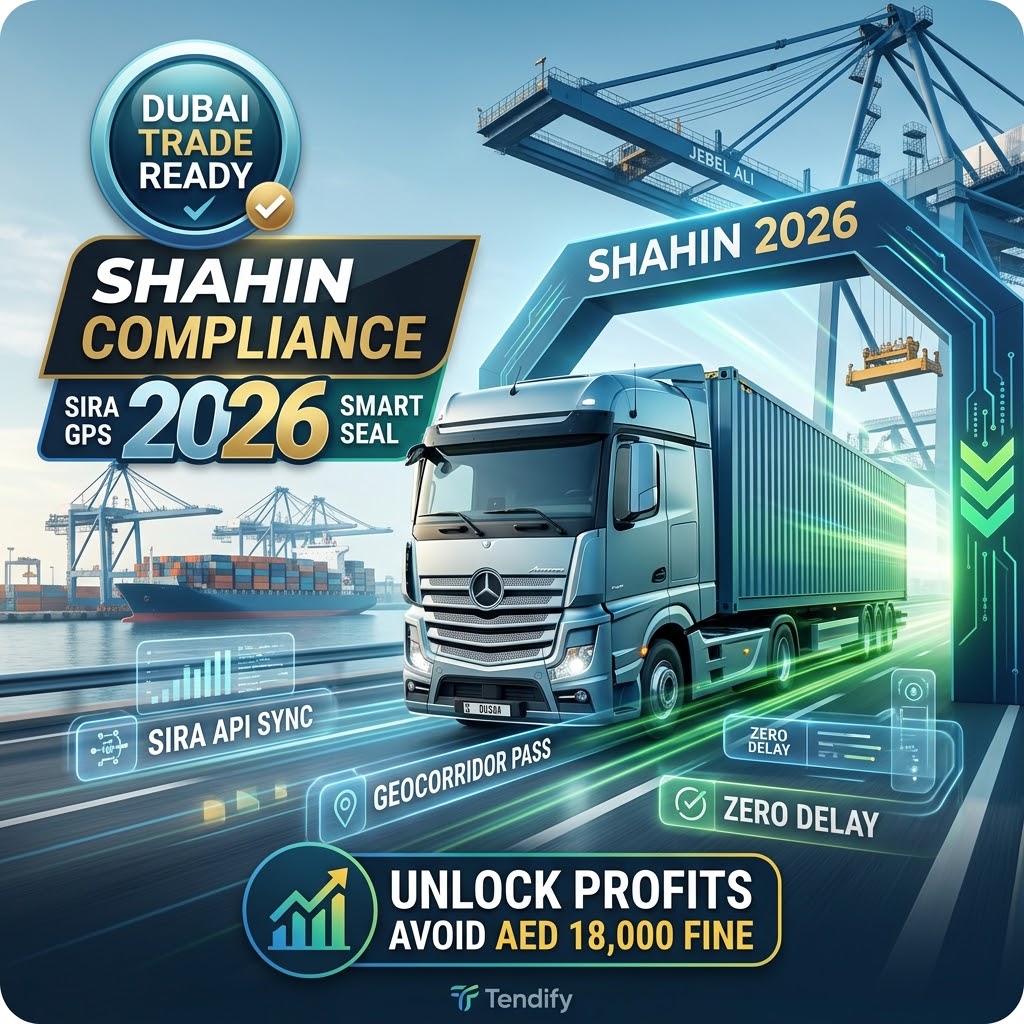
A truck leaves Jebel Ali after clearance. Within minutes the electronic seal is active, satellite pings begin, and the virtual corridor is live. Any deviation triggers an alert. For operators moving containers through Dubai’s ports in 2026, this is no longer optional technology. It is the operational baseline.
Shahin is the integrated smart monitoring system that Dubai Customs and the Security Industry Regulatory Agency (SIRA) use to track cargo trucks from entry points to final destination. Built on SecurePath Premium GPS hardware and electronic smart seals, it delivers continuous visibility, reduces customs friction, and protects supply-chain continuity. Non-compliant fleets face denied port access, fines that can reach AED 18,000 per violation, and delayed clearances that cascade into demurrage and lost contracts.
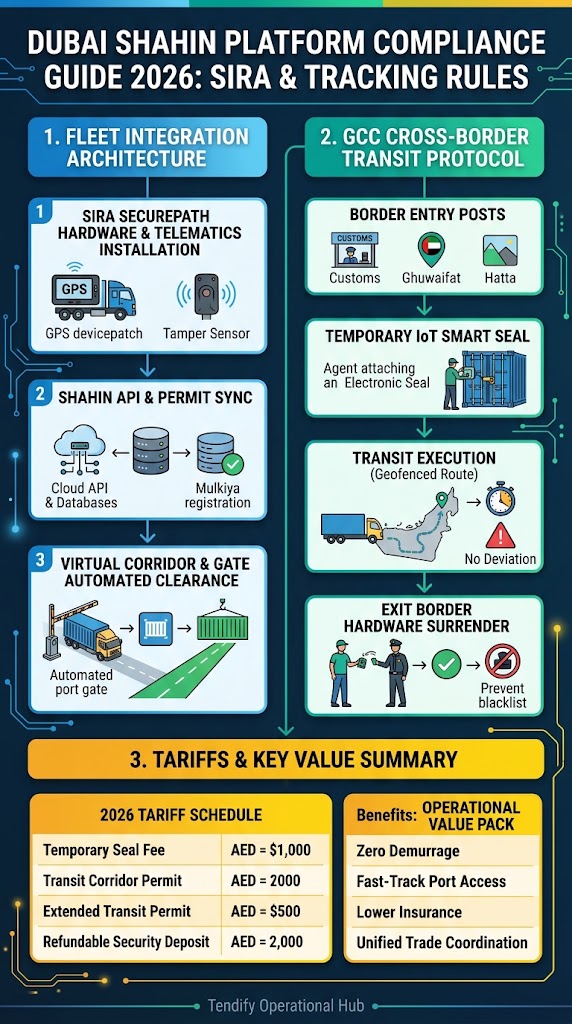
Dubai Shahin Compliance Guide 2026
This guide breaks down exactly what Shahin requires, who must comply, the registration and installation sequence, the operational impact on daily logistics, and the practical steps that keep fleets moving without interruption.
What Shahin Actually Is and Why It Exists
Shahin functions as an end-to-end truck and cargo tracking layer across Dubai’s customs entry points. After inspection and clearance, an electronic smart seal is applied to the truck. Satellite-based technology then monitors the vehicle in real time through designated virtual customs corridors. Instant alerts fire if the truck leaves the approved route or exhibits unusual movement.
The system serves four concrete objectives:
- Continuous 24/7 visibility of commercial cargo vehicles from port or airport gates to destination.
- Prevention of theft, unauthorized diversion, and illicit transit.
- Faster customs processes through data integration and reduced physical checks.
- Improved road safety and traffic management for heavy vehicles.
Dubai Customs has positioned Shahin as part of a broader digital resilience package that includes pre-clearance and Green Corridor facilitation. In practice, the platform turns what used to be a series of paper-based hand-offs into a single monitored digital flow. Operational assessments across GCC logistics corridors show that fleets with active Shahin links experience fewer secondary inspections and shorter gate times once the system is correctly synchronized.
Key Distinction
Understanding SIRA SecurePath vs. Dubai Shahin Platform
To prevent compliance confusion for fleet operators and logistics managers in the UAE, it is critical to distinguish between these two interconnected regulatory frameworks:
Who Must Comply: Vehicle Categories and Operational Scope
Compliance is mandatory for specific commercial categories operating in Dubai, particularly those accessing seaports, airports, or handling regulated cargo. The core groups include:
- Heavy and light trucks registered for general cargo transport.
- Container transporters moving between ports, free zones, and inland warehouses.
- Vehicles servicing Dubai Port Authority facilities, including Jebel Ali, Port Rashid, and related terminals.
- Specialized fleets: diesel and petroleum tankers, refrigerated trucks, hazardous materials carriers, mobile workshops, and certain high-risk categories (flammable liquids, explosives, radioactive materials where applicable).
Rental and leasing fleets fall under related SecurePath rules, but Shahin specifically targets cargo and port-bound operations. Vehicles registered in Dubai that regularly enter airport or seaport controlled areas fall under the requirement. Cross-emirate operators whose trucks enter Dubai ports must also ensure the Dubai-registered units are compliant.
Fines for non-compliance can reach AED 18,000 per violation. More critically, non-registered or non-transmitting vehicles are routinely denied entry or clearance. In high-volume corridors this translates directly into demurrage exposure and missed delivery windows.
🚛
Cross-Border & GCC Transit Fleets: Temporary vs. Permanent Compliance
A primary area of operational ambiguity for foreign logistics providers involves foreign-registered trucks entering Dubai from Saudi Arabia, Oman, or broader GCC corridors. Compliance rules depend strictly on vehicle registration status and entry duration:
SecurePath Premium: The Technical Backbone
Shahin operates on top of SecurePath Premium, the SIRA-approved GPS tracking platform. Only devices and installers certified by SIRA are accepted. The hardware must transmit location, status, and event data to the central monitoring system at defined intervals, remain tamper-resistant, and support continuous operation even under power interruption via backup battery.
Key technical expectations observed in operational deployments include:
- Real-time position reporting.
- Geofence and route-deviation alerts.
- Integration with electronic smart seals for post-clearance tracking.
- Data retention and audit-ready logs that meet SIRA standards.
Choosing a non-approved vendor creates an immediate compliance gap. The installation certificate issued by an authorized provider is a required upload during portal registration. Without it, the Shahin record cannot be activated.
Tech Standards
2026 Core Innovations: Beyond Standard GPS Tracking
While standard telematics confirm a truck’s geographical location, the Shahin platform incorporates proprietary, high-security technologies to safeguard the physical integrity of cargo during transit across Dubai’s logistics corridors.
🔒
IoT-Enabled Electronic Smart Seals
Applied immediately post-customs inspection, these heavy-duty electronic seals do far more than lock container doors. Equipped with built-in active IoT sensors, they continuously monitor device status. Any unauthorized opening, physical tampering, or cable cutting triggers an instant alarm to Dubai Customs control units and SIRA’s central dashboard, flagging the vehicle for immediate interception before reaching its final destination.
⚡
Automated Manifest & Dynamic Corridor Reconciliation
Shahin automatically cross-references real-time telematics with digital customs declarations, Bill of Lading (B/L) data, and cargo manifests. The system dynamically plots the approved “Virtual Customs Corridor” based on the declared destination. If a truck stops unexpectedly outside authorized zones or strays from the designated route, the automated reconciliation engine generates a risk flag, eliminating the need for manual checkpoints while guaranteeing strict route compliance.
Step-by-Step Registration and Activation Process
Workflow
Shahin Onboarding at a Glance
5 Steps
shahin.securepath.ae with Dubai Trade License➔
➔
➔
➔
✓
The process is sequential and document-driven. Skipping steps or using incomplete files is the most common source of delays.
- Company registration on the official portal
Create an account at the Shahin SecurePath portal using the valid Dubai trade license. Accurate company details, authorized signatory information, and contact data are required. Incomplete or mismatched license numbers trigger rejection. - Vehicle documentation preparation
Gather for each unit: Mulkiya (vehicle registration card), insurance details, and plate numbers. Emirates ID of the authorized representative is typically required. - Select a SIRA-approved GPS vendor and schedule installation
Only certified installers can fit SecurePath Premium devices and issue the Certificate of Installation. Installation includes proper power connection, ignition sensing, GPS/GSM antennas, and tamper-proofing. The vendor then uploads the certificate and links the device to the platform. - Link vehicles and activate monitoring
Once the installation certificate is available, register each vehicle on the Shahin portal. Upload the certificate, confirm data transmission, and complete any required test verification. Successful linkage activates the operational authorization. - Ongoing maintenance and renewal
Certificates are typically valid for one year and align with vehicle registration cycles. Devices must remain active and transmitting. Annual renewals and any hardware replacements must stay within the approved vendor network.
Operational teams that treat this as a one-time IT project often encounter later problems. The most reliable approach is to assign a single compliance owner who tracks device health, certificate expiry, and portal status on a monthly calendar.
🌐
Official Portals & Regulatory Verification Links
To ensure seamless verification and avoid fraudulent third-party intermediaries, fleet operators should access only the officially designated government portals:
Operational Impact on Daily Logistics
Once live, Shahin changes several routine workflows.
Port gate and clearance
Trucks with active, transmitting devices move through monitored corridors with higher predictability. Smart seals applied after inspection reduce the need for repeated physical checks. Integration with Green Corridor initiatives further shortens processing for compliant cargo.
Route discipline and exception management
Drivers receive clear corridor instructions. Any unplanned stop or deviation generates an alert that logistics control and authorities can act on immediately. This reduces both theft risk and the administrative time spent explaining unexplained movements.
Fleet visibility for shippers and forwarders
Real-time location data supports better ETA management and exception handling. In multi-leg GCC movements, the ability to confirm a truck remains on the approved path after leaving Jebel Ali provides measurable risk reduction for high-value or time-sensitive consignments.
Cost side effects
Installation and certification carry an upfront cost. The offset appears in avoided demurrage, fewer secondary inspections, lower cargo insurance premiums for some underwriters, and the elimination of last-minute compliance scrambles that halt entire schedules. Experiences across high-volume operators show that the net cost of non-compliance consistently exceeds the cost of proper setup.
Financial Baseline
Shahin Compliance Cost Structure & Turnaround Checklist
Estimates in AED
Understanding the financial outlay and activation timeline allows logistics managers to budget effectively while preventing unexpected downtime at port gates.
| Item / Requirement | Estimated Cost (AED) | Turnaround / Validity | Operational Impact |
|---|---|---|---|
| SecurePath Premium Hardware | AED 1,200 – 1,800 (One-time per unit) | 2 – 4 Hours (Physical Installation) | SIRA-certified device with tamper detection and battery backup. |
| Annual Platform & SIM Subscription | AED 500 – 800 (Per vehicle / year) | Valid for 12 Months | Covers continuous cellular data transmission & portal linkage. |
| Shahin Portal Registration & Cert. | AED 300 – 500 (Annual renewal) | 24 – 48 Hours (Verification) | Official authorization required for port gate entry pass issuance. |
| Temporary Border Seals (GCC Transit) | AED 150 – 300 (Per trip / non-Dubai trucks) | Single transit trip | Applied at entry posts (e.g., Ghuwaifat/Ports) for foreign fleets. |
| Non-Compliance Penalty (Fine) | Up to AED 18,000 (Per violation) | Immediate Lockout | Denied port access, container demurrage, and potential cargo hold. |
Common Failure Points and How to Avoid Them
Several recurring issues surface in operational reviews:
- Using non-SIRA hardware or unapproved installers. The device will not link and the certificate is invalid.
- Incomplete portal uploads or mismatched vehicle details. The system rejects the record until corrected.
- Device power or antenna issues that interrupt transmission after initial activation. Regular health checks are required.
- Failure to renew certificates in parallel with vehicle Mulkiya renewal. Expired status blocks port access.
- Assuming that a device installed for one purpose automatically satisfies Shahin. SecurePath Premium configuration and portal linkage are specific.
A practical mitigation is to maintain a shared compliance dashboard listing every vehicle, installation date, certificate number, next renewal, and last successful transmission check. Many operators now treat Shahin status as a go/no-go item on the pre-trip checklist for any Dubai port movement.
Integration with Broader Customs and Trade Processes
Shahin does not operate in isolation. It sits alongside Dubai Customs’ digital tools for pre-clearance, valuation, and Green Corridor facilitation. When the tracking data aligns with the customs declaration and the smart seal is intact, the probability of physical intervention drops. This is particularly relevant for repetitive, high-volume lanes where predictability compounds into measurable transit-time savings.
For companies managing multimodal flows—sea arrival at Jebel Ali followed by inland distribution—Shahin provides the road leg visibility that previously relied on manual reporting or third-party trackers of varying quality. The official system creates a single source of truth that both the operator and the authorities can reference.
Practical Checklist for New or Expanding Fleets
- Confirm which vehicles fall under the cargo/port requirement.
- Verify the current trade license activity codes cover the intended transport operations.
- Engage only SIRA-listed SecurePath Premium vendors for hardware and installation.
- Complete portal registration before or immediately after device fitment.
- Test transmission and confirm smart-seal readiness with a pilot run under controlled conditions.
- Align certificate renewals with existing fleet registration calendars.
- Train dispatch and drivers on corridor rules and the consequences of deviation.
- Maintain offline copies of installation certificates and portal confirmation for audit or gate presentation if required.
Looking Ahead: Continuous Evolution of Monitoring Standards
Dubai continues to tighten the linkage between physical movement and digital records. Smart seals, virtual corridors, and real-time alerting are already operational. Further refinement of geofencing, automated exception workflows, and deeper integration with free-zone and mainland logistics platforms is the logical next layer. Operators who treat Shahin as a static compliance checkbox will face repeated friction. Those who embed the data feeds into their own control towers gain both regulatory safety and operational leverage.
For logistics teams already managing complex GCC and broader MENA movements, Shahin is one more mandatory node in the compliance chain. Getting the registration, hardware, and transmission right once, then maintaining the system with the same discipline applied to insurance and vehicle licensing, removes a recurring source of delay and cost.
When your next container is cleared at Jebel Ali and the smart seal activates, the system is already watching. The only remaining variable is whether your fleet is fully linked and transmitting. Operational experience across the corridor shows that the fleets that treat this as core infrastructure, not an afterthought, move faster, face fewer interventions, and protect both cargo and commercial relationships more effectively.
To reduce friction across the full trade cycle—from documentation and HS classification through to final inland delivery—many operators now centralize their compliance and operational tools in one environment. Platform.Tendify.Net provides a practical workspace for coordinating these processes alongside market and logistics intelligence.
For related operational guidance on port costs and free-zone structures, see the detailed breakdowns available at Demurrage vs. Detention in GCC Ports: How to Save $2,000 per Container in UAE & Saudi Arabia و Types of Re-Export Setup in the UAE: Free Zone vs Mainland vs Bonded – Full 2026 Breakdown. Additional customs and documentation workflows are covered at GCC Ports 2026: Master Customs Valuation and Dodge Crushing Penalties.
Knowledge Base
الأسئلة الشائعة (FAQ)
Essential answers to critical operational, legal, and hardware compliance questions regarding Dubai’s Shahin platform:
❓ What happens if a truck’s GPS connection drops while inside a Virtual Corridor?
An immediate signal loss alert is flagged on the Dubai Customs control tower dashboard. Dispatch teams will be contacted to verify vehicle status. If the transmission failure is caused by hardware tampering or dead battery, the truck risks immediate police/customs interception and fines up to AED 18,000 upon arrival at the destination port gate.
❓ Can I use existing GPS hardware already fitted on my fleet?
Only if the installed hardware is SIRA-certified for SecurePath Premium and installed by an authorized SIRA technician. Standard aftermarket GPS trackers do not meet Shahin telemetry protocols or data encryption requirements and will be rejected during portal verification.
❓ Do cross-border trucks entering from Oman or Saudi Arabia need permanent registration?
No. Foreign-registered trucks transiting through Dubai receive temporary IoT tracking units and smart seals at the border entry gate (e.g., Ghuwaifat or seaport gates). Permanent SecurePath registration is only mandatory for UAE-registered commercial fleets or foreign fleets under long-term local operation contracts.
❓ How often do Shahin installation certificates need to be renewed?
Certificates are valid for 12 شهراً. Best practice is to align Shahin certificate renewals directly with your vehicle’s annual registration (Mulkiya) renewal cycle to avoid unexpected gaps in port entry permissions.
❓ What is the penalty for unauthorized opening of an electronic Smart Seal?
Tampering with or cutting an active IoT Smart Seal triggers an emergency breach alert. Aside from heavy financial penalties, the fleet operator faces cargo confiscation, full physical reinspection at owner expense, and potential suspension of port access permissions.

