


المدونة
Methanol Trade & Logistics: The Complete B2B Execution Guide
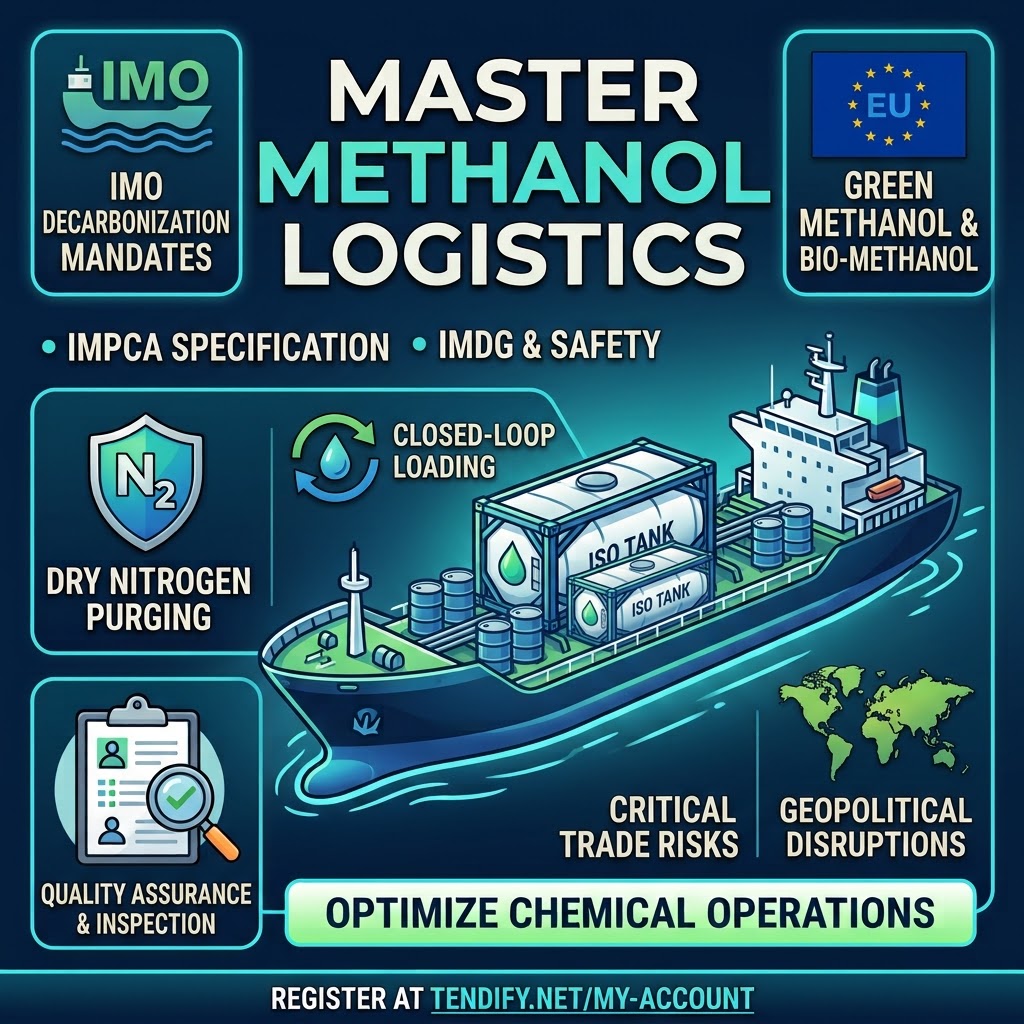
A single misclassified ISO tank or incomplete SDS can turn a profitable methanol shipment into a multi-week port hold, demurrage bill, and compliance investigation. In high-volume chemical trade lanes serving the Gulf, Southeast Asia, Europe and beyond, operators who treat methanol logistics as a pure freight problem consistently underperform those who treat it as an integrated safety, purity and documentation system.
This guide lays out the full operational chain for methanol export and logistics in 2026: product specification and purity control, packaging selection (ISO tank versus alternatives), regulatory classification under IMDG and related codes, documentation requirements, multimodal routing considerations, risk controls, and cost-management levers. The focus remains practical—what actually moves cargo cleanly across borders—rather than theoretical overviews.
Understanding Methanol as a Trade Commodity
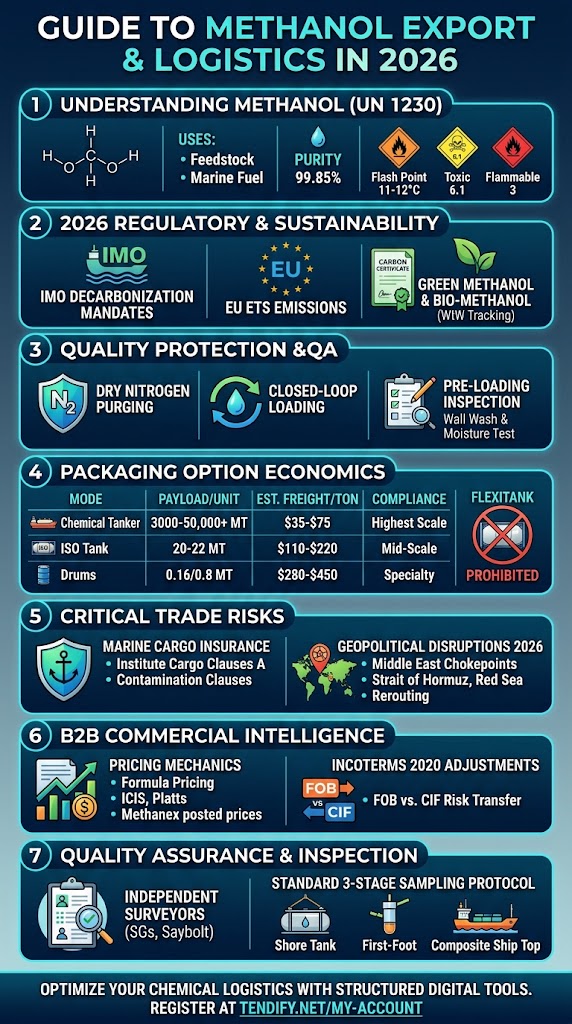
Methanol (methyl alcohol, CH₃OH) is a clear, colorless, highly flammable liquid used as a feedstock for formaldehyde, acetic acid, MTBE, biodiesel, and increasingly as a marine fuel. Industrial and AA-grade material typically ships at 99.85% purity or higher. Water content is tightly controlled (usually ≤0.1%), with limits on acetone, ethanol, acidity and color under ASTM and IMPCA reference specifications.
Methanol Trade & Logistics
From a logistics standpoint the critical properties are:
- Flash point approximately 11–12°C
- UN 1230 classification: Class 3 (flammable liquid), subsidiary risk 6.1 (toxic), Packing Group II
- Density around 0.791–0.793 at 20°C
- High affinity for water and many elastomers, requiring compatible materials in tanks, hoses and seals
These characteristics drive every downstream decision on tank selection, stowage, segregation, placarding and emergency response.
2026 Regulatory Update
Decarbonization, Green Methanol & Marine Fuel Transition
While traditionally handled as an industrial chemical feedstock, methanol’s role has expanded dramatically in 2026 due to aggressive International Maritime Organization (IMO) decarbonization mandates and strict EU Emissions Trading System (ETS) requirements.
Bio-Methanol & E-Methanol
Derived from sustainable biomass or captured carbon and green hydrogen. Demand is surging as dual-fuel container lines demand ultra-low carbon intensity (CI) certificates.
Carbon Footprint Tracking
Logistics managers must now track Well-to-Wake (WtW) emissions. A missing mass balance verification or ISCC EU sustainability certificate can trigger severe port fines.
Purity Grades and Quality Assurance for Export
Buyers in chemical manufacturing and fuel applications demand batch-specific Certificates of Analysis. Standard AA-grade parameters frequently referenced in contracts include:
- Purity: minimum 99.85% (ASTM D1152 or equivalent)
- Water: maximum 0.1%
- Color: maximum 5 Pt-Co
- Acetone and ethanol: tight ppm limits
- Acidity as acetic acid: maximum 0.003%
Pre-shipment sampling and independent laboratory verification protect both seller and buyer. Contamination during loading—residual previous cargo, moisture ingress, or incompatible gaskets—can drop a shipment below specification and trigger rejection or claims. ISO tanks that move product without intermediate transfer reduce this risk compared with multi-stage bulk transfers.
Quality Protection
Moisture Control & Atmospheric Safeguards During Loading
Because methanol is extremely hygroscopic, exposure to ambient air rapidly absorbs moisture, causing water content to spike above the strict ≤0.1% limit required for AA-grade certification. Operators implement three critical operational controls to prevent off-spec rejections:
Dry Nitrogen Purging & Padding
Prior to filling, ISO tanks or ship holds undergo positive-pressure flushing with dry nitrogen (dew point < -40°C). Maintaining a continuous nitrogen blanket isolates the chemical from atmospheric humidity.
Closed-Loop Loading Connections
Cargo transfers must use vapor-tight, closed-loop loading arms or flexible hoses. Open-hatch or gravity filling is strictly forbidden as it introduces humid air and vapor hazards.
Pre-Loading Wall Dryness Checks
Surveyors perform a visual check and Karl Fischer moisture titration on tank wall condensate or wash water to guarantee zero residual water before opening loading valves.
PDF Document (TND-PROT-METH-001)
Methanol Cargo Tank Cleaning & Wall Wash Protocol
Includes step-by-step 5-stage washing procedures, Permanganate Time Test standards, and official sign-off checklists for Chief Officers and independent surveyors (SGS/Saybolt).
Packaging Options: ISO Tanks, Chemical Tankers and Limited Alternatives
ISO Tank Containers
For the majority of containerized and intermodal methanol exports, the 20-foot ISO tank remains the workhorse. Typical capacities range from approximately 21,000 to 26,000 liters (roughly 5,500–6,340 US gallons depending on fill ratio and density). These portable tanks are built to IMDG portable tank instructions (commonly T7 with special provision TP2) and must carry valid CSC plates plus intermediate and periodic inspection certificates (2.5-year and 5-year intervals).
Advantages include door-to-door movement without product transfer, better purity protection, and full intermodal capability (truck–rail–vessel). Operators must confirm tank history (previous cargoes and cleaning certificates) and material compatibility before loading.
Chemical Tankers (Bulk)
For multi-thousand-ton parcels, specialized chemical tankers governed by the IBC Code provide the most economical solution. These vessels require dedicated or properly cleaned and certified tanks, vapor recovery systems where mandated, and strict segregation from incompatible cargoes.
Flexitanks
Standard flexitanks are designed for non-hazardous liquids. Methanol’s dual Class 3 + 6.1 classification and Packing Group II status generally exclude ordinary flexitanks. Specialized or approved systems exist in limited cases, but the default professional recommendation for methanol remains ISO tanks or bulk chemical tankers. Using an unapproved flexitank exposes the shipper to rejection, insurance denial and regulatory penalties.
Drums and IBCs
For smaller volumes or sample shipments, UN-certified steel drums (typically 200–215 liters) or intermediate bulk containers rated for Packing Group II are acceptable. These remain cost-effective only at low volumes because of higher per-liter freight and handling costs.
Financial Modeling
Packaging Economics & Freight Cost per Ton Comparison
Selecting the right packaging involves balancing total landed cost, purity preservation, and regulatory compliance. The table below illustrates the typical cost structures and operational feasibility across trade volumes:
Regulatory Classification and Safety Framework
Methanol moves under UN 1230, Proper Shipping Name METHANOL (or METHYL ALCOHOL). Key markings required on documents and packages:
- Class 3 primary hazard
- Subsidiary Class 6.1
- Packing Group II
- Labels: flammable liquid + toxic
- Stowage Category B under IMDG (away from living quarters)
- EmS: F-E, S-D
The Safety Data Sheet (SDS / MSDS) must be current, accurate and consistent with the Dangerous Goods Declaration. Discrepancies between the SDS transport section and the DG declaration are among the most common causes of holds at origin or destination ports. Emergency Response Guide information typically references Guide 131.
International shipments must also satisfy:
- IMDG Code for sea
- ADR / national road regulations for land legs
- Local port and free-zone rules in GCC hubs
- Destination country chemical import controls and any REACH-style registration requirements
Personnel handling methanol require appropriate training under the relevant dangerous goods regimes. Grounding and bonding during loading/unloading, vapor control, and spill response capability are non-negotiable operational standards.
PDF Document (TND-MAN-METH-003)
Methanol Safe Handling, Storage & Emergency Manual (UN 1230)
Covers IMDG Class 3 / 6.1 guidelines, nitrogen padding calculations, alcohol-resistant AR-AFFF foam firefighting, thermal imaging rules, and first-aid antidote protocols.
Risk Management
Marine Cargo Insurance & Contamination Clauses
While war-risk premiums capture headlines during regional instability, the most frequent financial losses in liquid chemical trading stem from off-spec contamination and quality degradation. Mitigating these exposure points requires structuring marine cargo coverage beyond basic transit damage.
1. Institute Cargo Clauses (A) vs. Specialized Chemical Coverage
قياسي Institute Cargo Clauses (A) provide All-Risks coverage but frequently exclude inherent vice or subtle quality changes unless explicitly endorsed. For high-purity AA-grade methanol, policies must incorporate dedicated Chemical & Liquid Cargo Contamination Clauses to protect against cross-contamination from shore pipelines, unpurged vessel manifolds, or compromised ISO tank gaskets.
2. Key Policy Endorsements for Methanol Cargoes
- Purity & Off-Spec Clause: Covers financial loss, re-conditioning, or downgrading costs if cargo fails ASTM D1152 purity specs due to moisture ingress or previous cargo residue during transit.
- Shore-to-Ship / Pipeline Extension: Extends coverage to include transfer operations through shore pipelines, loading arms, and terminal manifold connections prior to crossing the ship’s rail.
- Surveyor & Sampling Warranty: Mandates joint pre-loading and discharge sampling by certified independent surveyors (e.g., SGS, Saybolt). Insurers require sealed composite samples to validate valid claim triggers.
Critical Trade Risk
Sanctions, Financial Compliance & Banking Controls
In Middle East and Gulf chemical corridors, managing physical hazard risks is only half the equation. Navigating OFAC, EU, and regional sanction regimes alongside strict banking compliance determines whether a transaction actually settles or ends in frozen funds and seized cargo.
Origin Verification & Vessel Screening
Banks and port authorities rigorously audit Certificates of Origin (COO) and historical AIS vessel tracking to detect ship-to-ship (STS) transfers, dark fleet activity, or deceptive practices.
UBO Transparency & LC Settlement
Unclear Ultimate Beneficial Ownership (UBO) structures or discrepancies in Letters of Credit (LC) consistently lead to delayed bank clearance, trade finance rejections, and prolonged port holds.
Terminal Safety Standard
Shore-to-Ship & Terminal Transfer Protocols
Preserving methanol’s AA-grade specification during transfer requires rigorous engineering controls. Because methanol is both highly hygroscopic (water-absorbing) and flammable, terminal loading operations rely on strict atmospheric management.
Nitrogen Blanketing (N₂ Purity)
Tanks and pipework are inerted with high-purity dry Nitrogen prior to loading. Maintaining positive N₂ pressure prevents atmospheric moisture ingress (keeping water ≤0.1%) and eliminates oxygen to prevent explosive vapor mixtures.
Vapor Recovery & Bonding
Shore-to-ship manifolds require closed-loop Vapor Recovery Units (VRU). Continuous electrical bonding and static grounding are mandatory before hose connection to mitigate static charge generation during high-flow transfer.
End-to-End Export Process: Step-by-Step
- Product Specification Lock-In
Confirm grade, volume, delivery window and Incoterms with the buyer. Obtain or generate the batch COA and current SDS. - Tank or Vessel Nomination
Select ISO tanks with correct T-code and clean history or book space on a chemical tanker. Verify inspection certificates and previous cargo records. - Documentation Package Assembly
Core documents typically include:- Commercial invoice and packing list
- Certificate of Analysis
- SDS / MSDS
- Dangerous Goods Declaration
- Bill of Lading (or sea waybill)
- Certificate of Origin (where preferential treatment or local content rules apply)
- Export customs declaration (HS 2905.11)
- Any destination-specific import licenses or permits
- Loading and Sealing
Conduct pre-loading inspection of the tank or ship’s tanks. Load under controlled conditions with vapor recovery if required. Apply seals and record seal numbers. Take retention samples. - Inland Haul to Port
Use licensed dangerous goods carriers. Ensure placarding (flammable + toxic) and emergency equipment are present. Maintain temperature and pressure monitoring if relevant. - Port Handling and Vessel Loading
Present the full DG package to the terminal and carrier. Stow according to IMDG Category B requirements. Confirm segregation from incompatible cargoes. - Ocean Transit and Destination Clearance
Track the shipment. At destination the consignee or their agent handles import customs, any local chemical registration, and discharge. ISO tanks can often continue inland without product transfer. - Post-Delivery Reconciliation
Confirm quantity received, quality, and release of any remaining documentation or financial instruments (letters of credit, escrow, etc.).
B2B Commercial Intelligence
Methanol Pricing Mechanics & Global Benchmarks
In high-volume international trade, fixed-price spot quotes are increasingly rare. Commercial contracts rely on index-linked floating price formulas tied to globally recognized reporting agencies (PRAs) and producer posted prices.
ICIS & S&P Global Platts
Spot market benchmarks such as CFR China, CFR SE Asia, و FOB Rotterdam provide daily/weekly assessments that serve as baseline indexes for spot transactions and derivative hedging.
Methanex Posted Prices
Monthly non-discounted reference prices published by Methanex (APSP/Asian Posted Contract Price) act as the anchor for annual term contracts across Asian and European destinations.
Formula Structuring
Contracts are typically structured as:
P = (Index Average) ± Alpha - Discount + Freight Differential
accounting for freight diffs and purity premiums.
PDF Document (TND-SPA-METH-002)
Standard Methanol Master Sales & Purchase Agreement (SPA) Clauses
Features complete contract clauses for quality tolerance, laytime & demurrage provisions, 2026 Red Sea/Bab-el-Mandeb rerouting risk models, and strict AIS anti-evasion rules.
Commercial Execution
Incoterms 2020 Adjustments for Bulk Liquid Methanol
Standard Incoterms 2020 definitions often fail to address the unique operational nuances of bulk liquid chemical transport. In high-purity methanol trading, misalignment over the exact point of risk transfer during terminal connection, nitrogen padding, and composite sampling frequently leads to costly commercial disputes.
FOB (Free on Board) Structure
Risk transfers to the buyer as product passes the vessel’s permanent manifold flange at the loading port.
- Seller controls shore tank quality & terminal loading arm hookup.
- Buyer assumes risk for vessel tank cleanliness, ullage verification, and in-transit nitrogen padding pressure.
CFR / CIF (Cost, Freight & Insurance) Structure
Seller pays ocean freight (and insurance under CIF), but risk still transfers at the loading port manifold.
- Buyers mistakenly assume quality is guaranteed until arrival at the discharge port.
- Discharge port off-spec claims require clear proof of in-transit contamination vs. origin loading defects.
3 Operational Friction Points in SPA Contracts
- Nitrogen Blanketing & Tank Inerting Allocation: Who covers the cost and operational risk of vessel tank pre-purging and maintaining N₂ blanket pressure? SPAs must explicitly state whether inerting prior to loading is a seller’s terminal requirement or a buyer’s charterer obligation.
- The “First Foot” Sample Rule: Standard contracts mandate taking a sample after the first 1–2 feet of liquid enters the vessel tank. If the “first foot” sample is off-spec, loading halts immediately. Contract terms must define whether terminal line-flushing costs fall on the buyer or seller.
- Demurrage & Hose Connection Window: Demurrage clocks typically start 6 hours after Notice of Readiness (NOR) tendering. Delays caused by pre-loading wall dryness checks, vapor recovery hookup, or safety checklist audits must be clearly allocated in the charterparty and SPA laytime provisions.
Quality Assurance & Verification
Third-Party Independent Inspection (SGS, Saybolt, Intertek)
In high-volume AA-grade methanol export, internal lab results are insufficient to settle international commercial transactions. Appointing internationally recognized independent surveyors—such as SGS, Saybolt, or Intertek—is mandatory to establish legally binding Certificates of Quality and Quantity (COQ/COA).
The Standard 3-Stage Sampling Protocol
- Stage 1: Shore Tank Sample (Pre-Loading): Drawn directly from the exporter’s storage tank prior to line transfer. Verifies baseline purity (min 99.85%), water content (max 0.1%), and absence of particulate or hydrocarbon contamination.
- Stage 2: First-Foot Vessel Sample: Drawn after the first 1–2 feet of liquid enters the vessel/ISO tank. The loading valve is isolated immediately until lab analysis confirms zero pipeline cross-contamination or residual heel pick-up.
- Stage 3: Composite Ship/Tank Top Sample (Post-Loading): Drawn upon completion of loading from all vessel holds or ISO tank manifolds. Sealed composite samples are retained for a minimum of 60 to 90 days to resolve potential discharge port quality claims.
Key Surveyor Deliverables for Customs & Banking
Beyond laboratory titration and ASTM testing, independent surveyors perform physical operational audits required for bank LC negotiation and customs clearance:
- Issuance of official Certificate of Quantity via precise tank ullage and shore gauge measurements.
- Application of tamper-evident numbered security seals on all ISO tank valves, vessel manifold hatches, and sampling bottles.
- Verification of dry nitrogen padding pressure and vessel tank wall cleanliness before opening loading valves.
Cost Drivers and Optimization Levers
Major cost components include tank lease or vessel freight, inland haul, terminal handling, cleaning and survey fees, insurance (higher for Class 3/6.1), and potential demurrage or detention. Volume has the strongest influence: bulk chemical tankers deliver the lowest unit cost for large parcels, while ISO tanks offer flexibility for 20–25 ton lots and door-to-door purity control.
Operators reduce total landed cost by:
- Consolidating volumes to justify dedicated tanks or parcels
- Choosing free-zone or bonded facilities for temporary storage or re-export
- Aligning loading windows with vessel schedules to minimize dwell
- Using accurate HS classification (2905.11) and complete documentation to avoid inspection delays
- Selecting carriers with proven chemical expertise rather than generalist forwarders
In GCC and broader MENA trade corridors, proximity to major chemical production and consumption centers, combined with efficient ports such as those in the UAE and Saudi Arabia, supports competitive transit times when documentation and tank readiness are managed tightly.
Risk Controls That Separate Reliable Operators from Average Ones
Experienced operators treat the following as standard operating procedure rather than optional extras:
- Pre-booking verification of tank certificates and previous cargo history
- Dual-check of SDS versus DG declaration before any booking confirmation
- Retention sampling and third-party survey at loading
- Explicit contractual language covering contamination, delay and demurrage allocation
- Contingency planning for weather, port congestion or regulatory holds
- Regular review of carrier performance and tank operator cleaning standards
These controls protect both product integrity and commercial relationships. A single contamination event or documentation rejection can erase margins on multiple subsequent shipments.
Documentation Checklist for Smooth Clearance
Prepare a standardized packet that includes at minimum:
- Current SDS consistent with UN 1230 classification
- Batch COA meeting the contracted purity specification
- Dangerous Goods Declaration with correct sequence and emergency contact
- Commercial documents aligned with the physical cargo and HS code 2905.11
- Tank certificates (CSC, intermediate and periodic inspections)
- Seal records and loading survey report where required
Incomplete or inconsistent packets remain the leading cause of avoidable delays. Tools that help standardize HS classification, generate compliant documentation and track multimodal movements can reduce administrative friction; some operators integrate these into their broader trade workflow via platforms such as Platform.Tendify.Net for visibility across the chain.
Regional Logistics Guide
Middle East & Gulf Hub Infrastructure & Transit Protocols
While global IMDG rules establish the baseline, executing methanol shipments through the MENA corridor requires navigating specific regional port infrastructure and free-zone customs frameworks:
Jebel Ali (UAE) & GCC Transit Hubs
Acts as the primary regional re-export and ISO tank storage hub. Dangerous Goods (DG) dwell times are strictly capped in JAFZA, requiring pre-approved E-MIRAL / Dubai Trade customs documentation before tank arrival to avoid heavy demurrage.
Jubail & Yanbu Commercial Ports (Saudi Arabia)
World-scale export terminals handling massive bulk volumes. Strict compliance with SABIC/Sipchem quality standards and Saudi Ports Authority (MAWANI) chemical clearance rules is required, alongside automated Fasah customs pre-filing.
Bandar Imam Khomeini & Northern Gulf Outlets
Key specialized liquid terminals for regional exports. Operational focus centers on dedicated shore pipeline integrity, continuous nitrogen padding, and managing strict Certificate of Origin (COO) verification routines for regional transit.
Geopolitical Alert 2026
Middle East Conflicts & Global Maritime Transit Disruptions
Recent military escalations across Middle East trade corridors—specifically direct armed friction between Iran and the U.S. alongside sustained Houthi naval maneuvers in the Red Sea and confrontation with Saudi Arabia—have transformed maritime transit and chemical supply chain management into a critical macroeconomic battleground.
1. The Dual-Chokepoint Squeeze: Strait of Hormuz & Bab al-Mandab
- Strait of Hormuz Disruptions: Military naval standoffs and severe transit restrictions have threatened the movement of roughly 20% of the world’s petroleum and liquid chemical products.
- Bab al-Mandab & Red Sea Blockades: Control over coastal leverage points near Hanish Islands and Mokha effectively compromises access to the Suez Canal, shutting off primary Europe-Asia routes.
- Neutralization of Bypass Corridors: Saudi Arabia’s strategic East-West Pipeline to Yanbu on the Red Sea—designed to bypass Hormuz—faces ongoing drone threats and Red Sea maritime insecurity, leaving regional bypass routes equally volatile.
2. Core Impacts on Freight, Costs, and Supply Chains
Cape of Good Hope Rerouting
Vessels avoiding Red Sea and Gulf chokepoints face Cape circumnavigations, adding 10 to 21 extra days to transit times and stalling raw material feeds for downstream industries.
Freight & War-Risk Premiums
Container and chemical parcel spot rates have spiked 30% to 50%. War-risk insurance premiums have surged 3x–4x, directly inflating landed invoice prices.
Energy Shocks & Fertilizers
Bunker fuel surcharges add further freight friction. Meanwhile, regional export disruptions threaten ~30% of global urea and ammonia trade, triggering agricultural price instability.
Structural Rewiring (JIC Strategy)
Traders are abandoning “Just-in-Time” models for “Just-in-Case” buffer stocking, friendshoring suppliers, and establishing regional storage hubs to build resilience against choke point risks.
Practical Application
Real-World Methanol Trade Calculations & Case Studies
To bridge theoretical pricing formulas with physical operations, the following scenarios illustrate real-world commercial calculations, freight differentials, and demurrage exposure under current market conditions.
Scenario A: Formula Pricing Breakdown (CFR East Asia)
A buyer in China secures a contract for 10,000 MT of IMPCA-grade Methanol delivered CFR Zhangjiagang, priced off the ICIS East Asia Monthly Index.
• ICIS East Asia Monthly Average: $310.00 / MT
• Purity Premium (Alpha for >99.9%): +$5.00 / MT
• Commercial Discount (Off-take volume): -$12.00 / MT
————————————————–
Final Invoice Base Price: $310 + $5 – $12 = $303.00 / MT
Total Cargo Value: 10,000 MT × $303.00 = $3,030,000 USD
Scenario B: Demurrage & Congestion Cost Exposure
A charter vessel carrying 15,000 MT experiences berth congestion and customs inspection delays at the discharge port beyond the agreed laytime (36 hours allowed).
| Agreed Laytime: | 36 Hours |
| Actual Time Used (Berth + Discharge): | 108 Hours |
| Demurrage Rate (Tanker Charter): | $18,000 / Day ($750 / Hour) |
| Demurrage Penalty (72 Excess Hours): | $54,000 USD (+ $3.60 / MT cost impact) |
Scenario C: Bio-Methanol Green Premium (ISCC EU Certified)
A European marine fuel buyer acquires ISCC EU certified biomethanol to satisfy EU ETS compliance targets compared to fossil-based chemical grade methanol.
Linking Logistics Performance to Commercial Outcomes
Methanol trade rewards operators who treat logistics as a core commercial capability rather than a back-office function. Purity preserved through the journey supports premium pricing. Predictable transit and clean documentation support repeat business and stronger payment terms. Conversely, repeated holds or quality disputes damage reputation faster than most other operational failures.
For businesses expanding chemical trade into or through the Gulf region, aligning packaging choice, regulatory preparation and documentation discipline produces measurable improvements in cycle time and total cost. Related operational guidance on Incoterms selection for bulk liquids and HS code accuracy can be found in the resource library at tendify.net/blog.
Knowledge Base
الأسئلة الشائعة (FAQ)
Key commercial, quality, and regulatory insights for global Methanol buyers and charterers.
1. What is the standard purity requirement for industrial Methanol trading?
Most global B2B contracts adhere to the IMPCA (International Methanol Producers and Consumers Association) standard or ASTM D1152. Grade AA / IMPCA specification requires a minimum purity of 99.85% by weight, with maximum water content under 0.10% (1,000 ppm), non-volatile matter below 8 mg/100 mL, and strict permanganate time limits (>50 minutes) to ensure absence of oxidizing impurities.
2. How is Methanol pricing typically structured in long-term contracts?
Methanol pricing usually relies on index-linked formula pricing derived from benchmark publications such as ICIS, Platts, or IHS Markit. A standard CFR formula is written as:
P = (Benchmark Index Average) ± Premium/Discount + Freight Adjustments.
Discounts are negotiated based on volume commitment, credit terms (LC vs. TT), and discharge port congestion risk.
3. Why is Nitrogen padding mandatory during chemical tanker transport?
Methanol is highly volatile and flammable (Flash Point ~11°C, IMDG Class 3 / Toxic 6.1). Maintaining a 99.9% pure Nitrogen (N‚) blanket inside cargo tanks prevents the buildup of explosive oxygen mixtures, guards against moisture absorption (which degrades purity below IMPCA standards), and prevents oxidation during transit.
4. What are the key regulatory changes impacting Methanol shipping in 2026?
Under updated IMO greenhouse gas frameworks and EU ETS expansions, vessels transporting fossil-based Methanol or using Methanol as dual-fuel marine fuel must comply with strict lifecycle carbon intensity tracking. Shipments labeled as Bio-Methanol or E-Methanol require full chain-of-custody ISCC EU certification to qualify for carbon tax exemptions and green premiums.
5. How are laytime and demurrage claims managed in charter contracts?
Standard charter parties allow 36 to 72 hours SHINC (Sundays and Holidays Included) for loading and discharging operations. If port congestion or delay occurs beyond allowed laytime, demurrage charges accrue at fixed daily rates (typically ranging between $15,000 and $25,000/day depending on vessel DWT). Claims must be backed by a certified Statement of Facts (SOF) signed by the port agent and master.
تينديفاي دوت نت.
Closing the Loop: From First Inquiry to Repeatable Process
The complete methanol export and logistics chain is neither mysterious nor impossibly complex. It is a sequence of controlled decisions—specification, packaging, classification, documentation, handling and monitoring—executed with discipline. Operators who institutionalize these steps convert a high-risk chemical movement into a reliable commercial flow.
When the next parcel is ready, the difference between a clean delivery and a costly interruption almost always traces back to preparation quality at the front end. Build the process once, refine it with each shipment, and the operational advantage compounds.

