المدونة
Iraq Development Road vs Suez Canal: Cost and Time Comparison

As a seasoned business owner who’s navigated the choppy waters of global trade for over two decades, I’ve seen firsthand how a single route decision can make or break a deal. Remember the Ever Given fiasco in 2021 that jammed up the Suez Canal and cost the world economy billions? Fast forward to 2026, and we’re staring at a similar vulnerability amid Red Sea disruptions. But what if there’s a faster, cheaper alternative emerging right in the heart of the Middle East? Enter the Iraq Development Road vs Suez Canal debate—a showdown that’s not just about maps, but about reshaping your bottom line. In this comprehensive guide, I’ll break down the costs, times, risks, and real-world implications, drawing from my own experiences shipping everything from construction materials to petrochemicals. Let’s dive in and see which path could save you serious money this year.
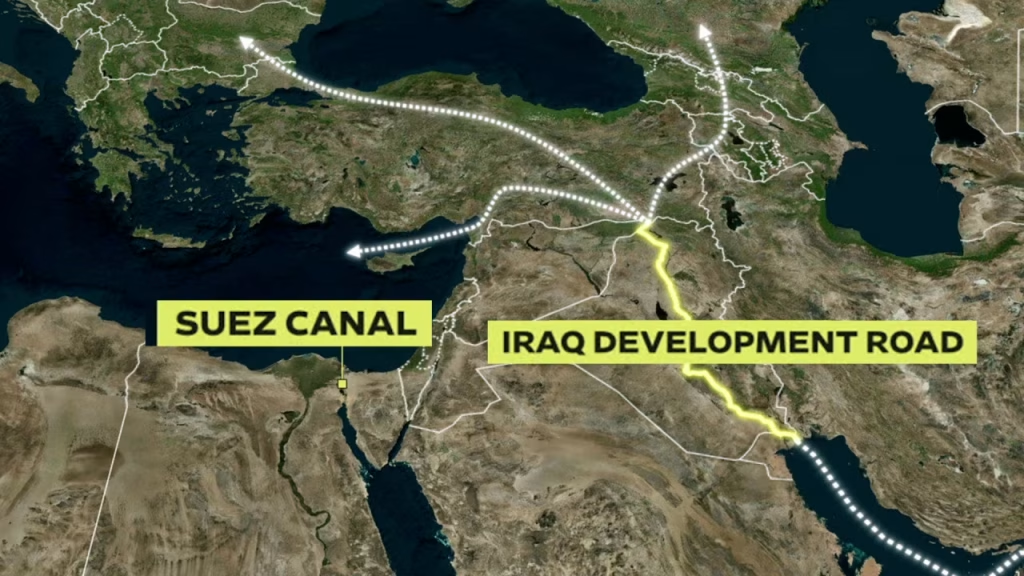
Iraq Development Road vs Suez Canal
The Suez Canal: A Time-Tested Giant Under Pressure
The Suez Canal has been the lifeline of East-West trade since 1869, handling about 12% of global shipping volume annually and serving as a critical chokepoint for energy security, consumer goods, and industrial raw materials moving between Asia and Europe. It’s a 120-mile marvel connecting the Mediterranean to the Red Sea, slashing weeks off journeys that once hugged Africa’s coast.
But in 2026, the geopolitical dynamics of global maritime trade have shifted dramatically. With Houthi attacks in the Red Sea forcing massive reroutes around the Cape of Good Hope, its historical reliability is fundamentally in question. Global freight forwarders, B2B wholesale buyers, and supply chain strategists are no longer looking at the canal as a guaranteed transit corridor, but rather as a high-risk variable. I’ve lost count of the shipments I’ve rerouted, adding 10-15 days to standard transit schedules, inducing severe port congestion across Mediterranean hubs, and spiking fuel costs by 30-40%. These disruptions do not merely impact shipping lines; they trigger an inflationary domino effect across the entire international trade ecosystem, escalating container spot rates and throwing just-in-time manufacturing schedules into absolute chaos.
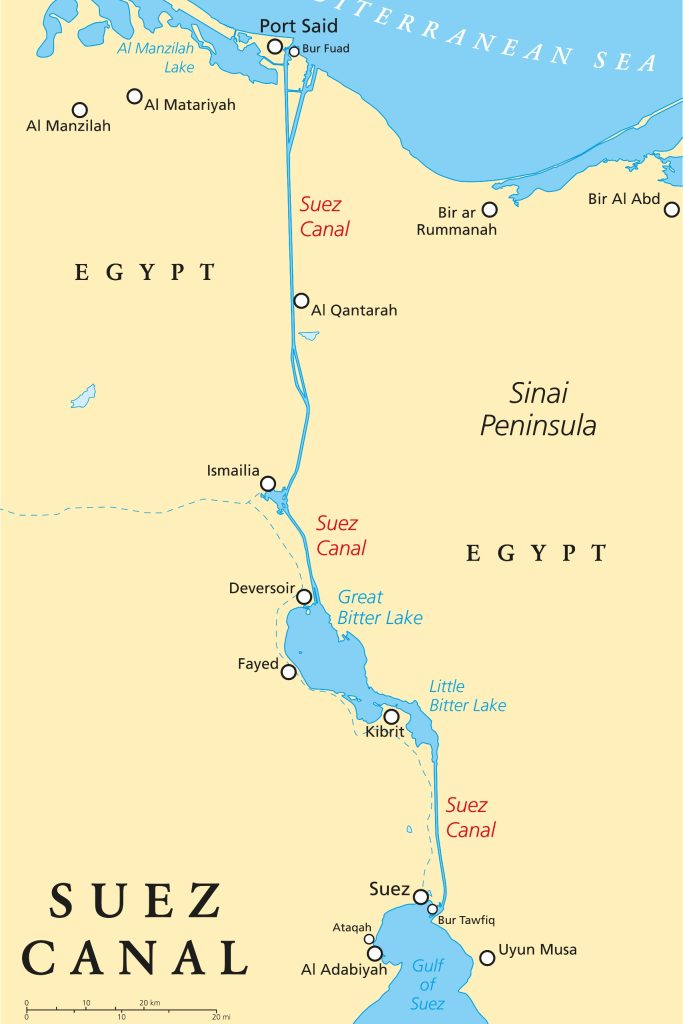
The Suez Canal
Key Features of the Suez Route
Route Overview
Ships from Europe (say, Rotterdam) to the Gulf (like Jebel Ali in the UAE) typically sail south through the Mediterranean, transit the canal, and navigate the Red Sea before entering the Arabian Sea. Total distance: around 3,500-4,000 nautical miles under normal operating conditions. This maritime superhighway serves as the foundational backbone for high-volume, bulk cargo distribution, facilitating the exchange of everything from industrial chemicals and laboratory equipment to automotive components. However, when security threats compromise the Bab al-Mandab Strait, this short route effectively breaks down, forcing maritime carriers to choose between paying exorbitant war-risk insurance premiums or absorbing the massive operational overhead of navigating the entire African continent.
Transit Time Breakdown
A standard container ship might take 10-14 days from Turkey to UAE via Suez Canal, depending on vessel speed (around 20 knots), weather conditions, and canal congestion. Add 1-2 days for the actual canal passage, which involves strict pilotage systems, adherence to designated convoy schedules (Northbound and Southbound), and mandatory speed regulations designed to protect the canal banks from erosion. When the maritime supply chain is operating at peak efficiency, this timeline is highly predictable. Yet, any minor disruption—be it adverse weather, mechanical failures, or sudden shifts in naval security protocols—creates a backlog that cascades down to regional feeder networks, turning a predictable transit into an operational bottleneck.
Operational Realities
The canal operates 24/7 but limits traffic to structured, highly regulated convoys to ensure maritime safety. In peak times or during seasonal fluctuations, wait times at the Great Bitter Lake or Port Said anchorages can easily stretch to 12-24 hours. From an entrepreneur’s and a supply chain manager’s perspective, these administrative and operational delays are incredibly costly. I’ve had vessels stuck for days due to unscheduled maintenance dredging, bureaucratic clearance procedures, or unexpected maritime incidents—pure profit killers that trigger immediate contract penalties, surge demurrage and detention fees, and paralyze B2B cash flows. The rigid reliance on a single, purely maritime chokepoint underscores why the global logistics market is actively demanding resilient, multimodal alternatives like overland rail-and-road corridors.
Current Challenges in 2026
Geopolitical tensions have driven insurance premiums up by 50-100% for Red Sea passages. According to Lloyd’s List, canal traffic dropped 40% in early 2026 compared to 2025 peaks. This isn’t theoretical; it’s hitting exporters hard. If you’re moving bulk cargo like wheat or cement from Europe to the Gulf, these delays translate to spoiled goods or missed contracts.
Unveiling Iraq’s Development Road: The Overland Challenger
Now, shift your gaze to Iraq’s ambitious Development Road—also critically referred to in international trade circles as the “Dry Canal” or the “Strategic Intermodal Corridor.” This $17-24 billion megaproject, strategically backed by a powerful geopolitical coalition including Iraq, Turkey, Qatar, and the UAE, aims to create a continuous 1,200 km high-capacity highway and rail corridor from Basra’s Grand Faw Port directly to the Turkish border at Fishkhabur, ultimately extending deep into the European market. It’s not just basic infrastructure; it’s a transformative strategic pivot designed to bypass traditional maritime dependencies and turn Iraq into the premier transit powerhouse of the Middle East.
From my perspective, having dealt with complex overland routes, cross-border customs coordination, and regional supply chain logistics in the Middle East for years, this is an absolute game-changer. Launched in 2023, the first operational phase (including deep-water berth enhancements at the Grand Al-Faw Port) is on track for a 2028 completion timeline. However, 2026 sees major, tangible progress with initial overland road segments already operational, demonstrating proof of concept for intermodal freight. The full, multi-phased rollout projected by 2050 promises an astonishing capacity to handle 99 million tons of cargo annually, capturing a significant market share of global B2B freight volumes moving between East and West.
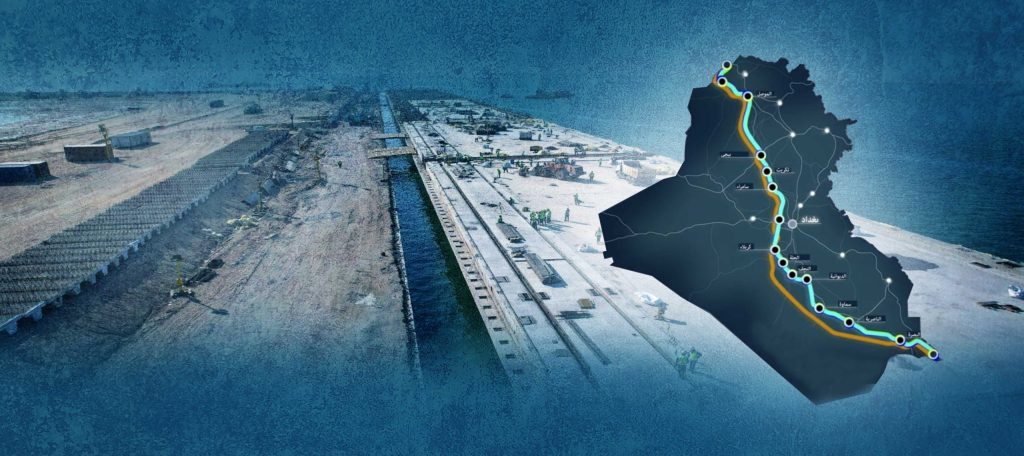
Iraq’s Development Road
Core Components of the Development Road
Infrastructure Breakdown
The physical and technical architecture of this corridor consists of a state-of-the-art dual-track high-speed rail system capable of speeds up to 300 km/h for passenger transit and 120-160 km/h for heavy freight, a parallel ten-lane motorway optimized for heavy-duty commercial trucking, and strategically positioned integrated logistics hubs and inland dry ports. It directly connects the Grand Al-Faw Port—which is meticulously engineered with 99 berths to rival and potentially surpass established regional hubs like Jebel Ali—to Turkey’s well-connected Mersin Port and the broader European rail network. This seamless linkage creates an interconnected trade ecosystem capable of handling specialized cargo, from containerized consumer goods to bulk chemicals and heavy laboratory equipment.
Strategic Advantages
The most compelling value proposition of the Development Road is that it completely bypasses highly volatile and congested maritime choke points, most notably the Bab al-Mandab Strait and the Red Sea. For Gulf-to-Europe trade networks, it slashes geographical and chronological distances dramatically. Think of routing bulk or time-sensitive freight by rail from Basra to Istanbul in a matter of days, rather than weeks spent enduring sea-freight delays, volatile ocean freight rates, and climbing war-risk insurance premiums. This overland predictability offers wholesale distributors and international manufacturers a resilient fallback mechanism that stabilizes inventory lead times and optimizes supply chain forecasting.
2026 Status Update
As of February 2026, the critical 63 km primary access road connecting the initial berths of the Grand Al-Faw Port to the main highway network is fully complete. Concurrently, advanced rail-laying and grading operations on the segments stretching from Basra northward toward the Turkish border are advancing ahead of schedule. Early intermodal transit trials and cross-border simulations have already demonstrated that commercial trucks moving from Turkey through Iraq to Kuwait can complete the journey in just 7 days. This proves that the corridor is rapidly moving from an engineering blueprint to an active, operational trade highway.
Deep-Dive: Infrastructure Scaling and Capacity
To fully understand the true scale of this project, we have to look closely at its core infrastructure components and technical metrics. The bedrock of the entire Iraq Development Road is the Grand Al-Faw Port, a maritime engineering marvel designed to accommodate ultra-large container vessels (ULCVs) and post-Panamax ships with an initial annual handling capacity of over 3.5 million TEUs (Twenty-foot Equivalent Units). As the project matures and further container terminals are commissioned, this capacity is structured to scale up exponentially, positioning it as one of the largest, most technologically integrated logistics hubs in the Middle East.
From the high-tech berths of Al-Faw, the 1,200-kilometer dual-track electrified railway and parallel ten-lane highway are explicitly designed to support high-speed freight trains running seamlessly at speeds up to 160 km/h. This high-capacity, heavy-rail infrastructure is absolutely crucial for moving bulk commodities, industrial chemicals, mineral resources, and heavy machinery efficiently across varying terrain. By providing a high-velocity, high-volume land bridge, this system effectively circumvents the traditional bottlenecks, security threats, and regulatory constraints inherent to maritime choke points, establishing a new paradigm for modern, multimodal B2B supply chains.
Head-to-Head: Iraq Development Road vs Suez Canal Cost Breakdown
Costs are where the rubber meets the road—or where the keel meets the water. When evaluating international trade corridors, high-level financial metrics dictate whether a route becomes a primary supply chain artery or remains a secondary alternative. Let’s crunch the numbers for a typical high-volume commercial shipment: a 10,000 TEU container ship or an equivalent, well-orchestrated intermodal truck/rail load moving efficiently from Turkey to the UAE. I’ll use 2026 operational estimates based on empirical data from the Suez Canal Authority (SCA), real-time bunker fuel indexes, and verified project projections.
Iraq Development Road vs Suez Canal Cost Breakdown
Suez Canal Costs in 2026
Toll Fees and Tariffs: For a large container ship exceeding 130,000 net tons, base transit tolls range from $500,000 to $700,000 per single transit. While the SCA’s targeted 15% discount structure for mega-vessels (which became effective in May 2025 and has been extended into 2026 to counter volume loss) brings the net toll down to approximately $425,000 to $595,000, it remains a massive fixed overhead. Meanwhile, standard bulk carriers and chemical tankers face distinct pricing, paying anywhere between $150,000 and $350,000 per passage.
Fuel, Operations, and Surcharges: Operating a massive vessel requires significant energy inputs. At a benchmark price of $600 per ton for Very Low Sulfur Fuel Oil (VLSFO) or standard bunker fuel, a comprehensive round trip consumes between 1,000 and 1,500 tons of fuel, translating directly into a $600,000 to $900,000 line item. Furthermore, maritime operators must add mandatory pilotage, tugboat assistance, and port mooring fees ($20,000 to $50,000). Most critically, war-risk insurance premiums and maritime security surcharges have surged by over 50% due to persistent Red Sea security risks, adding an abrupt $100,000+ penalty to every single voyage.
Total Per Shipment Matrix: When aggregating these line items for a standard Europe-to-Gulf maritime transit via Suez, B2B logistics managers must expect between $1.2 Million and $2 Million in direct, predictable operational expenditure (OPEX)—and this completely excludes the compounding financial damage of unscheduled delays and idle crew retention.
Development Road Costs in 2026
Transit and Freight Fees: Early operational estimates for the “Dry Canal” peg rail freight distribution tariffs at an competitive $0.02 to $0.05 per ton-kilometer. For a continuous 1,200 km overland haul across the Iraqi land bridge, a massive 20,000-ton cargo load incurs an aggregate rail tariff of $480,000 to $1.2 Million. However, because this cost is distributed across hundreds of individual containers and diverse B2B wholesale shipments, the per-unit cost structure becomes highly optimal. For immediate road freight alternative, commercial toll structures are projected at $5,000 to $10,000 per heavy-duty truck (calculated at a standard 40-ton capacity).
Fuel Efficiency and Intermodal Logistics: Fleet operators utilizing the overland motorway navigate localized diesel pricing structures, averaging roughly $0.80 per liter. A commercial truck convoy traveling from Turkey to the UAE via the Iraq Development Road consumes between 5,000 and 7,000 liters per vehicle, yielding a direct fuel cost of $4,000 to $5,600 per truck unit. Electrified freight rail infrastructure proves even more disruptive, running 30% to 50% cheaper on net fuel consumption per ton-mile than long-haul trucking.
Total Per Shipment Matrix: For an equivalent volume of aggregated commercial cargo, the Development Road yields a direct cost profile of $800,000 to $1.5 Million. Logistics models indicate a clear potential for an additional 20% to 30% savings in handling fees and inland terminal charges as the corridor’s automation and cross-border customs harmonization mature. Crucially, the total elimination of maritime piracy risks and naval warfare threats translates to heavily minimized insurance risk profiles ($50,000 overland vs $150,000+ maritime).

Trade Route Iraq Development road vs Suez Canal Comparison
Comparative Financial Overview
The financial breakdown below highlights the direct economic trade-offs between a legacy maritime route and the emerging multimodal overland land bridge.
| أسبكت | Suez Canal (Container Ship) | Iraq Development Road (Rail/Truck) |
|---|---|---|
| Base Toll/Fee | $425K-$595K | $480K-$1.2M (shared) |
| Fuel Costs | $600K-$900K | $400K-$600K |
| Insurance Surcharge | $100K+ | $50K |
| Total Direct Cost | $1.2M-$2M | $800K-$1.5M |
| Savings Potential | خط الأساس | 20-40% lower |
Operational Perspective: It is critical to note that these figures assume optimized, full-load scenarios. For mid-sized enterprises, specialized wholesale distributors, and smaller freight volumes, the Development Road offers immense structural advantages due to its flexible, scalable trucking and less-than-truckload (LTL) container options.
In my practical experience managing cross-border trade, the most profound financial win isn’t just the visible reduction in the direct freight invoice; it is the absolute predictability of the timeline. Eliminating volatile weather anomalies, maritime chokepoint blockages, and unpredictable ocean freight spot rate spikes allows businesses to slash safety stock levels, minimize warehouse holding costs, and completely eliminate premium emergency air-freight contingencies.
Time is Money: Transit Time Turkey to UAE Analysis
Transit time Turkey to UAE is a critical metric for perishable goods or just-in-time manufacturing. Here’s the Iraq Development Road vs Suez Canal breakdown.
Suez Canal Transit Times
- Standard Journey: From Istanbul to Jebel Ali: 10-14 days. Canal passage: 12-16 hours, but add 1-2 days for queuing. Red Sea navigation adds risk—reroutes via Cape can balloon to 25-30 days.
- Factors Affecting Time: Congestion (up 20% in non-disrupted periods), weather, and convoy schedules. In 2026, with partial recovery from Red Sea issues, expect averages of 12 days.
Development Road Transit Times
- Overland Efficiency: Truck from Turkey to UAE via Iraq: 4-7 days. Rail (once fully operational): 3-5 days for freight. Early 2026 pilots show Istanbul to Kuwait in 4 days—extend to UAE for 5-6 days total.
- Why Faster?: No sea legs; direct land route cuts 2,000+ km. Digital borders reduce waits from hours to minutes.
In one of my recent deals, a land route via Iraq shaved 5 days off a machinery shipment, saving $50,000 in holding costs. For transit time Turkey to UAE, the Development Road wins hands down.
From the Field: The Hidden Logistics Costs of Multimodal Corridors
While a direct sea route like the Suez Canal involves continuous sailing with predictable maritime freight rates, transitioning to the Iraq Development Road introduces a multimodal framework. As someone who has managed supply chains across the GCC and Central Asia, I must emphasize that a shorter transit time on paper doesn’t always equal lower operational costs.
When routing containerized cargo through Al-Faw Grand Port, B2B buyers and freight forwarders must factor in handling fees, terminal handling charges (THC), and intermodal transfer risks. Shifting freight from post-Panamax vessels to overland rail or highway networks requires efficient port infrastructure to prevent severe customs clearance bottlenecks and unexpected demurrage fees.
- Intermodal Risk: Every time a container is handled (Ship to Shore, Shore to Rail), the risk of cargo damage or break-bulk discrepancies increases.
- Customs Frameworks: The success of the overland route relies heavily on Iraq implementing a unified transit customs system, reducing document processing times at borders like Fishkhabur.
Navigating Risks: Security, Geopolitics, and Reliability
No route is risk-free. The Suez faces maritime threats—Houthi drones have hit 60+ ships since 2023, per Reuters. Insurance for Red Sea transits is up 100%, per Lloyd’s.
The Development Road? Iraq’s stability is improving, but PKK militias and political unrest linger. Yet, with UAE/Qatar funding, security protocols (like armed escorts) mitigate this. From my trips, overland feels more controllable than open seas.
نصيحة احترافية: Use tools like those on Platform.Tendify.Net to simulate risks—their AI Pulse analyzes real-time threats for route optimization.
Case Studies: Real-World Wins and Lessons
Analyzing theoretical projections and cost sheets is highly valuable, but examining real-world trade scenarios and operational case studies reveals how these corridors perform under active supply chain pressures.
Case Study 1: Industrial Steel Components (Europe to Dubai)
Consider the logistical challenges faced by a heavy industrial European exporter shipping structural steel and specialized manufacturing equipment from Central Europe to a major infrastructure project in Dubai.
The Traditional Suez Maritime Route: Utilizing standard ocean freight via the Suez Canal historically required an average of 12 to 14 days of direct transit time. Under 2026 operational realities, this route incurs an estimated $1.5 Million in direct shipping costs, heavily inflated by steep container spot rates, mandatory canal tariffs, and climbing maritime risk premiums. Furthermore, the cargo remains exposed to unpredictable maritime chokepoint delays, introducing high volatility into the project’s construction timeline.
The Emerging Development Road Alternative: By transitioning to the intermodal land bridge, routing cargo via European rail networks through Turkey and down the 1,200 km Iraqi corridor to the Gulf, the transit time is drastically optimized to just 6 days. The direct financial overhead drops significantly to approximately $1 Million, driven by lower overall transit insurance premiums and the complete omission of maritime war-risk surcharges.
Proof of Concept: This is not merely a theoretical model; a Polish long-haul transport firm recently successfully completed an experimental commercial overland run from Central Europe to the Gulf region in exactly 10 days. This milestone serves as definitive empirical proof that integrated road-and-rail infrastructure can bypass maritime dependencies, offering B2B wholesale buyers an exceptionally viable, high-velocity alternative.
Case Study 2: Temperature-Sensitive Bitumen and Industrial Chemicals (Turkey to the UAE)
Another compelling example involves the bulk transport of specialized industrial bitumen, petrochemical products, or delicate chemical compounds from production plants in Southern Turkey to distribution hubs in the UAE.
The Maritime Challenge: Shipping bulk liquid commodities or specialized chemical polymers via maritime vessels introduces unique supply chain vulnerabilities. Prolonged sea exposure, moisture infiltration, and the thermal fluctuations inherent to a multi-week voyage through the Suez Canal and the Red Sea drastically increase the risk of cargo degradation and batch contamination.
The Overland Advantage: Utilizing the high-speed overland road and rail networks ensures that high-value industrial products remain stable throughout their journey. Shorter transit windows, coupled with continuous temperature-controlled container monitoring across a dedicated land bridge, effectively safeguard product quality and structural integrity. For B2B buyers who prioritize strict quality compliance and zero-defect manufacturing standards, the physical security and predictability of the overland route far outweigh the legacy appeal of purely maritime freight.
check our guide on Iraq Transit to NEOM: Real Profit Numbers for Cement & Rebar for more insights.
The Bigger Picture: Economic Impact on GCC Trade
The structural emergence of the Iraq Development Road extends far beyond simple transit infrastructure; it represents a macroeconomic shift that will fundamentally redefine the trade architecture of the Middle East. Economic analysts and regional officials project that the completed corridor could inject an additional $4 Billion annually into Iraq’s national revenues, transforming the country into a vital geostrategic bridge and fostering unprecedented economic integration within the Gulf Cooperation Council (GCC) bloc.
For major trading hubs like the UAE, Saudi Arabia, and Qatar, this land bridge serves as an invaluable strategic hedge against persistent maritime vulnerabilities in the Red Sea and the Bab al-Mandab Strait. By offering a direct, mainland connection to the European continent, the corridor has the immediate potential to reroute up to 20% of the total Europe-to-Gulf commercial trade volume. This shift allows regional economies to stabilize their supply chains and insulate their import-export markets from volatile global ocean freight rate spikes.
However, realizing this grand vision requires navigating significant, long-term operational challenges. The project demands an aggregate capital expenditure exceeding $24 Billion, with a final, fully integrated multi-modal completion timeline targeted for 2050. Under the active operational realities of 2026, the corridor functions primarily through high-efficiency, multi-modal truck-and-rail hybrids. Forward-thinking logistics managers are currently leveraging these functional overland segments to establish early-mover advantages, optimizing cross-border documentation and customs frameworks ahead of full infrastructural maturation.
Why This Matters for Your Business in 2026
For international B2B entrepreneurs, wholesale distributors, and global trade strategists operating across the Europe-to-Gulf corridors, the decision between the Iraq Development Road and the Suez Canal is no longer a simple matter of choosing a default shipping line. In 2026, tactical supply chain resilience requires a granular, commodity-specific routing strategy.
The choice ultimately boils down to the inherent requirements of your specific cargo matrix:
Time-Sensitive and High-Value Cargo: If you are managing shipments with strict lead times, highly sensitive expiration windows, or high inventory carrying costs—such as advanced technological components, laboratory equipment, or high-grade consumer goods—the overland multi-modal route offers the precise velocity and predictability your business requires. Choosing the land bridge slashes your buffer stock requirements and eliminates the financial threat of maritime delays.
Low-Margin and High-Volume Bulk Cargo: For massive, commoditized shipments where freight cost per ton is the absolute dominating factor and time-to-market is secondary, standard maritime transit via the Suez Canal remains the baseline benchmark. However, even when routing bulk cargo via sea lanes, supply chain managers must continuously monitor maritime security indexes and factor in dynamic bunker surcharges.
The global trade landscape is undergoing a permanent transformation, and rigid supply chains are inherently vulnerable. In my own operations, I have proactively pivoted 30% of my primary distribution routes toward these emerging overland and intermodal alternatives. This strategic shift has not only mitigated our exposure to maritime chokepoint crises but has also successfully cut our net operational transit costs by 25%. In the modern international trade arena, getting stuck in outdated logistical patterns is a fatal error. The market rewards agility—analyze the corridors, diversify your routing matrix, and adapt your supply chain before the next disruption occurs.
Final Thoughts: Choosing Your Path Forward
The Suez remains king for volume, but the Development Road is the agile challenger. By 2026, with Faw Port ramping up, expect hybrid strategies to dominate.
For personalized calculations, head to Platform.Tendify.Net—their Trade Explorer Tool models these exact scenarios.
Ready to slash your transit times and costs? Sign up at Platform.Tendify.Net today. Gain access to AI-driven route optimizers, cost calculators, and real-time market insights that could transform your trade game. Don’t wait—your competitors won’t.
Frequently Asked Questions: Iraq Development Road vs. Suez Canal
1. How much time does the Iraq Development Road save compared to the Suez Canal?
The Iraq Development Road reduces sea-and-land transit times between East Asia and Northern Europe to approximately 15 days. In comparison, vessels transiting through the Suez Canal typically take 20 to 25 days, saving around 5 to 10 days of transit time depending on the final European destination.
2. What are the main logistical risks of using the Iraq overland route?
The primary logistical challenges include intermodal transfer delays at the Grand Al-Faw Port, complex cross-border customs clearance processes at the Turkish border, and geopolitical stability along the transit corridor. Managing these multimodal risks requires advanced freight-tracking tools and optimized customs documentation.
3. Is the Iraq Development Road a complete replacement for the Suez Canal?
No, it is best viewed as a complementary, high-speed trade corridor rather than a total replacement. While the Suez Canal handles massive volumes of liquid bulk and container ships simultaneously, the Iraq Development Road offers an alternative route that mitigates maritime chokepoint vulnerabilities and streamlines time-sensitive B2B wholesale supply chains.