


المدونة
UAE Corporate Bank Freeze: How to Unfreeze Accounts Fast

A trading company based in a free zone receives a routine payment from a long-standing buyer in a GCC market. The next morning the corporate account is restricted. Transfers fail. Salaries cannot be processed. Supplier payments stall. The bank message is brief: the account is under review for compliance reasons. No further detail is offered.
This scenario plays out across the Emirates with increasing frequency. Corporate bank accounts are frozen not because of insolvency or deliberate misconduct, but because automated monitoring systems or periodic reviews detect gaps against the strict AML and KYC framework enforced by the Central Bank of the UAE. Under Federal Decree-Law No. 10 of 2025 on Anti-Money Laundering and Combating the Financing of Terrorism, banks must continuously verify that activity matches the declared business profile, that ultimate beneficial ownership remains transparent, and that the source of funds for material transactions can be demonstrated.
The freeze itself is rarely the end of the story. Most cases are resolvable once the correct category of restriction is identified and the right evidence is presented in the right sequence. This guide maps the operational reality: how freezes arise, how to distinguish the different types, the exact steps to lift each one, the documentation that actually works, and the preventive disciplines that keep accounts operational in a high-scrutiny environment.
Understanding the Three Categories of Corporate Account Restriction
Not every restriction is the same. Treating an FIU-ordered hold as a simple document update wastes critical time. The first diagnostic step is to establish who ordered the freeze and who has authority to lift it.
Bank-initiated KYC or compliance freeze.
The bank itself imposes the restriction because documents have expired, a periodic review is overdue, or a transaction does not match the expected profile filed at account opening. Typical triggers include an expired Emirates ID or residence visa of a signatory, a trade licence that has not been renewed in the bank’s records, incomplete ultimate beneficial owner declarations, or a sudden change in transaction volume or geography. The bank controls the lift. Once the complete document package is submitted and verified, reactivation often occurs within one to two business days.

UAE Corporate Bank Freeze: How to Unfreeze Accounts Fast
AML or FIU suspicious-transaction hold.
The bank’s monitoring system flags activity and files a Suspicious Transaction Report through the goAML platform to the UAE Financial Intelligence Unit. Under the 2025 AML law, the head of the FIU can freeze funds for up to 30 days on suspicion alone, without prior notice. The Public Prosecution can extend the period if it opens a formal investigation. The bank has no discretion to reverse the hold. Common commercial triggers include large inbound transfers without supporting contracts or invoices, rapid movement of funds that do not match the licensed activity, payments linked to higher-risk jurisdictions, or activity inconsistent with the customer profile declared at onboarding.
External criminal, CID or court-ordered freeze.
A police complaint, Public Prosecution order or judicial precautionary attachment freezes the account. This can arise from a fraud report where funds were traced to the corporate account, a civil debt enforcement action, or sanctions-related screening. Again the bank is only the executing party. Release requires clearance from the ordering authority or a competent court.
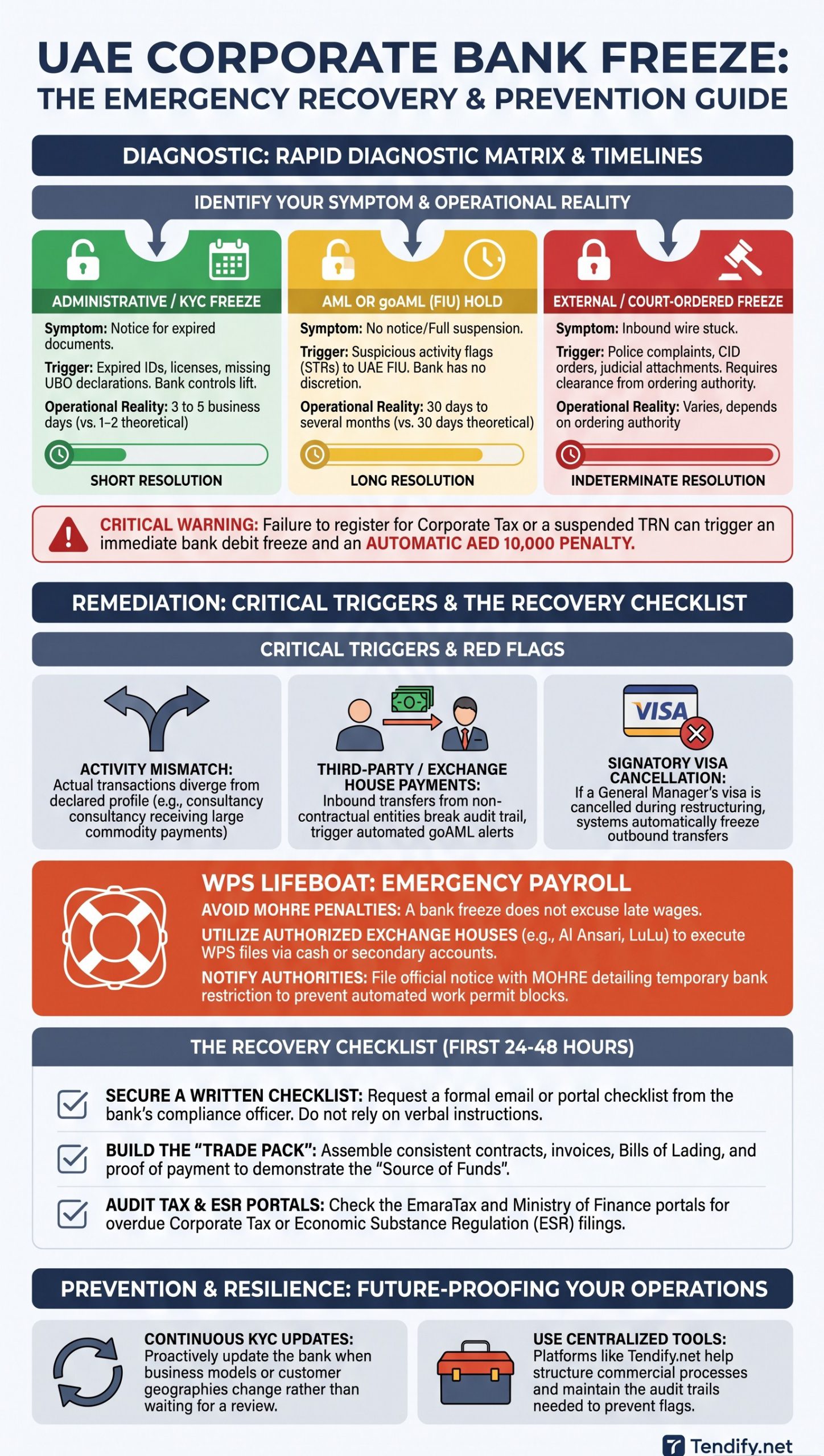
UAE Bank Freeze Recovery Guide
A short conversation with the bank’s compliance or relationship team is usually enough to establish the category. Ask directly whether the restriction is internal (KYC/compliance) or external (authority order). Staff may not disclose the underlying report because of tipping-off prohibitions, but the category itself determines the next move.
Root Causes That Trigger Freezes in Practice
Operational experience across free-zone and mainland entities shows recurring patterns.
Quick Diagnostic Matrix: Identify Your Freeze Type in Seconds
Match your bank notice or transaction symptom to pinpoint the root cause and immediate recovery pathway.
| Freeze Type | Primary Symptom | Root Trigger | Immediate Action Required |
|---|---|---|---|
| Administrative / KYC Freeze | Notice for expired EID, passport, trade licence, or missing TRN certificate. | Outdated corporate records or non-compliance with FTA Corporate Tax registration. | Submit updated KYC documents & Tax Clearance via bank portal. |
| Transaction-Specific Hold | Inbound/outbound wire stuck; bank requests supporting invoices within 24–48h. | Third-party payment, exchange house transfer, or high-value anomaly. | Provide Tripartite Agreement, Bill of Lading, & Remittance Slip. |
| Full AML / goAML Freeze | Account blocked without prior notice; online banking access restricted. | Activity mismatch, unverified source of funds, or automated goAML escalation. | Engage compliance counsel & submit a full audit trail file to the bank. |
Rapid Response Checklist: First 24 Hours
Realistic Resolution Timelines: Operational Reality vs. Expectations
Bank unfreezing timelines in the UAE vary significantly depending on whether processing remains at the branch level or escalates to Central Compliance and the FIU.
| Scenario Level | Theoretical / Best Case | Operational Reality | Primary Escalation Path |
|---|---|---|---|
| Standard KYC Update | 1 to 2 business days | 3 to 5 business days | Branch / Relationship Manager submission via core portal. |
| Central Compliance Review | 3 to 5 business days | 5 to 10 business days | Headquarters Compliance Desk review for transaction audit trail. |
| goAML / FIU Investigation | Initial 30-day statutory window | 30 days (Extendable to several months) | Financial Intelligence Unit (Central Bank) regulatory inquiry. |
Critical Operational Realities:
- Central Compliance Bottlenecks: While front-line branch managers often promise 24 to 48-hour turnarounds for minor KYC updates, files referred to Central Compliance routinely require 5 to 10 full business days for formal sign-off.
- FIU Statutory Extension Risks: Suspicious Transaction Reports (STRs) flagged via the goAML portal trigger an initial 30-day freeze by law. However, if the Financial Intelligence Unit (FIU) requests additional cross-border information, this statutory review window can be extended for several months without prior notification to the account holder.
Activity mismatch remains the single most frequent commercial trigger. At account opening the company declares its licensed activities, expected monthly volumes, main customer and supplier geographies, and typical transaction sizes. When actual flows diverge significantly—consultancy entities receiving large trading payments, local service companies suddenly handling multi-jurisdictional commodity settlements, or volumes that jump without corresponding contracts—the monitoring systems generate alerts.
Incomplete or outdated KYC documentation is equally common. Banks conduct both scheduled and event-driven reviews. An expired Emirates ID of a director or signatory, a trade licence that has not been updated in the bank’s file, missing or inconsistent UBO declarations (especially layered ownership structures), or outdated proof of address can all produce restrictions even when the underlying business is entirely legitimate.
Key Operational Risk: Authorized Signatory Resident Status & Visa Cancellations
A frequently overlooked trigger for sudden corporate account restrictions is the status change or cancellation of the primary Authorized Signatory or General Manager’s UAE residence visa. Under Central Bank rules, automated core banking systems directly monitor residency status linked to Emirates IDs. If a key signatory’s visa is cancelled during corporate restructuring, partner exits, or visa status updates, the bank’s risk engine automatically imposes a systemic freeze on all outbound transfers until a updated, valid Emirates ID and legal board resolution are formally submitted and verified.
Corporate Tax & TRN Non-Compliance: A Direct Trigger for Bank Freezes
Failure to register for Corporate Tax or suspension of your Tax Registration Number (TRN) in the UAE directly impacts corporate banking and trade operations.
1. Direct Consequences on Bank Accounts
UAE financial institutions regularly cross-reference corporate KYC files with the Federal Tax Authority (FTA) database:
- Formal Compliance Warning: Banks issue a strict deadline (typically 30 days) to submit proof of Corporate Tax registration or TRN validation.
- Debit Freeze: Failure to comply results in blocked outgoing transfers, cheque clearing halts, and international payment restrictions.
- Full Account Suspension: Suspended or cancelled TRNs prompt banks to classify the entity as a high risk for regulatory non-compliance, leading to account freezes.
2. Impact on Commercial Operations & Trade Licence
- Severe Administrative Fines: Late Corporate Tax registration incurs an automatic AED 10,000 penalty, alongside percentage-based monthly fines for overdue VAT filings.
- Licence Renewal Halts: Free Zone authorities and the Department of Economy and Tourism (DET) increasingly require active FTA status or tax clearance for trade licence renewals.
- Invalidation of Tax Invoices: Entities with suspended TRNs legally lose the right to issue Tax Invoices, preventing trade counterparties from claiming Input VAT recovery.
Remediation Steps to Restore Bank & Tax Compliance:
- Audit EmaraTax Portal: Access the FTA portal to identify the exact trigger (e.g., overdue filings or missing Corporate Tax registration).
- Settle Outstanding Liabilities: File pending VAT/Corporate Tax returns and settle any outstanding administrative penalties.
- Submit Reactivation Request: Apply for TRN reactivation directly through the FTA portal.
- Provide Tax Clearance to Bank: Submit the updated Tax Registration Certificate or clearance document immediately to the bank’s compliance team to update core KYC records.
Free Zone Economic Substance Regulations (ESR): Direct Banking Impact
For entities operating in UAE Free Zones (e.g., JAFZA, DAFZA, DMCC, IFZA), failure to meet Economic Substance Notification and Reporting requirements directly triggers corporate bank freezes.
1. How ESR Non-Compliance Affects Banking Status
UAE Free Zone Authorities and the Ministry of Finance closely align ESR filings with financial institution oversight:
- Automated Compliance Flags: Free Zone Authorities flag non-filing licenses directly to the Central Bank’s regulatory database, marking the entity as non-compliant.
- Regulatory Freezes: Banks automatically restrict account operations when an entity conducts Relevant Activities (e.g., Distribution, Headquarter, Intellectual Property) without valid ESR submissions.
- Severe Penalties: Failure to submit the ESR Notification or Report incurs fines starting at AED 20,000 up to AED 50,000+, alongside license renewal suspensions.
2. Essential ESR Steps for Free Zone Companies
- Relevant Activity Assessment: Determine whether your corporate operations fall under ESR scope (e.g., Banking, Insurance, Investment Fund Management, Shipping, Holding Company, Service Centers).
- Annual Notification Filing: Submit the mandatory ESR Notification via the Ministry of Finance Portal within 6 months of your financial year-end.
- Substance Test Compliance: Ensure adequate physical presence, full-time employees, and operational expenditure within the respective Free Zone.
Remediation Workflow for ESR-Related Freezes:
- Audit Ministry of Finance Portal: Review your company file on the MoF ESR portal to confirm missing notifications or overdue substance reports.
- File Backdated Reports & Settle Fines: Submit pending filings and pay any administrative penalties assessed by the regulatory authority.
- Submit ESR Clearance to Bank Compliance: Provide official MoF submission confirmations and clearance receipts to your bank’s KYC desk to remove account restrictions.
High-Risk Scenario: Exchange Houses & Third-Party Payments
A primary driver for goAML red-flagging and automated account freezes across Gulf trade corridors.
In Middle Eastern and GCC trade dynamics, buyers frequently execute transactions through third-party intermediaries, remittance agents, or local Exchange Houses instead of direct corporate bank accounts.
Why Third-Party Settlement Triggers Immediate Risk Flags:
- Third-Party Payment Flag: Inbound transfers from an entity other than the contractual buyer break the explicit audit trail required under Anti-Money Laundering (AML) standards.
- Automated goAML Escalation: UAE banking compliance systems flag exchange house transfers lacking pre-approved third-party authorization, automatically generating a Suspicious Transaction Report (STR) within the FIU’s goAML portal.
- Entity & Payer Discrepancy: When the remitting party name does not match the commercial invoice or bill of lading consignee, banks freeze incoming funds pending detailed proof of relationship.
Essential Compliance Controls for Third-Party Inflows:
- Tripartite Settlement Agreements: Execute a legally binding third-party payment agreement signed by the seller, buyer, and paying entity prior to funds transfer.
- Exchange House Remittance Advice: Obtain official deposit slips and exchange receipts detailing the original buyer’s name in the transaction remarks.
- Proactive Notice to Bank: Notify your relationship officer or compliance desk before receiving high-value exchange house transfers to avoid automated goAML freezes.
Source-of-funds gaps produce the sharpest scrutiny. A large inbound transfer without contemporaneous invoices, contracts, shipping documents or correspondence explaining the commercial purpose will almost always prompt a request for clarification. Banks are required to form a reasonable understanding of the economic rationale. Vague explanations or delayed responses escalate the matter.
Other practical triggers include links (real or perceived) to higher-risk jurisdictions, cash-intensive activity inconsistent with the licence, complex ownership chains that obscure natural persons controlling 25 percent or more, and failure to respond promptly to earlier information requests. Sanctions screening matches, even false positives, can also produce immediate holds.
Step-by-Step Process to Lift a Bank-Initiated KYC Freeze
When the bank confirms the restriction is internal, speed and completeness matter more than volume of paper.
- Obtain the precise document list in writing. Do not rely on verbal summaries. Ask for a formal email or portal checklist specifying every item required.
- Assemble a single, complete package. Typical requirements for corporate accounts include:
- Current trade licence and any amendments
- Memorandum and Articles of Association (or equivalent) with all shareholding updates
- Share register and UBO declaration identifying every natural person with 25 percent or greater ownership or control
- Valid passports, Emirates IDs and residence visas of all directors, authorised signatories and UBOs
- Board resolution confirming current signatories and account authorities
- Proof of registered address (Ejari or utility bill where applicable)
- Recent financial statements or management accounts if requested
- Source-of-funds evidence for any flagged transactions (contracts, invoices, correspondence, shipping documents)
- Ensure internal consistency. Names, shareholding percentages, activities and addresses must match across every document. Inconsistencies are a primary reason packages are rejected.
- Submit through the channel the bank specifies—branch, relationship manager, or secure portal—and request written confirmation of receipt together with an expected review timeline.
- Follow up systematically. If additional clarification is requested, respond within the stated window with the exact information sought. Partial or sequential submissions prolong the process.
Most straightforward KYC freezes clear once a clean, complete file is verified. Delays almost always stem from missing items or mismatched data rather than substantive risk.
WPS Payroll Continuity & Fund Transfers During Bank Freezes
A corporate bank freeze does not suspend Ministry of Human Resources & Emiratisation (MOHRE) compliance requirements for Wage Protection System (WPS) execution.
1. Fund Transfers & Inter-Bank Restrictions
During an active bank freeze, transferring corporate funds out of the affected account presents strict legal and operational boundaries:
- Debit Freeze Lock: Outgoing wire transfers, online banking execution, and cheque clearing are fully blocked by the holding bank.
- Switching Banks Under Freeze: You cannot transfer capital from a frozen account to a new corporate account until compliance clearance or a formal unfreezing order is issued.
- Inbound Capital Routing: Incoming trade receipts will land in the frozen account but immediately become trapped, compounding liquidity risks.
2. Avoiding MOHRE Penalties & WPS Suspensions
Non-payment of wages past the statutory MOHRE deadline triggers immediate work permit blockades, AED 5,000+ per-employee fines, and legal escalation:
- Approved Third-Party Exchange Agents: Utilize authorized Exchange Houses (e.g., Al Ansari, LuLu Exchange) to execute WPS salary files via cash deposit or funding from an secondary, non-frozen corporate account.
- SIF File Generation: Ensure your HR payroll team generates the standard Salary Information File (.SIF) and submits it via accredited exchange portals.
- Formal MOHRE Notification: File an official notice with MOHRE detailing the temporary banking restriction and providing proof of alternative WPS processing.
Emergency WPS Contingency Workflow:
- Route WPS via Exchange House: Open an agent WPS agreement with a major UAE Exchange House to disburse salaries using secondary funds.
- Provide Cash / Alternative Funding: Fund the payroll file at the exchange house desk using alternative liquid reserves or director injections.
- Submit Payment Receipts to MOHRE: Retain all official WPS execution receipts to prevent automated establishment blocks on the MOHRE system.
Resolving an AML or FIU Hold
External holds require a different approach. Document submission to the branch alone will not lift the freeze.
Confirm the nature of the hold with the bank. If it is external, stop treating it as a routine KYC matter. Engage a licensed UAE legal practitioner experienced in financial crime and banking compliance. The practitioner can approach the Public Prosecution or relevant channels to establish whether a file exists and what evidence is required.
Assemble a clear commercial narrative supported by primary documents. The objective is to demonstrate the legitimate economic purpose of the flagged funds or pattern of activity. Contracts, invoices, purchase orders, shipping documents, bank statements from the counterparty, and contemporaneous correspondence form the core evidence. A concise written explanation linking each document to the transaction helps the reviewing authority.
Cooperate fully with any information requests. Provide the evidence promptly and accurately. Uncooperative responses or incomplete files tend to extend the hold.
If the freeze appears unjustified or has outlived its investigative purpose, a formal grievance can be filed with the competent criminal court. The court is required to rule within a defined period after receiving a memorandum from the prosecution. Timing is critical—the window runs from the date of the order.
Once the authority issues a release, the instruction flows back to the bank through official channels. Request written confirmation that the account is fully operational again.
Documentation That Actually Satisfies Source-of-Funds and Ongoing Reviews
Banks distinguish source of funds (the origin of a specific sum) from source of wealth (the broader accumulation of the beneficial owner’s financial position). For most corporate transaction reviews the focus is source of funds.
Effective evidence is contemporaneous and specific:
- Signed contracts or purchase orders matching the amount and parties
- Commercial invoices with clear descriptions of goods or services
- Shipping or logistics documents where physical trade is involved
- Correspondence establishing the commercial relationship and purpose of payment
- Statements showing the funds left the counterparty’s account and arrived in the company’s account
- For capital contributions, share subscription documents, board resolutions and evidence of the investor’s own source of funds
For periodic KYC, maintain a standing file that includes current corporate documents, updated UBO charts, and a short business activity summary that reflects actual operations. Aligning the declared profile with reality is more effective than explanatory letters after the fact.
Prevention: Building Operational Resilience Against Freezes
Prevention is cheaper and less disruptive than remediation. Several disciplines consistently reduce exposure.
Keep the customer profile current. When the business model, customer base, supplier geography or expected volumes change, update the bank proactively rather than waiting for a review. Activity mismatch is one of the most preventable triggers.
Treat KYC as a continuous process, not a one-time event. Calendar reminders for licence renewals, ID expiries and periodic document refresh prevent automatic restrictions. Designate an internal owner responsible for bank compliance correspondence.
Document every material transaction at the time it occurs. A clean audit trail of contracts and invoices makes source-of-funds responses straightforward.
Maintain transparent ownership. Complex or opaque structures invite enhanced due diligence. Ensure every UBO is identified to a natural person and that the documentation is consistent.
Separate personal and corporate flows rigorously. Commingling remains a frequent red flag.
Choose banking relationships that match the risk profile of the business. Certain activities and ownership structures fit more comfortably with particular institutions. A mismatch at the relationship level increases friction throughout the life of the account.
For companies engaged in cross-border trade, consistent documentation of counterparties and payment purposes reduces the likelihood of automated alerts. Related guidance on structuring compliant cross-border payment flows can be found in the practical notes at B2B Cross-Border Payments: Modular Infrastructure & FX Rails.
Escalation Routes When the Bank Process Stalls
If a bank-initiated freeze is not resolved within a reasonable period after a complete package has been submitted, use the bank’s formal complaints process. Licensed financial institutions are required to acknowledge complaints promptly and provide a substantive response within defined timelines under Central Bank consumer protection rules.
If the internal process does not produce a satisfactory outcome, escalation is available through the Sanadak platform, the independent financial ombudsman unit. Prior internal complaint is normally a prerequisite. Sanadak handles eligible consumer and SME complaints against licensed institutions.
For external freezes the primary route remains the ordering authority and, where appropriate, the courts. Legal representation is the practical necessity.
Practical Realities for Free-Zone and Mainland Entities
Free-zone companies face the same AML and KYC obligations as mainland entities. The licence itself does not create a lighter banking regime. Banks still require full visibility of ownership, activity alignment and source of funds. Entities with predominantly non-resident ownership or multi-jurisdictional transaction patterns should expect enhanced due diligence as the baseline rather than the exception.
Mainland companies with economic substance and clear local operations often find relationship management smoother once the initial file is complete, but they remain fully subject to the same monitoring and reporting rules.
In both cases the quality of the initial onboarding file and the discipline of ongoing maintenance determine the frequency and severity of later reviews.
Moving From Reaction to Control
Corporate account freezes under the UAE’s AML and KYC regime are a structural feature of the regulatory environment rather than isolated errors. The systems are designed to surface inconsistencies, gaps in documentation and deviations from declared profiles. The businesses that navigate them with least disruption treat compliance as an operational process: they maintain current files, document transactions as they occur, update profiles when the business evolves, and respond to bank requests with complete, consistent evidence.
When a freeze does occur, the critical first move is diagnosis—internal versus external—followed by the corresponding evidence package and, where necessary, professional representation. Most commercial freezes are reversible. The difference between a multi-week disruption and a short interruption is usually the speed and quality of the response.
For companies seeking structured support in preparing compliant banking documentation, maintaining transaction audit trails, or aligning commercial flows with regulatory expectations, tools that centralise commercial records and counterparties can reduce friction. One such operational platform is available at Platform.Tendify.Net.
Further practical reading on related compliance topics appears at UAE Corporate Tax Small Business Relief: Do You Qualify for 0% Tax? و From Transactions to Trade Ecosystems: How Leading Import and Export Companies Build Influence, Stability, and Long-Term Power.
The regulatory bar is high and continuing to rise. The organisations that treat documentation, transparency and profile alignment as core operational disciplines rather than periodic administrative chores keep their accounts functional and their commercial momentum intact. When banking continuity is essential to cross-border operations, the disciplined approach is not optional—it is the practical cost of operating in one of the region’s most scrutinised financial systems.
الأسئلة الشائعة (FAQ)
Essential answers regarding UAE corporate bank freezes, goAML procedures, and WPS operations.

