


المدونة
When War Hits the Gulf: Risk Management for Traders
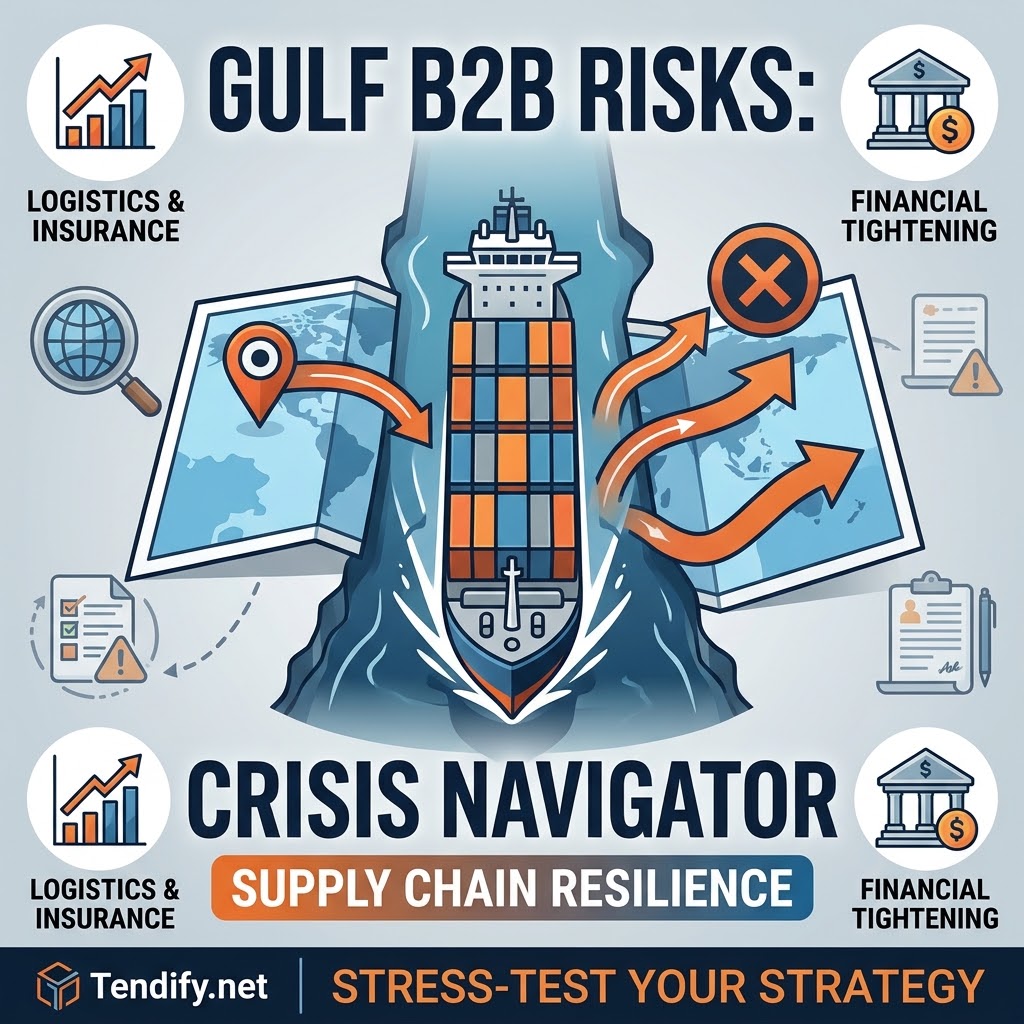
A single delayed vessel or a sudden spike in war-risk insurance can erase months of carefully negotiated margins. In the Gulf, that risk is not theoretical. Roughly one-fifth of global seaborne oil and significant volumes of petrochemicals, refined products, and containerized cargo normally move through the Strait of Hormuz. When tensions rise, insurance premiums jump, transit times lengthen, and payment channels tighten. Trade does not stop. It changes shape—and the traders who have already stress-tested their supply chains, contracts, and payment methods keep moving while others scramble.
This guide is written for buyers and suppliers operating across the GCC and broader MENA region. It focuses on operational realism: what actually breaks first, how costs move, and the concrete steps that protect cash flow, relationships, and delivery reliability when a regional conflict scenario materializes.
How Regional Crisis Hits B2B Trade First
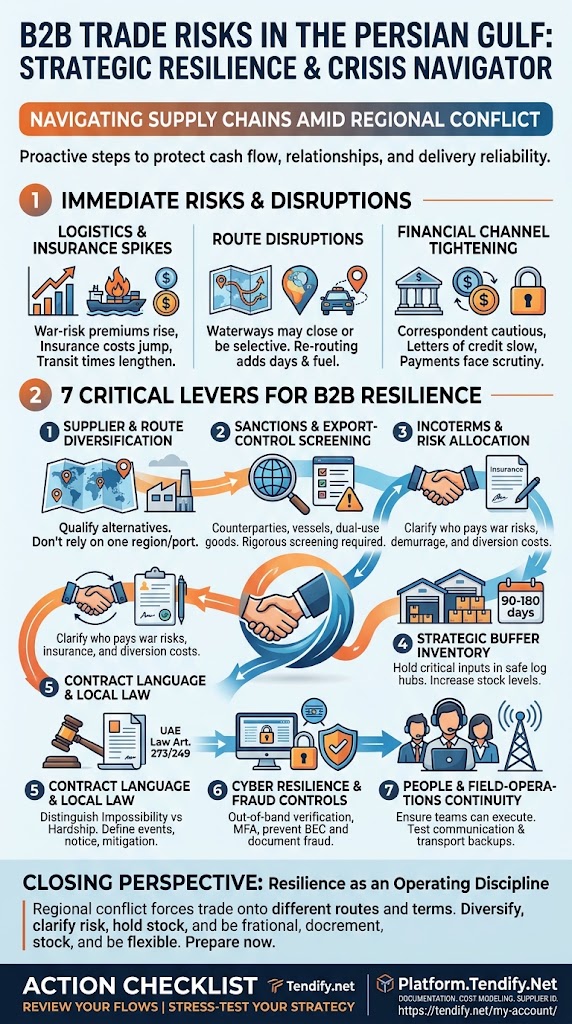
Logistics and marine insurance react fastest. Additional war-risk premiums for vessels operating in or near the Gulf have historically moved from roughly 0.25% of hull value in quiet periods to ranges of 6–10% during elevated risk. For a vessel valued at $100 million, that difference can mean millions of dollars per voyage. Those costs pass through to charterers and cargo owners. Many operators simply avoid the highest-risk legs, forcing cargo onto longer routes or alternative loading points.
Transit times stretch. Rerouting via the Cape of Good Hope adds 10–15 days (and sometimes more) depending on origin and destination, along with higher fuel burn. Capacity tightens. Freight rates for remaining available tonnage climb. Demurrage and detention risks rise at congested alternative ports. Even when physical transit remains possible, the combination of higher insurance, longer voyages, and scarce space compresses margins across the board.
Gulf war Risk
Strategic commodities feel the pressure next. Petrochemicals, base chemicals, metals, construction materials, and certain food and medical inputs that normally flow through Gulf hubs experience delayed loadings, partial cancellations, or sudden price spikes. Buyers who rely on single-source suppliers or single-port gateways discover their vulnerability within days. Suppliers with concentrated customer bases in one sub-region face the same problem from the other direction.
Financial channels tighten in parallel. Correspondent banking relationships become more cautious. Letter-of-credit confirmation and discounting slow or become more expensive. Currency conversion and cross-border settlement face additional scrutiny. Parties that previously moved funds smoothly begin exploring escrow structures, shorter payment cycles, or pre-agreed alternative settlement methods. Cash-flow pressure appears earlier than many expect.
None of these effects require a full closure of a major waterway. Elevated risk premiums, selective avoidance by mainstream tonnage, and conservative banking behavior are enough to disrupt ordinary B2B flows.
Practical Risk Management Moves That Actually Work
1. Supplier and Route Diversification
The most effective protection is structural, not reactive. Map every critical input and every major customer against geographic concentration risk. Identify which materials or finished goods currently depend on a single loading region, a single port cluster, or a single shipping corridor.
Then build deliberate alternatives. For Gulf-origin cargo, that often means qualifying suppliers or stock points that can load from ports outside the highest-risk zone—Fujairah and other Gulf of Oman facilities, Omani ports such as Sohar, Duqm or Salalah, or Red Sea gateways reachable by pipeline or overland transfer. For inbound cargo, maintain qualified secondary sources in more distant but lower-risk origins that can still reach the region via Cape routes or established land corridors within acceptable cost and lead-time bands.
Operational practice shows that a 70/30 split—primary flow under normal conditions, secondary capacity ready to scale—provides meaningful resilience without permanently destroying unit economics. The secondary suppliers must already be approved, quality-qualified, and commercially engaged. A list of names is not a contingency plan.
The same logic applies to logistics providers. Pre-qualify forwarders and carriers that maintain active relationships with alternative ports and have demonstrated ability to switch modes or routes under pressure.
2. Sanctions and Export Controls: The Missing Risk Layer
⚠️ Reality check for Gulf traders: A clean bill of lading does not mean a clean counterparty. In a regional crisis, sanctions are where commercial risk, banking risk, and legal liability concentrate. If your risk guide does not cover sanctions screening, secondary sanctions, and dual-use goods, it is not yet a risk guide.
Most trade-risk articles mention “licensing changes” in passing. That is not enough. In the GCC and wider MENA region, a single unscreened counterparty, vessel, port, bank, or end-user can freeze payments, expose cargo, trigger insurer disputes, and create personal or corporate liability long after the shipment has moved. Sanctions risk is not only a compliance function. It is a commercial survival function.
🔎 The Three Sanctions Exposures Every Trader Must Map
| Exposure | What It Looks Like in Practice | Minimum Practical Control |
|---|---|---|
| Counterparty screening | Your buyer, supplier, agent, freight forwarder, shipowner, charterer, bank, or beneficial owner appears on a sanctions list — or is owned or controlled by someone who does. | Screen at onboarding and again before each shipment or payment. Check ownership and control, not just the company name. Keep dated evidence of every screening result. |
| Secondary sanctions | A non-US trader deals with a designated person, sector, or transaction and then loses access to US banks, US-dollar clearing, insurance, shipping, or technology providers. | Adopt a risk-based approach. Identify any US nexus in goods, banks, currency, insurance, vessels, or shareholders. Escalate high-risk deals to legal counsel before quoting or booking. |
| Dual-use goods | A product has a civilian description but a potential military, nuclear, chemical, or missile-related application. Classification, end-use, and end-user checks are missing. | Classify goods before quotation. Obtain end-use and end-user statements. Apply catch-all controls. Review routing and transshipment points for diversion risk. |
🧭 A Practical Screening Workflow Before You Quote or Ship
- Classify the goods first. Confirm HS code, export-control classification, and whether any dual-use, military, nuclear, or chemical/biological trigger applies.
- Screen every party, not just the buyer. Include the supplier, end-user, consignee, notify party, agent, freight forwarder, carrier, vessel, beneficial owner, and bank.
- Screen the route. Check ports, transshipment hubs, free zones, and jurisdictions for restricted-party, diversion, or embargo exposure.
- Document end-use and end-user. Use signed statements, corporate documents, and, where risk is higher, enhanced due diligence.
- Review the payment route. Confirm that the bank, currency, and intermediary institutions can support the transaction without sanctions friction.
- Escalate before commitment. Set a clear internal trigger for legal review before pricing, booking, or signing. Do not wait for the bank to reject the payment.
- Retain records. Keep screening results, classifications, end-use certificates, approvals, and escalation notes for the full limitation period.
🚩 Red Flags That Should Stop the Transaction
🚩 The customer refuses to disclose the end-user.
🚩 The shipping route changes repeatedly without a commercial reason.
🚩 A new intermediary appears late in the deal and insists on unusual payment terms.
🚩 The goods are “civilian” but the destination, buyer, or quantity does not match any plausible civilian use.
🚩 The vessel has a history of dark activity, AIS gaps, or ownership changes near a restricted port.
🚩 The bank asks for documents that were not part of the original commercial discussion.
🚩 Ownership or control of a counterparty changes after onboarding and no one re-screens it.
📘 What to Add to Your Internal Risk Playbook
| Playbook Element | Practical Action | Evidence to Keep |
|---|---|---|
| Sanctions screening policy | Define who is screened, when, against which lists, and who signs off on exceptions. | Policy version, training records, screening logs. |
| Dual-use classification | Classify high-risk product lines before quotation, not after shipment. | Classification memo, HS code, technical specifications. |
| End-use / end-user file | Collect signed statements and verify corporate identity for higher-risk trades. | End-user certificate, trade licence, ownership chart. |
| Bank and payment-route review | Confirm sanctions clearance with the bank before cargo moves. | Bank confirmation, payment-route diagram, escalation emails. |
| Escalation and legal sign-off | Set red lines and require legal approval for any amber or red flag. | Signed legal opinion or internal approval note. |
| حماية العقود | Include sanctions representations, warranties, audit rights, suspension rights, and termination rights. | Executed contract, amendments, notices. |
💡 Bottom line for Gulf and MENA traders
Sanctions risk does not wait for a full regional war. It appears in a single ownership link, a vessel’s history, a bank’s internal review, or a misclassified product. Build screening into onboarding, quotation, contracting, shipping, and payment. A trader without a sanctions guide is not managing regional risk — they are only managing the risks they can see.
3. Incoterms and Risk Allocation Review
Standard Incoterms that worked in stable periods can leave one party unexpectedly exposed when routes lengthen or insurance costs explode. Review every active long-term contract and major framework agreement.
Consider shifting the point at which risk and insurance responsibility transfer so that the party best able to arrange and price war-risk cover does so. In some cases, terms that place greater responsibility on the seller for arranging carriage and insurance (CIF or CIP with clear war-risk wording) give better control. In others, the buyer may prefer to arrange cover itself once the goods leave a designated low-risk port.
Clarify who pays additional war-risk premiums, who absorbs demurrage caused by diversion, and how freight rate increases above a defined threshold are shared. Ambiguity here produces disputes precisely when relationships are already strained. For a practical tool that helps select and document the right term for different risk profiles, many operators refer to structured selection frameworks available on established trade platforms.
4. Strategic Buffer Inventory
Just-in-time inventory works until it does not. For critical inputs whose disruption would stop production or fulfillment, build deliberate buffer stocks sized to realistic recovery times rather than optimistic ones.
Analyses of regional resilience consistently recommend minimum coverage of 90 days for essential goods and longer (up to 180 days) for highly specialized or medical/industrial items that cannot be rapidly substituted. The exact number depends on the product, the alternative sourcing lead time, and the carrying cost the business can absorb.
Location matters as much as quantity. Holding buffer stock inside the same high-risk zone provides limited protection. Prefer storage at alternative ports, free zones, or inland logistics hubs that remain accessible via multiple routes. Shared or multi-user warehousing arrangements can reduce the capital tied up while still providing access when primary channels are constrained.
5. Force Majeure and Contract Flexibility
Force majeure clauses that simply list “war” or “acts of government” without further definition often prove inadequate. Modern drafting needs to address the realities of today’s trade environment: elevated war-risk premiums that make transit commercially unviable, port or waterway restrictions short of full closure, sanctions or licensing changes that affect payment or carriage, and prolonged supply-chain disruption caused by secondary effects.
Key elements that strengthen enforceability and reduce disputes:
- Clear definition of qualifying events, including hostilities, blockades, and material increases in insurance or transit costs that prevent performance on commercially reasonable terms.
- Explicit notice requirements and timelines.
- Obligation to mitigate, including by using alternative routes or suppliers where reasonably available.
- Rules for cost allocation of mitigation measures.
- Rights to suspend, renegotiate, or terminate after a defined period of continued disruption.
- Alignment of the clause across the full contractual chain so that upstream and downstream parties do not face mismatched risk.
Review existing long-term contracts now. Where the clause is weak, negotiate amendments while relations are still cooperative. New contracts should treat the force majeure and hardship language as a core commercial term rather than boilerplate.
5A. The Local Law Gap: Why “Force Majeure” Rarely Saves a Gulf Trader
⚠️ The uncomfortable truth: In the GCC, declaring force majeure is easy. Proving it in court is not. A regional war, a closed waterway, or a war-risk premium that doubles the cost of a voyage is not, by itself, force majeure under most Gulf civil codes. The legal test is usually impossibility, not hardship. Traders who rely on generic “war” clauses without understanding the local statutory threshold discover this gap only after performance has already failed.
The article so far has treated force majeure as a contractual drafting issue. That is necessary but incomplete. In the UAE, Saudi Arabia, Qatar, Oman, and Kuwait, force majeure and hardship are statutory doctrines with specific — and often strict — conditions. The governing law of the contract determines whether relief is available, what form it takes, and how quickly a counterparty can challenge it. A trader who assumes that “war” automatically excuses performance is likely to be wrong in the jurisdictions where Gulf trade contracts are most often litigated.
⚖️ The UAE: Article 273 Is Not a General War Clause
Onshore UAE law is the most frequently chosen governing law for GCC trade contracts. Article 273 of the old Civil Transactions Law (Federal Law No. 5 of 1985) provides that where a force majeure event renders performance impossible, the corresponding obligation is extinguished and the contract is automatically rescinded From 1 June 2026, the same principle is preserved in Article 236 of the new Civil Transactions Law (Federal Decree-Law No. 25 of 2025).
The critical word is impossible. UAE courts have consistently interpreted this strictly. Performance that has become more expensive, more delayed, or commercially unattractive does not qualify. The event must be:
- Beyond the party’s control — its effects could not have been avoided even with reasonable efforts.
- Unforeseeable at the time of contracting — a risk that was reasonably foreseeable cannot be invoked later.
- The direct and sole cause of non-performance — if the party contributed to the failure in any way, the defence may be rejected entirely.
- Genuinely impossible — physical or legal impossibility, such as destruction of the subject matter or a government order making performance unlawful.
💡 What this means for a Gulf trader: A vessel delayed by rerouting, a war-risk premium that rises from 0.25% to 7%, or a buyer who can no longer obtain confirming bank approval is not automatically force majeure under Article 273. If cargo can still move — even at a loss — the Article 273 threshold is probably not met.
🔄 The Alternative That Most Traders Ignore: Hardship Under Article 249
Where performance remains possible but has become excessively onerous because of exceptional and unforeseeable circumstances, UAE law provides a separate remedy: hardship (sometimes called “exceptional circumstances”) under Article 249 of the old law (Article 224 under the new law). Unlike Article 273, hardship does not automatically terminate the contract. Instead, a court may intervene to rebalance the obligation to a reasonable level, restoring the economic equilibrium between the parties.
The practical distinction is decisive:
| Doctrine | Trigger | Effect | Who Decides |
|---|---|---|---|
| Force majeure (Art. 273) | Performance is impossible | Obligation extinguished; contract automatically rescinded | Court declares the legal effect |
| Hardship (Art. 249) | Performance is possible but excessively burdensome | Obligation adjusted to a reasonable level; contract continues | Court rebalances the terms |
Hardship relief is discretionary and requires proof that the event is exceptional, public in nature, and could not have been foreseen. It is also frequently the more realistic remedy when a regional conflict raises freight, insurance, and financing costs without making performance literally impossible — yet it is often overlooked because traders fixate on the word “force majeure”.
🌍 The GCC Is Not One Legal System
A single regional risk playbook cannot assume that the UAE position applies everywhere. The GCC contains several distinct legal regimes, and the availability of force majeure relief varies meaningfully between them.
| Jurisdiction | Core Force Majeure Rule | Hardship Relief? | Practical Note for Traders |
|---|---|---|---|
| Onshore UAE | Art. 273 (old) / Art. 236 (new): strict impossibility | Yes — Art. 249 (old) / Art. 224 (new) | Courts apply a high threshold; hardship is available but rarely invoked. |
| مركز دبي المالي العالمي | Art. 82 DIFC Contract Law implies a force majeure term even if the contract is silent; payment obligations are generally not excused | Limited; common-law frustration is narrow | Notice within a reasonable time is critical; silence is less fatal than in ADGM, but payment risk remains. |
| سوق أبوظبي العالمي | No statutory force majeure; only an express clause or the common-law doctrine of frustration | Frustration only; very high threshold | A contract silent on force majeure is materially exposed. Drafting is not optional here. |
| المملكة العربية السعودية | Civil Transactions Law (2023): Art. 110 and related provisions; broadly mirrors the UAE approach | Yes — codified hardship doctrine | Newer codification; judicial application is still developing, so contractual clarity matters more, not less. |
| قطر | Civil Code Arts. 187–188; force majeure can be contracted out of in some contexts | Yes — Art. 171 | Parties may allocate the risk differently by agreement; review the clause, not just the statute. |
| سلطنة عمان | Civil Code Arts. 172 and 159; codified force majeure and hardship | نعم | Codified framework; local-law advice is essential before relying on either doctrine. |
📌 What a Trader Must Actually Do Before Invoking Force Majeure
- Identify the governing law of the contract — not the law of the place of performance. A contract performed in the Gulf but governed by English law is not governed by Article 273.
- Read the force majeure clause against the statutory default. A clause that defines events more broadly than the statute may help, but courts may still apply mandatory statutory concepts. A clause that is narrower than the statute may waive relief the law would otherwise provide.
- Distinguish impossibility from hardship before sending a notice. Claiming force majeure when the real issue is cost escalation can undermine credibility and expose the claiming party to a wrongful-termination claim.
- Check notice and mitigation requirements. Even where the statute does not expressly require notice, courts assess the parties’ conduct. Failure to mitigate — for example, by not exploring alternative routes or suppliers — can defeat relief.
- Preserve evidence of causation. The party invoking force majeure bears the burden of proving that the event, and not its own commercial decisions, caused the non-performance.
💡 Bottom line for Gulf and MENA traders
Force majeure in the GCC is a statutory doctrine with a high threshold, not a commercial escape hatch. A regional war may justify relief — but only if the contract’s governing law, the specific clause, and the facts satisfy the local test. Before the next disruption, review the governing law of every high-value contract, compare the force majeure clause against the statutory default, and identify whether the realistic remedy is termination under force majeure or rebalancing under hardship. The difference between the two is often the difference between recovering costs and absorbing them.
5B. Cyber Resilience and Fraud Controls: The Operational Threat That Arrives Before the Crisis Does
⚠️ The overlooked front: Physical disruption in the Gulf is visible. Cyber and fraud risk is not. State-backed hackers have breached port systems and vessel networks in the region. Business email compromise now drives cargo theft and payment diversion. Trade document fraud — phantom shipments, manipulated invoices, falsified bills of lading — is the mechanism through which illicit finance moves under the cover of legitimate trade. A trader who plans for war-risk premiums but ignores a compromised inbox or a forged bill of lading has protected the wrong asset.
Regional instability does not create cyber and fraud risk from nothing. It accelerates it. Oversight becomes uneven, supplier substitution happens under time pressure, new intermediaries appear, and transaction volumes shift to unfamiliar routes. Legitimate and illicit actors converge on the same commercial ecosystems, and the controls that worked in stable periods become visibly inadequate.This section addresses three operational threats that materialise before physical supply-chain failure becomes acute: state-linked cyber attacks on logistics infrastructure, business email compromise (BEC) linked to cargo theft and payment diversion, and trade document fraud.
🖥️ State-Linked Cyber Attacks on Logistics and Maritime Systems
Iran and associated actors have moved from a “second-tier” cyber threat to one of the leading sponsors of geopolitical cyberattacks, blending state espionage with the broader cybercrime ecosystem. The operational record in the Gulf is concrete:
- A hacking group penetrated a vessel’s Automatic Identification System (AIS) network and accessed on-board CCTV cameras, obtaining real-time visual intelligence.
- An Iran-linked group claimed it exfiltrated 430,000 documents from the Port of Fujairah — including contract details, ship traffic, financial transactions, and pipeline maps — and passed targeting data to missile units hours before a kinetic strike.
- The same actor described the Fujairah attack as a “coordinated hybrid cyber and missile operation” that began with a breach of port systems and was followed by kinetic attacks “minutes later”.
The financial asymmetry is stark. Most ship owners spend only $300 to $1,000 per month on cybersecurity, while a single vessel can consume $175,000 to $3 million per month in fuel alone. A ransomware attack crippling a vessel in port can cost up to $100,000 per day. The question for a trader is not whether a carrier or port has been breached — it is whether you will discover the consequences through your own failed delivery, frozen payment, or misdirected cargo.
🛡️ Minimum cyber controls a trader should verify across critical partners
| Control Area | What to Ask or Require | Why It Matters for Trade |
|---|---|---|
| Carrier / forwarder cyber posture | Do they enforce MFA across operational systems? Do they have a tested incident-response plan for a port-system breach? | A compromised forwarder or carrier can lose your booking data, reroute cargo, or become the entry point for BEC. |
| Port and terminal dependency | Does the port operator disclose cyber incidents? Is there a manual fallback if terminal systems go down? | Port-system breaches have preceded physical attacks; operational continuity depends on fallback procedures, not just firewalls. |
| Vessel AIS integrity | For chartered tonnage, confirm AIS transmission history is consistent with the declared route and port calls. | AIS spoofing and gaps are established deceptive shipping practices; they also signal a vessel that may be compromised or evading scrutiny. |
| Email domain enforcement | Confirm your own domain has DMARC set to quarantine or reject, not monitoring only. | Attackers impersonate your domain to defraud your counterparties; weak DMARC makes you a vector, not just a victim. |
📧 Business Email Compromise: The Inbox Is the New Loading Dock
Business email compromise and cargo theft now share a single entry point: a compromised inbox, not the loading dock. Attackers use hijacked mailboxes for fictitious pickups, shipment misdirection, and payment diversion.The pattern is consistent across maritime and logistics targets:
- Initial access — phishing, a reused password without MFA, or malware delivered through an impersonated supply-chain company.
- Silent observation — the attacker reads the mailbox, learning shipment schedules, pickup appointments, bills of lading, carrier contacts, and routine communication tone.
- Three plays — fictitious pickup (an impostor driver collects a high-value load), shipment misdirection (a message from the real address inside a real thread changes the consignee or delivery point), or payment diversion (an invoice arrives with new remit-to bank details).
In the second quarter of 2026, CargoNet recorded 158 fictitious pickup incidents across the US and Canada, with losses more than doubling to approximately $304.6 million. CargoNet identified BEC as the primary access point for many of the quarter’s most sophisticated schemes. The attacker does not need to break anything. They reply inside a conversation your team already trusts.
🚩 BEC red flags in a trade context
🚩 A payment-details change arrives by email, even from a known address, with an urgency justification.
🚩 A pickup or delivery change is requested “as a favour” or “to avoid demurrage” at the last minute.
🚩 A new bank account is introduced for an existing supplier with no prior documentary trail.
🚩 The sender’s display name matches a known contact, but the domain has a subtle substitution (e.g., “rn” for “m”).
🚩 A mailbox rule forwards shipment-related replies to an external address the owner does not recognise.
🚩 A carrier or broker portal login is shared among multiple staff, or a departed employee’s access remains active.
🔐 Out-of-band verification: the single control that defeats most BEC
Any change to a pickup time, carrier, driver, delivery address, consignee, or bank details must be confirmed by phone — using a number already on file, never a number from the message requesting the change. Require two people to approve payment-detail changes. Release freight only to the driver and equipment details confirmed in advance; treat a last-minute driver swap as a stop-and-call event, not a routine update.
Technical baseline: phishing-resistant MFA on every mailbox that sees shipments or money (shipping/receiving, customer service, accounts payable, administrators), external auto-forwarding disabled by default, alerts on newly created inbox rules, and DMARC at enforcement (quarantine or reject), not monitoring.These are platform settings, not new infrastructure. But they must be verified across your forwarders, brokers, and carriers, not only inside your own organisation.
📄 Trade Document Fraud: Phantom Shipments and Manipulated Paperwork
The strongest recent evidence on document fraud comes from the UAE Financial Intelligence Unit’s strategic analysis of trade-based money laundering. Based on 610 credible reports, the FIU found that 61% involved phantom shipments و 41% involved document manipulation, especially invoices and bills of lading.In a phantom shipment, the payment is real, the paperwork often looks real, and the trade finance facility may be real — but the cargo never existed, never moved as stated, or moved in a materially different way from the declared transaction.
🧩 How a phantom shipment is assembled
- A front company, complicit trader, or shell importer/exporter is created or repurposed.
- Commercial documents are generated — purchase orders, invoices, sales contracts, packing lists, bills of lading.
- A payment channel is selected (wire transfer, documentary collection, or letter of credit).
- Supporting evidence is manipulated: container numbers, shipment dates, ports of loading, buyer or seller names, cargo descriptions.
- Funds are paid or financing is advanced.
- The goods never move as represented, or a different cargo moves and the mismatch is never reconciled.
Where maritime evasion is involved, the scheme becomes more sophisticated: AIS disablement, signal spoofing, falsified cargo or vessel documents, complex ownership chains, and ship-to-ship transfers designed to obscure origin and destination. Public reporting in 2026 described Iranian-linked tankers broadcasting false positions while actually loading crude, then using falsified ownership or registry signals to support the appearance of lawful trade.
🚩 Document-level red flags drawn from UAE and CBUAE guidance
| العلم الأحمر | What to Cross-Check |
|---|---|
| The trading party on the invoice differs from the payment beneficiary | Verify the contractual chain and the remit-to entity against independent corporate records. |
| Invoice amounts do not match payments, or invoices are addressed to individuals rather than entities | Reconcile invoice value, payment value, and the underlying commercial contract. |
| Invoice and bill of lading show different amounts, prices, or goods descriptions | Compare invoice line items against the B/L, packing list, and customs declaration. |
| Documents appear to have signs of forgery, alteration, or illogical formatting | Check fonts, logos, stamps, and issuing-authority letterhead; contact the issuing branch directly using independently sourced contact details. |
| Payment is received from unrelated third parties, an intermediary, or shell companies not on the letter of credit | Trace the payment origin against the contractual counterparty and LC terms. |
| AIS data shows the vessel in a different location than the declared port of loading | Cross-reference the B/L vessel IMO number with AIS satellite tracking and port-call records. |
Open-account trade, where SWIFT messages carry minimal detail, is specifically flagged as high-risk and requires enhanced monitoring. The control architecture that works is not modular. Banks see documents, ports see cargo, customs see declarations, insurers see selected voyage information, and maritime intelligence sees AIS — rarely combined in time to stop payment or financing. A trader’s own verification process must therefore cross-reference what each party sees, rather than relying on any single document set.
✅ Minimum document-integrity checks before payment or shipment release
- Does the shipment exist? Cross-check B/L, port data, and warehouse receipts; for containerised cargo, verify container number and seal against terminal records.
- Is the counterparty genuine and commercially connected? Confirm the supplier’s business licence, operating status, and whether its stated main activity is related to the goods.
- Does the document set reconcile internally? Invoice ↔ B/L ↔ packing list ↔ LC terms ↔ customs declaration. Discrepancies are not clerical — they are risk signals.
- Has the same invoice or B/L been used elsewhere? Check for duplicate invoice numbers across financing requests and document presentations.
- Was the document issued by the authority it claims to be from? Contact the issuing body directly using a number or address sourced independently, never one printed on the document itself.
💡 Bottom line for Gulf and MENA traders
Cyber and fraud risk in a regional crisis is not an IT problem or a compliance box. It is an operational threat that determines whether your cargo moves, your payment arrives at the intended recipient, and your documents survive scrutiny. State-linked actors have breached port and vessel systems in the Gulf. BEC now steals cargo and diverts payments through inboxes your team already trusts. Document fraud — phantom shipments, manipulated invoices, falsified bills of lading — is how illicit value moves through the same trade channels you use. The controls are not exotic: out-of-band verification, phishing-resistant MFA, DMARC enforcement, independent document cross-checking, and verification of counterparty and vessel reality. The traders who keep executing will be those who treated these controls as part of the same risk playbook as war-risk insurance and force majeure — not as a separate function that someone else owns.
5C. People and Field Operations: The Human Layer of Trade Risk
⚠️ The risk that walks out the door: Most trade-risk plans protect cargo, cash, and contracts. Very few protect the people who actually execute the trade. In a regional crisis, the first operational failure is often not a blocked waterway — it is a missing operations manager, a revoked residency visa, a stranded surveyor, or a field team that can no longer reach the port. If your playbook does not address people and field operations, it has a blind spot exactly where execution happens.
The Gulf trade model depends on a mobile, expatriate-heavy workforce. Operations managers, documentation clerks, customs brokers, surveyors, warehouse supervisors, drivers, and finance staff are often resident under employer-sponsored visas. When regional tensions rise, the same mechanisms that make this workforce flexible become points of failure: visa processing slows or freezes, borders close with little notice, curfews restrict movement, schools and dependents need evacuation, and key staff may decide — rationally — that their families should leave first. The result is not a dramatic shutdown. It is a slow erosion of execution capacity that appears as missed deadlines, failed inspections, delayed documentation, and broken communication with counterparties.
👥 The Four People Risks That Materialise First
| People Risk | How It Shows Up Operationally | Minimum Practical Control |
|---|---|---|
| Evacuation and safety of staff | Key personnel leave or are withdrawn; field teams cannot reach ports, warehouses, or inspection sites; local staff face movement restrictions or personal security threats. | Maintain a current staff location register, a tiered evacuation plan, and pre-agreed safe assembly points. Confirm medical evacuation coverage and know which hospitals remain accessible. |
| Visa, residency, and work-permit disruption | Renewals stall; new hires cannot enter; dependents’ visas expire; staff cannot re-enter after travel; sponsor transfers become impossible. | Track expiry dates for every critical employee and dependent. Build a 90-day buffer before expiry. Identify which roles can be performed remotely or by a regional alternative office. |
| Loss of institutional knowledge | One person holds the broker relationship, the port contact, the bank sign-off, or the customs password. When they leave, execution stops. | Document critical processes and contacts. Cross-train at least one backup per critical role. Remove single-person dependencies in banking, customs, and documentation. |
| Field operations and access | Surveyors cannot attend loadings; inspectors cannot reach terminals; drivers face checkpoints; warehouse staff cannot commute. | Pre-qualify remote inspection options, alternative surveyors in other regions, and digital documentation workflows. Agree with counterparties in advance which inspections can be waived or deferred. |
🛂 Visa and Residency: The Quiet Bottleneck
In the GCC, the employment relationship, the residency permit, and the right to remain in the country are tightly linked. A crisis can freeze visa processing, suspend sponsor transfers, or strand dependents outside the country. For a trading company, the practical consequences are immediate: a documentation clerk cannot renew a permit, a finance manager cannot re-enter after a family evacuation, or a newly hired operations lead cannot obtain a visa because processing has slowed to a crawl.
📋 Practical visa and residency checklist
- Maintain a live register of every employee and dependent, including visa type, expiry date, sponsor, and passport validity.
- Start renewals 90 days early and treat any renewal that enters the final 30 days as an escalation item.
- Identify critical roles that cannot be performed remotely and confirm whether a regional alternative office or a neighbouring-country team can cover them.
- Pre-clear re-entry for staff who travel frequently; keep copies of permits, entry stamps, and sponsor letters in a secure shared folder.
- Check dependents’ status separately — school-age children and non-working spouses often have different renewal timelines and travel restrictions.
- Document the fallback for each critical role: who covers it, from where, and under what authority.
🚨 Evacuation, Duty of Care, and Communication
Duty of care is not a legal formality. In a regional crisis, it determines whether staff trust the company enough to stay, whether field teams can operate safely, and whether the business can retain the people it needs after the immediate disruption passes. The companies that keep executing are usually the ones that communicated early, moved dependents before movement became difficult, and kept a clear line of authority for decisions.
🧭 Minimum field-operations continuity plan
- Define evacuation tiers — for example: advisory, dependents-first, non-essential staff, essential staff, and full relocation. Set clear triggers for each tier.
- Maintain a staff location and contact register that is updated at least weekly and accessible to more than one person.
- Pre-arrange safe transport and accommodation for essential staff, and identify a regional fallback office outside the highest-risk zone.
- Confirm medical and security coverage — including evacuation insurance, accessible hospitals, and a 24/7 emergency contact tree.
- Agree communication protocols — who speaks to staff, who speaks to counterparties, and how often. Avoid rumour-driven decisions by issuing scheduled updates.
- Document authority to act — who can approve evacuation, who can sign payments, and who can commit the company if the usual approver is unavailable.
🧑💼 Field Teams and Third-Party Dependencies
Many trading operations rely on third parties for the physical layer: surveyors, inspectors, customs brokers, freight forwarders, warehouse operators, and drivers. These are often small local firms with limited contingency capacity. In a crisis, they may be the first to suspend operations, lose staff, or prioritise larger clients. A trader who has not mapped these dependencies discovers the gap only when a loading cannot be surveyed or a customs declaration cannot be filed.
| Third-Party Dependency | What to Confirm in Advance | Fallback Option |
|---|---|---|
| Surveyor / inspector | Can they operate remotely? Do they have staff in an alternative location? What is their notice period for suspension? | Pre-qualify a second surveyor in a different region; agree with the counterparty which inspections can be deferred or replaced by digital evidence. |
| Customs broker | Do they have a backup team? Are their systems accessible remotely? Who holds the portal credentials? | Identify an alternative broker and confirm that your company holds the underlying authorisations, not only the broker. |
| Warehouse operator | Can they operate with reduced staff? Do they have security arrangements for stored cargo? What is their evacuation policy? | Identify alternative storage outside the highest-risk zone; confirm insurance covers relocation and storage at alternative sites. |
| Driver / transport provider | Are routes and checkpoints mapped? Do drivers have the documentation to move under curfew or restrictions? | Pre-agree alternative routes and a second transport provider; confirm cargo insurance covers diversion and delays. |
📘 What to Add to Your Internal Risk Playbook
| Playbook Element | Practical Action | Evidence to Keep |
|---|---|---|
| Staff location and contact register | Update weekly; store in a shared, access-controlled location; assign two owners. | Register version history, emergency contact list. |
| Evacuation and duty-of-care plan | Define tiers, triggers, transport, accommodation, medical coverage, and authority to act. | Signed plan, insurance certificates, emergency contact tree. |
| Visa and residency tracker | Track every employee and dependent; escalate renewals inside 30 days. | Tracker, renewal receipts, sponsor letters. |
| Critical-role backup matrix | Name a primary and a backup for each critical role; confirm remote or regional coverage. | Matrix, cross-training records, access permissions. |
| Third-party dependency map | List surveyors, brokers, warehouses, and transport providers; confirm fallback options and notice periods. | Contracts, fallback agreements, contact details. |
| Communication protocol | Set scheduled staff and counterparty updates; assign spokespeople; prepare templates. | Protocol document, message templates, distribution lists. |
💡 Bottom line for Gulf and MENA traders
Trade is executed by people, not by contracts alone. In a regional crisis, the first operational gap is often a missing permit, an evacuated manager, a surveyor who cannot reach the port, or a field team that has no clear instruction. The controls are practical, not exotic: a live staff register, a tiered evacuation plan, a visa tracker, a critical-role backup matrix, a third-party dependency map, and a communication protocol with clear authority to act. Build these before the next disruption, test them annually, and treat people and field operations as part of the same risk playbook as war-risk insurance, sanctions screening, and force majeure. The traders who keep executing will be those whose people can still do their jobs — safely, legally, and with clear direction.
Financial Continuity Under Pressure
Payment risk often surfaces before physical delivery problems become acute. Maintain relationships with multiple banks and payment service providers. Pre-agree escrow or secure payment arrangements for higher-value or higher-risk trades so that both sides have a neutral mechanism ready. Shorten payment cycles where possible once early warning indicators appear. For some counterparties, verified digital platforms that combine trade matching with structured settlement options reduce the friction of finding and funding alternative transactions when traditional channels slow.
Opportunities That Appear When Routes and Relationships Shift
Crises rearrange trade patterns. Cargo that once moved exclusively through the highest-risk chokepoint begins loading from alternative Gulf of Oman and Omani ports. Pipeline and overland transfers gain commercial importance. East-west corridors across the Arabian Peninsula and connections toward the Red Sea and Mediterranean receive renewed attention and investment. Digital matching platforms allow buyers to identify and qualify secondary suppliers in days rather than months.
Operators who already maintain multi-port capability, diversified supplier panels, and flexible contracts capture volume that previously flowed through more concentrated channels. The same disruption that raises costs for unprepared traders creates new demand for reliable alternative capacity.
Platforms that combine supplier discovery, documentation tools, and logistics visibility reduce the time required to activate those alternatives. One such operational environment is available at Platform.Tendify.Net; used properly, it functions as a rapid matching and process layer rather than a replacement for direct commercial relationships.
Building an Internal Risk Playbook
Successful firms do not wait for the crisis to write the plan. They maintain a living document that covers:
- Early-warning indicators (insurance premium thresholds, transit volume drops, banking friction signals).
- Pre-qualified alternative suppliers and ports with current commercial terms.
- Decision trees for switching Incoterms or activating buffer stock.
- Pre-drafted force majeure notices and cost-sharing protocols.
- Communication templates for customers and suppliers.
- Cash and working-capital buffers sized to the expected duration of disruption.
Test the playbook annually with tabletop exercises. Update supplier qualifications and insurance relationships continuously. The cost of preparation is modest compared with the cost of improvisation under pressure.
Frequently Asked Questions: Regional War Risk for Middle East Traders
📌 Quick answer guide: This FAQ consolidates the practical questions Gulf and MENA traders ask most often about regional conflict risk — from war-risk insurance and supplier diversification to sanctions screening, local-law force majeure, cyber fraud, and people continuity. Use the quick index below to jump to the question that matters most for your operation.
🧭 Quick Index
| Topic | Questions Covered |
|---|---|
| Trade disruption | What breaks first? · How fast do costs move? · What insurance threshold matters? |
| Supply chain | Is 70/30 diversification realistic? · How much buffer inventory is enough? · Which Incoterms are safer? |
| Contracts and local law | Force majeure vs. hardship? · Does Article 273 cover war? · DIFC, ADGM, Saudi, Qatar, Oman? |
| Sanctions and compliance | What screening is required? · Secondary sanctions and dual-use goods? |
| Cyber and fraud | How does BEC steal cargo? · Document fraud red flags? · Which cyber controls to verify? |
| People and operations | Visa, evacuation, and field teams? · What early-warning indicators? · What belongs in the playbook? |
| Opportunity and next steps | Does crisis create opportunity? · What is the first practical step? |
1. What breaks first when a regional crisis escalates?
Logistics and marine insurance react first. War-risk premiums rise, some operators avoid the highest-risk legs, transit times lengthen, and freight capacity tightens. Financial channels tighten in parallel: correspondent banks become cautious, letter-of-credit confirmation slows, and cross-border settlement faces additional scrutiny. Physical cargo movement may continue, but the cost and friction around it change before any waterway closes.
2. How fast can costs move for a Gulf trader?
Costs can move within days, not months. Additional war-risk premiums have historically moved from roughly 0.25% of hull value in quiet periods to 6–10% during elevated risk. For a $100 million vessel, that difference can mean millions of dollars per voyage. Rerouting via the Cape of Good Hope can add 10–15 days or more, plus higher fuel burn, demurrage, and detention risk at alternative ports.
3. What insurance or freight threshold should trigger action?
Do not wait for a formal closure. Treat any of the following as an early trigger for review:
- War-risk premiums move materially above your contracted baseline.
- Mainstream carriers begin omitting or avoiding a route you depend on.
- Freight rates on alternative routes rise faster than your pricing can absorb.
- Your bank asks for additional documents or delays confirmation without a commercial reason.
- Your insurer introduces new exclusions or notice requirements.
The right threshold is commercial, not legal: the point at which your margin or delivery reliability is at risk.
4. Is a 70/30 supplier or route split realistic?
It can be, but it is not a universal rule. A 70/30 split — primary flow under normal conditions, secondary capacity ready to scale — provides resilience without permanently destroying unit economics only if the secondary supplier or route is already approved, quality-qualified, and commercially engaged. For low-margin commodities, the right split may be 85/15. For critical or high-risk inputs, it may be 60/40. Calculate the split based on the cost of disruption versus the carrying cost of redundancy for each product line.
5. How much buffer inventory is enough?
Regional resilience analyses often recommend 90 يوماً of coverage for essential goods and up to 180 يوماً for highly specialized or medical/industrial items that cannot be rapidly substituted. For SMEs, the realistic answer depends on carrying cost, storage location, and alternative sourcing lead time. A smaller buffer held in a lower-risk location — or through shared warehousing — can be more useful than a larger buffer held inside the same high-risk zone.
6. Which Incoterms are safer in a high-risk period?
There is no universally “safe” Incoterm. The right choice depends on who can best arrange and price war-risk cover, and who can absorb diversion and demurrage risk. In some cases, terms that place greater responsibility on the seller for carriage and insurance — such as CIF or CIP with clear war-risk wording — give better control. In others, the buyer may prefer to arrange cover once goods leave a designated low-risk port. The critical step is to clarify who pays additional war-risk premiums, who absorbs diversion-related demurrage, and how freight increases above a defined threshold are shared.
7. What is the difference between force majeure and hardship in the UAE?
Under onshore UAE law, force majeure (Article 273 of the old Civil Transactions Law; Article 236 of the new law from 1 June 2026) applies when performance becomes impossible. The obligation is extinguished and the contract is automatically rescinded. Hardship (Article 249 old; Article 224 new) applies when performance remains possible but becomes excessively burdensome because of exceptional and unforeseeable circumstances. A court may rebalance the obligation to a reasonable level; the contract continues. Force majeure ends the contract; hardship adjusts it.
8. Does Article 273 automatically cover war or regional conflict?
No. UAE courts interpret Article 273 strictly. The event must be beyond the party’s control, unforeseeable at contracting, the direct and sole cause of non-performance, and genuinely impossible — not merely more expensive or delayed. A vessel rerouted, a war-risk premium that rises sharply, or a buyer who cannot obtain bank confirmation is not automatically force majeure if cargo can still move, even at a loss.
9. Do DIFC, ADGM, Saudi Arabia, Qatar, and Oman apply the same rules?
No. The GCC is not one legal system.
| Jurisdiction | Key Point |
|---|---|
| مركز دبي المالي العالمي | Article 82 of the DIFC Contract Law implies a force majeure term even if the contract is silent; payment obligations are generally not excused. Notice within a reasonable time is critical. |
| سوق أبوظبي العالمي | No statutory force majeure. Only an express clause or the common-law doctrine of frustration applies. A silent contract is materially exposed. |
| المملكة العربية السعودية | Civil Transactions Law (2023) broadly mirrors the UAE approach, including codified hardship. Judicial application is still developing, so contractual clarity matters more. |
| قطر | Civil Code Articles 187–188; force majeure can be contracted out of in some contexts. Hardship is available under Article 171. |
| سلطنة عمان | Civil Code Articles 172 and 159 codify force majeure and hardship. Local-law advice is essential before relying on either doctrine. |
10. What sanctions screening must a trader do before quoting or shipping?
Screen every party, not just the buyer: supplier, end-user, consignee, notify party, agent, freight forwarder, carrier, vessel, beneficial owner, and bank. Classify the goods first, including HS code and any dual-use, military, nuclear, or chemical/biological trigger. Screen the route, including ports, transshipment hubs, and free zones. Obtain end-use and end-user statements. Review the payment route with the bank before cargo moves. Document every screening result and escalate amber or red flags to legal counsel before pricing, booking, or signing.
11. What are secondary sanctions and dual-use goods?
Secondary sanctions risk arises when a non-US trader deals with a designated person, sector, or transaction and then loses access to US banks, US-dollar clearing, insurance, shipping, or technology providers. Identify any US nexus in goods, banks, currency, insurance, vessels, or shareholders. Dual-use goods have a civilian description but a potential military, nuclear, chemical, or missile-related application. Classify them before quotation, obtain end-use and end-user statements, apply catch-all controls, and review routing and transshipment points for diversion risk.
12. How does business email compromise steal cargo or divert payments?
Attackers compromise a mailbox, observe shipment schedules and payment routines, then use three plays: fictitious pickup (an impostor driver collects a high-value load), shipment misdirection (a message from the real address inside a real thread changes the consignee or delivery point), or payment diversion (an invoice arrives with new remit-to bank details). The control that defeats most BEC is out-of-band verification: confirm any change to pickup, carrier, driver, delivery address, consignee, or bank details by phone using a number already on file — never a number from the message requesting the change.
13. What are the main trade document fraud red flags?
Watch for: the trading party on the invoice differs from the payment beneficiary; invoice amounts do not match payments; invoice and bill of lading show different amounts, prices, or goods descriptions; documents show signs of forgery or alteration; payment comes from unrelated third parties or shell companies; AIS data shows the vessel in a different location than the declared port of loading. Cross-check invoice, B/L, packing list, letter of credit, customs declaration, and port data. Discrepancies are risk signals, not clerical errors.
14. Which cyber controls should a trader verify across partners?
Verify that critical partners enforce phishing-resistant MFA on mailboxes that see shipments or money, disable external auto-forwarding by default, alert on newly created inbox rules, and set DMARC to quarantine or reject — not monitoring only. Ask carriers and forwarders whether they have a tested incident-response plan for a port-system breach. For chartered tonnage, confirm AIS transmission history is consistent with the declared route and port calls. These are platform settings, not new infrastructure, but they must be verified across forwarders, brokers, and carriers — not only inside your own organisation.
15. What people, visa, and field-operation controls matter most?
Maintain a live staff location and contact register, updated weekly and accessible to more than one person. Track every employee and dependent’s visa, residency, and passport expiry, and start renewals 90 days early. Define evacuation tiers with clear triggers, pre-arrange transport and accommodation for essential staff, and confirm medical and security coverage. Build a critical-role backup matrix so no single person holds the broker relationship, bank sign-off, or customs credentials. Map third-party dependencies — surveyors, customs brokers, warehouses, and transport providers — and confirm fallback options and notice periods in advance.
16. What early-warning indicators should trigger the playbook?
Use a small set of indicators that you can actually monitor:
- War-risk insurance premium thresholds and new insurer exclusions.
- Transit volume drops or carrier route omissions.
- Freight rate spikes on alternative routes.
- Bank friction: additional document requests, delayed LC confirmation, or payment scrutiny.
- Visa or border-processing delays affecting critical staff.
- Unusual email, payment, or document-change requests from counterparties.
Set a defined trigger for each indicator and assign an owner. An indicator without a trigger is just news.
17. What belongs in an internal regional-risk playbook?
A living document covering: early-warning indicators and thresholds; pre-qualified alternative suppliers and ports with current commercial terms; decision trees for switching Incoterms or activating buffer stock; pre-drafted force majeure notices and cost-sharing protocols; sanctions screening and escalation procedures; BEC and document-fraud verification steps; communication templates for customers and suppliers; staff evacuation, visa, and critical-role backup plans; and cash and working-capital buffers sized to the expected duration of disruption. Test it annually with tabletop exercises and update supplier qualifications and insurance relationships continuously.
18. Does a regional crisis create opportunities for traders?
Yes. Crises rearrange trade patterns. Cargo that once moved exclusively through the highest-risk chokepoint begins loading from alternative Gulf of Oman and Omani ports. Pipeline and overland transfers gain commercial importance. East-west corridors across the Arabian Peninsula and connections toward the Red Sea and Mediterranean receive renewed attention. Operators with multi-port capability, diversified supplier panels, and flexible contracts can capture volume that previously flowed through more concentrated channels. The same disruption that raises costs for unprepared traders creates demand for reliable alternative capacity.
19. What is the first practical step after reading this guide?
Review your highest-volume or highest-margin flows against the seven levers in this guide: supplier and route diversification, sanctions and export-control screening, Incoterms and insurance clarity, buffer positioning, contract language, cyber resilience and fraud controls, and people and field-operations continuity. Close the largest gap first. Then test the playbook with a tabletop exercise and update it before the next period of elevated risk arrives.
✅ Final takeaway: Regional conflict does not end trade in the Middle East. It forces trade onto different routes, different terms, and different relationships. The traders who keep executing are those who prepared before they had to — across cargo, cash, contracts, compliance, cyber, and people. Trade adapts. The question is whether your operation adapts with it — or after it.
Closing Perspective: Resilience as an Operating Discipline
Regional conflict scenarios do not end trade in the Middle East. They force it onto different routes, different terms, and different relationships. The traders who emerge stronger are those who treated resilience as an operating discipline rather than a crisis response. They diversified before they had to, clarified risk allocation while negotiations were still calm, held strategic inventory in the right places, and kept financial channels flexible.
🛡️ Action Checklist: Review Your Flows Against the 7 Critical Levers
- ✅ 1. Supplier & Route Diversification: Are your secondary channels active and pre-qualified?
- ✅ 2. Sanctions & Export-Control Screening: Do you screen ownership, vessels, and end-users before quoting?
- ✅ 3. Incoterms & Insurance Clarity: Who absorbs war-risk premiums and unexpected diversion costs?
- ✅ 4. Buffer Positioning: Is your inventory stored inside safe, multi-route logistics hubs?
- ✅ 5. Contract Language & Local Law: Do your contracts account for statutory limits like UAE Art. 273/249?
- ✅ 6. Cyber Resilience & Fraud Controls: Are you protected against BEC, AIS spoofing, and document forgery?
- ✅ 7. People & Field-Operations Continuity: Can your team execute smoothly when primary communication or transport lines break?
For tools that support documentation, cost modeling, and supplier identification in this environment, the resources at Platform.Tendify.Net can accelerate the work.
When the next period of elevated risk arrives, the difference between those who continue executing and those who pause will be the quality of the preparation already completed. Trade adapts. The question is whether your operation adapts with it—or after it.
Ready to put these systems in place with structured tools for contracts, cost analysis, and supplier matching?

