


Blog
Last-Minute Christmas Logistics: B2B Survival Guide (2026)
By the first week of October, the Christmas inventory pipeline has already left the factory gates. Most bulk sea bookings for holiday goods were locked between June and August. Containers now sit on the water, at transshipment hubs, or in the queue for final clearance. The window for traditional supplier hunting has closed.
What remains is the high-stakes operational phase. Shortages surface. Carriers announce fresh Peak Season Surcharges. Ports tighten free time. Demurrage clocks start ticking. For B2B traders and logistics managers moving wholesale volumes into retail networks, distribution centers, or regional hubs across the GCC, Europe, and North America, October is decision month. The difference between a profitable Q4 and a margin wipe-out is measured in days of dwell, air-freight conversion costs, and reverse-logistics readiness for January.
Operational assessments across multiple trade lanes show that the final 10–12 weeks of the Christmas cycle generate the largest share of unexpected logistics cost. These costs rarely appear in the original freight quote. They emerge from rolled sailings, extended yard dwell, sudden surcharge revisions, and the January returns wave that follows the selling peak.
Last-Minute Christmas Logistics
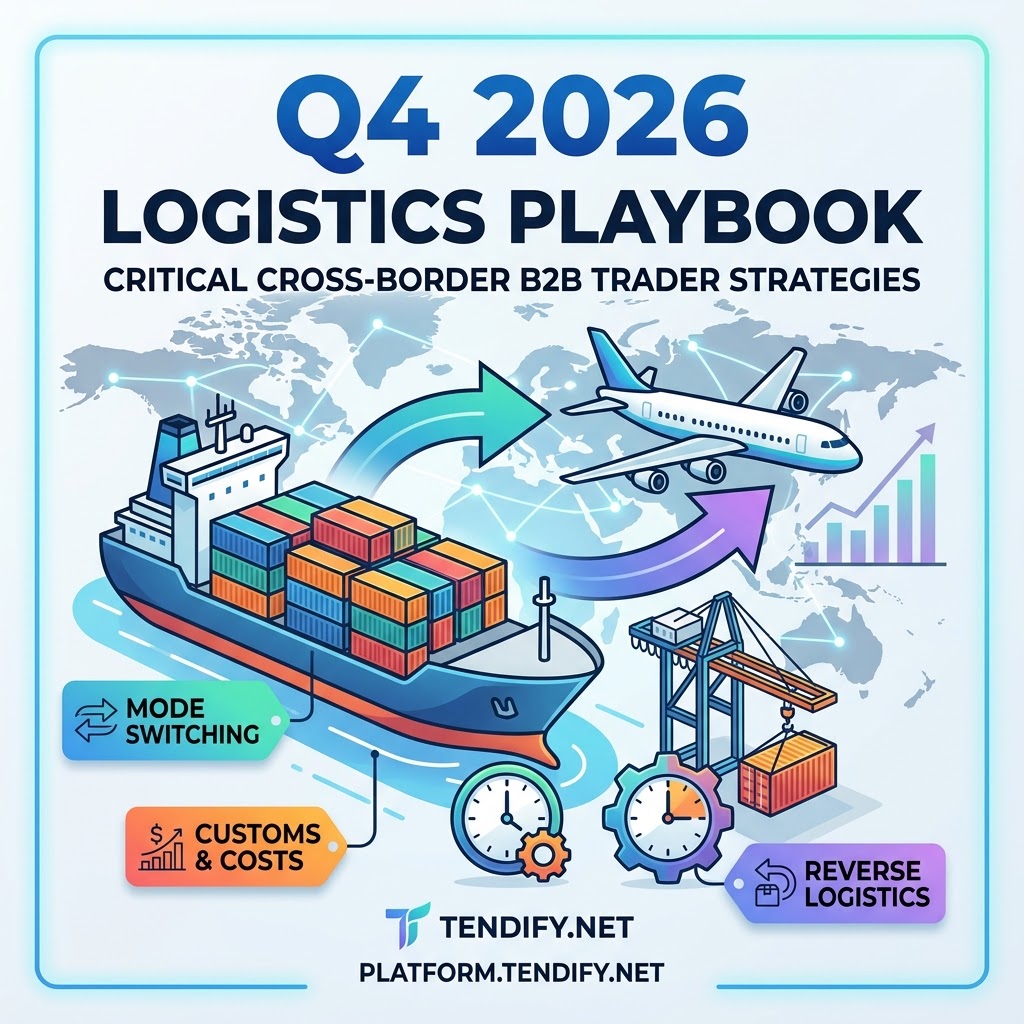
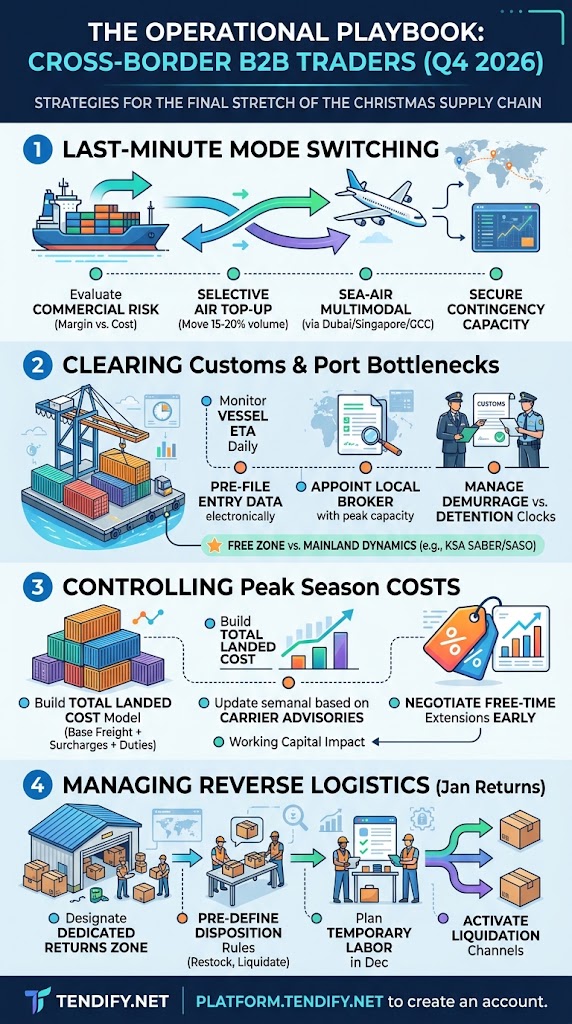
This playbook focuses on the four pressure points that define the final stretch of the Christmas supply chain for cross-border B2B operators: emergency mode switching from ocean to air or multimodal routes, clearing Q4 customs and port bottlenecks without bleeding cash on demurrage and detention, controlling Peak Season Surcharges and crystallizing true landed cost, and building a reverse-logistics and January warehousing plan that protects margin after the returns wave hits.
1. Last-Minute Mode Switching: Sea-to-Air and Multimodal Conversion
When a container is delayed at origin, rolled at a hub, or stuck behind congestion, the commercial decision is binary for many SKUs: accept a stock-out or pay for speed. Full conversion of an entire ocean shipment to air is rarely the optimal answer. Selective air-freight of the critical portion, combined with multimodal sea-air routing, delivers the better cost-to-service ratio.
Market observations in recent peak seasons confirm that ocean schedule reliability often falls into the low-to-mid 60 percent range during the heaviest months. Average delay on late vessels frequently exceeds five days. For seasonal merchandise with a hard retail shelf deadline, that delay is commercially fatal. The response is not panic booking of full air; it is structured conversion of only the volume that protects revenue.
Cape Rerouting & Amplified Q4 Rolled Sailing Risks
In 2026, persistent vessel rerouting around the Cape of Good Hope has structurally added 10 to 14 days to baseline ocean transit times across Asia-Europe and Asia-GCC trade corridors. Standard maritime schedules are already stretched thin before peak-season volumes hit port gates. In October, this baseline lag completely eliminates remaining transit buffers—a single rolled sailing at origin or transshipment delay no longer causes a manageable multi-day slip, but guarantees missed retail deadlines unless emergency mode switching is executed immediately.
When Conversion Makes Commercial Sense
Evaluate three variables before authorizing any mode switch:
- Contribution margin at risk: Calculate lost contribution if the goods miss the final retail or wholesale delivery window. High-velocity seasonal SKUs, promotional sets, and production-critical components usually justify premium freight. Low-margin bulk items rarely do.
- Remaining free time and demurrage exposure: If the delayed ocean box will incur daily demurrage exceeding the air premium on a partial volume, the conversion threshold drops sharply. Teams that model demurrage against air cost on a per-unit basis make faster, cleaner decisions.
- Downstream contractual penalties: Late-delivery clauses in retailer or distributor contracts often exceed freight differentials by a wide margin. Include charge-back exposure and lost shelf space in the decision matrix.
Sea-to-Air Conversion Decision Tree
Evaluate margin at risk, demurrage exposure, and contractual penalties before authorizing premium freight.
🚨 TRIGGER: Ocean Vessel Delayed / Rolled (ETA Slip Threatens Retail Shelf Cutoff)
STEP 1
Calculate Total Commercial Exposure
Formula: [Lost Margin] + [Demurrage Risk] + [Retail Fines]
IF LOW EXPOSURE (NO)
Absorb transit delay. Air premium differential exceeds commercial exposure.
IF HIGH EXPOSURE (YES)
Exposure exceeds air freight cost. Proceed to optimal pathway selection.
STEP 2
Select Optimal Conversion Pathway
Match volume velocity and deadline urgency against cost efficiency:
OPTION A (BEST RATIO)
Fly 15–20% of volume to cover immediate 10–14 day shelf demand; keep balance on water.
OPTION B (BALANCED)
Ocean to GCC transshipment hub (Jebel Ali/Hamad), air to final destination (15–25 days total transit).
OPTION C (EMERGENCY)
Execute only for production-critical components or high-value SKUs where stock-out equals total campaign cancellation.
Practical Conversion Pathways
Selective air top-up
Move only the volume needed to cover the next 10–14 days of demand by air. Leave the balance on the water. This is the most common and cost-efficient pattern observed in peak-season operations. It protects immediate sales while limiting the premium paid to the absolute minimum required.
Sea-air multimodal
Ocean to a major hub (Dubai, Singapore, or a European gateway), then air for the final leg. Transit typically falls between pure ocean and pure air while total cost remains substantially below full air. This structure works particularly well when the ocean leg is already under way and only the final segment needs acceleration.
Strategic Sea-Air Gateways: Jebel Ali, Hamad Port & King Abdulaziz Port
For cross-border trade connecting Asia to Europe and the Middle East, primary GCC ports—most notably Jebel Ali (Dubai), Hamad Port (Qatar), and King Abdulaziz Port (Dammam, KSA)—serve as critical Sea-Air transshipment valves. Ocean cargo arriving from East Asian origins can be cleared into bonded transfer zones and inducted into air networks via regional air hubs (such as DXB, DWC, or DOH) within 24 to 48 hours. This multimodal bypass avoids extended ocean choke points while securing delivery into European and regional retail centers well ahead of hard December cutoffs.
Charter or dedicated capacity
For high-value or ultra-time-sensitive cargo where commercial freighter space is exhausted, ad-hoc charters become viable. Booking windows in late November and early December often stretch to 5–8 days or longer on standard air services. Contingency capacity must therefore be pre-identified and relationship-based rather than transactional.
Comparative Cost and Transit Overview
The following comparison summarizes typical decision ranges observed across major lanes during peak windows. Actual figures vary by origin, destination, and market conditions.
Execution Checklist for Mode Switch
- Identify the exact SKUs and quantities that must arrive by a hard commercial date.
- Confirm available air or multimodal capacity with two or more forwarders within 24 hours.
- Recalculate total landed cost including additional handling, customs formalities, and last-mile delivery.
- Update the commercial side: revise ETAs, notify buyers, and adjust invoices or credit terms if required.
- Document the force-majeure or delay narrative for insurance, carrier claims, and contractual records.
2. Clearing Q4 Customs and Port Bottlenecks Without Destroying Margin
October through December concentrates inspection intensity, documentation scrutiny, and yard congestion. Free time evaporates. Demurrage and detention charges compound daily. Storage fees at terminal or off-dock facilities add another layer. The operational priority is to keep containers moving and to recover free time wherever possible.
In peak windows, even minor documentation gaps that would clear in hours under normal conditions can stretch into multi-day holds. The commercial impact is not limited to the surcharge itself. Extended dwell reduces container velocity, ties up working capital, and can cascade into missed delivery appointments further down the chain.
Demurrage vs Detention: Know the Clock
Demurrage covers the period the container remains inside the terminal after free time expires. Detention covers the period after the container leaves the terminal and before the empty is returned to the carrier’s designated depot. Both are contractual and escalate with time. In high-congestion windows, daily rates can double or triple standard tariffs.
Operational teams that treat free time as a soft guideline routinely lose four figures per container. The corrective discipline is pre-clearance of every document set and proactive empty-return planning the moment the container gates out.
Q4 Customs Clearance Checklist
- Confirm HS classification and valuation documentation is complete and consistent across commercial invoice, packing list, and bill of lading before the vessel arrives.
- Pre-file entry data where electronic systems allow. Many GCC and European ports reward early electronic submission with faster release.
- Secure any required certificates (origin, quality, phytosanitary, conformity) well before the free-time window opens.
- Appoint a local customs broker with proven peak-season capacity and clear escalation paths for inspection holds.
- Monitor vessel ETA daily and trigger document release plus payment of duties and taxes the moment the container is discharged.
- Coordinate trucking and empty-return slots in parallel so the container does not sit idle after customs release.
Navigating Free Zone vs. Mainland Clearance Dynamics
Operators moving Q4 inventory into GCC markets must actively manage the operational split between Free Zone (FZ) storage and Mainland release. Gating containers into bonded free zones (such as JAFZA or KIZAD) defers duty liabilities and offers extended storage buffers while buyer delivery schedules are finalized. However, transferring goods from FZ status into Mainland retail distribution during the December rush requires dedicated local customs declarations and conformity approvals (e.g., SABER/SASO in KSA or MoIAT standards in the UAE). Pre-clearing regulatory compliance before container discharge is mandatory to prevent last-mile distribution gridlock.
Port Congestion Workarounds and Free-Time Recovery
When primary gateways experience extended berthing delays, secondary or alternative discharge ports combined with bonded inland movement can preserve schedule integrity. The critical control points are confirming that commercial documents and insurance cover the revised routing, and verifying that free-time and demurrage rules transfer cleanly to the new terminal.
Some operators successfully negotiate free-time extensions when they present a documented operational plan and a clear empty-return commitment. Requests made after the free-time clock has already started face far lower success rates. The practical rule is to open the conversation the moment ETA risk becomes visible.
3. Peak Season Surcharges and the True Cost of Landed Inventory
Peak Season Surcharges (PSS) are capacity fees carriers layer on top of base ocean rates during the highest-demand window. In 2026 the classic ocean PSS calendar runs from roughly August through November on major east-west lanes, with residual pressure into December. Air freight demand surcharges typically begin in September and can extend into January.
PSS amounts vary widely by trade lane and carrier. On some trans-Pacific and Asia-Europe routes, per-container PSS has ranged from a few hundred dollars to several thousand in tight years. On Middle East and Indian Subcontinent lanes into North America, published levels have reached multi-thousand-dollar figures per TEU or FEU. These charges sit on top of bunker adjustment factors, terminal handling, and any emergency or contingency surcharges already in force.
The commercial problem is not the existence of PSS. It is the gap between the freight cost assumed at the time of purchase-order placement and the final invoice that arrives weeks later. Traders who negotiate only the base rate and ignore the surcharge stack routinely understate true cost by 15–40 percent in peak windows.
Building a Reliable Landed-Cost Model
A complete Q4 landed-cost calculation must include every material component:
- Base ocean or air freight
- All published surcharges (PSS, BAF, CAF, emergency, congestion, peak demand)
- Origin and destination terminal handling and documentation fees
- Customs duties, VAT or GST, and any temporary trade measures
- Inland haulage, last-mile delivery, and expected demurrage or detention buffers
- Insurance adjusted for peak-season risk factors and any revised routing
The practical control method is to lock as many surcharge elements as possible into long-term contracts or service-level agreements, and to maintain a live rate sheet that is refreshed weekly against carrier advisories. When a new PSS notice is published, the landed-cost model for every open shipment must be updated the same day.
Managing the Q4 Working Capital & Credit Squeeze
The October logistics rush creates an acute liquidity pinch for B2B cross-border operators. Shipping lines, forwarders, and terminal authorities demand immediate cash settlement for unbudgeted Peak Season Surcharges (PSS), customs duties, and emergency air freight premiums weeks before wholesale buyers pay out Q4 invoices. To prevent working capital lockup, finance teams must align directly with supply chain operations: adjust Letter of Credit (LC) presentation and expiry windows to accommodate 10–14 day transit cushions, pre-arrange flexible trade finance or invoice discounting facilities specifically for seasonal surcharge spikes, and model cash burn against extended port dwell times rather than best-case ocean schedules.
Cost-Control Levers Still Available in October
- Consolidate remaining volume: Fewer containers mean fewer surcharge events and simpler empty-return logistics.
- Negotiate free-time extensions: Many carriers still grant additional free days for key accounts when requested early and backed by a clear operational plan.
- Use secondary ports or inland hubs: Lower congestion can offset higher inland costs and reduce demurrage exposure.
- Split critical versus non-critical inventory: Air only what must move fast; keep the rest on the most economical remaining ocean service.
4. Reverse Logistics and January Warehousing: Protecting Margin After the Returns Wave
Christmas selling creates a predictable returns surge that peaks in the first two weeks of January. Return rates on holiday merchandise commonly run 10–20 percent or higher depending on category. The volume arrives while outbound fulfillment is still elevated and warehouse capacity is constrained by residual seasonal stock.
Without a pre-built reverse-logistics process, returns sit, inventory accuracy collapses, and recoverable value erodes. A unit returned and restocked within three days can still sell at full or near-full price. The same unit sitting six weeks becomes a markdown or write-off. For B2B operators supplying retail networks, the returns wave also generates secondary commercial conversations around residual inventory, open-box channels, and liquidation.
Core Elements of a January-Ready Reverse System
- Dedicated returns zone: Separate receiving, inspection, and disposition space so inbound returns never block outbound docks or forward inventory.
- Pre-defined disposition rules: Restock, recondition, secondary channel, liquidate, or dispose. Decision criteria must be written, trained, and available to floor staff before the surge arrives.
- Temporary labor plan: Hire and train returns staff in mid-to-late December so they are productive from the first working day of January. Training during the surge itself is too late.
- Carrier and 3PL capacity: Confirm return freight rates and induction capacity in advance. Reverse moves often cost more per unit than outbound and face capacity constraints of their own.
- Data capture at intake: Record return reason, condition grade, and SKU so root-cause analysis can reduce future return rates and improve product or packaging decisions.
Warehousing Strategy for Early Q1
January warehousing must absorb residual Christmas stock, process the returns wave, and prepare for the next replenishment cycle. Practical steps include flexible short-term space agreements, clear inventory aging policies, and secondary-market channels already activated for excess or returned merchandise.
B2B bulk liquidation of open-box or excess inventory can clear space faster than consumer-level resale and recover meaningful residual value. Operators who establish these channels in November avoid the January scramble for buyers when every warehouse is simultaneously trying to move the same categories of excess.
Putting It Together: A 30-Day Operational Cadence for October–November
Week 1–2 of October
- Audit every open ocean booking for ETA risk and free-time exposure.
- Identify SKUs that justify selective air conversion and quantify the commercial upside.
- Refresh the landed-cost model with the latest PSS, congestion, and emergency surcharges.
Week 3–4 of October
- Execute any approved mode switches and update commercial partners with revised ETAs.
- Pre-clear documentation for all remaining arrivals and confirm broker capacity.
- Confirm empty-return and trucking capacity at destination ports and inland hubs.
November
- Daily monitoring of dwell and demurrage exposure with escalation triggers.
- Finalize reverse-logistics staffing, space allocation, and disposition SOPs.
- Lock secondary-channel buyers for expected excess and returns volume.
Frequently Asked Questions: Q4 & Christmas Logistics
Key operational answers for B2B cross-border traders navigating peak-season supply chain bottlenecks.
Q. Is October too late to ship Q4 Christmas inventory by ocean freight?
Yes, for standard ocean bookings. By October, baseline maritime delays and Q4 port congestion make full ocean FCL arrivals highly risky for December retail shelf dates. At this stage, operators must transition to selective air top-ups, Sea-Air multimodal conversion via regional hubs, or leverage bonded Free Zone stock.
Q. What is the most cost-effective alternative to full air freight?
Selective Air Top-Up and Sea-Air Multimodal routing deliver the best cost-to-speed balance. Flying 15–20% of high-margin SKUs by air covers immediate 10–14 day shelf demand while the main volume moves by sea. Alternatively, routing via GCC Sea-Air hubs (like Jebel Ali or Hamad Port) cuts ocean transit times by up to 50% at roughly one-third the cost of pure air freight.
Q. How can we prevent daily demurrage and detention charges at congested Q4 ports?
Pre-clear customs documentation (commercial invoices, HS codes, conformity certificates) at least 3–5 days prior to vessel discharge. Pre-book destination trucking slots immediately, negotiate free-time extensions (e.g., requesting 10–14 days instead of 5) prior to container gating out, and maintain automated dwell-time monitoring.
Q. How much do Peak Season Surcharges (PSS) impact final landed cost?
Unbudgeted Peak Season Surcharges (PSS), congestion fees, and emergency surcharges routinely increase baseline freight costs by 15% to 40% during Q4. B2B traders must refresh landed-cost models weekly to incorporate current carrier advisories and prevent margin erosion on final wholesale pricing.
Q. Why must reverse logistics planning begin in December?
Holiday return surges peak in the first two weeks of January, averaging 10% to 20% of sold volume. Without a pre-defined returns zone, clear disposition SOPs (restock, recondition, liquidate), and trained temporary staff ready by January 1st, returned inventory creates severe warehouse bottlenecks and loses recoverable resale value.
Tools That Reduce Friction in the Final Stretch
Operational visibility remains the highest-leverage investment in peak season. Real-time container tracking, automated free-time alerts, and integrated duty calculators cut reaction time from days to hours—allowing teams to act before costs compound rather than after invoices arrive.
🛠️
Tendify Workflow Suite
Consolidate HS classification, landed-cost simulation, and documentation checklists into a single real-time workflow.Access Trade Platform →
📊
Demurrage & Detention Control
Practical rate benchmarks, demurrage vs. detention cost drivers, and fee recovery tactics for GCC port operations.Calculate Demurrage Risk →
🏢
Free-Zone vs. Mainland Setup
Decision frameworks and operational steps for bonded re-export setup vs. mainland clearance in UAE & GCC gateways.Explore Setup Frameworks →
The Margin Is in the Minutes
Christmas B2B logistics in October is no longer about finding suppliers or negotiating annual contracts. Those decisions are already in the rear-view mirror. The remaining work is pure execution under compressed time and elevated cost pressure.
Teams that treat free time as a hard constraint, that pre-qualify air and multimodal options before the crisis hits, that model the full surcharge stack into landed cost, and that stand up reverse-logistics capacity before the January returns wave, consistently protect more margin than those that react after the first demurrage invoice lands.
The calendar does not slow down. The only controllable variable is how quickly and accurately the operation responds to the signals that are already visible on the water and at the terminal gate.

