


وبلاگ
8 Export Mistakes Disrupting Your Landed Profits (And How to Fix Them)
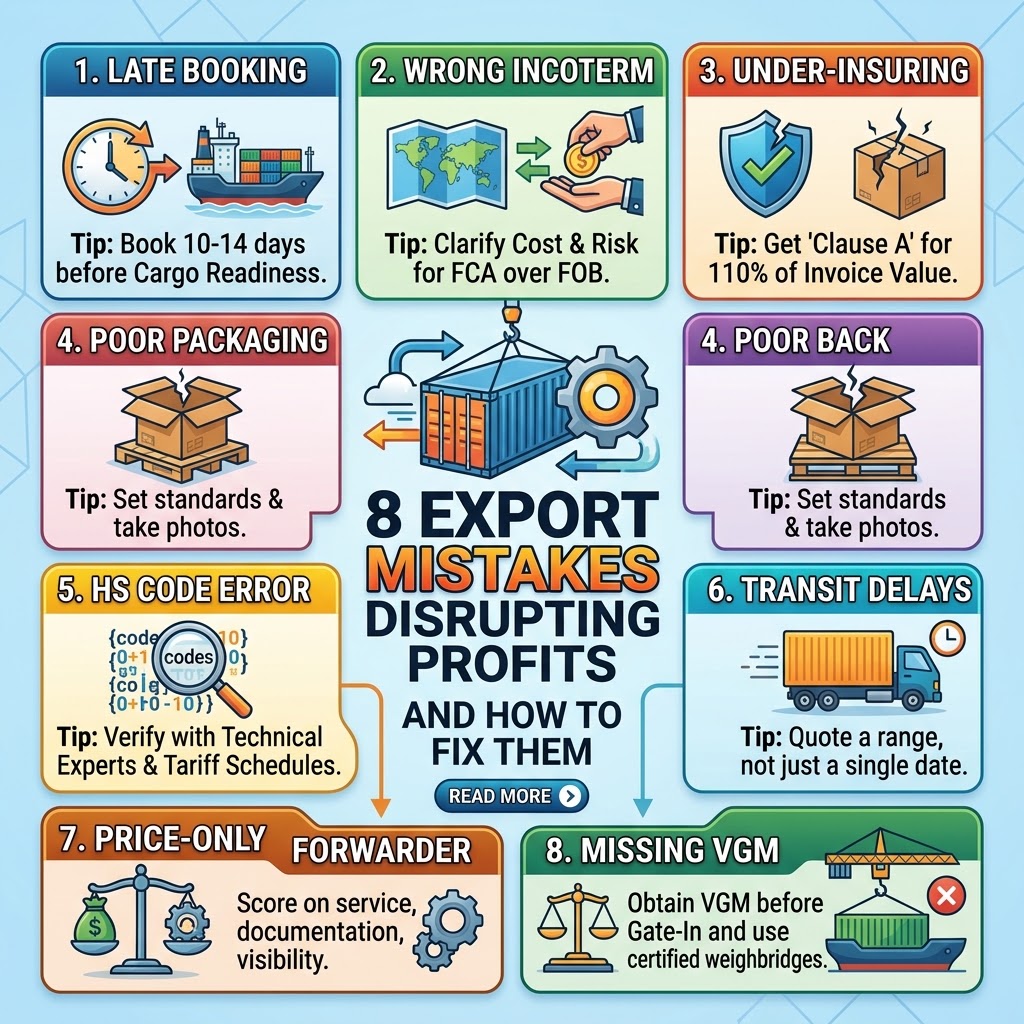
A single delayed booking or misclassified HS code can erase the entire margin on a container. Operational reviews across Middle East and Asian export corridors show that preventable process errors—not market volatility—remain the largest controllable drain on landed profitability. Demurrage alone frequently runs $75–$300 per container per day once free time expires, and a modest five-day hold quickly reaches four figures before detention or inspection fees are added.
Exporting is not finished when the buyer signs the contract. It is finished only when the cargo arrives on time, undamaged, compliant, and fully paid. The gap between those two points is where the eight mistakes below quietly compound.
Below is a field-level breakdown of each error: what it actually looks like in practice, the measurable financial exposure, and the concrete prevention steps used by teams that keep their cost-to-serve under control.
Crucial Rule
Document Discrepancies & Payment Risks
A minor discrepancy in a packing list, commercial invoice, or bill of lading can freeze Letter of Credit (L/C) negotiations, delay customs release, and tie up capital for weeks. Exporting is not merely about physically delivering cargo—it is completed only when the funds safely clear into your bank account.
Pro Export Rule: Always cross-validate shipping document details against payment terms before vessel departure to prevent document rejection at the negotiating bank.
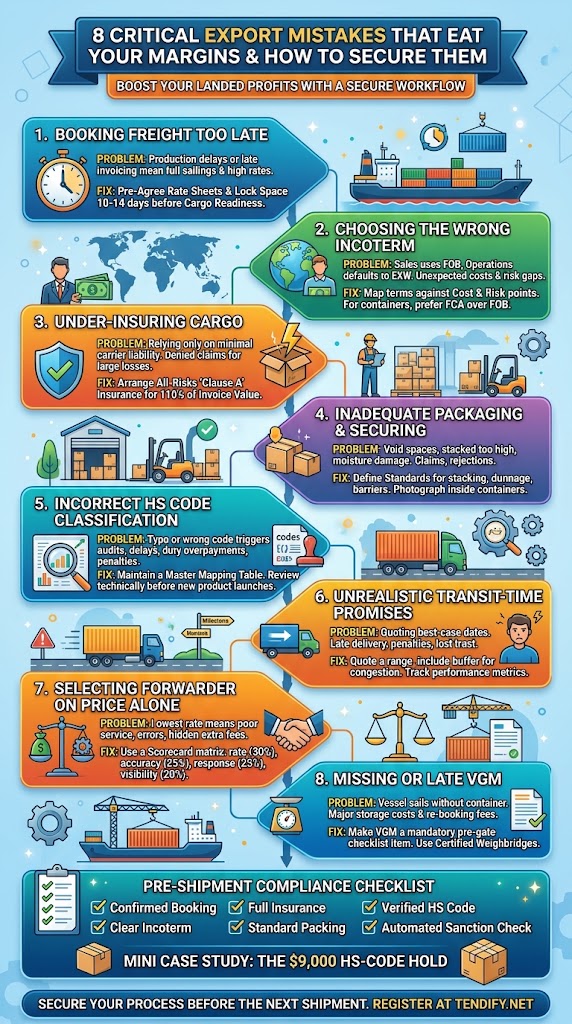
8 Export Mistakes
1. Booking Freight Too Late
The problem
Space is reserved only after production is complete or the commercial invoice is finalized. By then, preferred sailings are full, rates have risen, and the only remaining options are slower vessels or higher-cost carriers.
Why it happens and the cost
Production schedules slip, documentation teams wait for final packing lists, and no one owns the booking window. The result is higher ocean rates (often 15–30 % above early-booked levels), limited equipment availability, and missed cut-offs that trigger the next set of problems—demurrage and detention. In peak seasons the cost differential on a single 40-foot container can exceed the entire profit margin.
Prevention pro-tip
Treat the booking window as a hard production milestone. Lock space 10–14 days before cargo readiness whenever possible. Maintain a short-list of two to three carriers with confirmed allocation and pre-agreed rate sheets. Build a simple internal alert that flags any shipment still unbooked seven days before the planned gate-in date.
Montaji Dubai Registration Guide: Clear Customs Without Delays
UAE Export Hidden Costs: What Every Exporter Misses
2. Choosing the Wrong Incoterm
The problem
The sales contract states FOB while the commercial invoice and bill of lading show CIF, or the team defaults to EXW without clarifying who handles export clearance and inland haulage to the port.
Why it happens and the cost
Sales teams focus on closing the deal; operations inherit the term without a risk review. The mismatch creates gaps in insurance coverage, unexpected terminal handling charges, and disputes over who pays for delays. In one documented pattern, risk-transfer points that do not match the insurance policy lead to claim denials that can reach the full cargo value.
Prevention pro-tip
Map every Incoterm against three questions before the contract is signed: Who pays freight? Who controls the carrier? Who holds insurance at each leg? For containerized cargo, prefer FCA over classic FOB so the seller controls the inland leg and the risk transfer occurs at the terminal rather than the ship’s rail. Keep a one-page internal matrix that shows cost and risk allocation for the five most-used terms in your trade lanes.
3. Skipping or Under-Insuring Cargo
The problem
The shipment moves under carrier liability only, or the seller relies on the minimal Institute Cargo Clauses (C) coverage required by CIF without arranging additional all-risks protection.
Why it happens and the cost
Premiums look expensive until a claim appears. Carrier liability is typically limited to a few hundred dollars per package or a low SDR per kilogram—far below the commercial value of most B2B cargo. Without proper insurance, a single water-damage or theft event can wipe out both the goods and the receivable. Average all-risks ocean premiums sit in the 0.5–1 % range of insured value; the cost of a denied claim is often 100 % of that value.
Prevention pro-tip
Insure for at least 110 % of invoice value under Institute Cargo Clauses (A) or equivalent. Explicitly record the Incoterm and the insurance obligation in both the sales contract and the booking confirmation. For high-value or temperature-sensitive cargo, add a warehouse-to-warehouse extension so coverage begins before the goods leave the seller’s premises.
4. Inadequate Packaging and Load Securing
The problem
Cartons are stacked beyond their rated crush strength, void spaces are left unfilled, or moisture-sensitive goods are packed without desiccants or vapor barriers. The container arrives with crushed outer packaging, shifted loads, or condensation damage.
Why it happens and the cost
Packaging decisions are often left to the warehouse floor with no written specification linked to the destination climate or handling conditions. Claims for physical damage, rejected goods, and subsequent disposal or rework can exceed the original freight cost. In extreme cases the entire container is refused at destination.
Prevention pro-tip
Write a packaging standard for each product family that includes maximum stacking height, required dunnage, and climate-specific barriers. Photograph the loaded container before doors are closed and retain the images with the shipment file. For bulk or heavy cargo, require a load-securing certificate from the stuffing contractor.
Quality & Standards
Pre-Shipment Conformity & Quarantine Clearance Delays
Even with a verified HS code and perfect documentation, missing destination-specific conformity certificates—such as SABER in Saudi Arabia, COSQC in Iraq, or Phytosanitary and Health Certificates—will lead to immediate cargo rejection at destination ports. Re-exporting rejected shipments or waiting for retrofitted approvals incurs massive demurrage and risks complete cargo destruction.
Operational Checklist: Always verify destination mandatory certification protocols (CoC, SASO/SABER, Quarantine inspection) and obtain pre-loading clearance before closing container doors.
5. Incorrect HS Code Classification & Overlooking Rules of Origin
The problem
The commercial invoice and shipping documents carry an HS code that does not match the product’s technical characteristics or the destination country’s tariff schedule. Alternatively, exporters fail to substantiate Rules of Origin requirements tied to that classification. Customs either reclassifies the goods, holds the shipment, or invalidates preferential trade treatment.
Why it happens and the cost
Classification is often treated as a clerical task rather than a technical compliance step. A one-digit discrepancy can trigger duty under- or over-payment, physical examination, and multi-day holds running $75–$300 per container in demurrage. Furthermore, an incorrect HS code completely forfeits preferential tariff benefits under Free Trade Agreements (FTAs) or Regional Trade Agreements (such as GAFTA or GCC customs union preferences), forcing the importer to pay full standard customs duties and forfeiting competitive pricing.
Prevention pro-tip: Maintain a master product-to-HS mapping table reviewed by technical and compliance experts. Cross-check codes against destination tariffs and verify specific Rules of Origin (ROO) criteria before claiming FTA preferential duty rates on the Certificate of Origin.
High-Risk Alert
Trade Compliance & Sanctions Screening Risks
Across Asian and Middle Eastern trade corridors, failing to screen counterparties against Denied Parties Lists or ignoring transshipment restrictions can result in immediate cargo seizure, severe regulatory fines, or frozen banking access. Even unintentional interactions with restricted entities along the supply chain trigger strict liability under international trade laws.
Compliance Best Practice: Run automated sanction and restricted-party checks on buyers, ultimate consignees, and intermediate freight handlers before issuing commercial invoices or dispatching cargo.
6. Unrealistic Transit-Time Promises
The problem
Sales quotes a door-to-door window based on the best-case sailing schedule and ignores actual port congestion, customs processing, or inland transit variability.
Why it happens and the cost
Buyers plan production or retail launches around the quoted date. When the cargo arrives late, the exporter faces contractual penalties, air-freight upgrades, or lost repeat business. The reputational cost often exceeds the immediate financial penalty.
Prevention pro-tip
Quote a transit range rather than a single date, and add a realistic buffer for the specific lane. Track actual versus quoted performance for every major destination and adjust the standard quote quarterly. Share the buffer rationale with the buyer so expectations remain aligned.
7. Selecting the Freight Forwarder on Price Alone
The problem
The lowest quote wins the business. Service quality, documentation accuracy, exception handling, and visibility are treated as secondary.
Why it happens and the cost
A low base rate is frequently offset by higher accessorial charges, slower response times, and higher error rates on documentation. The net landed cost, once demurrage, detention, and correction fees are included, often exceeds the original higher-priced offer. In addition, poor communication leaves the exporter blind when problems arise.
Prevention pro-tip
Score forwarders on a simple matrix: rate competitiveness (30 %), documentation accuracy (25 %), exception response time (25 %), and visibility tools (20 %). Run a short pilot with two providers before awarding large volumes. Require weekly exception reports so performance is measured rather than assumed.
8. Missing, Late, or Inaccurate Verified Gross Mass (VGM)
The problem
The container is gated in without a verified gross mass declaration, or the declared weight is understated to save on ocean freight charges. Consequently, the terminal refuses loading or the vessel sails without the cargo.
Why it happens and the cost
Weight is measured after stuffing, but the VGM certificate fails to transmit before the carrier cut-off. Beyond missed sailings, rolled bookings, and demurrage penalties, inaccurate VGM poses severe structural hazards. Misdeclared container weights compromise vessel stowage balance, causing stack collapses, crane failure, or maritime accidents. In the event of an incident, shipper misdeclaration exposes the exporter to catastrophic strict legal liability, cargo claims, and severe statutory fines under IMO SOLAS regulations.
Prevention pro-tip: Enforce VGM submission as a non-negotiable pre-gate requirement. Rely on certified weighbridges (Method 1) or calibrated equipment calculations (Method 2) that auto-generate digital weight slips, protecting your operation from both logistics delays and legal exposure.
Tendify Trade Tools
Pre-Shipment Export Compliance Checklist
✓ Standard Dispatch Protocol
Use this verified checklist as the final gate before cargo leaves your warehouse. Print or save this template, assign operational ownership, and require sign-off prior to container dispatch.
| وضعیت | Checkpoint | Responsible Owner | Operational Reference & Notes |
|---|---|---|---|
| Space Booked & Confirmed | Logistics / Forwarding | Carrier booking reference recorded & gate-in window locked | |
| Incoterm & Risk Transfer Clear | Commercial / Legal | Contract clause mapped against transport leg & insurance obligation | |
| Cargo Insurance Confirmed | Finance / Risk | Policy number issued under Institute Cargo Clauses (A) or equal | |
| Packaging Standard Followed | Warehouse Manager | Dunnage verified, moisture barriers set & container stuffing photos logged | |
| Pre-Shipment Conformity (CoC/SABER) | Quality & Compliance | Destination mandatory inspection & quarantine certificates cleared | |
| HS Code & Tariff Verified | Customs Compliance | Matched against destination master schedule & Rules of Origin verified | |
| Sanctions & Counterparty Screened | Compliance Officer | Buyer & intermediary entities cleared against restricted parties lists | |
| Transit Time Buffer Communicated | Sales / Account Ops | Realistic door-to-door range acknowledged by buyer in writing | |
| Forwarder Performance Score Verified | Supply Chain Team | Documentation SLA & exception response rate approved on file | |
| VGM Weight Certificate Submitted | Ops / Weighbridge | Certified weight slip generated & transmitted prior to carrier cut-off | |
| Shipping Documents Matched | Documentation Team | Commercial Invoice, Packing List & Bill of Lading cross-validated |
Mini Case Study: The $9,000 HS-Code Hold
A mid-sized industrial-components exporter shipped a 40-foot container of specialized valves to a GCC buyer under a tight delivery window. The commercial invoice carried an HS code that had been correct for an earlier product generation but no longer matched the revised technical specifications. Destination customs flagged the discrepancy, ordered a physical examination, and held the container for eight days.
Demurrage and examination fees totaled just over $2,400. Because the buyer’s production line was waiting, the exporter absorbed an additional $6,500 in air-freight of a partial replacement shipment and a contractual late-delivery penalty. The total unplanned cost exceeded $9,000—more than the ocean freight on the original container—and the buyer reduced subsequent order volumes for two quarters.
The root cause was the absence of a product-change trigger in the HS-mapping process. After the incident the exporter introduced a mandatory technical review whenever a product revision affected material composition or function. Subsequent shipments on the same lane cleared without incident.
Knowledge Base
سوالات متداول (FAQ)
Q1: Who is legally responsible for the Verified Gross Mass (VGM) declaration?
Under the International Maritime Organization (IMO) SOLAS regulations, the shipper named on the Ocean Bill of Lading is legally responsible for obtaining, verifying, and transmitting the VGM to the ocean carrier or terminal representative prior to the carrier’s cut-off deadline.
Q2: What is the difference between Demurrage and Detention charges?
Demurrage applies when a full container remains inside the port terminal beyond the allowed free days before being cleared or picked up. Detention applies when the importer takes the equipment outside the port terminal for devanning and fails to return the empty container to the shipping line’s designated depot within the free-time window.
Q3: Can an incorrect HS Code lead to customs fines or cargo forfeiture?
Yes. Declaring an incorrect HS Code can be treated as customs misdeclaration or tax evasion by destination customs authorities. Penalties range from administrative fines and retroactive duty assessments to extended physical inspections, cargo seizure, and the forfeiture of preferential trade rates under Free Trade Agreements (FTAs).
Q4: Why should containerized exporters prefer FCA over traditional FOB terms?
Under modern Incoterms 2020 rules, FCA (Free Carrier) transfers liability and risk the moment the goods are delivered to the ocean carrier at the inland terminal or container depot. Classic FOB (Free on Board) forces the seller to bear risk until the container is physically loaded across the ship’s rail, leaving a dangerous risk gap during terminal handling and port storage.
Closing the Loop
These eight mistakes share a common pattern: they occur in the hand-off zones between sales, operations, compliance, and the warehouse. The teams that keep margins intact treat each hand-off as a controlled process rather than an assumption.
When classification, Incoterm selection, or documentation accuracy needs a faster, more reliable check, the trade-support tools available through Platform.Tendify.Net can compress the review cycle without adding another layer of manual work. For deeper operational detail on related topics such as demurrage control and Incoterm risk mapping, see the practical guides already published on the Tendify knowledge base.
The exporters who treat process discipline as a competitive advantage do not merely avoid cost—they protect delivery reliability, customer trust, and the ability to quote with confidence. If your current workflow still relies on memory, email threads, or last-minute corrections, the next container is already carrying unnecessary risk.

