


وبلاگ
Iraq–Syria Oil Corridor: The New Mediterranean Supply Line

Hundreds of fuel tankers now move daily across a desert border that stayed largely closed for more than a decade. What began as an emergency workaround for disrupted southern export routes has rapidly become a functioning overland artery linking Iraqi production centers to Mediterranean loading points. For logistics managers, commodity traders, and B2B operators focused on the Gulf and Levant, the Al-Tanf–Al-Walid corridor (also referred to as the Al-Waleed–Al-Tanf crossing) has shifted from theoretical alternative to active commercial reality.
This route carries refined products and growing volumes of other goods westward through Syrian territory to the port of Baniyas. From there, cargo moves onto tankers bound for European and other Mediterranean markets. The economics remain truck-based and therefore higher-cost than pipeline or direct Gulf shipping, yet the corridor delivers something many operators value more highly in the current environment: optionality and geographic diversification.
Operational assessments across regional supply chains show that routes offering reliable access to the Mediterranean without dependence on a single chokepoint attract sustained commercial interest. The Al-Tanf–Al-Walid corridor now sits firmly in that category.
Why This Crossing Matters Now
The Al-Waleed crossing on the Iraqi side (Anbar province) faces Al-Tanf on the Syrian side (Homs governorate). It sits near the Iraq-Syria-Jordan tripoint and historically served as a primary overland link between Baghdad and Damascus. Closure during the previous decade of conflict removed it from commercial maps. Its formal reopening in early April 2026 restored that connectivity.
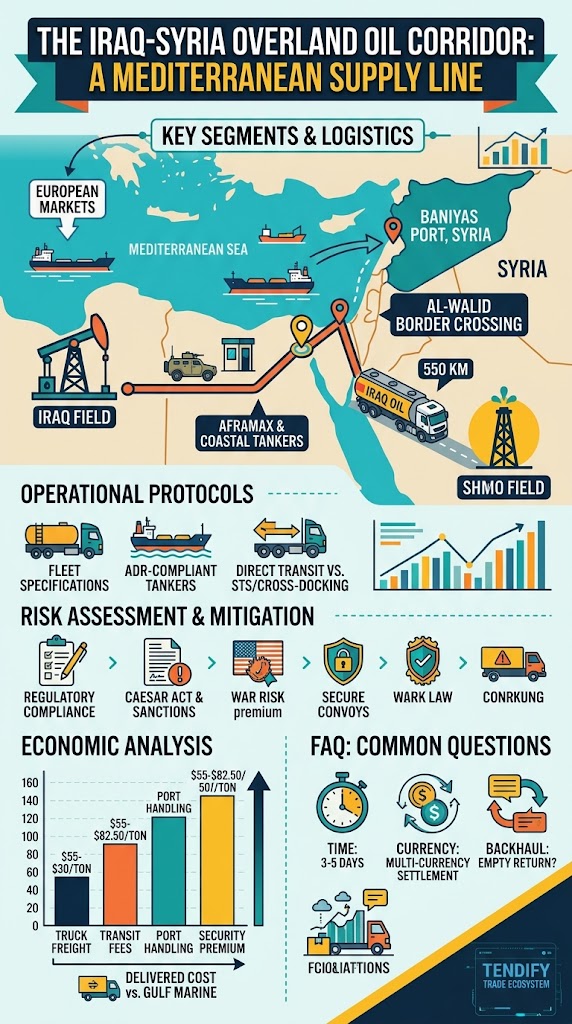
Iraq–Syria Oil Corridor
Initial traffic focused almost exclusively on fuel oil. Iraqi state marketing arrangements contracted significant monthly volumes for overland movement. Tanker convoys began crossing within days of the official inauguration. Syrian authorities positioned the route as reactivation of Syria’s role as a regional energy transit hub. Iraqi operators treated it as essential diversification away from southern terminals affected by broader maritime constraints in the Gulf.
Within months the corridor handled rising daily truck counts. Reports from the period document hundreds of tankers per day early on, with later figures citing substantially higher flows as procedures stabilized and unloading capacity at Baniyas improved. Cumulative fuel-oil volumes transported via the Syrian route reached tens of millions of barrels by late summer 2026. Non-energy cargo, including construction materials and other bulk goods, began appearing as well.
For B2B operators the practical takeaway is straightforward: a previously unavailable westbound land option now functions at commercial scale.
How the Corridor Operates Day to Day
Traffic moves primarily by road tanker. Vehicles load in Iraq, cross at Al-Waleed/Al-Tanf, and travel the roughly 250–300 mile inland route across Syrian desert and agricultural areas to storage and loading facilities at Baniyas on the Mediterranean coast. Unloading occurs into tanks; product is then transferred to seagoing tankers via existing marine infrastructure.
Key operational features observed in the first half-year of activity include:
- Coordinated customs and border procedures between Iraqi and Syrian authorities, with joint presence at the crossing.
- Convoy organization and security escorts on the Syrian side to maintain flow and reduce delays.
- Progressive expansion of unloading pumps and storage at Baniyas to raise daily throughput.
Baniyas Oil Terminal: Marine Infrastructure & Storage Technical Specs
Port Capabilities
Commercial feasibility depends directly on the marine terminal’s capacity to receive inland road convoys, store liquid bulk, and offload into ocean-going tankers without incurring severe demurrage.
Shore Tank Storage Capacity
Active Tank Farm: Total dedicated liquid bulk capacity ranges between 1.2 million to 1.5 million metric tons (~8 to 10 million barrels), divided across heavy fuel oil, crude, and refined product tanks.
Max Tanker Class & Draft
Primary Class: Aframax (80,000–120,000 DWT) via Single Point Mooring (SPM) buoys.
Secondary/Coastal: Handysize / MR Tankers (25,000–50,000 DWT) at inner berths with 12–14m maximum draft.
Marine Transfer Rates
Pumping Throughput: Offloading pumps deliver 2,500 to 4,000 metric tons per hour to offshore SPM moorings, enabling an Aframax vessel to complete loading within 24–36 hours.
Operational Insight: While SPM berths accommodate larger Aframax vessels, Suezmax tankers generally cannot load to full capacity without offshore Ship-to-Ship (STS) topping off due to sea-line pressure restrictions and berth depth limitations.
- Documentation focused on transit status rather than local consumption, preserving the export character of the cargo.
Fleet Specifications & Border Transfer Logistics
Operational Protocol
Understanding the physical transfer mechanics and fleet standards at the Al-Walid–Al-Tanf border is critical for forwarders and commodity traders planning overland movement.
Vehicle & Tanker Standards
- Tanker Capacity: Standard 30,000–36,000 liter (approx. 20–24 metric ton) ADR-compliant rigid or semi-trailer road tankers.
- Material Specifications: Carbon steel insulated tanks equipped with high-capacity bottom-discharge valves and heating coils (essential for high-viscosity fuel oil).
- Safety & Tracking: Mandatory GPS transponders, sealable manifold locks, and dual-fire suppression systems required for convoy clearance.
Direct Through-Transit vs. Transshipment
- Direct Transit Model: Iraqi-registered commercial fleets with bilateral transit permits are permitted to drive through Syrian territory directly to Baniyas port under organized Syrian convoy escort.
- Cross-Docking / STS Option: Dedicated liquid-to-liquid transfer stations (STS) operate at the Al-Walid border zone for unpermitted operators, transferring product directly to Syrian haulers within 2–4 hours.
- Driver Clearance: Fast-track security manifest protocols apply to vetted Iraqi drivers entering Syrian jurisdiction.
Logistics Recommendation: Direct through-transit avoids cargo loss and contamination associated with border transshipment, but requires fleet-wide Syrian insurance endorsements and security clearance 72 hours prior to arrival.
Capacity constraints remain real. Early daily unloading at Baniyas lagged peak truck arrivals, creating queues. Infrastructure work—additional pumps, expanded tankage, harbor improvements—has been ongoing. Border facilities themselves received upgrades, including temporary administrative structures and process streamlining. Daily truck numbers have fluctuated with permit issuance, storage availability, and weather or security conditions on the road.
Cost structures differ markedly from Gulf marine exports. Trucking over hundreds of kilometers, multiple border formalities, and inland handling add layers of expense. Operators accept the premium because the alternative—delayed or constrained southern shipments—carries higher opportunity and storage costs. Transit fees accrue to Syrian entities, creating a revenue incentive to keep the corridor efficient.
Volumes, Economics, and Commercial Scale
Published operational data from the period illustrate rapid scaling. Initial contracts targeted roughly 650,000 metric tons of fuel oil per month for the April–June window. Actual movements grew as procedures matured. By mid-year, monthly volumes in the hundreds of thousands of tons were routine. Cumulative figures through August exceeded 21 million barrels of fuel oil moved via Syrian routes. One mid-year assessment placed total fuel-oil tonnage transported toward Europe above 2 million tonnes since April.
These numbers matter less as absolute records and more as proof of concept. A land corridor that can absorb hundreds of heavy tankers daily demonstrates infrastructure resilience and administrative coordination sufficient for commercial planning. Non-fuel cargo has begun to follow. Cement shipments and other bulk materials have crossed, signaling that the route is not limited to energy products.
For traders the economic calculation centers on delivered cost, reliability, and market access. Mediterranean loading opens European destinations more directly than Gulf-origin voyages that must navigate longer routes or face variable insurance and transit risks. Buyers seeking diversification of supply origin also find the corridor useful. The higher unit transport cost is frequently offset by reduced demurrage exposure at congested southern terminals and faster cycle times once trucks are allocated.
Corridor Economics: Estimated Cost & Transit Fee Breakdown
Financial Model (2026 Estimates)
Moving liquid bulk overland across ~500–600 km incurs significantly higher direct unit costs than deep-sea tanker logistics. Below is the operational cost breakdown per metric ton and barrel for fuel-oil shipments along the Al-Walid–Baniyas route:
| عنصر هزینه | Benchmark Rate / Range | Est. Cost per Ton | Est. Cost per Barrel |
|---|---|---|---|
| Truck Freight Rate (Inland) | $0.10 – $0.15 per ton-km (~550 km) | $55.00 – $82.50 | $8.15 – $12.20 |
| Syrian Transit & Customs Fees | Official transit tariffs + border processing | $15.00 – $25.00 | $2.20 – $3.70 |
| Baniyas Port Handling & STS | Pumping, storage & marine transfer | $8.00 – $14.00 | $1.20 – $2.10 |
| Security & Convoy Escort Premium | Desert transit tracking & security coverage | $5.00 – $10.00 | $0.75 – $1.50 |
| Total Landed Corridor Cost | Cumulative Premium vs Direct Marine | $83.00 – $131.50 | $12.30 – $19.50 |
Landed Cost Estimation Formula:
Total Trucking Cost = (Distance in km × Rate/ton-km) + Transit Fees + Port Storage/Pumping + Risk Premium
*Note: A standard road tanker holds ~20 metric tons (~135 barrels of fuel oil). While paying a $12–$19/bbl transport premium is prohibitive in standard markets, it remains commercially viable during Gulf maritime disruptions or when hedging against severe port demurrage.
Strategic Advantages for Regional B2B Operators
Several structural benefits stand out for companies managing cross-border flows in the broader MENA and Gulf space.
First, geographic diversification. Dependence on a single maritime outlet creates systemic exposure. An active land alternative to the Mediterranean reduces that concentration risk. Even if volumes remain a fraction of total exports, the option itself changes negotiation dynamics with buyers and logistics providers.
Second, reactivation of Syria’s transit potential. Years of limited commercial use left roads, border posts, and port facilities underutilized. Sustained Iraqi traffic generates fees, employment for drivers and handlers, and political incentive to maintain operational standards. Parallel trade in other goods—construction materials outbound from Iraq, agricultural products inbound—broadens the commercial base.
Third, complementarity with existing corridors. Operators already using Turkish or Jordanian routes gain an additional parallel option. Multimodal combinations become more feasible: truck to Baniyas, then short-sea to other Mediterranean hubs, or onward rail connections once inland infrastructure improves.
Fourth, signaling effect. Reopening and rapid scaling of a previously dormant crossing demonstrates that regional authorities can restore commercial connectivity when incentives align. This improves the overall risk perception of Levantine land logistics among international counterparties.
Practical experience along the corridor also highlights process improvements. Digital coordination of permits, standardized documentation for transit cargo, and joint border management reduce the friction that historically plagued such routes. Companies that invest early in understanding these procedures position themselves for preferential allocation when capacity tightens.
Challenges Operators Must Manage
The corridor is not frictionless. Several operational realities require active management.
Security and route integrity remain considerations. Convoys operate under escort arrangements, yet desert stretches and residual risk environments demand insurance coverage, driver protocols, and real-time tracking. Companies new to the route typically partner with established local haulers who already hold the necessary relationships and clearances.
Capacity bottlenecks appear at both ends. Border processing and Baniyas unloading have improved but still constrain peak flows. Storage limits at the port create temporary backlogs. Forwarders must build buffer time into schedules and maintain flexible truck allocation.
Cost transparency is imperfect. Layered fees—border, transit, handling, and potential informal costs—can vary. Experienced operators model full landed cost carefully and negotiate clear all-in rates with carriers rather than accepting open-ended arrangements.
Documentation and compliance demand precision. Transit cargo must remain clearly distinguished from local-entry goods. Incorrect classification or incomplete paperwork triggers delays or penalties. Alignment with both Iraqi export and Syrian transit requirements is non-negotiable.
Seasonal and weather factors affect desert roads. Summer heat impacts vehicle performance and driver endurance; winter conditions can slow progress. Contingency planning for these variables is essential.
None of these challenges are unique to this corridor, yet they are more visible here because the route scaled so quickly from near-zero baseline. Operators who treat the corridor as a mature highway rather than a developing alternative underestimate the management attention required.
Critical Risk Factor
Regulatory Compliance, Sanctions & Financial Settlement Risks
While physical throughput along the Al-Tanf–Al-Walid corridor demonstrates clear operational viability, cross-border operators must navigate stringent international regulatory frameworks. Syrian territory and critical infrastructure—including the loading terminal at Baniyas—remain subject to comprehensive secondary sanctions frameworks, notably the U.S. Caesar Syria Civilian Protection Act and European Union restrictive measures.
Key Legal & Financial Safeguards for B2B Traders:
- Banking & Settlement Protocols: Direct USD/EUR clearing through SWIFT channels for cargo routed via Syrian ports is blocked. Transactions typically require specialized multi-currency escrow arrangements or local non-SWIFT financial intermediaries operating outside Western banking jurisdictions.
- P&I Club & Vessel Cover: International Group of P&I Clubs insurers generally restrict coverage for vessels calling at Baniyas or handling Syrian-origin/transit cargo. Off-takers must verify non-Western marine insurance and charterparty terms before fixing tonnage.
- Origin & Transit Documentation: Re-export and transit documentation must explicitly verify Iraqi origin to prevent seizure or non-compliance penalties at downstream Mediterranean discharge ports.
Notice: Operators evaluating this corridor should conduct thorough sanctions screening and legal due diligence before committing cargo or entering binding off-take agreements.
Customs Compliance & Required Transit Documentation Matrix
Regulatory Requirements
To maintain strict transit status and prevent duty assessment or administrative impoundment, shipments traversing the Al-Walid–Al-Tanf corridor must present a standardized documentation dossier verified by Iraqi and Syrian authorities.
1. Certificate of Origin (COO)
Issuing Body: Baghdad Chamber of Commerce / Federation of Iraqi Chambers.
Must explicitly certify non-sanctioned Iraqi origin and incorporate dual legalizations from the Ministry of Foreign Affairs and Syrian Consular authorities.
2. Transit Customs Manifest (Form T-1)
Issuing Body: General Customs Authority of Iraq & Syrian Directorate.
Unified cross-border transit declaration specifying sealing bolt serial numbers, driver IDs, and designated path to Baniyas port without internal clearance rights.
3. Quality & Quantity Certificate (Q&Q)
Issuing Body: Accredited Independent Inspection Agency (e.g., SGS/BIVAC).
Verifies exact chemical specs (Sulphur %, Density, Viscosity, Flash Point) at loading point in Iraq to prevent cargo substitution in transit.
4. Port Discharge Authorization & Off-take Contract
Issuing Body: Syrian Crude Oil Transport Company (SCOT) / Baniyas Port Authority.
Guarantees tankage allocation and loading window for designated marine tanker before trucks depart the border post.
Compliance Verification Workflow: All paperwork must be pre-uploaded to the joint Iraqi-Syrian border digital portal at least 24 hours prior to convoy movement to issue the electronic transit permit.
Pipeline Ambitions and Longer-Term Evolution
Truck traffic serves as both immediate solution and bridge to more efficient infrastructure. Discussions around pipeline revival and new construction have intensified. Historical lines linking Iraqi fields to Baniyas suffered severe damage over decades of conflict. Rehabilitation concepts and new segments, including connections via Haditha, appear in official planning statements. Estimated timelines run to multiple years and multi-billion-dollar investment levels.
Successful pipeline development would transform the economics. Unit costs would drop sharply, volumes could rise by an order of magnitude, and the corridor’s strategic weight would increase further. Until then, road transport remains the only operational path. Companies evaluating long-term supply contracts or offtake arrangements should model both the current truck-based reality and the potential pipeline future.
Expansion beyond fuel oil is already visible. Construction materials, sulfur, and general cargo have begun using the crossing. As procedures standardize and capacity grows, the corridor can support a wider range of B2B flows—industrial inputs, project cargo, and consumer goods moving in both directions.
Red Sea Security: How the Makkah Pact Impacts B2B Landed Costs & Logistics
Fake UAE Trade Deficit Claims: What Official IMF Data Proves
Non-Energy Trade Logistics: Dry Bulk & Container Security Mechanics
Security Protocol
Navigating non-liquid cargo—such as bagged cement, bulk sulfur, and containerized industrial goods—through the highly sensitive military-security zone at Al-Tanf requires specialized physical inspection and convoy integration protocols.
1. High-Security X-Ray & Inspection
Unlike sealed liquid tankers, dry bulk and box trailers undergo mandatory full-vehicle mobile X-ray scanning at the Al-Walid border portal to verify manifest contents and detect restricted dual-use materials before clearing the security perimeter.
2. Cargo Containment & Sealing
Containerized freight moves under tamper-evident RFID digital tracking seals. Open-bed dry bulk vehicles (e.g., clinker or raw sulfur) must apply heavy-duty weather and tamper seals before joining scheduled security escorts across the M2/M11 highway corridors.
3. Integrated Commercial Convoys
Non-energy trucks are integrated into structured commercial convoys alongside fuel tankers. Vehicles are assigned fixed transit time-windows (typically early morning hours) under armed highway patrol coverage to ensure uninterrupted transit to Baniyas or Latakia.
Operational Advisory: Forwarders handling non-energy bulk must secure pre-clearance approvals for HS codes with Syrian and Iraqi border military liaisons 48 hours prior to transit to avoid extended hold times at the Al-Tanf security checkpoint.
سوالات متداول (FAQ)
Essential operational, regulatory, and financial insights for the Al-Tanf–Al-Walid overland corridor.
Q1: How long does the overland transit take from Iraqi loading points to Baniyas Port?
Average transit time for dedicated fuel convoys ranges between 3 to 5 days (approx. 550–600 km). This includes border processing at Al-Walid/Al-Tanf (24–36 hours), armed desert convoy transit under Syrian escort, and queuing for discharge at the Baniyas shore tank facilities.
Q2: How are payments settled given SWIFT restrictions and Syrian sanctions?
Direct USD/EUR bank transfers through SWIFT to Syrian bank accounts are blocked under the Caesar Act. Financial settlements typically utilize multi-currency escrow accounts or non-SWIFT financial intermediaries operating outside Western banking jurisdictions (primarily via UAE-dirham [AED] or cash settlement frameworks in Baghdad and Dubai).
Q3: Are Iraqi-registered trucks allowed direct transit into Syria, or is border transshipment mandatory?
Both options exist. Iraqi fleets holding bilateral transit permits and security clearances can proceed directly to Baniyas under Syrian convoy escort (Direct Through-Transit). Unpermitted operators must utilize border cross-docking stations at Al-Walid to transfer liquid cargo directly to Syrian haulers (takes ~2–4 hours).
Q4: Can non-energy dry bulk or containerized goods use the Al-Tanf crossing?
Yes. While fuel oil dominates volume, non-energy cargo like cement, clinker, raw sulfur, and general bulk freight regularly cross the border. Dry bulk and box trailers must undergo mandatory mobile X-ray scanning and receive electronic RFID seals at the border before joining escorted convoys.
Q5: What maritime vessel classes can load fuel oil at Baniyas Terminal?
Baniyas primarily accommodates Aframax tankers (80,000–120,000 DWT) via Single Point Mooring (SPM) offshore buoys, loading at rates up to 4,000 MT/hr. Smaller coastal/MR tankers (25,000–50,000 DWT) use inner berths. Suezmax vessels generally require offshore Ship-to-Ship (STS) topping off due to sea-line draft limits.
Practical Steps for Companies Considering the Corridor
Operators evaluating or already using the route typically follow a structured approach:
- Map full landed cost versus alternative routes, including demurrage risk, insurance differentials, and cycle time.
- Engage carriers with proven experience on the Al-Waleed–Al-Tanf stretch rather than general regional truckers.
- Secure clear transit documentation templates aligned with both Iraqi and Syrian requirements before the first load.
- Build relationships with Syrian storage and port handlers at Baniyas to improve allocation priority.
- Implement real-time tracking and contingency protocols for security or weather disruptions.
- Monitor capacity indicators—daily truck counts, Baniyas storage levels, and permit processing times—to time shipments optimally.
- Explore multi-corridor strategies that combine this route with Turkish, Jordanian, or residual Gulf options for portfolio resilience.
Companies already active in Gulf logistics can leverage existing compliance frameworks and carrier networks. Those new to Levantine land routes benefit from starting with smaller trial volumes to stress-test processes before scaling.
Tools that support HS-code classification, landed-cost modeling, and documentation standardization reduce friction on any new corridor. Platform resources available through specialized trade operating systems can accelerate this preparation without requiring large internal teams.
📥 Standard Operating Procedure (SOP) Manual
Download the Official Operational Guide:
Get step-by-step documentation for fleet compliance, mandatory safety protocols, and border cross-docking procedures along the Al-Qaim / Al-Walid to Baniyas fuel transit corridor.
Implications for Broader MENA Supply Chains
The rapid emergence of a functional Iraq–Syria–Mediterranean land link illustrates a larger pattern: regional operators adapt infrastructure and procedures faster than many external observers expect when commercial necessity is clear. Similar dynamics appear in other Gulf and Levant corridors where alternative routes gain traction during periods of constraint on primary paths.
For B2B decision-makers the lesson is practical. Optionality has measurable value. Routes that looked marginal or closed a short time ago can reopen and scale when incentives align. Maintaining awareness of such developments, testing them with controlled volumes, and integrating successful ones into regular planning processes separates resilient operators from those locked into single-path dependency.
The Al-Tanf–Al-Walid corridor will not replace southern marine exports. It does not need to. Its contribution lies in providing a credible, functioning alternative that reaches the Mediterranean directly. That contribution already influences contracting, insurance pricing, and logistics design across a growing set of regional trades.
Companies that treat the corridor as a permanent feature of the regional logistics map—rather than a temporary emergency measure—will extract the greatest commercial advantage as volumes, infrastructure, and procedures continue to mature.

