


وبلاگ
China’s African Port Expansion: The 2026 Trade Map
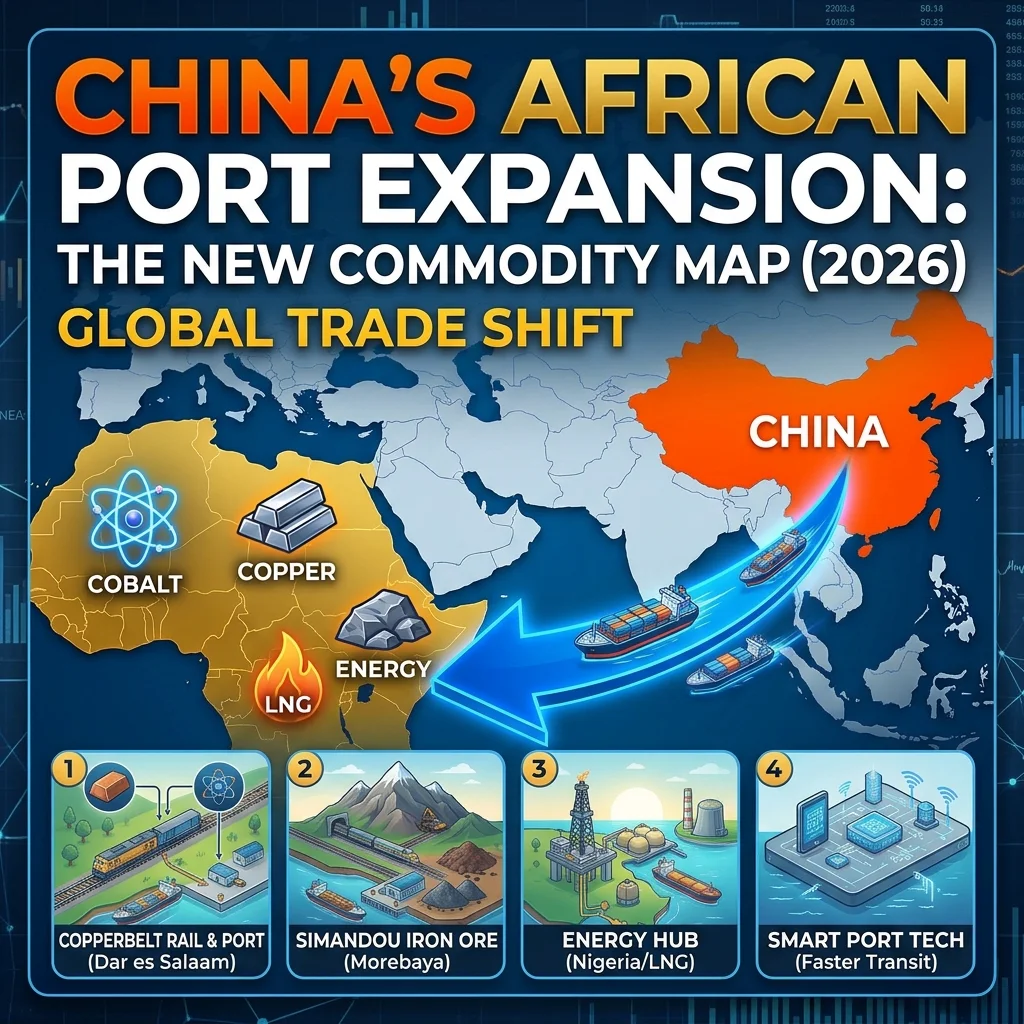
A single delayed vessel at a congested East African berth can cascade into weeks of demurrage, missed offtake windows, and margin erosion for copper, cobalt, or iron ore cargoes. In 2025 China–Africa trade hit a record $348 billion, with Chinese exports at $225 billion and African imports into China at $123 billion. Behind those numbers sits a quieter structural shift: Chinese state-owned enterprises and partners now finance, build, operate, or hold stakes in roughly one-third of Africa’s commercial ports—approximately 78 facilities across 32 countries.
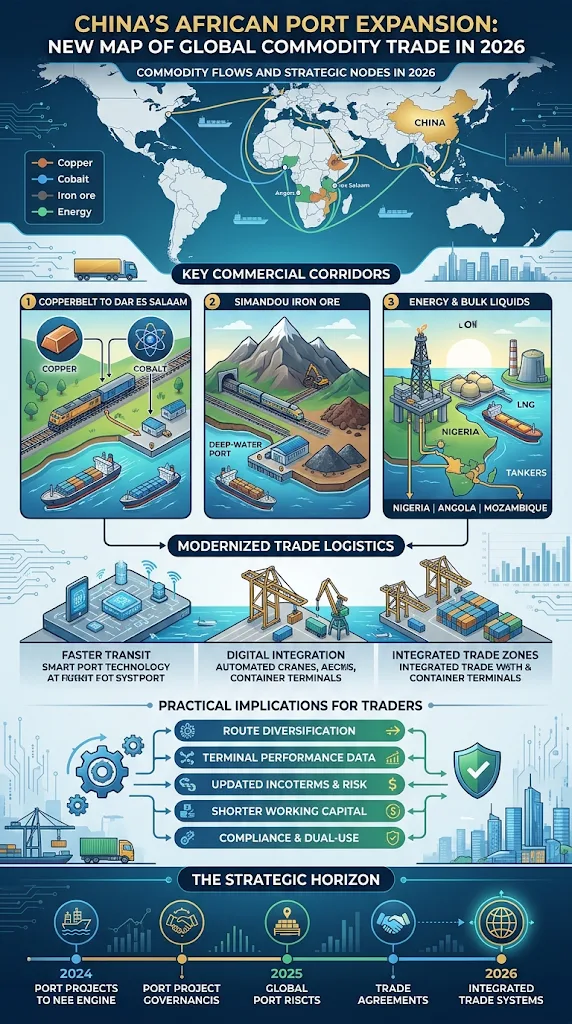
China’s African Port Expansion
This is not abstract geopolitics. For commodity traders, bulk shippers, offtakers, and logistics operators, the ports of Djibouti, Mombasa, Dar es Salaam, Lekki, Maputo, and the emerging nodes linked to Simandou and the Copperbelt are becoming the chokepoints and accelerators of global mineral, energy, and agricultural flows. The next phase of competition will be decided less by mine ownership alone and more by who controls the integrated corridors that move those commodities to market.
The Scale and Pattern of Chinese Port Engagement
Chinese involvement spans construction, financing, equity stakes, and long-term operational concessions. West Africa accounts for the densest concentration, followed by East, Southern, and North Africa. Projects range from greenfield deep-water terminals to modernization of existing facilities and adjacent free-trade or industrial zones. Total Chinese investment in African port infrastructure since the Belt and Road Initiative era is estimated near $50 billion.
The commercial logic is straightforward. Africa supplies critical inputs—copper and cobalt from the Democratic Republic of Congo and Zambia, iron ore from Guinea’s Simandou, crude and LNG from West and East African basins, and agricultural bulk. Reliable maritime access reduces the land-side bottlenecks that historically inflated landed costs and limited offtake volumes. At the same time, Chinese operators and equipment suppliers embed software, automation, and terminal operating systems, creating longer-term operational stickiness beyond the construction phase.
DP World’s late-2026 launch of the China Africa Link service illustrates how non-Chinese operators are responding. The weekly rotation links Shanghai, Ningbo, and Nansha with Port Klang, Dar es Salaam, and Maputo, backed by more than $665 million in terminal upgrades at the two African ports. The move pairs vessel capacity with physical infrastructure already under modernization.
Critical Commodity Corridors and Why Ports Matter More Than Mines
Control of extraction rights is only half the equation. Without efficient port throughput, rail connectivity, and storage, minerals remain stranded capital. Three corridors illustrate the point.
Copperbelt to Indian Ocean. Much of the region’s copper and cobalt traditionally moves east via the TAZARA railway to Dar es Salaam. China has committed roughly $1.4 billion under a long-term concession to rehabilitate and operate the line while Zambia and Tanzania retain ownership. Improved reliability shortens transit times and reduces the risk premium that traders previously priced into East African offtake. Competing westbound options such as the Lobito Corridor are advancing with other partners, creating genuine route choice for the first time in decades.
Simandou iron ore. The multi-billion-dollar project in Guinea required not only mining rights but a dedicated heavy-haul railway and a purpose-built deep-water port at Morebaya. Chinese consortiums participated in both the mining ventures and the logistics spine. Once commercial shipments began, the corridor demonstrated how integrated infrastructure can unlock previously stranded high-grade ore for Asian steelmakers and global traders.
Energy and bulk liquids. Ports handling crude, refined products, and LNG in Nigeria, Angola, Mozambique, and the Horn of Africa sit at the intersection of Chinese energy security needs and African export ambitions. Modern berths capable of handling larger vessels and faster turnaround directly affect charter rates, inventory carrying costs, and the feasibility of just-in-time supply to Asian refineries.
Agricultural commodities follow similar logic. Faster, more predictable container and bulk handling at upgraded East and Southern African ports improves the competitiveness of African grains, oilseeds, and specialty crops against Latin American and Black Sea alternatives.
The US–EU Counterweight: The Lobito Corridor and the Great Power Port Race
While the Lobito Corridor is briefly noted for opening alternative westbound routes from the Copperbelt, the analysis omits the broader geopolitical structural shift: the G7-backed Partnership for Global Infrastructure and Investment (PGII). Spearheaded by the United States and the European Union, the PGII is designed to directly counter China’s Belt and Road footprint by financing and upgrading the Lobito Atlantic Railway and connected Angolan port facilities.
For commodity traders, bulk shippers, and logistics operators, this intensifying race between Chinese state-backed consortia and Western-backed infrastructure initiatives introduces a critical strategic crossroad. Choosing a transport corridor is no longer just a calculation of draft depth, quay length, or transit days—it increasingly involves navigating competing financing frameworks, regulatory standards, and vessel flag considerations. Operators must factor in how great-power competition could shape future tariff structures, sanctions compliance, and long-term asset availability across African trade arteries.
East Africa: Djibouti, Mombasa, and Dar es Salaam as Strategic Nodes
Djibouti’s Doraleh Multipurpose Port remains the clearest example of commercial–strategic integration. Chinese firms financed and built the facility; China Merchants Group holds a meaningful operational stake. The adjacent free-trade zone and the nearby People’s Liberation Army support base create a dual-use environment that commercial operators must factor into risk assessments. Djibouti’s location astride the Bab el-Mandeb Strait gives it outsized importance for vessels moving between Asia, the Red Sea, and the Mediterranean.
Mombasa continues to serve as Kenya’s primary gateway and a potential privatization target for additional berths. Chinese contractors have been active in related rail and port works. Lamu further north offers alternative capacity as Kenya diversifies its maritime infrastructure.
Dar es Salaam is undergoing major modernization, with DP World committing more than $500 million. The port’s role as the primary Indian Ocean outlet for landlocked Copperbelt producers makes every efficiency gain in quay length, draft, and hinterland connectivity commercially material. New direct China–East Africa services reduce the need for intermediate hub transshipment, lowering both cost and schedule risk for time-sensitive mineral concentrates.
Maritime Security Threats: Red Sea Bottlenecks, Gulf of Guinea Piracy, and Insurance Spikes
While Djibouti’s position along the Bab el-Mandeb Strait highlights its strategic value, operational risk models must incorporate the escalating maritime security challenges confronting critical African trade lanes. Heightened geopolitical friction and asymmetric attacks in the Red Sea and Southern Bab el-Mandeb, alongside persistent piracy and armed robbery risks in the Gulf of Guinea, have fundamentally shifted shipping economics for vessels calling at Chinese-operated terminals.
For bulk carriers and container lines, these maritime vulnerabilities translate directly into bottom-line operational costs. Security threats force operators to choose between two costly alternatives: incurring substantial War Risk Insurance premiums and armed guard surcharges to transit high-risk zones, or diverting vessels around the Cape of Good Hope, which adds 10 to 14 days to transit schedules and significantly increases fuel consumption. Commodity traders managing Asian off-take from West and East African ports must continuously re-evaluate voyage charter terms, demurrage exposures, and force majeure declarations against these real-time security dynamics.
West and Southern Africa: Density and Emerging Alternatives
West Africa hosts the highest number of Chinese-linked projects. Lekki Deep Sea Port in Nigeria, built with significant Chinese engineering and financing participation and long-term operational involvement, expands capacity near Africa’s largest economy and a major oil and gas producer. Kribi in Cameroon and Lomé in Togo show similar equity and construction patterns. These facilities improve access for Nigerian crude, refined products, and regional container trade while offering Chinese operators commercial footholds on the Atlantic side.
Southern Africa presents a more mixed picture. Maputo’s container terminal expansion by DP World is designed to more than double capacity and deepen berths, positioning the port as a stronger Southern African hub. Chinese activity is present but competes with established regional players and other international terminal operators. The result is greater route diversity for traders moving bulk and containerized cargoes between Southern Africa and Asia.
From Standalone Ports to Integrated Trade Corridors
The most consequential development is the shift from isolated port projects to “port–park–city” or corridor models. Chinese operators frequently pair terminal concessions with industrial zones, rail links, and power infrastructure. The commercial effect is to shorten the distance between mine or farm and vessel, reduce intermediate handling, and create captive cargo flows that improve terminal utilization.
For traders this changes inventory strategy. More predictable inland transit and faster vessel turnaround allow lower safety stocks and tighter matching of production schedules to offtake windows. It also raises the importance of multi-corridor risk management: a disruption on TAZARA can now be partially offset by Lobito or alternative East African options, provided commercial relationships and documentation systems are already in place.
Trade finance and project finance follow the physical infrastructure. Port modernization creates opportunities for structured commodity finance, warehouse receipt systems, and longer-term offtake-backed lending. Public–private partnership models are becoming more common as Chinese policy banks recalibrate risk and African governments seek to retain greater ownership while still accessing capital and expertise.
Currency Dynamics and Financial Settlement: The RMB and CBDC Frontier
As Chinese state-owned enterprises and consortiums deepen their operational footprint across African ports, the mechanics of trade finance, port dues, and corridor financing are undergoing a parallel shift. Traditional reliance on U.S. dollar-denominated settlement is increasingly challenged by the growing adoption of the Chinese Yuan (RMB) and cross-border renminbi clearing mechanisms.
For commodity traders and logistics operators, this creates both opportunities and operational frictions. Utilizing RMB for port dues, terminal services, and offtake financing can reduce foreign exchange conversion costs and bypass Western banking bottlenecks in bilateral trade corridors. At the same time, it requires firms to manage multi-currency cash flows, assess currency volatility, and anticipate the long-term rise of central bank digital currencies (CBDCs) and alternative digital settlement platforms designed to anchor China–Africa commodity flows outside traditional Western architectures.
Practical Implications for Commodity Traders and Logistics Operators
Route diversification is now operational, not theoretical. Traders who previously relied on a single East African outlet for Copperbelt material should map alternative corridors, test documentation and customs processes, and establish relationships with operators on both Indian Ocean and Atlantic routes.
Terminal performance data matters more. Quay productivity, average vessel turnaround, and hinterland dwell times directly affect demurrage exposure and landed cost. Operators with Chinese systems or DP World-style upgrades often publish clearer performance metrics; these should be incorporated into freight and offtake models.
Incoterms and risk allocation need updating. Where Chinese or other international operators control key terminals, force majeure, congestion, and security clauses should reflect actual operational realities rather than generic templates. For bulk liquids and concentrates, quality preservation and sampling protocols at the new facilities require verification.
Working capital cycles can shorten. Faster transit and more reliable schedules reduce the cash conversion cycle for traders who finance cargo from mine gate to discharge. This advantage is largest for mid-sized traders who previously absorbed higher financing costs due to uncertainty.
Compliance and dual-use awareness. Ports with documented dual-use design features or frequent naval activity require heightened due-diligence on sanctions, end-use, and insurance. Commercial operators should treat these as standard operational risks rather than political exceptions.
Digital Terminal Architecture: TOS Integration, e-BL, and Customs Interoperability
Beyond physical infrastructure, the deployment of proprietary Chinese Terminal Operating Systems (TOS) and smart port software creates a deep digital integration across the China–Africa trade corridor. Chinese operators are rapidly standardizing paperless trade protocols, facilitating the seamless adoption of electronic Bills of Lading (e-BL), digital certificate verification, and real-time container tracking.
This digital backbone directly interfaces with Chinese customs clearance frameworks and single-window platforms. For commodity traders and supply chain managers, end-to-end data integration significantly reduces customs hold-ups, eliminates paper-processing latencies at origin and discharge ports, and compresses the overall document turn-around time—a core capability leveraged by modern digital trade platforms such as Tendify.net to optimize cross-border compliance.
ESG Compliance, CBAM, and the Green Corridor Imperative
As sustainability mandates reshape global supply chains, the operational efficiency of African ports is no longer measured solely by throughput speed and quay productivity. The implementation of stringent Western environmental regulations—most notably the European Union’s Carbon Border Adjustment Mechanism (CBAM)—is placing immense pressure on off-takers of steel, copper, cobalt, and aluminum to account for the full carbon footprint of their logistical routes.
Chinese port operators are increasingly embedding decarbonization technologies into their terminal developments, from electrified container handling equipment and shore power systems to solar-supplemented logistics parks. However, the pace of green transition varies widely across corridors. For commodity traders targeting Western markets, shipping through a non-decarbonized or high-emission port terminal risks inflating Scope 3 emissions calculations, directly exposing cargo to heavy CBAM carbon tariffs upon entry into the EU. Evaluating the environmental metrics and green infrastructure of transshipment nodes is now an essential prerequisite for optimizing landed commodity margins.
Freight Rate Compression: Direct Liner Services and Slot Economics
The establishment of direct, non-stop shipping strings linking Chinese manufacturing hubs (such as Shanghai, Ningbo, and Nansha) directly with East and Southern African ports has fundamentally altered regional freight economics. By bypassing intermediate transshipment hubs in Southeast Asia, carriers have significantly lowered slot costs and reduced transit times for both containerized trade and dry bulk flows.
For shippers and charterers, these operational efficiencies translate directly into compressed ocean freight rates and lower inventory holding costs. The resulting predictability in transit schedules enables traders to price cargo with tighter margins, minimize emergency safety stock requirements, and optimize landed commodity economics between Asia and Africa.
Investment and Partnership Angles
Port modernization and corridor development create openings beyond pure trading. Equity participation in terminal concessions, logistics parks, and inland container depots offers exposure to throughput growth without direct mining risk. African governments increasingly favor structures that retain majority ownership while granting operational control and revenue-sharing to experienced operators.
For Gulf-based and international logistics groups, the combination of Chinese construction scale and third-party terminal management (as seen with DP World) creates hybrid opportunities. Trade finance providers can structure facilities around the improved physical infrastructure, using warehouse receipts and offtake agreements as collateral more reliably than in the past.
Operational Playbook for Entering or Scaling in These Corridors
- Map primary and secondary corridors for each commodity class you handle, including current and projected capacity, draft restrictions, and rail/road reliability.
- Establish direct commercial relationships with terminal operators rather than relying solely on shipping lines for berth allocation and priority.
- Stress-test documentation and customs processes at both Chinese origin ports and African discharge ports; misclassification or incomplete certificates remain common sources of delay.
- Build multi-corridor contingency plans with pre-agreed offtake flexibility and alternative vessel routing.
- Incorporate terminal performance KPIs into freight rate negotiations and demurrage calculations.
- Monitor debt sustainability and political risk indicators at host-country level; sudden policy shifts on concessions or tariffs can alter commercial viability faster than physical capacity changes.
- Explore warehouse and processing options inside free zones attached to major ports to capture value-add closer to the source.
Platforms that aggregate real-time freight, compliance, and market data can compress the time required to execute these steps. Tools available through Platform.Tendify.Net, for example, help operators compare corridor costs and documentation requirements without maintaining separate data feeds for every route.
Related operational guidance on corridor logistics and cost structures appears in existing analysis on Gulf multimodal transport and freight costs و cross-border logistics streamlining for B2B trade. Traders evaluating payment and risk allocation structures will also find practical comparisons in coverage of modern trade finance alternatives.
The Strategic Horizon
The geography of global commodity trade is being redrawn not by a single megaproject but by the cumulative effect of dozens of terminal upgrades, rail rehabilitations, and new shipping strings. Chinese capital and contractors have accelerated capacity where African governments and private operators alone could not. Other international players, including Gulf terminal operators, are responding with complementary services and investments.
For commercial participants the opportunity lies in treating these corridors as active, competitive systems rather than fixed background infrastructure. Those who map the new options, lock in operational relationships, and price risk accurately will move cargo faster and at lower total cost. Those who continue to plan around yesterday’s bottlenecks will absorb higher demurrage, longer cash cycles, and lost offtake windows.
The ports themselves are only the visible edge. The real competition is over the integrated systems—rail, storage, finance, and information—that turn African resources into reliable global supply. Understanding that system is now a core competency for any serious commodity or logistics business operating between Africa and Asia.
To move from analysis to execution—securing verified counterparties, comparing live corridor economics, and structuring safer cross-border flows—register and access the full suite of trade tools at https://tendify.net/my-account/. The infrastructure is being built; the commercial advantage will belong to those who use it first and most precisely.

