


وبلاگ
GCC Military Command in Kuwait: Securing 2026 Trade Corridors
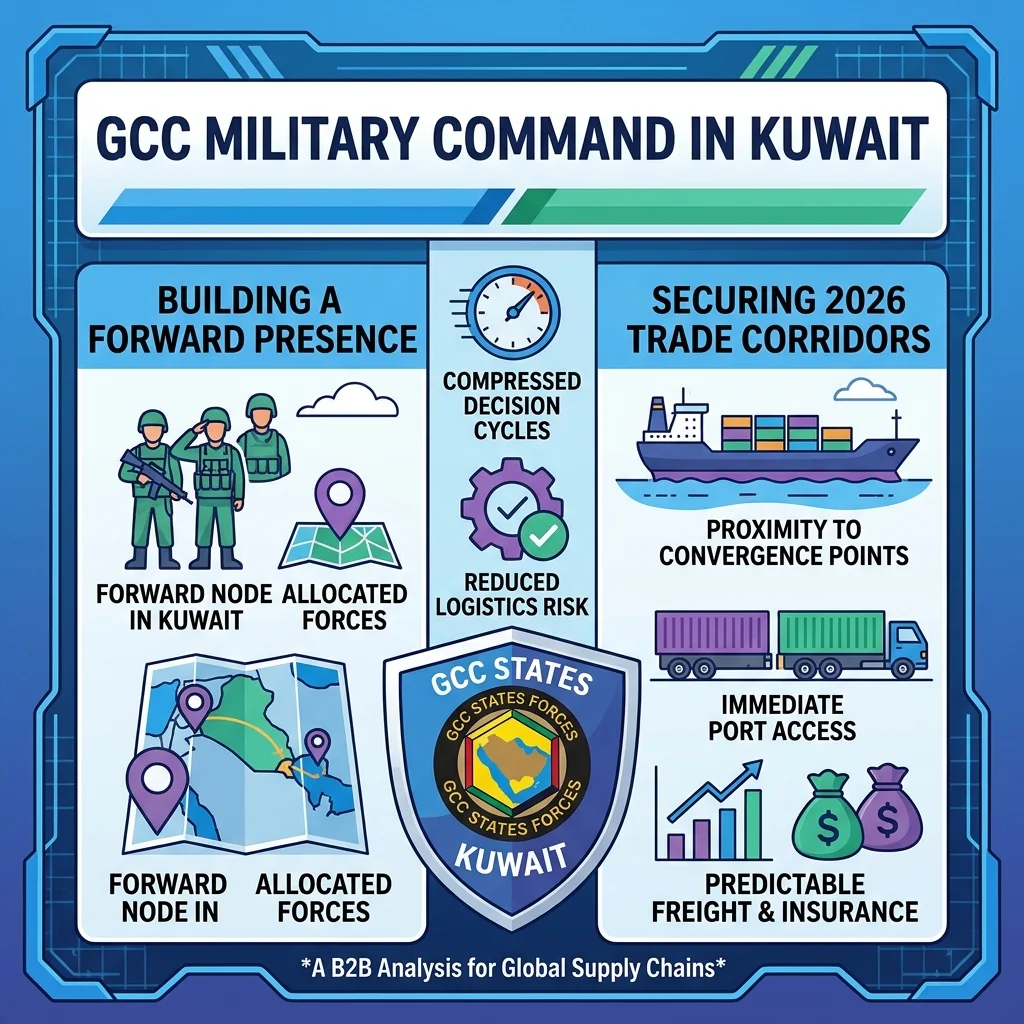
GCC Advanced Military Command Headquarters in Kuwait: Securing Trade Corridors and B2B Supply Chains in 2026
Regional stability is the invisible infrastructure of every cross-border shipment. When defence architecture shifts at the northern end of the Gulf, the effects cascade through freight rates, insurance premiums, inventory buffers, and the willingness of buyers and sellers to commit capital. In mid-November 2026 the six GCC states approved the establishment of an advanced forward headquarters for their Unified Military Command in Kuwait and the allocation of appropriate forces to it. The decision, taken at the 23rd session of the Joint Defence Council, marks the most concrete operational step yet toward a permanent, collective defence posture closer to the region’s primary maritime and overland trade arteries.
This is not abstract geopolitics for traders, logistics operators, or procurement teams. It is a structural change in the risk environment that governs the movement of bulk commodities, project cargo, refrigerated goods, and high-value manufactured products through the Gulf. Understanding the new command’s purpose, location logic, and practical consequences allows B2B operators to recalibrate contracts, insurance strategies, and network design with greater precision.
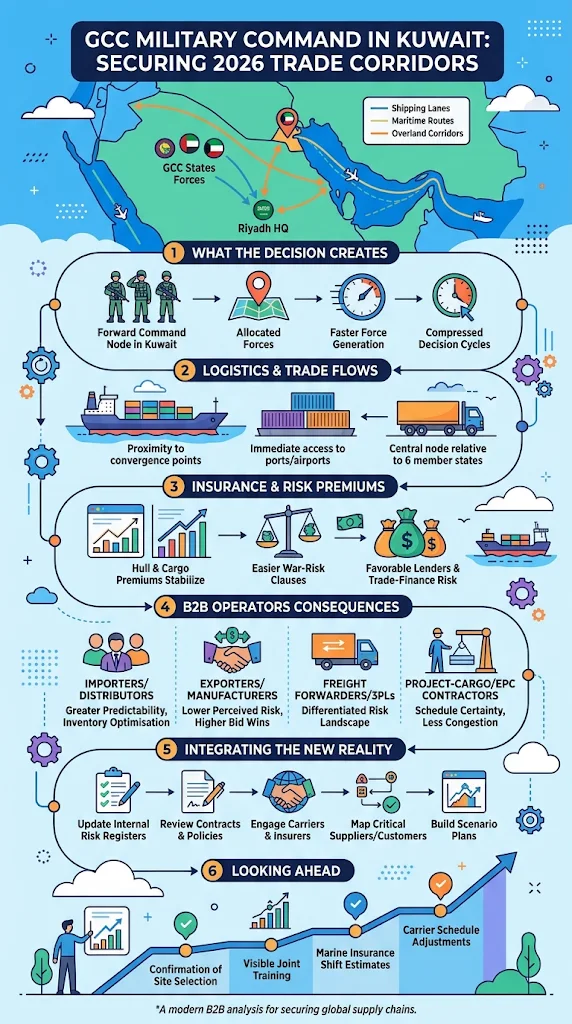
GCC Military Command in Kuwait
What the Decision Actually Creates
The Unified Military Command itself dates to a 2013 summit decision. Its permanent headquarters later opened in Riyadh. The 2026 move does not relocate that headquarters. It adds a forward command node in Kuwait—positioned at the northern tip of the Gulf—and assigns forces to give the structure real operational weight. A forward headquarters exists to compress decision cycles, improve real-time coordination among national forces, and place command closer to the geography where rapid response matters most.
Kuwait’s selection is deliberate. It sits at the interface of major shipping lanes, critical port infrastructure, and the overland corridors that link the Gulf to wider regional markets. Placing a permanent joint command presence there signals that collective defence is no longer purely reactive or summit-driven. It is being embedded in the physical landscape of trade.
Operational details—exact site, force composition, timeline for full activation—remain limited in public statements. What is clear is the strategic intent: deeper integration of national capabilities under a single operational framework, faster force generation, and a more coherent defensive envelope around the economic assets that generate the bulk of GCC trade volumes.
The Geographic Specificity Gap: Missing Critical Nodes and Trade Corridors
While the analysis outlines broader strategic shifts, it currently lacks references to the specific physical choke points and trade arteries that matter most to supply chain operators. A truly actionable B2B risk assessment must explicitly ground security architecture in the geography it protects:
- Key Maritime Gateways: Kuwait’s Shuwaikh و Shuaiba ports, alongside the massive upcoming development at Mubarak Al Kabeer Port روی Bubiyan Island, and the maritime approaches through the Strait of Hormuz.
- Critical Overland Corridors: Cross-border trade routes including the Safwan/Abdali border crossing (linking into Iraq’s logistics grid) and the Nuwaiseeb crossing (connecting to Saudi Arabia), as well as regional integration projects like the GCC Railway network.
Why Location Matters for Logistics and Trade Flows
Geography is destiny in maritime and multimodal logistics. Kuwait’s position gives any forward command several structural advantages that translate directly into trade-security outcomes:
- Proximity to the northern approaches of the Gulf, where vessel traffic converges before dispersing to major load centers.
- Immediate access to existing high-capacity port and air infrastructure that already serves both commercial and dual-use functions.
- A central node relative to the six member states, reducing the latency of joint decision-making compared with a purely Riyadh-centric model.
For freight forwarders, carriers, and shippers the practical result is a higher baseline of collective readiness around the routes and nodes that carry the majority of regional container, bulk, and project cargo. Reduced uncertainty around response times to maritime or aerial threats lowers the probability of prolonged disruptions that force vessels into costly diversions or idle time.
Operational assessments of Gulf supply chains consistently show that even short interruptions at northern nodes create cascading delays measured in days and weeks rather than hours. A permanent joint command presence is designed to shrink those interruption windows.
Implications for Insurance, Risk Premiums, and Contract Structures
Trade finance and marine insurance markets price risk continuously. When collective defence capability becomes more tangible and geographically forward-deployed, the market responds through several channels:
- Marine hull and cargo premiums for routes that remain inside the enhanced defensive envelope tend to stabilize or ease relative to routes that sit outside it.
The London Market Benchmark: Navigating Joint War Committee (JWC) Listed Areas and AWRP
Marine hull and cargo underwriting decisions are ultimately governed by institutional benchmarks rather than general political sentiment. For commercial operators traversing the Gulf, the primary metric is the designation issued by the Lloyd’s Joint War Committee (JWC):
Impact on Additional War Risk Premiums (AWRP): Whenever regional tensions escalate or de-escalate, insurers look to JWC listed area updates to adjust AWRP surcharges. The permanent presence of a forward joint command in northern waters provides underwriters with the institutional confidence required to stabilize or gradually re-price these risk loadings.
Predictable Claims & Underwriting Dialogues: Shippers and shipowners can leverage concrete collective defense milestones during annual policy renewals to negotiate more favorable deductible thresholds and secure predictable premium rate filings in London and regional insurance markets.
- War-risk and contingency clauses in charter parties and sales contracts become easier to negotiate when counterparties can point to concrete joint-force infrastructure rather than aspirational statements.
- Lenders and trade-finance providers view collateral and performance risk more favorably when the physical movement of goods is underwritten by a more integrated regional security architecture.
Experienced operators already adjust force-majeure and delay clauses in light of regional security posture. The Kuwait forward command gives those adjustments a clearer factual foundation. Contracts signed in the coming quarters will increasingly reference the existence of permanent joint command nodes as part of the risk matrix.
Deconstructing Threat Vectors: What the Forward Command Mitigates vs. What It Leaves Unresolved
A rigorous B2B risk assessment requires separating physical security threats from commercial vulnerabilities. While the Kuwait forward command directly alters the kinetic and operational risk landscape, it does not act as an economic blanket. Supply chain operators must evaluate risks across distinct vectors:
- Covered Kinetic & Maritime Threats: Asymmetric naval hazards, missile/drone interdiction trajectories targeting northern maritime approaches, electronic warfare interference such as GPS/AIS spoofing and jamming in the northern Gulf, and temporary airspace or sea-lane closures requiring rapid joint-force deterrence.
- Unresolved Commercial & Structural Risks: Regulatory bottlenecks, customs compliance delays at border gates (e.g., Safwan/Abdali), trade-finance default exposures, counterparty credit risks, and tariff volatility—none of which fall under military command purview.
Practical Consequences for B2B Operators Across the Value Chain
Different actors experience the change differently.
Importers and distributors
gain greater predictability around arrival windows at Kuwaiti and neighboring ports. Inventory buffers that were inflated to absorb geopolitical uncertainty can be modestly optimized once the market internalizes the new baseline of readiness.
Exporters and manufacturers
supplying the GCC face lower perceived risk when quoting delivery terms that rely on northern Gulf gateways. This can improve win rates on tenders that include strict delivery reliability metrics.
Redefining Incoterm Selection: From FOB Hesitation to DDP Confidence in Northern Gateways
General force-majeure clauses are insufficient for modern B2B trade contracts traversing the Gulf. A tangible regional security architecture directly impacts how trading partners allocate risk under formal Incoterms 2020 rules:
- Shifting from FOB to DDP Confidence: Exporters and sellers historically resisted quoting Delivered Duty Paid (DDP) terms for northern Gulf deliveries due to volatile regional disruptions and unpredictable clearance friction. Enhanced collective defense baselines reduce terminal-delay variance, empowering sellers to offer competitive DDP terms into Kuwaiti and upper-Gulf nodes with leaner contingency margins.
- Optimizing CIF and Charter-Party Risk: For buyers operating under Cost, Insurance, and Freight (CIF) arrangements, stable maritime approaches translate to more predictable war-risk insurance surcharges, preventing last-minute freight-rate spikes during contract execution phases.
Freight forwarders and 3PLs
should expect demand for contingency routing options to remain, but the pricing of those options will reflect a more differentiated risk landscape. Routes that stay inside the enhanced command envelope will command different risk premia from those that do not.
Project-cargo and EPC contractors
moving heavy equipment for infrastructure and industrial projects benefit from reduced likelihood of extended port congestion or temporary closures driven by security incidents. Schedule certainty is often more valuable than marginal freight savings on these movements.
Unlocking Sovereign Tenders: Lower Risk Margins for International EPC Bidders
For international contractors and OEM suppliers tracking sovereign procurement across Kuwait and Saudi Arabia, geopolitical risk surcharges have long inflated bid pricing. A permanent joint command node in the northern Gulf directly improves bid competitiveness on capital-intensive tenders:
- Upstream Energy & Mega-Projects: Foreign EPC contractors bidding on Kuwait Oil Company (KOC) upstream packages, port expansion contracts, and northern Saudi industrial infrastructure can trim geopolitical contingency buffers from their commercial proposals without sacrificing margin protection.
- Performance Bond & Mobilization Confidence: Lower perceived disruption risk around northern logistics gateways reduces friction when securing international performance bonds and guarantees strict adherence to aggressive project mobilization schedules.
Across all segments, the existence of a permanent forward command strengthens the case for longer-term volume commitments and multi-year logistics partnerships rather than pure spot-market dependence.
Integrating the New Reality into Daily Operations
High-level awareness of regional security changes must be converted into rigorous contractual and operational workflows. Supply chain teams can execute five granular adjustments immediately:
1. Incorporate Specific War-Risk Clauses: Update charter parties and sales contracts past generic force-majeure language by explicitly referencing standard industry templates such as CONWARTIME or VOYCONWARTIME clauses to govern northern Gulf routing changes and equitable freight cost-sharing.
2. Recalibrate Northern Buffer Stock: Audit current safety stock inventories held for Kuwaiti and upper-Gulf nodes, trimming inflated cushions by 10–15% in light of compressed maritime response times.
3. Underwriting Policy Reviews: Engage marine and cargo insurers proactively ahead of annual policy renewals to ensure the enhanced regional defense posture is reflected in reduced Additional War Risk Premium (AWRP) loadings.
4. Supplier and Corridor Mapping: Cross-reference Tier-1 and Tier-2 component suppliers against the physical security envelope of northern ports and transit corridors like the Safwan-Abdali gate.
5. Stress-Test Disruption Scenarios: Build operational models assuming shorter northern Gulf delay windows while establishing alternative multi-modal contingency triggers for non-covered trade risks.
None of these steps require waiting for full public disclosure of force numbers or exact facilities. The directional signal is already strong enough to act on.
Broader Regional Trade Architecture and Complementary Developments
The military decision does not exist in isolation. It sits alongside continuing investment in port capacity, customs digitalization, multimodal corridors, and free-zone regimes across the GCC. A more robust collective defence posture reduces the probability that those physical and digital investments are undercut by prolonged security shocks.
Traders who already operate multi-country GCC networks will find that the forward command reinforces the logic of treating the six markets as a more integrated economic space. Risk diversification still matters, but the cost of concentrating certain flows through the most efficient northern nodes declines when the security overlay improves.
For those evaluating new market entry or expanded warehousing footprints, the existence of permanent joint command infrastructure is one more factor that tilts the risk-reward calculation toward deeper regional commitment.
Looking Ahead: What to Monitor
Several indicators will reveal how quickly the decision translates into operational reality:
- Public or industry confirmation of site selection and construction timelines.
- Observable changes in joint training activity or force posture around Kuwaiti facilities.
- Shifts in marine insurance rate filings or war-risk assessments that explicitly cite the forward command.
- Adjustments in carrier schedules or contingency routing that treat northern Gulf approaches as lower-variance relative to earlier baselines.
None of these will move overnight. Collective defence structures mature over years. The approval itself, however, removes a long-standing source of ambiguity about the GCC’s willingness to embed joint capability in the geography that matters most for trade.
Positioning Your Organization for the New Baseline
Regional trade has always rewarded operators who treat security architecture as a core input into network design rather than an external noise factor. The 2026 decision to stand up an advanced forward headquarters for the Unified Military Command in Kuwait and assign forces to it is a material upgrade to that architecture.
Organizations that update their internal models, contract language, and partner conversations accordingly will capture the efficiency gains first. Those that treat the development as distant political news will continue to carry higher risk buffers and less competitive landed costs.
The practical tools for executing that adjustment—real-time market intelligence, standardized documentation workflows, and secure counterparty discovery—are already available inside modern B2B platforms. One such environment is Platform.Tendify.Net, which many operators already use to align logistics, compliance, and commercial processes across Gulf corridors.
For teams ready to translate the new security baseline into tighter operations and stronger commercial positions, the next step is straightforward. Create an account at tendify.net/my-account and begin mapping your current routes, contracts, and risk exposures against the evolving regional posture. The operators who move earliest will set the performance standard others are measured against.

