


وبلاگ
Air Freight Documentation Flow: Mastering Digital Customs
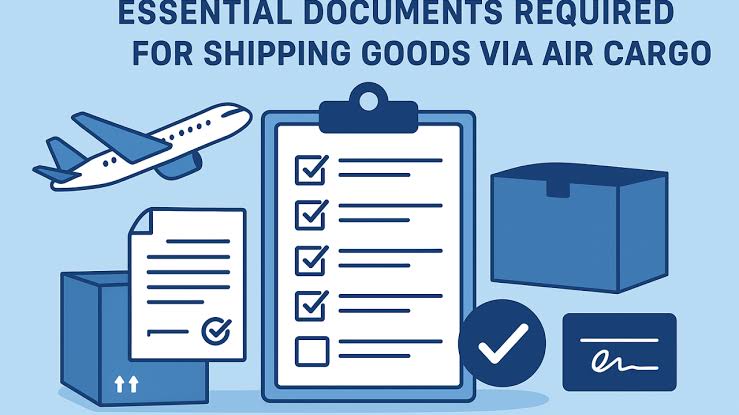
In high-stakes B2B trade, especially across GCC and MENA markets, a single missing or incorrect document can turn a profitable air freight shipment into a costly delay at customs. Cargo moves physically through the skies, but it is the documents that clear the legal path. Exporters who master this process consistently achieve faster turnaround times, lower rejection rates, and stronger relationships with international buyers.

Air Freight Documentation Flow
This guide breaks down the entire air freight export documentation flow with practical, step-by-step insights drawn from operational realities in cross-border supply chains. Whether you ship electronics, pharmaceuticals, perishables, or industrial components, understanding who prepares what, when, and why will help you eliminate bottlenecks and scale confidently in 2026.
20 Documents Used in Export & Import
Why Air Freight Documentation Demands Precision in Today’s Market
Air freight offers unmatched speed for time-sensitive or high-value goods, but it operates under strict regulatory scrutiny. Airports have tighter security protocols, weight and volume constraints, and faster clearance timelines than sea freight. Errors here compound quickly.
AIR FREIGHT EXPORT DOCUMENTATION
Recent industry analyses show that documentation discrepancies account for up to 40% of air cargo delays globally. In GCC hubs like Dubai and Doha, where re-export volumes continue to grow, customs authorities emphasize digital verification and accurate valuation. Mastering the flow is no longer optional—it is a competitive advantage.
Key benefits of streamlined documentation:
- Reduced dwell times at origin and destination airports
- Lower risk of storage or demurrage fees
- Improved cash flow through faster payment cycles
- Stronger compliance posture amid evolving trade rules
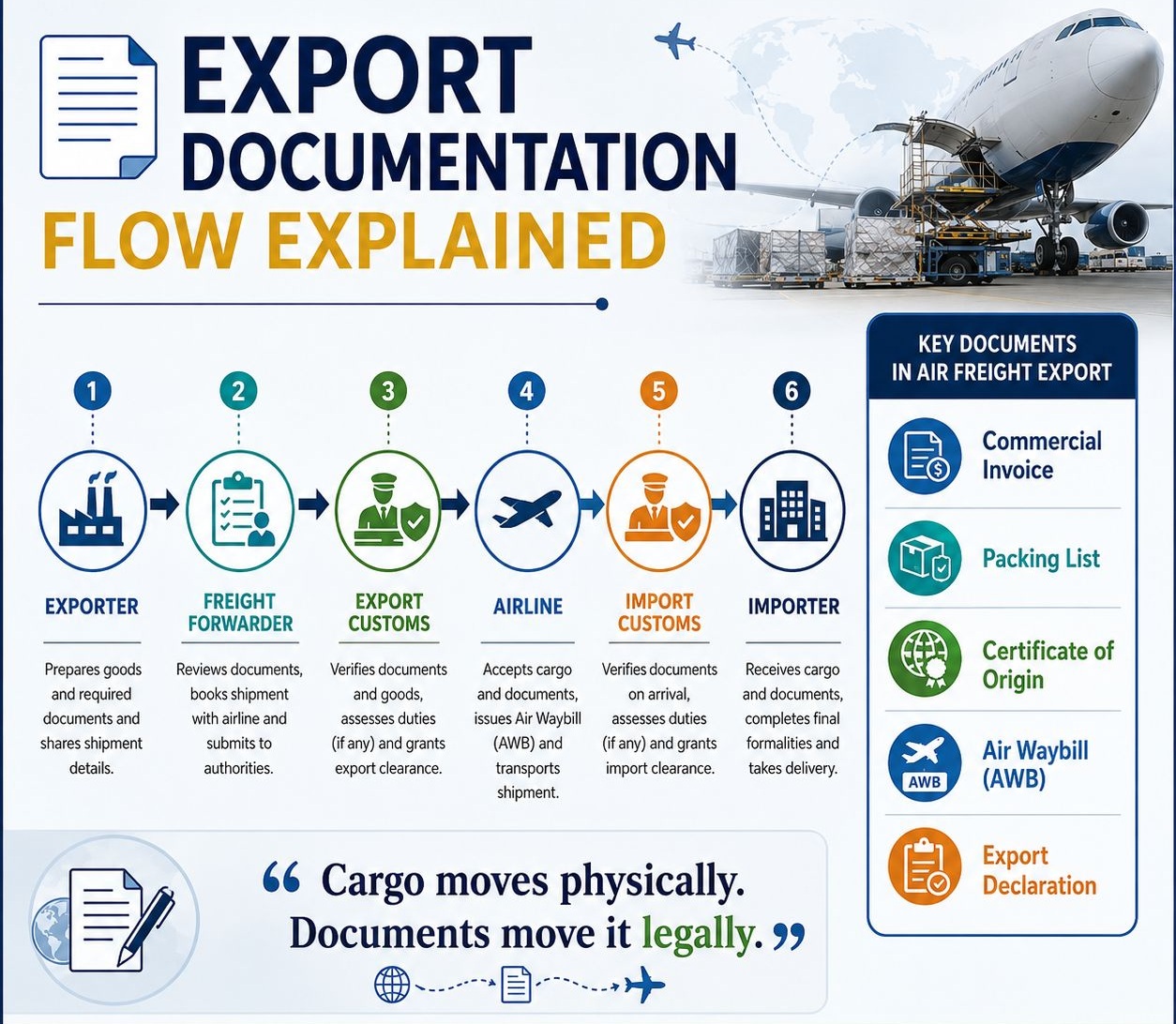
The Air Freight Export Documentation Flow: Visual Overview
The process follows a clear sequence involving six primary stakeholders:
- Exporter → Prepares core commercial documents and shipment details.
- Freight Forwarder → Reviews, books space, and coordinates submissions.
- Export Customs → Verifies and grants clearance.
- Airline → Accepts cargo and issues the Air Waybill (AWB).
- Import Customs → Assesses duties and releases goods.
- Importer → Receives and finalizes delivery.
This linear yet interconnected flow ensures that physical cargo and legal documentation move in sync. As the operational principle states: Cargo moves physically. Documents move it legally.
Step-by-Step Breakdown of Each Stage
1. Exporter Preparation Phase
The exporter initiates the entire export lifecycle by compiling essential commercial, financial, and operational data. At this stage, errors in paperwork immediately jeopardize downstream activities.
Core documents prepared by the exporter include:
Commercial Invoice: This is the legal foundation of the transaction. It details the exact transaction value, applicable Incoterms (e.g., FCA, CPT, CIP), payment terms, detailed currency specifications, harmonized system (HS) codes, and a meticulous description of the goods. It must be highly accurate to prevent valuation disputes and penalty assessments by customs auditors.
Packing List: This document itemizes the exact contents, net and gross weights, precise dimensions per package/pallet, and the specific packaging types used. It is a critical operational document utilized by airlines for aircraft weight-and-balance calculations and physical cargo buildup.
Certificate of Origin (CoO): Proves the definitive nationality of the manufactured goods. It is indispensable for unlocking preferential tariffs and duty exemptions under regional trade agreements such as the GAFTA (Greater Arab Free Trade Area) and GCC unified customs treaties.
Export Declaration: A mandatory regulatory filing providing customs authorities with statistical and security data regarding the outbound shipment.
Operational Insider Tip: Ensure absolute data uniformity across all core documents. A minor mismatch in product descriptions or weight metrics between the Commercial Invoice and the Packing List is an immediate red flag that triggers manual customs inspection and holding lines.
2. Freight Forwarder Coordination
Experienced international freight forwarders act as the crucial operational bridge between the shipper, regulatory bodies, and air carriers. They audit the exporter’s documentation, secure block space agreements (BSA) with airlines, manage physical consolidation, and schedule transport routes.
Key forwarder responsibilities include:
Cargo Consolidation: Merging Less-than-Container Load (LCL) or smaller air shipments into a single, cohesive flight layout to optimize space and lower freight rates.
Issuance of the House Air Waybill (HAWB): Generating the specific transport document that governs consolidated cargo, serving as the contract between the individual shipper and the forwarder.
Dangerous Goods Regulations (DGR) Compliance: Verifying and managing complex documentation (such as Shippers Declaration for Dangerous Goods) if the shipment involves lithium batteries, chemicals, or temperature-sensitive pharmaceuticals.
Pre-Shipment Inspection (PSI) Coordination: Interfacing with international verification bodies to secure necessary compliance certificates before the airport gate-in.
In practice, forwarders with localized infrastructure and strong airline relationships secure reliable space allocations and priority ground handling, which is exceptionally vital during peak seasons at major MENA transit airports.
3. Export Customs Clearance
Before cargo can be handed over to an airline terminal operator, national export customs authorities must verify that the shipment complies with outbound trade laws, security mandates, and international embargo restrictions.
Critical customs validation checkpoints include:
HS Code Audit: Verifying that the assigned Harmonized System classifications match the actual technical specifications of the cargo.
Valuation Verification: Cross-referencing invoice declarations against regional valuation databases to ensure there is no deliberate under-invoicing to evade statistics or future taxes.
Strategic Export Controls: Checking for required dual-use export licenses, environmental permits, or restricted item sanctions.
Physical Markings and Labeling: Ensuring shipping marks on pallets align perfectly with the submitted manifest data.
Modern digital customs systems in major trade hubs now allow for advanced electronic pre-arrival submissions, allowing compliant cargo to achieve digital clearance prior to physical arrival at the airport terminal.
4. Airline Acceptance and Transport
Upon receiving export clearance, the cargo is physically delivered to the airline’s ground handling agent (GHA). Once the airline accepts physical custody and confirms the cargo build-up matches safety protocols, it issues the Master Air Waybill (MAWB). The MAWB represents the single most critical legal document in the air freight industry.
The Air Waybill serves three non-negotiable legal functions:
Contract of Carriage: Establishes the formal legal terms and liabilities between the shipper (or forwarder) and the air carrier.
Receipt of Goods: Confirms that the airline has accepted the cargo in good condition and is committed to executing the designated flight route.
Customs and Delivery Document: Acts as the primary document utilized by destination authorities to initiate import processing.
Airlines require strict structural formatting and enforce electronic data messaging via global platforms like Cargo iQ or IATA’s electronic Air Waybill (e-AWB) messaging protocols before wheels-up.
5. Import Customs Processing
Immediately upon landing at the destination gateway, the import customs authority assumes regulatory jurisdiction over the aircraft’s manifest. Import customs reviews the complete dossier transmitted electronically or physically to assess duties, collect localized taxes, and issue a formal release order.
Importers or their licensed customs brokers typically orchestrate this stage. They must present the original MAWB/HAWB, the verified Commercial Invoice, the Packing List, and any localized certificates (such as health or conformity papers).
In highly automated hubs, pre-clearance mechanisms allow documentation to be audited while the plane is still in transit, enabling instantaneous “green channel” release upon touchdown for trusted traders.
6. Delivery to Importer
The final stage of the air freight documentation flow occurs when the import customs authority issues the official release note. The importer or their designated domestic logistics provider fulfills outstanding terminal handling fees, takes physical possession of the cargo from the airport warehouse, and concludes the journey.
From an administrative standpoint, the final signed delivery order, customs entry documents, and stamped air waybills are returned to the importer’s corporate compliance department. These documents are archived to satisfy mandatory tax audits, verify inventory valuation ledger accounts, and validate proper corporate accounting records.
Cross-Border Commerce: Mastering the Hybrid Human + AI Operating System
Key Documents in Air Freight Export: Detailed Guide
2026 GCC Tax Compliance: Commercial Invoice Impact
Air freight documentation is inextricably linked to commercial valuation. Recent shifts in the GCC tax landscape—specifically regarding corporate tax implementations and updated Value Added Tax (VAT) frameworks for free zones—demand rigorous adjustments to how your Commercial Invoice is structured.
Following recent corporate tax integration, air cargo moving out of designated free zones (like DWC or DAFZA) into mainland GCC markets must explicitly state the customs suspension status or correct VAT treatment on the face of the commercial invoice to prevent double taxation or customs holds.
Saudi Arabia’s ZATCA enforces strict matching between customs declarations and tax filings. For air shipments, your commercial invoices must feature verified HS codes, precise transaction value currencies (with strict adherence to official exchange rates), and the buyer’s local Tax Identification Number (TIN).
- Clearly define the Incoterm (e.g., DAP Dubai Airport vs. DDP Riyadh) as this dictates who accounts for import VAT.
- Mandatorily display the Tax Registration Number (TRN/TIN) of both the exporter and the GCC importer.
- Provide a detailed break-down of freight and insurance charges if they are not integrated into the unit price, to avoid arbitrary customs valuation adjustments.
فهرست بستهبندی
Complement the invoice with detailed packing information. Include net/gross weights, measurements, number of packages, and marks/numbers. Airlines use this for loading plans.
Volumetric Weight Synchronization: Packing List to AWB
A major source of customs and airline discrepancies is a data mismatch between the exporter’s فهرست بستهبندی and the final Air Waybill (AWB) regarding weight metrics. Airlines bill air cargo based on the Chargeable Weight—which is whichever is higher: the Actual Gross Weight or the Volumetric (Dimensional) Weight.
Standard IATA Air Freight Formula
On Your Packing List
You must explicitly break down the dimensions of each individual package or pallet in centimeters. Do not just supply total Cubic Meters (CBM). Airlines use these exact line items to independently audit and cross-check the volumetric conversion against your totals.
On the Air Waybill (AWB)
The freight forwarder inputs three critical fields: Gross Weight, Rate Class, and Chargeable Weight. If your volumetric weight calculation exceeds the actual weight, the volumetric total must be declared as the Chargeable Weight to ensure clean data synchronization.
Air Waybill (AWB)
Non-negotiable document. Contains three parties: shipper, consignee, and notifying party. Includes flight details, chargeable weight, and special handling instructions.
2026 Mandate: The Total Deprecation of Paper AWBs
Describing the electronic Air Waybill (e-AWB) as merely an “industry standard” is no longer accurate. **In 2026, the international aviation framework has shifted from preference to absolute mandate.** The International Air Transport Association (IATA) along with global legacy carriers have fully deprecated traditional paper workflows on major trade lanes.
Major airlines operating out of GCC mega-hubs (such as Emirates SkyCargo, Qatar Airways Cargo, and Saudia Cargo) enforce a strict digital-only policy. Cargo missing an electronic data interchange (EDI) message transmission prior to airport arrival face immediate dock rejection.
Attempting to clear cargo using physical master bills where localized laws require manual handling triggers hefty “Paper Processing Fees” from terminal operators and pushes your shipment out of priority customs queuing lanes.
گواهی مبدا
Essential for tariff benefits. Issued by chambers of commerce or authorized bodies. In MENA trade, verify requirements per destination country.
The Language & Legalization Bottleneck in MENA Clearance
One of the most frequent causes of unexpected air cargo delays at destination airports is the failure to comply with local language and legalization rules. While global air freight operates heavily in English, customs authorities in several North African and Levant jurisdictions demand strict compliance with localized documentation.
Customs often require the Commercial Invoice and Certificate of Origin to be physically legalized by the destination country’s embassy or consulate in the origin country before arrival. Skipping this can hold cargo indefinitely.
In North African markets, transport layouts require bilingual descriptions. Packing lists and product descriptions must frequently undergo certified translation into Arabic or French to bypass manual inspection flags.
💡
Air Freight Pro-Tip: Because air cargo transit times are measured in hours, not weeks, never ship the physical goods before confirming if electronic pre-clearance platforms accept digital copies, or if original, physically attested paper workflows are mandatory upon touchdown.
Export Declaration / Customs Documents Varies by country but typically includes declarations for statistical and security purposes.
Additional documents (as needed):
- Phytosanitary or health certificates for perishables
- Dangerous Goods Declaration (DGD)
- Insurance certificates
- Letters of credit supporting documents
چالشهای رایج و چگونگی غلبه بر آنها
Challenge 1: Inconsistent Data Across Documents (Data Discrepancies)
The Problem: A single typographical variance between different documents—such as a different spelling of a product name on the Commercial Invoice compared to the Packing List, or an incorrectly typed Tax Identification Number (TIN)—triggers automated customs fraud or valuation flags. This leads to immediate shipment suspension at the destination airport.
The Solution: Move away from manual spreadsheet data entry. Exporters should implement centralized document automation systems or integrated Enterprise Resource Planning (ERP) tools that utilize a “single source of truth.” By auto-populating fields across all export forms from a single verified master data entry, human clerical errors are effectively eliminated.
Challenge 2: Last-Minute Commercial and Operational Changes
The Problem: In the fast-paced B2B procurement environment, buyers frequently modify order volumes, item selections, or shipping addresses while the cargo is already en route to the airport cargo terminal. Amending a finalized, digitally transmitted electronic Air Waybill (e-AWB) or an export declaration causes extreme logistical gridlock and expensive warehouse dwell-time fees.
The Solution: Establish strict cut-off times within your Sales and Purchase Agreements (SPAs). Finalize all commercial and operational terms well before the physical cargo buildup begins. If an emergency change is absolutely unavoidable, immediately notify your freight forwarder so they can execute an AWB amendment through the carrier’s electronic data interchange (EDI) system before the flight manifest is legally locked by export customs.
Challenge 3: Rapidly Evolving Regional Regulatory Updates
The Problem: Customs authorities across the GCC and MENA regions frequently update their import/export protocols, valuation methodologies, compliance frameworks (such as Saudi Arabia’s ZATCA or Egypt’s Nafeza platforms), and banned or restricted item registries without extended prior warning. Shipping under outdated regulations results in immediate cargo confiscation or heavy financial penalties.
The Solution: Build a robust regulatory monitoring process. Exporters must subscribe to official customs circulars, participate in regional trade chambers, and utilize modern automated trade compliance software. Furthermore, establishing clear Incoterms protocols—such as utilizing Delivered At Place (DAP) instead of Delivered Duty Paid (DDP)—shifts local customs clearing and compliance responsibilities directly to the local importer, who is naturally more aligned with their domestic legal updates.
Challenge 4: Volumetric Weight and Measurement Mismatches
The Problem: Airlines enforce strict auditing on physical cargo profiles. If the cargo dimensions or gross weights recorded on your Packing List differ from the physical dimensions measured by the airline’s automated terminal scales, the carrier will flag a data discrepancy. The airline will instantly suspend loading or issue a significant freight rate adjustment invoice based on the higher chargeable volumetric weight.
The Solution: Implement precision pre-shipment measurement validation. Warehouse teams must utilize calibrated digital scales and record exact, maximum-point outer dimensions (including the height and overhang of pallets) rather than theoretical product box dimensions. Ensure that your automated invoicing or logistics documentation tools incorporate the standard IATA volumetric ratio divisor (5000 cm³/kg) to calculate and print the precise expected chargeable weight directly onto your operational instructions before turning the cargo over to the forwarder.
Best Practices for 2026 Compliance and Efficiency
- Digital First Approach: Adopt e-AWB and electronic document platforms to reduce paper handling.
- HS Code Mastery: Accurate classification prevents delays. Cross-reference with destination requirements.
- ترازبندی اینکوترمز: Clearly state DDP, DAP, or EXW to define responsibilities.
- Pre-Shipment Validation: Conduct internal audits before forwarding to authorities.
- Temperature-Controlled and Special Cargo: Additional documentation and handling instructions are mandatory.
In practice, companies that integrate documentation into their ERP or trade platforms report 30-50% faster processing times.
Regional Considerations for GCC and MENA Air Freight
Major hubs like Dubai World Central (DWC), Hamad International, and others have sophisticated digital clearance systems. Understanding local nuances—such as SABER requirements in Saudi Arabia or specific valuation rules in Qatar—prevents surprises.
Critical Digital Customs Systems in the MENA Region
While Saudi Arabia’s SABER platform is essential for product conformity compliance, seamless air freight clearance across major GCC and MENA hubs heavily relies on mastering distinct, country-specific digital customs ecosystems. Documentation preparation must be strictly synchronized with the following local portals to eliminate clearance bottlenecks:
Dubai Customs’ advanced electronic system. Handles declarations, clearing goods in minutes under integrated risk management frameworks.
The centralized single-window system operating across Oman and Bahrain customs, automating manifest screening and duty exemptions.
Manages logistics corridors and trade documentation, particularly crucial for balancing cross-border transit data and customs security clearances.
For re-export operations common in the UAE, maintain clear records of temporary import/export procedures.
How Technology Is Transforming Air Freight Documentation
Modern platforms streamline preparation, validation, and sharing. Tools for automated invoice generation, checklist builders, and real-time tracking reduce human error.
For example, integrated systems can flag missing fields or compliance issues before submission .To eliminate these calculation and documentation errors, traders can utilize the automated document generator and CBM/Volumetric tools available directly on Platform.Tendify.Net.
Internal Resources for Deeper Learning
- Streamlining Cross-Border Logistics for Efficient B2B Trade in the Gulf Region
- The Role of Digital Freight Forwarders in Modern B2B Supply Chains
- Cost-Effective Air & Sea Logistics Solutions for B2B Businesses in Saudi Arabia
Conclusion: Build a Document-First Export Operation
Successful air freight export hinges on synchronization between cargo movement and documentation flow. By treating documents as strategic assets rather than administrative burdens, B2B traders minimize risks, accelerate delivery, and strengthen supply chain resilience.
Implement the frameworks outlined here, audit your current processes, and continuously refine based on real shipment data. In competitive global markets, precision in paperwork translates directly to profitability and reliability.
Ready to streamline your export operations, access advanced tools, and connect with reliable logistics partners? Register today at https://tendify.net/my-account/ to gain practical advantages in cross-border trade.

