


وبلاگ
Blue Economy Alliances : Navigating Shipping Regulations & Risk
A single container delayed by fuel compliance rules or port congestion can erase margins on an entire shipment. In 2026, that risk multiplies as international maritime rules tighten and energy routes shift. Operators who treat oceans only as transit lanes miss the larger shift underway: neighboring economies are forming structured alliances around shared marine resources, clean fuels, and undersea infrastructure. These Blue Economy Alliances turn adjacent coastlines into coordinated platforms for energy security, lower-carbon logistics, and long-term investment.
Blue Economy Alliances
Blue Economy Alliances are formal or semi-formal partnerships between countries, ports, and private operators that pursue joint economic returns from oceans while protecting marine ecosystems. They move beyond bilateral trade deals. Participants align regulatory standards, pool capital for large infrastructure, and create shared protocols for shipping, energy transmission, and seabed activity. The result is measurable reduction in friction for B2B supply chains that depend on sea routes.
SFDA Approval Guide: Saudi Market Access & Customs Clearance
What the Blue Economy Actually Means for Trade Operators
The Blue Economy covers sustainable use of ocean, sea, and coastal resources to generate growth, employment, and improved livelihoods without degrading marine health. For traders and logistics managers this translates into three practical domains:
- Maritime transport and port operations that meet tightening emissions rules.
- Offshore and undersea energy systems that supply both fuel and electricity.
- Resource and data infrastructure—submarine cables, potential mineral extraction, and monitoring systems—that support reliable connectivity and future critical materials.
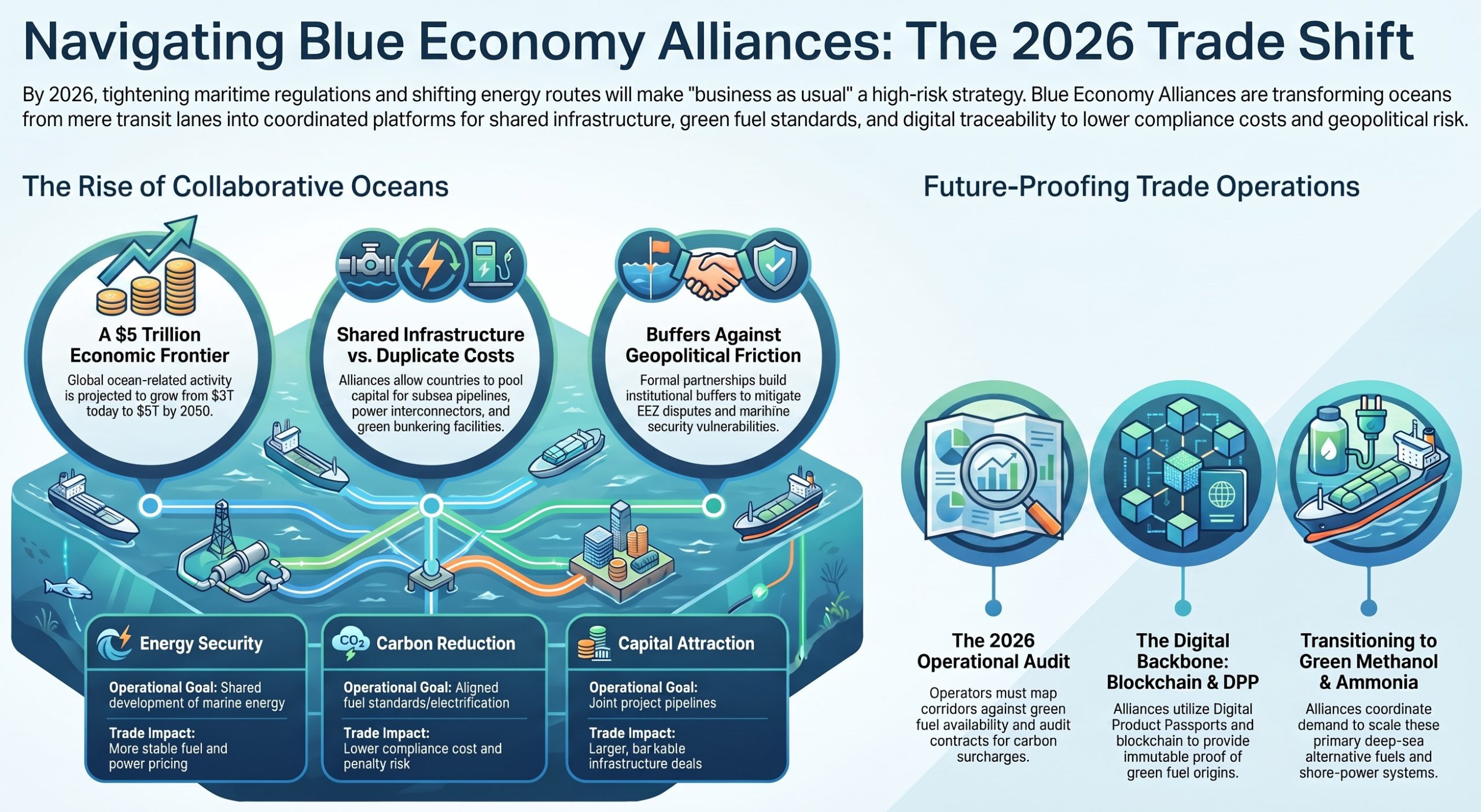
Global ocean-related economic activity already exceeds $3 trillion annually and is projected to reach roughly $5 trillion by 2050 under accelerated low-carbon pathways. Shipping alone moves more than 90 percent of world trade volume. When alliances coordinate fuel standards, bunkering availability, and clearance procedures across multiple jurisdictions, the cost of compliance and the risk of delay fall for every participant in the chain.
Why Regional Alliances Form: The Eastern Mediterranean Case
Shared geography creates shared constraints. No single coastal state can finance, build, and operate the full set of pipelines, liquefaction plants, power interconnectors, and green bunkering facilities required by modern energy and trade flows. Alliances solve the coordination problem.
Navigating Blue Economy Trade Shift
In the Eastern Mediterranean, discoveries of substantial natural gas reserves have driven practical cooperation between Greece, Egypt, and Cyprus. Gas from Cypriot fields is planned to move via subsea pipelines to Egypt’s existing liquefaction terminals for export, primarily toward European markets. This arrangement uses installed capacity rather than requiring each country to construct duplicate infrastructure. Parallel discussions continue around electricity interconnections that would allow renewable power generated in one jurisdiction to serve demand in another.
The logic is operational, not ceremonial. Egypt’s position astride the Suez Canal already makes it a logistics node between Asia, Africa, and Europe. Greece and Cyprus provide European market access and additional maritime gateways. Joint protocols reduce the commercial and political risk of developing large offshore fields and the associated midstream assets. For a freight forwarder or commodity trader, the practical outcome is more predictable energy pricing along the corridor and clearer pathways for vessels calling at ports that participate in the same regulatory and fuel ecosystem.
Similar patterns appear elsewhere. Pacific island nations have formed the Pacific Blue Shipping Partnership to modernize domestic fleets with lower-carbon vessels and shared maintenance capacity. Red Sea and Gulf of Aden countries launched a multi-year initiative backed by the Global Environment Facility to improve coastal management and generate sustainable economic activity across shared marine ecosystems. African states continue to advance continental blue-economy strategies that emphasize regional trade pathways and capital mobilization. In each case the alliance structure addresses problems too large or too interconnected for unilateral action.
Real-Time Free Forex Technical Analysis Tool
Navigating Geopolitical Friction, EEZ Disputes, and Operational Realities
While the economic logic of Blue Economy Alliances is compelling, execution rarely unfolds in a geopolitical vacuum. In high-stakes maritime corridors—such as the Eastern Mediterranean, the Red Sea, and strategic choke points across the MENA region—ambitious regional partnerships frequently collide with complex sovereign interests, contested maritime boundaries, and security vulnerabilities.
1. Exclusive Economic Zone (EEZ) Overlaps & Transit Delays
Unresolved maritime boundaries create severe legal friction for infrastructure deployment. Subsea power interconnectors, optical cables, and offshore pipeline routes often cross contested waters, leading to delayed permitting, diplomatic standoffs, and costly rerouting requirements that can stall multi-billion-dollar energy projects for years.
2. Physical & Cyber Security of Undersea Infrastructure
Subsea pipelines and data cables represent highly concentrated capital assets vulnerable to regional conflict, sabotage, and gray-zone threats. As alliances centralize energy and data transit through critical corridors, the cost of maritime security, continuous monitoring, and asset insurance premiums escalates significantly, impacting project IRRs.
3. Regulatory Asymmetry Across Non-Member States
An alliance is only as effective as its geographic continuity. When neighboring littoral states decline to join regional environmental or fuel standards, trade routes experience fragmented compliance regimes. Vessels transitioning between alliance-compliant ports and non-member jurisdictions face administrative friction, varying port dues, and inconsistent green fuel availability.
4. Capital Hesitation & Political Risk Premiums
International financiers and private infrastructure funds require stable long-term regulatory frameworks. Shifts in national political leadership or sudden diplomatic realignments among partner states can alter project priorities, forcing private operators to demand higher risk premiums or delay final investment decisions (FIDs).
Strategic Takeaway for Logistics & Trade Operators: Successful Blue Economy Alliances do not eradicate geopolitical risk—they build legal, operational, and institutional buffers against it. Commercial operators should treat alliance agreements as indicators of long-term stability, but remain agile by diversifying transit lanes, maintaining flexible multi-fuel strategies, and utilizing real-time trade monitoring platforms to mitigate sudden geopolitical disruptions.
Two Core Pillars of Modern Blue Economy Alliances
Green Shipping Fuels and Port Electrification
International shipping accounts for a material share of global greenhouse-gas emissions. The International Maritime Organization’s revised strategy sets checkpoints of 20–30 percent reduction by 2030 and 70–80 percent by 2040, with net-zero by 2050. National and regional rules, including FuelEU Maritime and emissions pricing mechanisms, already impose costs on high-carbon fuels.
Alliances respond by coordinating investment in alternative fuels and supporting infrastructure:
- Green methanol and ammonia are the leading candidates for deep-sea vessels. Methanol-capable ships already operate in commercial service; ammonia engines and bunkering systems are advancing through pilots toward wider availability later this decade. Production of both fuels depends on renewable electricity and, for methanol, a sustainable carbon source. Regional cooperation pools demand so that producers can reach scale.
- Cold ironing (shore power) allows vessels to shut down auxiliary engines while at berth, cutting local emissions and noise. Ports that install standardized shore-power systems and align with neighboring ports create continuous low-emission corridors.
- Green shipping corridors link specific port pairs with agreed fuel standards, bunkering capacity, and data-sharing protocols. More than fifty such initiatives exist globally. Participation reduces the risk that a vessel finds compliant fuel unavailable at the next call.
For B2B operators the operational impact is direct. Contracts increasingly include emissions clauses. Vessels that can demonstrate compliance avoid penalties and, in some routes, gain preferential berthing or lower port dues. Alliances that standardize fuel specifications and reporting across multiple ports lower the administrative burden of multi-leg voyages.
Digital Passports, Carbon Verification, and Blockchain in Maritime Trade
Modern Blue Economy Alliances rely on more than concrete piers and subsea cables—they depend on seamless, tamper-proof digital infrastructure. As regulatory frameworks like FuelEU Maritime and emissions trading systems enforce strict carbon accounting, physical trade corridors are rapidly pairing with transparent data-exchange protocols.
1. Immutable Carbon Tracking & Blockchain Ledgering
Verifying green fuel origins—such as green methanol or ammonia—requires immutable proof from production to bunkering. Distributed ledger technology (blockchain) enables alliance member ports to issue verifiable, audit-ready certificates for low-emission calls, preventing double-counting and streamlining regulatory compliance across jurisdictions.
2. Digital Product Passports (DPP) & Cargo Visibility
International supply chains are transitioning toward mandatory Digital Product Passports (DPPs) that track a commodity’s environmental footprint across its lifecycle. Coordinated ports leverage shared data standards to validate DPP compliance at berth, drastically reducing customs dwell times for sustainable cargo.
Operational Alignment: How Tendify Bridges the Digital Gap
Navigating fragmented regional standards and evolving digital compliance mandates requires integrated visibility. The tools available at Platform.Tendify.Net allow traders, carriers, and freight forwarders to unify documentation, estimate compliance costs, and track regulatory shifts across key maritime corridors in real time.
Seabed Resources and Undersea Infrastructure
The seabed hosts three categories of strategic assets:
- Hydrocarbon and gas reserves already under development in several basins.
- Submarine power cables and fiber-optic systems that carry electricity and data between continents and islands. Cross-border electricity interconnectors enable renewable generation in one country to serve demand in another, stabilizing grids and supporting industrial loads at ports and free zones.
- Potential mineral deposits—polymetallic nodules, seafloor massive sulfides—containing metals required for batteries and advanced manufacturing. Commercial extraction remains at early stages and faces strict environmental scrutiny, yet alliances are beginning to shape the regulatory and research frameworks that will govern any future activity.
Coordinated permitting, environmental monitoring, and infrastructure planning reduce the risk of conflicting claims or duplicated environmental studies. Traders and project developers gain clearer timelines for when new capacity—whether gas, power, or data—will come online.
Practical Objectives Alliances Pursue
| Focus Area | Operational Goal | Trade Impact |
|---|---|---|
| Energy security | Shared development and transmission of marine energy | More stable fuel and power pricing along corridors |
| Carbon reduction | Aligned fuel standards and port electrification | Lower compliance cost and penalty risk |
| Capital attraction | Joint project pipelines and risk-sharing structures | Larger, bankable infrastructure deals |
| Ecosystem protection | Coordinated monitoring and spatial planning | Reduced disruption from environmental incidents |
These objectives are not abstract. They translate into measurable differences in demurrage exposure, fuel surcharges, and the reliability of just-in-time supply chains.
Implications for GCC and Wider MENA Logistics
Gulf ports already handle substantial re-export volumes and are investing heavily in capacity and digital systems. Blue Economy thinking is visible in several parallel tracks:
- Ports exploring methanol and ammonia bunkering capability.
- Investments in all-electric or hybrid terminal equipment and shore-power readiness.
- National strategies that link fisheries, desalination, coastal tourism, and maritime transport under a single sustainability frame.
- Cross-border logistics corridors that reduce dependence on single chokepoints.
Operators moving cargo through the region can treat alliance participation as a signal of future regulatory alignment and infrastructure availability. When neighboring ports adopt compatible cold-ironing standards or share data on vessel emissions, multi-port itineraries become simpler to plan and cost.
For deeper operational guidance on related cost drivers, see the analysis of demurrage and detention charges in GCC ports and the practical steps for streamlining cross-border logistics in the Gulf region.
How Businesses Can Position Themselves
- Map exposure to alliance corridors. Identify which of your regular routes or potential new lanes fall inside active or emerging Blue Economy partnerships. Prioritize vessels and contracts that can meet the evolving fuel and reporting standards of those corridors.
- Build fuel and compliance flexibility. Dual-fuel or multi-fuel capability, or access to compliant bunkering, reduces the risk of stranded assets or last-minute surcharges. Track green-corridor developments that match your trade lanes.
- Engage early on infrastructure timelines. Subsea cables, power interconnectors, and new bunkering facilities change the relative attractiveness of ports. Operators who understand planned capacity can lock in preferential terms before the facilities open.
- Treat documentation and data as competitive tools. Alliances increasingly rely on shared digital platforms for emissions reporting, vessel tracking, and clearance. Systems that already generate clean, standardized data integrate faster.
- Evaluate counterparties through an alliance lens. Freight forwarders, terminal operators, and energy suppliers that participate in regional blue-economy working groups often gain earlier visibility into rule changes and capacity additions.
Platforms that aggregate trade tools, compliance checks, and market intelligence can shorten the time required to act on these signals. One such resource is available at Platform.Tendify.Net for operators seeking integrated visibility across duty, documentation, and logistics variables.
What This Means for Small and Mid-Sized Enterprises (SMBs)
While Blue Economy Alliances are driven by governments and ocean carriers, small-to-mid-sized importers and exporters are not insulated from these shifts. The immediate impacts for SMBs will appear in two key operational areas:
- Trickle-Down Compliance Costs: Major carriers investing heavily in green methanol, ammonia, and cold-ironing technology are passing capital expenditures down through green fuel surcharges and adjusted freight rates. SMBs must account for a 5–15% long-term drift in baseline shipping costs.
- Scope 3 Carbon Reporting Requirements: Large enterprise buyers and international distributors are increasingly auditing their mid-tier suppliers. Small vendors that cannot provide transparent carbon-footprint data or utilize compliant trade corridors risk losing preferred supplier status in international markets.
Blue Economy Readiness Checklist (2026)
5-Step operational audit for logistics directors, trade operators, and supply chain managers.
| وضعیت | Action Domain | Operational Requirement | Target Output |
|---|---|---|---|
| 1. Corridor Mapping | Audit primary shipping lanes against active Blue Economy corridors (e.g., East Med, GCC, Red Sea) to identify ports offering green fuel bunkering and shore-power discounts. | Optimized Route Matrix | |
| 2. Contract & Surcharge Audit | Review ocean carrier contracts for FuelEU Maritime and carbon emissions surcharge clauses. Ensure dual-fuel or compliant vessel options are prioritized. | Cost Exposure Cap | |
| 3. Digital Data Integration | Implement standardized digital documentation and carbon-tracking systems to meet emerging Digital Product Passport (DPP) requirements at alliance-aligned ports. | Fast-Track Customs | |
| 4. Contingency Planning | Establish secondary routing protocols for contested maritime zones (EEZ disputes/chokepoint disruptions) to mitigate sudden demurrage and insurance spikes. | Geopolitical Buffer | |
| 5. Partner Evaluation | Screen freight forwarders and terminal operators based on their participation in regional sustainability working groups and real-time compliance readiness. | Vetted Partner Network |
Looking Ahead: From Competition to Coordinated Capacity
Blue Economy Alliances do not eliminate commercial competition. They reframe it. Instead of racing to claim exclusive control over a shared resource, participants compete on the efficiency and reliability of the services they build on top of joint infrastructure. The winners are the ports, carriers, and traders who can deliver compliant, low-friction, and predictable performance across multiple jurisdictions.
The underlying economics remain straightforward. Oceans already carry the bulk of global merchandise trade and an increasing share of energy and data flows. The regulatory and physical systems that govern those flows are becoming more interconnected. Alliances that reduce fragmentation in fuels, standards, and infrastructure lower the cost of using the ocean as a productive asset rather than merely a transit medium.
Operators who treat these partnerships as background noise will face rising compliance friction and missed capacity windows. Those who map the alliances against their own routes, fuel strategies, and documentation processes will find lower risk and clearer growth paths in the maritime corridors that matter most.
For teams ready to align their cross-border processes with the emerging requirements of sustainable maritime trade, registration at https://tendify.net/my-account/ provides access to the operational tools and market visibility needed to move faster and with greater certainty.

