


وبلاگ
Strait of Hormuz: Why Global Logistics Cannot Bypass It
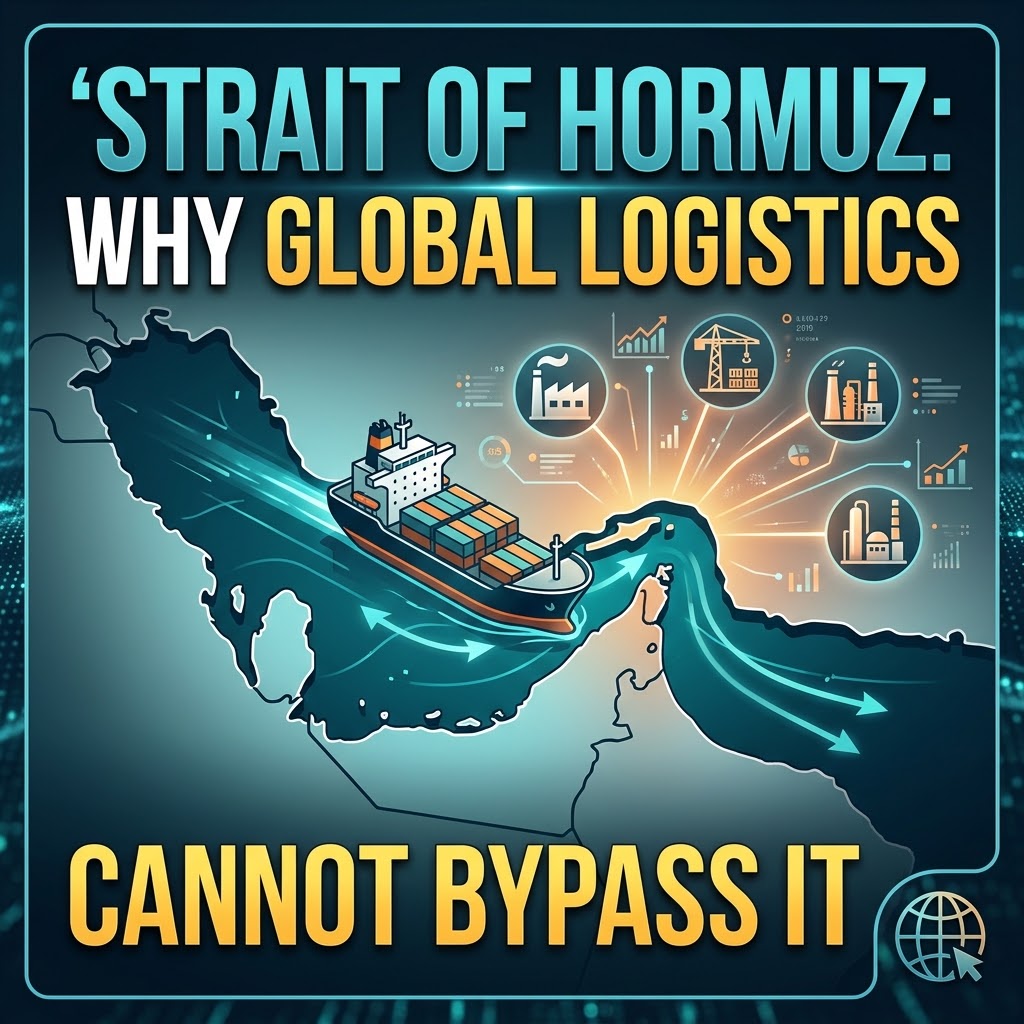
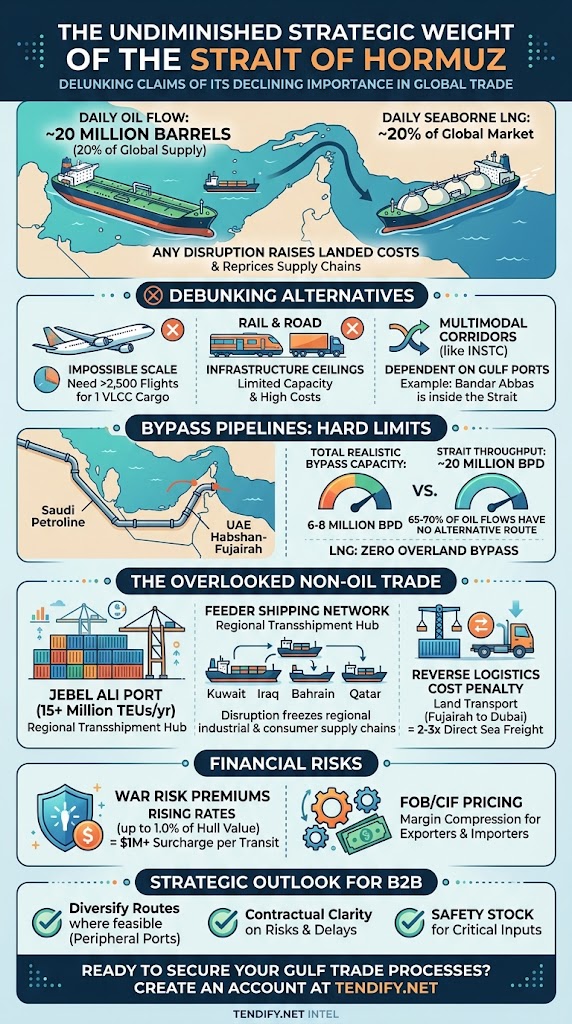
A single narrow waterway continues to dictate the economics of energy and industrial trade across the Gulf. Roughly 20 million barrels of crude oil and petroleum products move through the Strait of Hormuz every day under normal conditions—about one-fifth of global petroleum consumption. Nearly the same share of the world’s seaborne LNG also transits this corridor, the overwhelming majority bound for Asian markets. Add the steady flow of containerized industrial goods, construction materials, chemicals, and consumer products through the region’s major ports, and the commercial stakes become clear: any sustained disruption immediately raises landed costs, stretches lead times, and forces B2B buyers and sellers to reprice entire supply chains.
Claims that land, rail, or air alternatives have diminished the strait’s strategic weight do not survive operational scrutiny. The physical and economic realities of bulk energy and high-volume container trade leave maritime transit through the Gulf as the only scalable option for the majority of volume. This article examines those realities from a logistics and commercial perspective—capacity limits of existing bypass infrastructure, the hidden costs of non-oil trade disruption, and the practical steps exporters and importers can take to manage residual risk.
Why Air, Rail, and Road Cannot Replace Maritime Volume
Bulk liquid energy and heavy industrial cargoes operate at scales that other modes simply cannot match.
A single Very Large Crude Carrier (VLCC) routinely carries around 2 million barrels—approximately 300,000 metric tons. The largest commercial freighter aircraft move roughly 120 tons. Moving the contents of one VLCC by air would require more than 2,500 flights. Fuel burn, slot availability, and airport handling capacity make the idea operationally impossible at any meaningful scale. Freight rates would also be orders of magnitude higher than tanker economics.
Bypass Strait of Hormuz
Rail faces similar physical constraints. A long heavy-haul freight train might move 8,000–10,000 tons under ideal conditions. Relocating 20 million barrels of oil daily would demand thousands of train movements every 24 hours across networks that were never designed for that intensity. Gulf rail corridors, while expanding under regional connectivity programs, still lack the continuous high-capacity alignment, loading terminals, and rolling stock needed for energy-scale volumes. Road transport multiplies the same problems: multiple handling stages, higher loss risk, severe congestion on cross-border highways, and unit costs far above seaborne rates.
Maritime transport remains the only mode that combines massive capacity, low per-unit cost, and direct access to destination markets without repeated transloading. Experiences across Gulf supply chains confirm that attempts to shift even modest shares of energy or bulk industrial cargo to land modes quickly collide with infrastructure ceilings and cost barriers.
Bypass Pipelines: Real Capacity, Hard Limits
The only practical land-based alternatives currently in operation are crude oil pipelines that terminate outside the strait. Two systems carry the bulk of available bypass volume.
Saudi Arabia’s East-West Pipeline (Petroline) runs from the eastern processing centers to Yanbu on the Red Sea. Nameplate capacity has been expanded toward 7 million barrels per day in recent years, though sustainable export throughput at the Yanbu terminals is often constrained closer to 5 million barrels per day once refining offtake and operational flexibility are taken into account. The line provides a genuine alternative for a substantial portion of Saudi crude, yet it cannot absorb the full regional flow.
The UAE’s Habshan–Fujairah pipeline (ADCOP) moves onshore crude to the Fujairah terminal on the Gulf of Oman, completely outside the strait. Current capacity sits in the 1.5–1.8 million barrels per day range, with expansion projects under way that could eventually approach 3 million barrels per day. Even after those upgrades, the system covers only a fraction of UAE export potential and none of the broader regional volume.
Regional Bypass Infrastructure
Iran’s Goreh-Jask Pipeline: Strategic Intent vs. Current Operational Scale
In addition to Saudi and UAE infrastructure, Iran developed the 1,000-kilometer Goreh-Jask crude oil pipeline, designed to transport heavy crude from Bushehr province to the Jask terminal on the Gulf of Oman—bypassing the Strait of Hormuz entirely.
Combined realistic bypass capacity across these and related systems typically falls in the 6–8 million barrels per day range under sustained high utilization. Against a normal Hormuz throughput of approximately 20 million barrels per day, that leaves 60–70 percent of oil flows without an alternative route. The gap is structural: pipeline diameter, pump stations, and terminal loading capacity set hard physical limits that cannot be overcome by policy statements or temporary surge operations.
For LNG the picture is starker. Qatar and the UAE together account for a large share of global LNG exports. Virtually all of that volume moves by specialized tanker through the strait. No operational overland pipeline currently exists that can substitute for those maritime cargoes at commercial scale.
| متریک | Maritime via Strait of Hormuz | Existing Bypass Pipelines |
|---|---|---|
| Typical daily oil capacity | ~20 million barrels | 6–8 million barrels (realistic) |
| Cost per barrel | Lowest available | Higher (construction + pumping + terminal) |
| Destination flexibility | Direct to Asia, Europe, Americas | Fixed terminal endpoints |
| LNG coverage | Near 100% of regional exports | هیچکدام |
| Scalability under stress | Immediate (existing fleet) | Limited by pumps and terminal berths |
The table underscores a simple commercial truth: pipelines reduce exposure for specific producers but cannot replace the strait for the regional system as a whole.
Energy Security Vulnerability
Liquefied Natural Gas (LNG): The Zero-Bypass Imperative
While crude oil can theoretically be diverted via cross-border overland pipelines, Liquefied Natural Gas (LNG) possesses absolute zero overland bypass capability. Qatar—which supplies over 20% of global LNG demand alongside exports from the UAE—remains 100% reliant on maritime transit through the Strait of Hormuz.
- The Cryogenic Barrier: LNG requires a continuous cryogenic temperature of -162°C (-260°F) under atmospheric pressure to maintain its liquid state. Overland pipeline technology for long-distance cryogenic LNG transport does not exist, ruling out any cross-peninsula land route to outer ports.
- Q-Flex & Q-Max Carrier Reliance: Qatar’s massive export fleet—dominated by specialized Q-Flex (210,000 m³) و Q-Max (266,000 m³) mega-tankers—is geographically locked inside the Persian Gulf. Any maritime disruption inside the Strait completely halts berth loading at Ras Laffan Industrial City.
- Global Market Imbalance: Unlike oil markets where strategic petroleum reserves (SPR) offer short-term buffers, gas markets rely heavily on just-in-time delivery. A Strait closure would instantly trigger unprecedented price spikes across Europe and Asian import hubs (Japan, South Korea, China).
Regional Gas Infrastructure
The Dolphin Gas Pipeline: Why It Cannot Bypass Hormuz
The 364-kilometer subsea Dolphin Gas Pipeline transports up to 2 billion cubic feet per day of dry natural gas from Qatar’s Ras Laffan to Abu Dhabi and Oman. However, it offers zero bypass capability for global markets for two critical reasons:
- Intra-Gulf Alignment: The pipeline operates entirely within the Persian Gulf basin, terminating inside the Strait rather than connecting to deepwater berths on the Gulf of Oman.
- Domestic Consumption Only: The throughput satisfies local utility demand in the UAE and Oman; it lacks cryogenic liquefaction infrastructure to convert piped gas into seaborne LNG exports for Asian or European buyers.
The Overlooked Dimension: Non-Oil Container and Industrial Trade
Public discussion often focuses exclusively on oil. For B2B traders the container and break-bulk flows matter equally. Gulf ports collectively handle tens of millions of TEUs annually. Jebel Ali alone processes more than 15 million TEUs in a typical year and functions as a major transshipment hub for cargoes moving into the wider GCC, East Africa, and South Asia. Substantial volumes of petrochemicals, construction materials, machinery, food ingredients, and finished goods also move through Dammam, Shuwaikh, Hamad, and other regional gateways.
Regional Logistics Hub
Jebel Ali & The Fragility of Intra-Gulf Feeder Networks
While often discussed in isolation, Jebel Ali Port functions as the operational heart of the non-oil economy across the Middle East. Handling over 15 million TEUs annually, it serves as the master transshipment hub where deep-sea ocean liners from Asia and Europe discharge containerized cargo before redistribution.
Mainline ultra-large container vessels (ULCVs) rarely berth at smaller upper-Gulf ports. Instead, cargo destined for Iraq (Umm Qasr), Kuwait (Shuwaikh), Bahrain (Khalifa Bin Salman), and Qatar (Hamad Port) relies almost entirely on regional feeder shipping originating from Jebel Ali.
If access through the Strait of Hormuz is constrained, Jebel Ali is effectively isolated from global ocean routes. Consequently, the secondary feeder network breaks down immediately, freezing last-mile industrial imports and consumer supply chains for multiple sovereign markets simultaneously.
Commercial Risk Factor for B2B Importers: Alternative discharge ports outside the strait (e.g., Sohar, Salalah, or Fujairah) currently lack the transshipment feeder connections and berth capacity needed to absorb Jebel Ali’s massive intra-regional container volumes without severe, multi-week delays.
These cargoes cannot be redirected to external ports without creating reverse logistics costs. Inland haulage from an alternative discharge port back into the Gulf market frequently exceeds the original ocean freight differential. Storage congestion, last-mile trucking shortages, and demurrage exposure compound the problem. Operational data from recent periods of elevated risk show that container transit times and total landed costs rise sharply even when some energy volumes are successfully diverted through pipelines.
Traders who treat the strait solely as an energy chokepoint underestimate the exposure embedded in everyday industrial supply chains. A delayed container of intermediate chemicals or construction components can idle manufacturing lines or construction schedules across multiple countries. The cost appears not only in higher freight but in working-capital lockup and contractual penalties.
Quantifying the Bypass Penalty: Ocean Freight vs. Inland Haulage
Cost Breakdown
Discharging containerized cargo at peripheral gateways outside the Strait of Hormuz—such as Fujairah (UAE) or Sohar (Oman)—and trucking it back into core Persian Gulf markets introduces a severe economic penalty. Ocean freight gains efficiency from massive scale; overland trucking scales linearly per unit.
| بخش مسیر | نحوه حمل و نقل | Est. Cost per 40ft Container | Multiplier vs. Baseline |
|---|---|---|---|
| Shanghai to Jebel Ali (Baseline) | Direct Ocean Liner | $1,200 – $1,800 | 1.0x (Baseline) |
| Fujairah to Dubai / Jebel Ali (~120 km) | Inland Trucking | $1,800 – $2,500 | 1.3x – 1.5x Ocean Cost |
| Fujairah to Riyadh, KSA (~950 km) | Cross-Border Trucking | $3,500 – $5,200 | 2.5x – 3.0x Ocean Cost |
- Cross-Border Clearance & Border Congestion: Custom clearance delays at Ghuwaifat / Batha borders add $150–$300 per day in driver detention charges.
- Equipment Imbalance (Empty Returns): Trucking companies factor in return legs without cargo, effectively doubling the per-kilometer haulage rate.
- Port Handling & Transshipment Surcharges: Unloading at Fujairah plus reloading onto flatbed trailers adds $250–$400 in gate and terminal handling fees (THC).
Commercial Impact of Elevated Risk: Freight, Insurance, and Lead Times
When navigational risk rises, two cost lines move first: ocean freight rates and war-risk insurance premiums. Historical spikes have seen war-risk premiums move from fractions of a percent of hull value to several percentage points for exposed voyages. On a large tanker or container vessel those premiums translate into millions of dollars per transit. Charter rates for the same vessels also firm as owners demand compensation for elevated risk and potential delays.
The Economics of War-Risk Premiums: Quantifying the JWC Impact
Insurance Mechanics
When maritime security escalates in the Gulf, the Joint War Committee (JWC)—comprising Lloyd’s market and London company underwriters—designates the Strait of Hormuz and Persian Gulf as a High Risk Area (HRA). This designation instantly triggers additional war risk premiums (AWRP) that fundamentally alter voyage economics.
Real-World Scenario: Under baseline conditions, war risk is nominal (around 0.02% to 0.05%). During crisis spikes, JWC underwriters adjust rates upward to 0.5% – 1.0% of the vessel’s insured hull value for a standard 7-day transit window.
A 1% premium surge equals an immediate $1,000,000 surcharge per single transit—adding roughly $0.50 to $0.60 directly to the per-barrel freight cost.
A 0.75% rate adds $1,125,000 per voyage, which carriers pass directly to B2B cargo owners as a War Risk Surcharge (WRS) of $100–$250 per TEU.
For B2B contracts priced on CIF or similar terms, the increase flows directly into the buyer’s landed cost. Exporters working on FOB terms face the opposite pressure: buyers demand discounts or switch to alternative origins. Either way, margin compression appears quickly. Lead times lengthen as vessels slow, wait for convoy arrangements, or divert. Inventory buffers that once covered two weeks of demand suddenly prove inadequate, forcing emergency air freight or production slowdowns.
These effects are measurable. In periods of heightened tension, freight components have accounted for 10–25 percent of the delivered price of certain crude grades, compared with single-digit percentages under normal conditions. Similar percentage increases appear in container rates on Gulf–Asia and Gulf–Europe lanes. The commercial response is predictable: buyers lengthen order cycles, dual-source critical materials, and rewrite force-majeure clauses.
Complementary Corridors and Peripheral Ports: Useful, Not Substitutes
Regional connectivity projects and ports located outside the strait offer valuable diversification, not replacement capacity.
Ports on the Gulf of Oman and Arabian Sea—Fujairah, Sohar, Duqm, and Salalah—already handle growing volumes of energy and container traffic that never enter the strait. Continued investment in these gateways reduces internal transshipment pressure and shortens some inland legs. Rail and road links connecting these ports to major consumption centers further improve resilience.
Broader multimodal corridors that link the Gulf to northern markets and the Indian Ocean can absorb incremental non-oil volumes and provide alternative routing options during localized disruptions. Their projected annual capacities, however, remain measured in tens of millions of tons—orders of magnitude below the daily energy throughput of the strait. They function best as complementary arteries that improve overall network flexibility rather than as full substitutes.
For practical planning, traders should map which of their product categories can realistically use these peripheral routes and which remain locked to traditional Gulf ports. The former gain a genuine risk-reduction lever; the latter require contractual and inventory buffers instead.
Multimodal Transit Analysis
The INSTC Paradox: Why the North-South Corridor Remains Bound to Hormuz
The International North-South Transport Corridor (INSTC)—connecting India and the Gulf to Russia and Europe via Iran—is frequently cited by traders as a strategic overland workaround for regional chokepoints. However, commercial logistics data exposes a critical dependency: the INSTC is not immune to a Strait of Hormuz disruption.
The primary southern gateway for the INSTC is Bandar Abbas (Shahid Rajaee Port), located directly inside the Strait of Hormuz. Any maritime blockage or elevated war-risk premium at the strait immediately halts container feed from Mumbai or Jebel Ali to the railhead.
While Iran’s Chabahar Port on the Gulf of Oman bypasses the strait, its current rail-connection capacity and container-handling throughput represent less than 15% of Bandar Abbas’s volume, making it a bottleneck during a sudden shift.
Commercial Implication for Tendify Users: B2B operators utilizing INSTC for Eurasian trade cannot treat it as an isolated overland route. Supply chain contingency plans must factor in Gulf ocean-freight surcharges and transit delays at the primary port entry points before cargo ever touches the Caspian rail network.
Practical Steps for B2B Exporters and Importers
Operational experience across Gulf supply chains points to a consistent set of actions that reduce exposure without requiring perfect foresight:
- Segment cargo by chokepoint sensitivity. Energy and high-volume bulk remain highly exposed; certain containerized industrial goods can shift to peripheral ports or multimodal corridors with acceptable cost trade-offs.
- Embed explicit war-risk and delay clauses in contracts, with clear cost-allocation mechanisms. Ambiguity here is expensive.
- Maintain dual-sourcing options for critical inputs and pre-qualify alternative logistics providers who already operate through Fujairah, Sohar, or Red Sea gateways.
- Model total landed cost under elevated freight and insurance scenarios rather than relying on baseline rates. Tools that calculate end-to-end trade costs, including duties and inland haulage, make these comparisons concrete.
- Monitor demurrage and detention exposure at Gulf terminals. Congestion during risk spikes turns free time into a major cost center; proactive container optimization and documentation accuracy limit the damage.
- Build modest safety stock for items with long lead times or single-source origins. The carrying cost is usually lower than the disruption cost of a multi-week delay.
Platforms that aggregate real-time logistics intelligence, HS-code classification, and cost calculators can compress the time required to run these scenarios. For teams already managing multi-origin supply chains, a structured view of alternative routings and cost drivers often surfaces the highest-leverage adjustments first.
Strategic Outlook for Cross-Border Trade
The physical constraints that make the Strait of Hormuz dominant are not temporary. Pipeline expansions will continue, peripheral ports will grow, and multimodal corridors will mature. Each of these developments improves system resilience. None of them alters the fundamental arithmetic: the majority of regional energy and a large share of industrial trade still require the maritime corridor through the Gulf.
For B2B operators the implication is straightforward. Risk management centers on diversification of routes where feasible, contractual clarity where it is not, and continuous measurement of landed-cost sensitivity to freight and insurance spikes. Companies that treat the strait as a permanent structural feature of Gulf logistics—rather than a problem waiting for a complete technological substitute—consistently outperform those that wait for perfect alternatives.
Accurate, up-to-date cost modeling and documentation discipline remain the most reliable defenses. Teams that can quantify the impact of a 20–30 percent freight increase or a multi-week delay on their specific product mix make better commercial decisions under pressure.
Cross-border trade through the Gulf will continue to reward operators who combine realistic assessment of chokepoint exposure with disciplined execution on contracts, inventory, and logistics partners. The strait’s role is not diminishing; the quality of preparation around it is what separates resilient supply chains from vulnerable ones.
Ready to Tighten Your Trade Processes Against Chokepoint Risk?
Equip your supply chain with real-time operational tools, route feasibility frameworks, and specialized compliance intelligence designed for Gulf and cross-border trade operators.

