


وبلاگ
Ethiopia Trade Finance: Navigating Forex Reforms and Supply Chain Shifts

Ethiopia’s recent decision to open its banking sector to foreign participation after nearly 50 years of restrictions marks one of the most significant shifts in East African finance. For B2B traders navigating GCC-MENA supply chains and global commodity flows, this change is more than regulatory news—it’s a practical gateway to better capital access, smoother forex transactions, and new partnership models in a high-growth market of over 120 million people.

Ethiopia Trade Finance
Operational assessments in frontier markets show that such liberalizations often accelerate trade volumes by reducing financing friction and improving currency predictability. In Ethiopia’s case, the reforms under Banking Business Proclamation No. 1360/2025 and complementary forex directives are already reshaping how exporters, importers, and investors structure deals.
This guide breaks down the mechanics, risks, and actionable strategies for leveraging these changes—whether you’re sourcing coffee, construction materials, or exploring FDI in manufacturing and logistics.
Ethiopia’s Banking Opening: From Closed System to Controlled Liberalization
For decades, Ethiopia maintained one of Africa’s most protected banking sectors. Foreign entities had virtually no direct role. That changed with the 2025 proclamation, which allows reputable international banks to establish subsidiaries, branches, or representative offices and acquire equity in local institutions.

Ethiopia’s Banking Opening
Key Structural Limits
- Foreign ownership cap: Aggregate foreign stake in any domestic bank is limited to 49%. This includes breakdowns such as strategic investors (up to ~40%), foreign-owned Ethiopian entities (up to 10%), and individuals (up to 7%). Control remains with local partners.
- Entry modes: Full subsidiaries for major players or minority stakes for targeted collaboration. Minimum capital requirements for foreign banks are substantial (around $40 million in some cases), signaling a focus on serious, well-capitalized institutions.
These rules balance capital infusion with protection of the domestic sector. In practice, they encourage joint ventures where foreign expertise in risk management, digital banking, and trade finance complements local networks.
Why This Matters for B2B Trade
Traders moving goods between GCC ports and Ethiopian markets previously faced long waits for letters of credit (LCs) and fragmented forex access. Delegating LC and CAD approvals to commercial banks has already cut bureaucracy. Foreign bank participation is expected to bring standardized trade finance products, faster correspondent banking relationships, and better hedging tools—critical for volatile commodities like coffee, sesame, or construction inputs.
Forex Reforms: Moving Toward Market-Driven Liquidity
Parallel to banking liberalization, Ethiopia overhauled its foreign exchange regime starting in 2024, with further refinements into 2026. The shift from rigid controls to a more market-based system addresses chronic shortages that once forced traders into inefficient workarounds.
Free Ultimate Forex Technical Analysis Tool
Auction System and Liquidity Management
The National Bank of Ethiopia (NBE) continues periodic forex auctions—often $100 million or larger—to stabilize the Birr while commercial banks build capacity. Demand frequently exceeds supply (e.g., $160–236 million bids on $100 million offers), but larger injections and interbank trading are gradually improving depth.
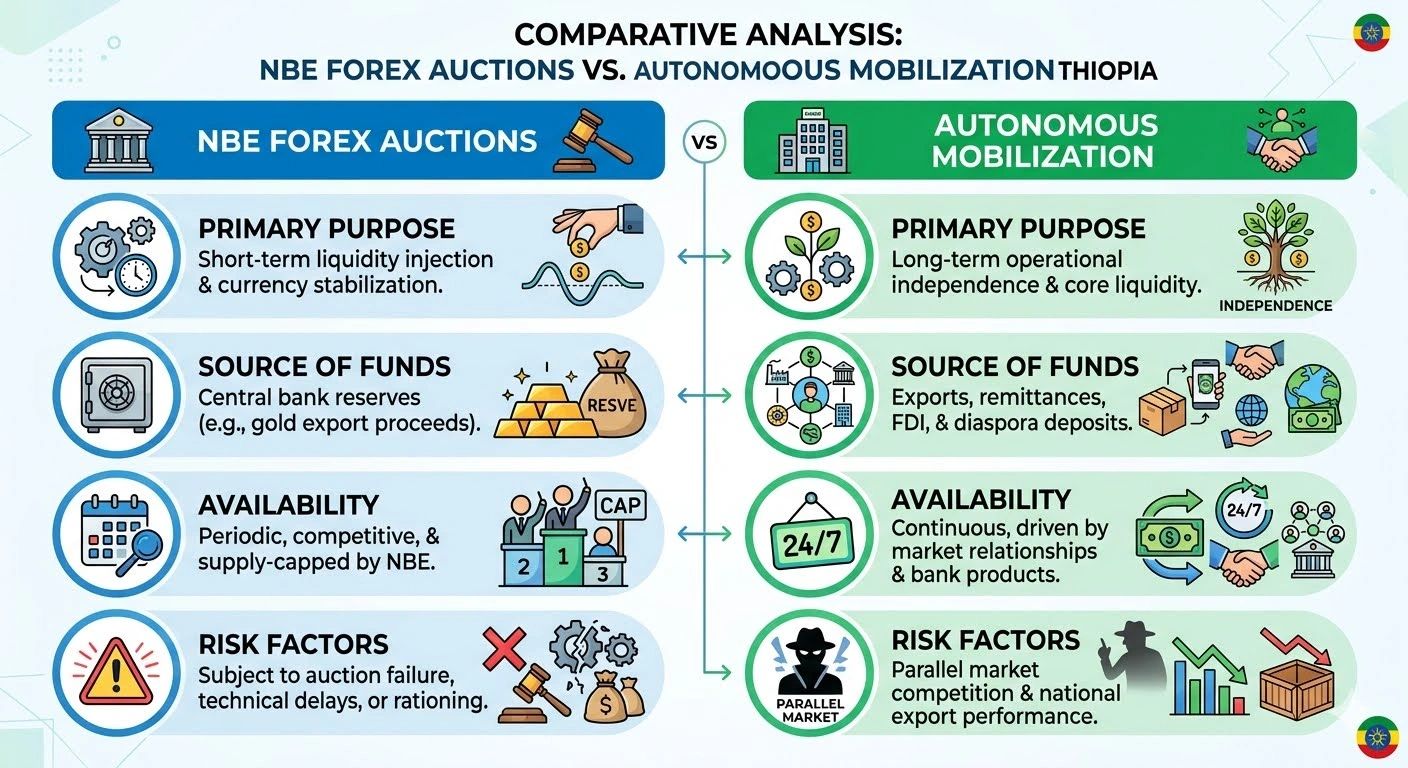
Ethiopia overhauled its foreign exchange regime
Retention and Retention Flexibility
- Exporters of goods typically retain 50% of proceeds in foreign currency accounts.
- Service exporters (hotels, airlines, consultants) and FDI entities enjoy fuller retention rights.
📢 Strategic Update: Full Operational Autonomy for FDI Repatriation
Under Directive FXD/04/2026, commercial banks have transitioned to full operational autonomy regarding foreign investment. Crucially for international businesses, commercial lenders are now authorized to independently approve and remit net profits, dividends, and manage external loans
without seeking case-by-case central bank (NBE) pre-approval letters.
This eliminates the historical administrative bottlenecks and provides unprecedented predictability for corporate treasury operations.
💡 Diaspora Capital Capture: In a fierce bid to maximize autonomous foreign currency inflows, commercial lenders have completely eliminated
minimum balance requirements for opening foreign currency accounts.
By removing this entry barrier and pairing it with internationally recognized payment cards, banks are directly targeting informal remittance channels to secure long-term liquidity.
These changes reduce the previous “surrender” burden and lower the effective cost of accessing hard currency. For cross-border operators, this translates to faster working capital cycles and less reliance on parallel markets.
Currency Dynamics in 2026
The Birr has seen depreciation as the market adjusts, but officials project greater stability in the 2026/27 fiscal year amid ongoing reforms. Real effective exchange rate competitiveness has improved for exporters, though importers must manage higher costs through better pricing and supply chain efficiency.
The Export Paradox: Why “Loss-Making” Shipments Still Make Sense
One of the most discussed features of Ethiopia’s pre-reform economy is the apparent paradox of exporters accepting losses on commodities like coffee or oilseeds. Operational data from traders reveals this is rarely irrational—it’s a calculated cross-subsidization strategy rooted in forex scarcity.
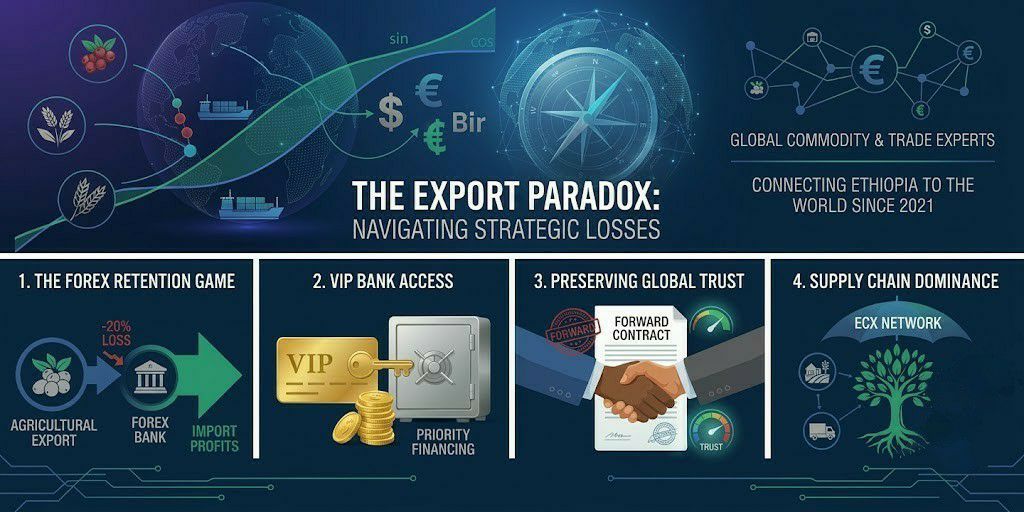
The Export Paradox
Core Mechanics
- Forex as the Real Prize: Exporting generates legitimate access to dollars or euros. A nominal 5–20% loss on coffee exports is offset by 50–100%+ margins on imported high-demand goods (machinery, building materials, pharmaceuticals) sold domestically.
- Banking Relationships: Consistent forex earners receive priority credit lines, LC facilities, and local financing—essential for scaling operations in housing, manufacturing, or agribusiness.
- Supply Chain Continuity: Long-term buyer relationships and farmer networks cannot be paused without permanent loss of market share or sourcing capacity.
- Contractual Discipline: Major international buyers expect reliable supply; breaking contracts damages reputation across seasons.
Reform Impact With improved forex availability and retention rules, this model is evolving. Pure export profitability should rise as the gap between official and parallel rates narrows and banks independently source currency. Forward-thinking traders are already shifting toward value-added processing, direct contracts, and diversified revenue (e.g., combining exports with local distribution or light manufacturing).
⚠️ Critical Shift: The Death of the Cross-Subsidization Model
The “export at a loss to import at a premium” game is rapidly approaching its expiration date. As the NBE’s macroeconomic adjustments continue to converge the official exchange rate with the parallel market, the artificial spread that fueled this cross-subsidization will dissolve.
When the premium disappears, only traders with hyper-efficient supply chains will survive. Survival in Ethiopia’s new economic era will not be determined by forex arbitrage, but by structural cost reduction—optimized multi-modal logistics, digitized documentation, and direct-to-farm supply transparency. This is precisely where deploying data-driven orchestration layers like Tendify.net becomes non-negotiable for regional operators looking to protect their margins.
Practical Strategies for GCC and MENA Traders Entering Ethiopia
“The real play for most diaspora investors and frontier funds isn’t to ‘buy a bank’—it’s identifying which domestic commercial lenders are positioned to secure imminent strategic foreign partnerships, and riding that valuation wave.”
🎯 The Strategic Pivot | Proclamation 1360 Market Intelligence
1. Partner Selection and Joint Ventures
Target local banks likely to attract strategic foreign partners. Equity stakes or service agreements can provide preferential trade finance. Use platforms for initial matchmaking and due diligence on compliance and track records.
2. Forex and Payment Optimization
- Structure deals with clear retention accounts and hedging where available.
- Explore escrow or digital payment solutions for smaller transactions to reduce LC dependency.
- Monitor NBE auctions and interbank rates for timing large imports/exports.
3. Sector Priorities with High Synergy
- Agriculture & Commodities: Coffee, sesame, flowers—leverage improved export incentives.
- Construction & Infrastructure: Steel, cement, machinery—align with Ethiopia’s urbanization and Vision-aligned projects.
- Manufacturing & Logistics: Light industry and warehousing benefit from FDI-friendly policies and port access improvements.
- خدمات: Tourism, consulting, and fintech—fuller forex retention applies.
4. Risk Mitigation
- Currency volatility: Build buffers and use local partners for distribution.
- Regulatory navigation: Engage advisors familiar with NBE directives.
- Geopolitical/operational: Diversify routes (e.g., via Djibouti or emerging corridors).
⚡ Digital Infrastructure: Mitigating Transition Risks via Smart Escrow
Navigating a frontier market in the midst of aggressive macroeconomic transition introduces operational friction—specifically in counterparty trust and multi-currency clearing timelines. For GCC-MENA traders, the traditional reliance on physical Letters of Credit (LCs) is increasingly being augmented by digital trade platforms و decentralized escrow protocols.
By hardcoding NBE retention rules, customs compliance steps, and verified multi-modal shipping milestones into Smart Contracts, B2B platforms provide an immutable layer of security. Funds are held in automated escrow and released programmatically only when verified digital documents (such as electronic Bills of Lading or SGS quality certifications) are matched. This cross-border tech integration bridges the gap between traditional banking speed and the real-time requirements of modern commodity flows.
Comparative Edge vs. Other Markets
Ethiopia offers a young population, competitive labor, and strategic location. Reforms address historical bottlenecks in finance and forex that previously favored more open neighbors. For GCC importers seeking alternatives to traditional sourcing, the combination of policy momentum and market size creates a compelling case.
Operational Playbook: Step-by-Step for New Market Entry
- Market Intelligence: Analyze sector demand via trade data and buyer directories.
- Entity Setup: Register locally or partner; understand minimum investments.
- Banking Relationships: Open accounts with both local and soon-to-be foreign-linked institutions.
- Trade Structuring: Draft contracts with clear Incoterms, payment terms, and forex clauses.
- Compliance & Documentation: Master updated customs, HS codes, and quality standards.
- Scaling: Use data from initial shipments to negotiate better terms and financing.
- نظارت: Track Birr performance, auction results, and policy updates quarterly.
Tools like duty calculators, container optimizers, and contract builders streamline these steps for efficiency.
Future Outlook: Sustained Momentum or Growing Pains?
Ethiopia’s reforms are part of a broader Home-Grown Economic Reform Agenda aiming for private-sector-led growth, FDI attraction, and macroeconomic stability. Success depends on implementation—bank readiness, inflation control, and infrastructure delivery.
Early signals are positive: increased competition should drive innovation in trade finance, digital services, and risk management. For regional traders, this creates opportunities to build resilient supply chains less vulnerable to single-market disruptions.
Challenges remain—high demand for forex, infrastructure gaps, and the need for capacity building. Businesses that engage early with transparent partners and agile operations will capture disproportionate value.
Internal Resources:
- Streamlining Cross-Border Logistics for Efficient B2B Trade in the Gulf Region
- Mastering Digital Networking for B2B Success in Gulf Markets
- The Role of Digital Freight Forwarders in Modern B2B Supply Chains
In volatile global trade, platforms that connect verified buyers, sellers, and service providers across borders reduce friction and accelerate execution. Platform.Tendify.Net serves as one such operational layer for deal structuring and logistics coordination.
The window for strategic positioning in Ethiopia is open. Those who map regulations to real workflows—rather than waiting for perfect conditions—will define the next wave of regional value chains.
Ready to secure your position in these evolving markets? Register at https://tendify.net/my-account/ to access tools, networks, and insights that turn policy shifts into profitable trade flows. Your next high-margin corridor may start with a single compliant transaction in Addis Ababa.

