


وبلاگ
Russia Supply Shortage: B2B Export Guide & Key HS Codes

Warehouse fires, disrupted energy nodes, and damaged storage capacity do not remain local problems for long. When bulk fuel tanks, cold-storage facilities, or regional distribution hubs go offline, the immediate effect is a sudden drop in available inventory. Prices jump. Retailers and industrial buyers start searching for the fastest possible replacement supply. That moment of shortage is precisely when prepared exporters with short lead times and the right product mix can capture durable market share.
Russia Supply Shortage
This analysis examines the commercial consequences of recent infrastructure stress on Russia’s domestic supply chains. It focuses strictly on operational realities: which product categories face the sharpest demand spikes, which HS codes carry the highest practical potential, what certification and logistics constraints still apply, and how traders can structure deals to manage currency, payment, and transit risk. The lens is pure supply-chain crisis management.
Why Inventory Shocks Create Fast-Track Import Windows
When storage and processing capacity is impaired, two things happen almost simultaneously. First, existing stocks are drawn down faster than they can be replenished from domestic production. Second, buyers shift from planned procurement cycles to emergency sourcing. The preference moves toward goods that can move quickly, clear customs without prolonged inspection delays, and require minimal specialized handling once they arrive.
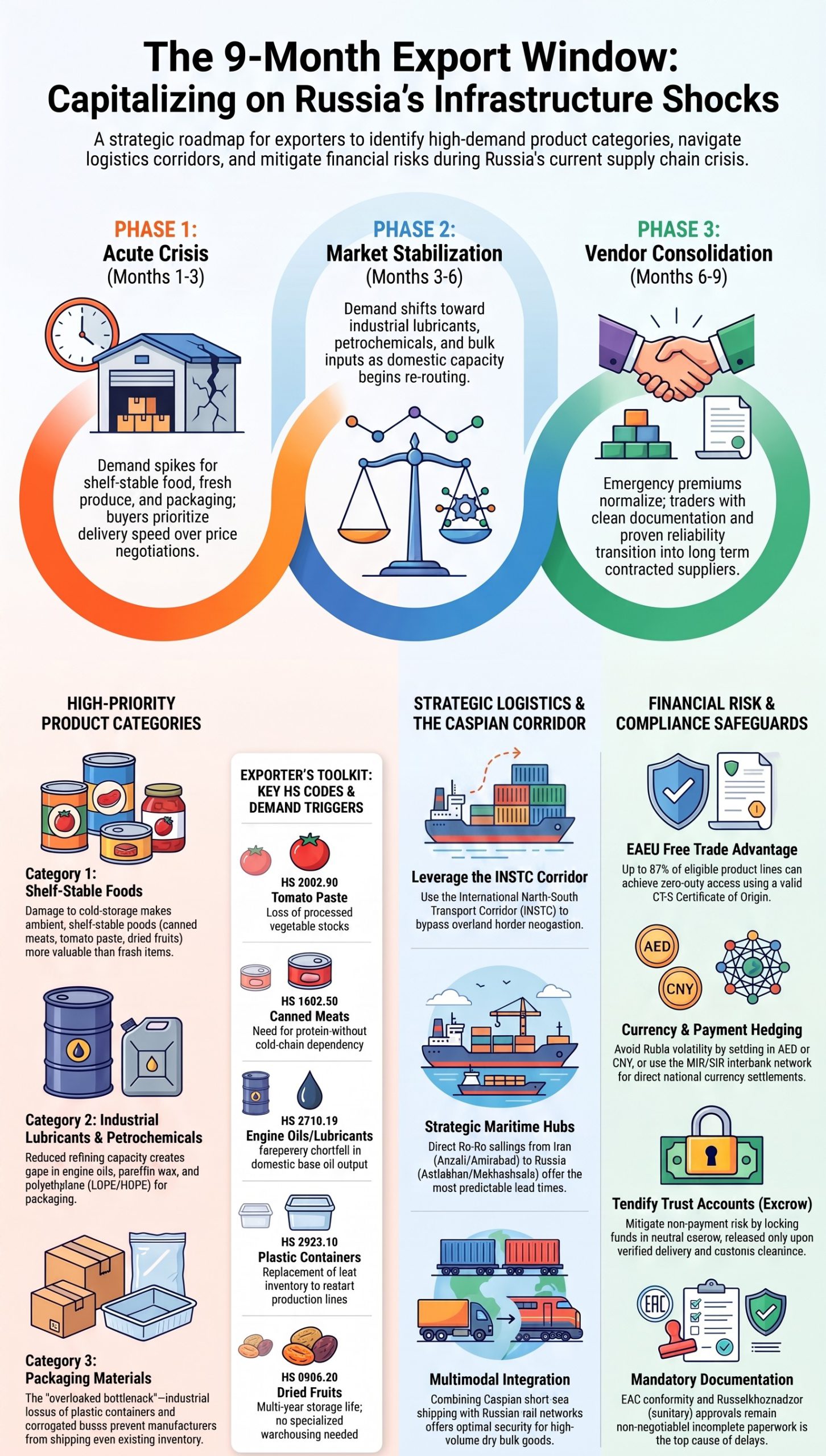
9 Month Russia Export Window
Southern and western regions of the country—those closest to active trade corridors—feel the pressure first. Cities and industrial zones that previously relied on regional warehouses now look outward for rapid replenishment. Traders who can deliver consistent quality, complete documentation, and predictable transit times become preferred partners, often at premiums that would not exist under normal inventory conditions.
The commercial opportunity is real, but it is time-sensitive and operationally demanding. Success depends on matching product selection to the specific nature of the shortage, not on broad assumptions about “the market needs everything.”
The Opportunity Lifecycle: 3-to-9 Month Execution Window
Inventory shocks do not remain open indefinitely. Based on industrial recovery cycles and domestic supply-chain re-routing patterns, exporters should plan around a 3-to-9 month high-demand cycle:
- Phase 1: Months 1 to 3 (Acute Crisis & Emergency Sourcing): Primary demand spikes for shelf-stable food, immediate fresh produce, and stock packaging. Buyers prioritize delivery speed over price negotiations.
- Phase 2: Months 3 to 6 (Market Stabilization & Alternative Supply Lines): Russian domestic industrial capacity begins re-routing raw materials and temporary warehousing. Demand shifts heavily toward industrial lubricants, petrochemicals, and bulk inputs.
- Phase 3: Months 6 to 9 (Long-Term Vendor Consolidation): Emergency pricing premiums normalize. Traders who established clean EAC documentation, reliable logistics performance, and secure payment pathways during Phase 1 transition into long-term contracted suppliers.
Operational Takeaway: Exporters who delay initial compliance and logistics setup beyond the first 60 days risk entering the market just as domestic Russian capacity recovers and margins compress.
Category 1: Long-Shelf-Life Food Products and Prepared Foods
Damage to cold-storage infrastructure immediately raises the value of ambient, shelf-stable goods. Buyers prioritize items that do not depend on unbroken refrigeration chains and that can be distributed through ordinary dry warehouses.
| کد HS | Product Group | Primary Demand Driver | Operational Advantage for Regional Suppliers |
|---|---|---|---|
| 2002.90 | Tomato paste (bulk and aseptic) | Loss of processed vegetable stocks; industrial food manufacturers need stable intermediate inputs | High production capacity in the broader region; aseptic packaging allows ordinary dry-container movement |
| 1602.50 / 1602.32 | Prepared meat and poultry products (canned) | Need for ready protein without cold-chain dependency | Established sanitary protocols recognized by Russian authorities; long shelf life |
| 2005.20 / 2005.40 | Canned vegetables (peas, corn, mixed) | Shortfall in fresh produce distribution to inland centers | Competitive landed cost; moves in standard dry containers |
| 0806.20 / 0806.10 | Dried grapes, pistachios, dates, figs | High nutritional density, multi-year storage life, no specialized warehousing required | Strong existing export infrastructure and quality reputation in these codes |
These categories benefit from two structural factors. First, they reduce the buyer’s exposure to further cold-chain failures. Second, they can be positioned as both retail-ready and industrial inputs, widening the customer base inside Russia.
Practical requirement: phytosanitary certificates and, where applicable, Rosselkhoznadzor approvals remain mandatory. Incomplete documentation is the single most common cause of clearance delays even when the commercial need is urgent.
Category 2: Fresh Produce for Near-Border Replenishment
Regional warehouse losses create acute shortages of fresh items in cities closer to southern borders and Caspian access points. The demand here is for speed more than volume.
| کد HS | محصول | Demand Trigger | Logistics Notes |
|---|---|---|---|
| 0702.00 | Fresh or chilled tomatoes | Local greenhouse and storage disruption | Requires rapid phytosanitary certification and tight temperature control during transit |
| 0707.00 | Fresh cucumbers | Gaps in wholesale distribution hubs | Best moved via faster multimodal options rather than pure long-haul road |
| 0701.90 | Fresh or chilled potatoes | Damage to bulk silos and underground storage | High volume potential; economic when moved in bulk or specialized rail wagons |
Lead time is the decisive variable. Shipments that can reach key distribution nodes within days rather than weeks command priority. Multimodal combinations—short sea or Caspian Ro-Ro legs linked to rail—often outperform pure overland routes when border congestion appears.
Strategic Transit Corridors & Key Caspian Logistics Hubs
To bypass overland border congestion and minimize lead times into Russia’s southern and western distribution networks, exporters should leverage the International North-South Transport Corridor (INSTC) via key maritime and land gateways:
- Caspian Sea Ro-Ro & Maritime Hubs: Direct sailings from Iran’s northern ports—primarily Anzali Port و Amirabad Port—to Russia’s strategic Caspian entry points at Astrakhan Port و Makhachkala Commercial Sea Port provide reliable alternatives to highway bottlenecks.
- Land Corridor Gateways: The Astara border crossing serves as the primary overland artery, connecting directly to western Russian logistics hubs via Azerbaijan.
- Multimodal Integration: Combining Caspian short-sea shipping with Russian rail networks at Astrakhan offers optimal security and speed for high-volume dry bulk and shelf-stable goods.
Category 3: Lubricants, Industrial Oils and Basic Petrochemicals
Reduced refining and storage capacity for petroleum derivatives creates temporary but sharp gaps in industrial lubricants, process oils, and certain base petrochemicals. Packaging industries and manufacturing lines that cannot stop production become aggressive buyers.
| کد HS | Product Group | Demand Driver | Supplier Considerations |
|---|---|---|---|
| 2710.19 | Engine oils, industrial lubricants, greases | Temporary shortfall in domestic base-oil output | Existing regional refining and blending capacity; quality specifications must match Russian industrial standards |
| 2712.20 | Paraffin wax and petroleum waxes | Needs in packaging, candle, and insulation sectors | Competitive pricing when denominated in stable settlement currencies |
| 3901.10 / 3901.20 | Polyethylene (LDPE / HDPE) | Replacement demand for packaging films and containers after warehouse losses | Volume availability and consistent melt-flow specifications matter more than minor price differences |
These products often move under more complex commercial terms because of value density and regulatory scrutiny. Payment structuring and precise quality documentation become critical risk-management tools.
Operational Alert: Strict Technical Data Sheet (TDS / MSDS) Verification
When supplying industrial lubricants, process oils, and specialty chemicals to fill emergency supply gaps, exporters must anticipate heightened technical scrutiny from Russian industrial buyers:
- Substitution Compatibility: Industrial buyers replacing previously imported European or premium domestic formulations require exact parameter matching (viscosity index, flash point, pour point, additive chemistry, and purity levels).
- Mandatory Documentation: Every shipment must be accompanied by updated, certified Technical Data Sheets (TDS) و Material Safety Data Sheets (MSDS) translated into Russian and compliant with EAEU technical regulations.
- Pre-Dispatch Sample Clearance: To avoid rejection or custom clearance holds at Caspian entry ports, ensure lab sample testing is pre-approved by the buyer’s technical team prior to committing bulk logistics capacity.
Category 4: Packaging Materials – The Overlooked Bottleneck
When warehouses burn, the packaging stored inside them disappears with the goods. Food processors and distributors then face a secondary crisis: they cannot pack or re-pack what they still have. This creates immediate demand for industrial packaging.
| HS Code Range | محصول | چرا مهم است؟ |
|---|---|---|
| 3923.10 – 3923.30 | Plastic containers, preforms, bottles, industrial bags (including FIBC / jumbo bags) | Food and chemical plants need rapid replacement of lost packaging inventory to restart lines |
| 4819.10 | Cartons and corrugated boxes | Distribution networks require outer packaging for both domestic and re-export flows |
Packaging shortages can halt production even when raw materials are available. Traders who can supply both the product and the packaging often win preferred-supplier status.
Competitive Advantages That Still Matter in a Shortage Environment
Speed of delivery remains the primary differentiator. Regional suppliers with established production, shorter transit corridors, and experience clearing Eurasian Economic Union documentation hold a structural edge over distant origins.
Trade facilitation mechanisms under existing Eurasian agreements can reduce certain duties and simplify procedures for qualifying goods, provided the exporter maintains full compliance. Green-corridor or priority-processing arrangements, where available, further compress clearance times.
EAEU Free Trade Agreement: Unlocking Duty-Free Access & Competitive Margins
Beyond speed and logistics, the commercial viability of entering the Russian market during supply disruptions is significantly enhanced by the Eurasian Economic Union Free Trade Agreement (EAEU FTA):
- Tariff Elimination & Tariff Reductions: Under the full FTA framework, up to 87% of product lines—including essential HS categories such as canned foods, fresh produce, dried fruits, and select industrial products—benefit from zero-duty access or substantial tariff reductions upon entry into Russia.
- Immediate Margin Advantage: Tariff savings directly offset higher emergency freight or insurance costs, allowing regional exporters to offer highly competitive landed prices while protecting profit margins.
- Rules of Origin & CT-3 Certificate: To qualify for preferential tariff treatment, exporters must ensure strict compliance with EAEU Rules of Origin and secure a valid CT-3 Certificate of Origin prior to customs clearance.
None of these advantages eliminate the need for rigorous preparation. They only amplify the returns available to those who arrive ready.
Core Risks and Practical Hedging Approaches
Currency exposure. The ruble remains volatile. Settlement in more stable regional currencies, or structured arrangements that limit open ruble positions, reduces the risk that a profitable shipment turns into a loss between contract signing and payment receipt.
Payment channels.
Actionable Payment Mechanisms & Financial Risk Mitigation
Traditional banking routes remain constrained, but commercial deals during supply disruptions can be securely settled using established alternative financial channels and structured intermediaries:
- Banking Intermediaries & Banking Networks: Utilize specialized banking channels, such as Mir Business Bank, and leverage integrated payment frameworks like the MIR / Shetab interbank network integration to facilitate direct rouble-to-rial and national currency settlements.
- Third-Currency & Multi-Currency Settlement: Structure international sales contracts around stable third-party currencies—primarily United Arab Emirates Dirham (AED) یا Chinese Yuan (CNY)—using verified financial intermediaries and exchange houses to eliminate direct rouble volatility.
- Tendify Trust Account & Escrow Services: To eliminate counterparty non-payment risk during emergency shipments, traders can utilize Tendify.net’s Trust Account mechanism. Funds are locked in neutral escrow prior to dispatch and released only upon verified delivery and customs clearance, protecting both buyer capital and seller liquidity.
Logistics congestion. Border points and key multimodal hubs can become bottlenecks precisely when demand peaks. Diversifying between pure road, Caspian Ro-Ro, and rail-linked options provides resilience. Advance booking of capacity and real-time visibility tools become operational necessities rather than optional extras.
Certification. EAC conformity assessment and, for agricultural and animal-origin products, Rosselkhoznadzor approval are non-negotiable. Shortage conditions do not waive these requirements; they only increase the cost of non-compliance through demurrage and lost sales windows.
Legal Compliance & Dual-Use Goods Screening
While commercial opportunities during shortage windows are substantial, exporters must maintain rigorous regulatory and sanctions compliance to prevent severe legal and operational exposure:
- Dual-Use Goods Verification: Certain chemicals, industrial lubricants, polymers, and electronic equipment—even within standard commercial HS codes—may fall under dual-use restrictions. Exporters must rigorously screen product specifications against international control lists prior to contract signing.
- Secondary Sanctions & Sanctioned Entity Checks: Always perform Know-Your-Customer (KYC) and screening protocols on Russian buyers, logistics intermediaries, and end-users to ensure they are not listed on secondary sanctions lists.
- Customs & End-User Declarations: Ensure all End-User Certificates (EUC) and technical datasheets are fully documented to ensure smooth compliance verification at both export and import border check points.
Quality Assurance & Caspian Cargo Insurance Protocol
In high-pressure shortage markets, buyers may raise unexpected quality disputes upon arrival to renegotiate prices. Mitigating destination claims requires strict pre-shipment protocols and comprehensive maritime coverage:
- Pre-Shipment Inspection (PSI) Certificates: Mandate third-party quality and quantity verification through internationally recognized inspection agencies (such as SGS or accredited regional entities like IEI) at the loading port. A clean Inspection Certificate issued prior to dispatch acts as definitive legal proof of compliance.
- Caspian Marine Cargo Insurance: Maritime transit across the Caspian Sea involves unique risks, including deck cargo exposure during seasonal weather disruptions and port demurrage. Ensure all shipments are secured under comprehensive Institute Cargo Clauses (A) coverage, specifically formatted for Caspian multimodal routes.
- Dispute Resolution Clauses: Explicitly define inspection parameters and sampling standards in the sales contract, tying final payment release via Tendify Trust Account to the clean Pre-Shipment Inspection report rather than unilateral destination feedback.

Russian Market Shortage
Building a Repeatable Operating Model
- Map the exact HS codes and preferred packing configurations against current Russian import statistics and buyer feedback.
- Pre-qualify logistics partners on the specific corridors that serve the highest-demand regions.
- Secure or renew the necessary EAC and sanitary certificates before the first commercial inquiry arrives.
- Structure payment terms that limit currency and counterparty exposure.
- Maintain a small buffer of ready-to-ship inventory in the most liquid categories so that the first orders can be fulfilled without production lead time.
- Document every process so that scaling volume does not introduce new failure points.
Traders who treat the current window as a temporary arbitrage opportunity will capture some short-term margin. Those who use it to establish reliable supply relationships, clean documentation records, and proven logistics performance will hold share after domestic Russian capacity recovers.
سوالات متداول (FAQ)
1. Is the CT-3 Certificate of Origin mandatory for all eligible HS codes under EAEU FTA?
Yes. To claim preferential zero-duty or reduced tariff rates under the EAEU Free Trade Agreement, a valid CT-3 Certificate of Origin issued by the exporting country’s chamber of commerce is mandatory. Without a compliant CT-3 certificate, Russian customs will apply standard non-preferential import duties regardless of product eligibility.
2. How can exporters protect themselves against destination quality disputes from Russian buyers?
Exporters should mandate a Pre-Shipment Inspection (PSI) conducted by independent verification agencies (such as SGS or accredited regional inspection bodies) at the origin port. Tying contract payment releases—specifically through the Tendify Trust Account—to the loading-port PSI report prevents unilateral claims or price deductions upon arrival in Russia.
3. What are the fastest transit corridors for emergency food and industrial shipments to Russia?
For high-priority shipments, direct Caspian Sea Ro-Ro routes from Anzali Port و Amirabad Port به Astrakhan یا Makhachkala offer predictable lead times and bypass land border congestion. For high-volume overland cargo, the Astara crossing integrated into the International North-South Transport Corridor (INSTC) remains the primary artery.
4. How long is the high-demand export window expected to last following inventory shocks?
Historical supply-chain recovery cycles show that acute shortage windows typically remain open for 3 to 9 months. Phase 1 (Months 1–3) favors immediate shelf-stable foods and packaging replacements, while Phase 2 (Months 3–6) shifts toward industrial lubricants, petrochemicals, and bulk inputs before domestic capacity stabilizes.
📥 Download Free Trade Execution Kit (PDF Guides)
Accelerate your export operations to Russia with our practical, ready-to-use compliance checklists, transit matrixes, and legal contract templates:
Moving from Analysis to Execution
Inventory shocks create temporary imbalances. They also reveal which suppliers can operate under pressure. The exporters who combine the right product mix, disciplined risk management, and operational speed will convert the present disruption into lasting commercial positions.
For traders seeking structured support in HS classification, duty estimation, documentation checklists, or partner discovery across active trade corridors, the tools available at Platform.Tendify.Net can compress the preparation cycle. Complementary resources on practical export documentation and corridor-specific logistics planning are also available in the knowledge base.
When readiness, compliance, and speed align, shortage markets reward the prepared. The current conditions in the Russian supply landscape favor those who treat the opportunity as a disciplined operating challenge rather than a speculative windfall.
Ready to Capitalize on Regional Supply Signals?
The traders who move first with complete documentation, pre-cleared compliance, and realistic logistics plans will define the next phase of regional supply relationships.
Take the Next Operational Step:
Map your specific product capabilities against live market demand signals, access HS-code tariff calculators, and secure your transactions using verified escrow tools.👉 Register Your Trading Account & Access Live Demand Signals at Tendify.net »

