Country Guides, Market Analysis

Iraq Rebar Market: Export Opportunities & Pricing Trends

Iraq Steel Rebar

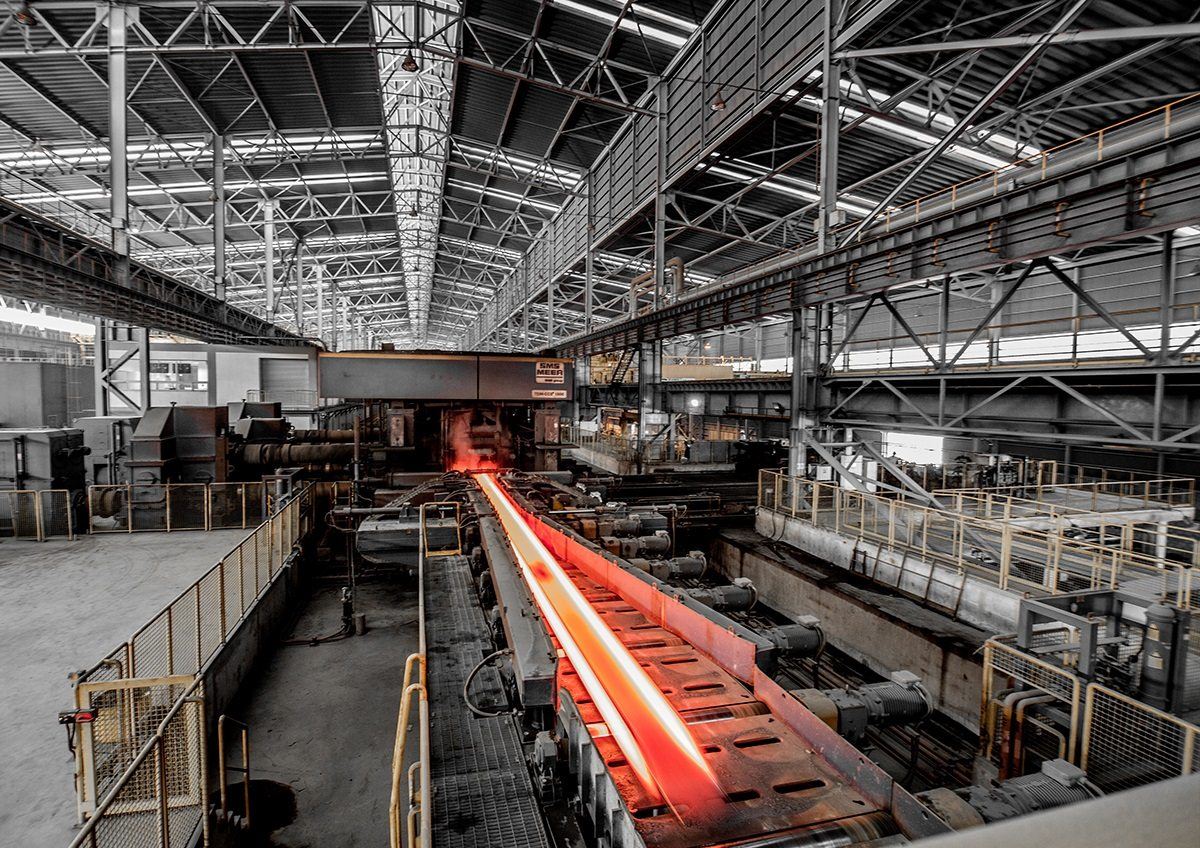
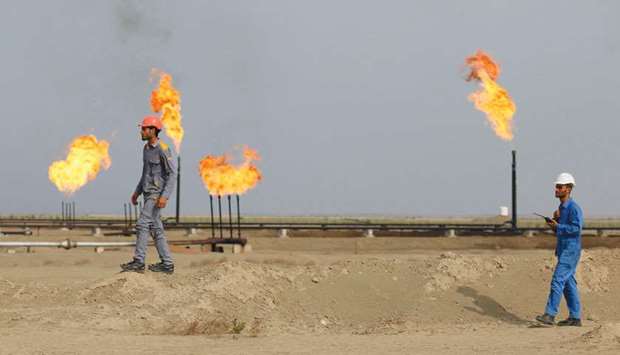
I’ve spent over 40 years navigating global commodities markets, supplying everything from petrochemicals to construction materials across challenging regions. Right now, one of the hottest opportunities I’m tracking is steel rebar exports to Iraq. With sustained high search volumes for Iraq rebar pricing and supply, it’s clear traders and contractors are actively leveraging this market. Iraq’s post-conflict reconstruction and infrastructure surge are driving massive demand for reinforcing steel bars—and smart suppliers are positioning themselves to capitalize.
Iraq Steel Rebar

Iraq Steel Rebar

The reality? Iraq’s construction sector is exploding, projected to grow at 5-6% annually through 2030, fueled by billions in oil revenues and international investments. Domestic production is ramping up, but quality imports remain essential for major projects. Get in now with compliant, high-grade rebar, and you can secure long-term margins in a market hungry for reliable supply.

Iraq’s Steel Rebar Market Overview: Demand Drivers and Growth Trajectory

Iraq consumes millions of tons of rebar annually, primarily for concrete reinforcement in buildings, bridges, and roads. Recent reports peg the construction industry at a potential $65 billion value by 2030, with steel rebar forming the backbone.

Here’s what’s fueling this:

  • Reconstruction Momentum: Post-conflict rebuilding in cities like Mosul and Baghdad requires vast quantities of structural steel.
  • Infrastructure Mega-Projects: Initiatives like the Development Road corridor, new ports, and highways demand high-strength deformed bars.
  • Housing and Urban Growth: Rapid urbanization and population growth push residential and commercial developments.
  • Energy Sector Expansion: Oil, gas, and renewable projects need durable reinforcement for facilities.

Industry forecasts show steady growth, with public-private partnerships accelerating projects. I’ve seen similar booms—when demand outpaces local supply, importers win big.

Current Rebar Prices in Iraq: Essential Data for Traders

Prices fluctuate with global scrap, energy costs, and local supply. Based on current market intelligence:

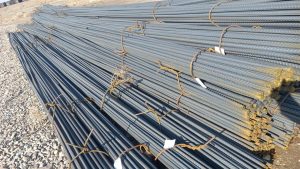
  • Local mill offers: Around $600-710 per ton ex-works, with Basra often lower at ~$600/t.
  • Imported rebar: Competitive, especially from regional sources, landing at $525-575/t warehouse.
  • Per kg equivalent: Roughly $0.60-0.71/kg ex-works (divide ton prices by 1000).
Rebar Prices in Iraq

Rebar Prices in Iraq

These figures come from real-time market trackers like SteelRadar and Kallanish. Volatility is normal—scrap inflows or crude oil swings can shift prices 5-10% monthly.

📊 Iraq Rebar Price Structure & Trade Terms (Incoterms)

Understanding the cost difference between Ex-Works, FOB, and CIF rates—including freight and landing costs to Iraq border points.

Source / TypeTrade Term (Incoterm)Price Range (USD / Ton)Est. Per KG ($)Freight & Logistics Notes
Iraqi Domestic MillsEXW (Ex-Works)$650 – $710$0.65 – $0.71Factory gate price. Excludes inland trucking to jobsite ($15–$35/t depending on distance).
Basra Regional ProducersEXW (Ex-Works)~$600~$0.60Lower baseline due to port proximity and scrap availability in the south.
Turkish Import OffersFOB (Loaded Port)$560 – $625$0.56 – $0.62Requires adding sea freight to Umm Qasr ($25–$40/t) or overland via Ibrahim Khalil border ($40–$60/t).
Regional Imports (Iranian/GCC)CIF / CPT Border$525 – $575$0.52 – $0.57Delivered to major border posts (e.g., Shalamcheh/Parvizkhan). Customs duties & clearance extra (~$20–$35/t).

💡 Pro Trader Note on Pricing Calculations:
All steel prices are based on metric tons (1 Metric Ton = 1,000 kg). To convert ton pricing to kilogram pricing, simply divide the ton rate by 1,000 (e.g., $650/ton = $0.65/kg). When comparing offers, always confirm whether the quote is EXW, FOB, or CIF/CPT to account for freight, border tariffs, and customs clearance charges.

Why the spread? Local protectionism and duties sometimes favor domestic, but projects demand ASTM/EN-compliant grades that imports often deliver better.

🌍 Major Import Sources & Regional Competitive Advantages

Iraq relies heavily on foreign supply to bridge its domestic rebar deficit. Each key exporting country holds distinct trade advantages based on freight costs, quality certifications, and border logistics.

🇹🇷 Turkey

Quality Premium

Market Focus: Northern & Central Iraq (Kurdistan Region, Baghdad).

  • High compliance with international standards (ASTM A615 / BS 4449).
  • Established overland corridor via Ibrahim Khalil border crossing.
  • Preferred choice for mega-infrastructure and state-backed contractors.

🇮🇷 Iran

Cost Leader

Market Focus: Southern & Eastern Iraq (Basra, Najaf, Karbala, Diyala).

  • Highly competitive FOB/EXW prices driven by abundant billet production.
  • Extensive land borders (Shalamcheh, Parvizkhan, Mehran) lower freight time.
  • Strong footprint in private housing and medium-scale residential developments.

🇦🇪 UAE & GCC

Maritime Logistics

Market Focus: Southern Iraq (Port projects, Oil & Gas facilities).

  • Direct bulk sea freight routes to Umm Qasr Port in Basra.
  • High-grade specs compliant with energy-sector durability requirements.
  • Flexible LC payment processing and reliable banking channels.

🇨🇳 China

Volume Supply

Market Focus: Major Chinese EPC contracts & long-term bulk procurement.

  • Scalable volume production suitable for massive development corridors.
  • Often tied directly to Chinese-funded infrastructure and energy deals.
  • Slightly longer maritime lead times compared to regional producers.

Strategic Sourcing Takeaway: Buyers in Iraq select suppliers based on project location and spec requirements. While Iran dominates on sheer landed-cost efficiency for southern/eastern borders and Turkey leads in northern specifications, UAE and China remain key partners for seaport bulk arrivals in Basra.

Why Steel Rebar Exports to Iraq Remain a High-Yield Opportunity in 2026

This isn’t just another market—it’s emerging fast.

Key Opportunities

  • Quality Gap: Many projects specify high-yield deformed rebar (e.g., Grade 60 or equivalent) for seismic and load-bearing needs.
  • Tax Incentives: Article 15 exemptions for reconstruction materials cut costs significantly.
  • Logistics Advantages: Proximity from Gulf/Middle East hubs reduces freight vs. distant sources.
  • Rising Standards: Compliance with Iraqi Quality Standards (IQS) opens doors to government tenders.

For details on navigating exemptions, see our practical guide: Unlocking Tax Exemptions for Iraq’s Reconstruction Projects: A Practical Guide to Article 15 Benefits.

And for quality compliance strategies, check The Ultimate Guide to Iraqi Quality Standards (IQS): Mandatory Products and Compliance Strategies.

Challenges in Supplying Rebar to Iraq—and How to Overcome Them

I’ve dealt with these firsthand:

  • Regulatory Hurdles: IQS certification and pre-inspection requirements.
  • Logistics Risks: Border delays or multimodal needs.
  • Payment and Currency: Preference for secure terms amid volatility.
  • Competition: Local mills expanding capacity.

Solutions? Partner with verified forwarders, secure LCs, and focus on certified grades.

💳 Navigating Financial & Payment Realities in Iraq

While traditional international trade leans heavily on Letters of Credit (LCs), doing business in Iraq requires navigating dynamic FX spreads (IQD vs. USD), Central Bank regulations, and local cash flow mechanisms.

1. Exchange Houses & Hawala (T/T Transfers)

The Preferred Reality: A significant portion of private sector steel trade is settled via licensed exchange companies (Hawala/TT). Buyers deposit Iraqi Dinar (IQD) locally, which is converted to USD and transferred overseas. Faster than traditional banks, but relies on clear exchange rate agreements.

2. Letters of Credit (LC) & Bank Guarantees

Best for Government Tenders: Essential for large-scale state infrastructure projects and major corporate contractors. Issued through major Iraqi banks (e.g., Trade Bank of Iraq – TBI). Secures payment but involves strict documentation and longer processing windows.

3. Phased Advance Payments (CAD / Cash)

Risk Mitigation Strategy: For cross-border land shipments, suppliers often use a structured advance model: 20–30% advance deposit via exchange transfer upon order confirmation, and balance against Cash Against Documents (CAD) or border arrival inspection.

⚠️ Managing FX Spread & Rate Fluctuations:
In Iraq, a gap often exists between the Central Bank of Iraq (CBI) official exchange rate and the parallel market rate. Trader Tip: Always fix the currency conversion rate and specified payment channel explicitly in contract terms prior to loading to prevent margin erosion during settlement delays.

🚛 Key Border Crossings, Tariffs & Domestic Protection Rules

Clearing rebar through Iraqi customs requires strategic port selection, understanding local tariff protections, and strict compliance with pre-shipment quality standards.

Strategic Entry Gateways into Iraq

⚓ Port of Umm Qasr (Basra)

Primary Maritime Hub: Handles deep-sea bulk vessels and containerized steel shipments from global suppliers (GCC, China, Sea Route). Direct rail and highway access to Southern and Central Iraq.

🏔️ Ibrahim Khalil Crossing (Turkey Border)

Northern Overland Gateway: The main entry corridor for Turkish rebar. Connects directly into the Kurdistan Regional Government (KRG) network before moving southward to Mosul and Baghdad.

🚚 Shalamcheh, Parvizkhan & Bashmaq (Iran Borders)

Eastern Land Gateways: Key land routes handling heavy truck traffic for land-bound regional rebar. Shalamcheh feeds Basra/South, while Parvizkhan and Bashmaq serve Central and Northern governorates.

🏷️ Import Duties & Tariff Regulations

Standard import tariffs on foreign steel rebar generally range between 10% to 15%. However, under Article 15 of the Investment Law, registered reconstruction projects and strategic infrastructure developments can secure duty exemptions, cutting landed costs significantly.

🛡️ Domestic Production Safeguards

To protect local electric arc furnace (EAF) mills in Basra and Erbil, the Iraqi Ministry of Industry periodically imposes price floors or seasonal quotas on imported rebar. Traders must stay informed on active import bans or tariff adjustments before dispatching shipments.

📋 Mandatory Compliance & IQS Inspection:
All rebar imports entering Iraq must undergo pre-shipment inspection (PSI) to obtain a Certificate of Conformity (CoC) verifying compliance with Iraqi Quality Standards (IQS) or international equivalents (ASTM A615 Grade 60). Uncertified shipments face lengthy holds at customs check-posts or outright rejection.

Step-by-Step Guide: Exporting Steel Rebar to Iraq Successfully

From decades of deals:

  1. Research Demand: Target regions like Baghdad, Basra, Erbil via tenders.
  2. Ensure Compliance: Obtain IQS/CMI certificates; test for yield strength, ductility.
  3. Price Competitively: Factor duties, freight—aim below local peaks.
  4. Secure Logistics: Use containers or bulk; plan for Umm Qasr port.
  5. Build Relationships: Direct with contractors or via platforms.
  6. Mitigate Risks: Use insurance, phased shipments.
  7. Monitor Market: Track scrap/crude for timing.

This approach has locked in multi-thousand-ton contracts for clients.

📜 IQS Compliance & Mandatory Steel Rebar Grades in Iraq

Government ministries (Ministry of Construction and Housing) and tier-1 EPC contractors enforce strict technical specifications regulated by the Central Organization for Standardization and Quality Control (COSQC) under Iraqi Quality Standards (IQS).

ASTM A615 Grade 60

American Standard

Min Yield Strength: 420 MPa (60,000 psi)

  • The primary benchmark for high-rise commercial structures, bridges, and highways.
  • Mandated in US-engineered and major oil & gas infrastructure projects in Basra.
  • Requires specific rib geometry and tensile-to-yield ratio checks.

BS 4449 B500B / B500C

British/European Standard

Min Yield Strength: 500 MPa

  • Standard specification in public infrastructure and federal housing tenders.
  • B500C (High Ductility): Required for seismic design considerations in Northern Iraq and heavy load-bearing zones.
  • Superior weldability and bendability characteristics.

ParameterStandard Iraqi Tender RequirementsVerification & Testing Method
Bar Diameters8mm, 10mm, 12mm, 16mm, 20mm, 25mm, 32mm (12m bundle lengths)Dimensional tolerance caliper checks at border/mill.
Chemical CompositionCarbon Equivalent Value (CEV) ≤ 0.51% (Ensures proper weldability)Spectrometer chemical ladle analysis.
Mechanical IntegrityTensile strength, Yield strength, Elongation %, Bend & Re-bend testsUniversal Testing Machine (UTM) sample pulling.

⚠️ Pre-Shipment Inspection (PSI) Requirement:
To avoid customs clearance rejections at Iraqi borders (Umm Qasr, Ibrahim Khalil, Shalamcheh), importers must obtain a Certificate of Conformity (CoC) issued by an accredited third-party inspection agency (e.g., SGS, Bureau Veritas, Intertek, or TÜV) prior to loading at the origin port.

Recent Price Dynamics and Market Cycles

In late 2024, prices dipped amid oversupply from regional producers. But as 2025 kicked off, a 5-10% uptick emerged, fueled by construction restarts after seasonal slowdowns. This shift highlights the cyclical nature of the market—something I’ve leveraged in my own dealings by timing purchases during lows.

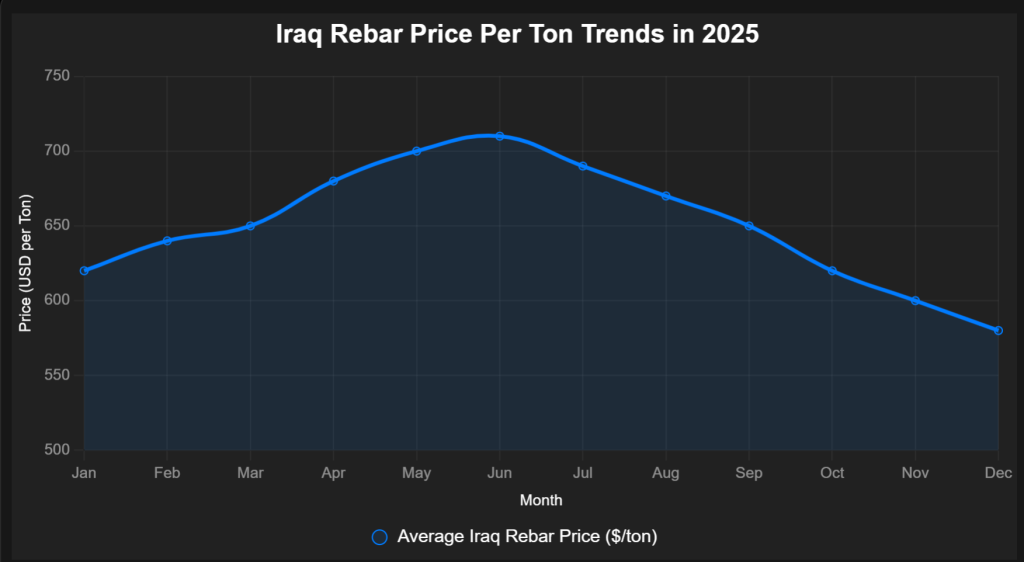
Average Iraq Rebar Price Per Ton in 2025: A Balanced View

Based on aggregated data from key market monitors, the benchmark Iraq rebar price per ton currently ranges around $650–$680. This figure accounts for both domestic and imported supplies, with variations by region. In Basra, closer to ports, averages trended lower at about $600-620 per ton, while northern areas like Erbil saw $680-700 due to logistics costs.

Why this average? It’s a blend of local mill outputs and imports. Domestic producers aimed to hold floors at $600 to prevent further erosion, as noted in industry decisions. Imported rebar from Turkey and Iran often undercut this, averaging $550-650, but quality premiums pushed the overall mean higher. For businesses, this average serves as a benchmark—plan budgets around it, but build in 10-15% buffers for volatility.
Iraq Rebar Price Per Ton 2025

Iraq Rebar Price Per Ton 2025

Regional Variations in Average Prices

  • Southern Iraq (e.g., Basra): Closer to import hubs, averages ~$600/ton, benefiting from lower transport fees.
  • Central Iraq (e.g., Baghdad): $650-670/ton, balancing domestic and imported sources.
  • Northern Iraq: Higher at $680+, due to inland shipping and security premiums.

These averages reflect a market striving for stability amid growth.

High and Low Price Points for Iraq Rebar in 2025

The market displays clear seasonal swings. Peak pricing typically reaches around $710 per ton during high-demand construction windows, driven by local mill adjustments and raw material surges. Conversely, baseline dips adjust toward $550–$600 per ton during slower quarters when regional imports expand. Understanding this spread helps timing trade entries effectively.

Monthly Breakdown of Highs and Lows

To make it actionable, here’s a simplified table of estimated monthly ranges:

MonthLow ($$ /ton)High ( $$/ton)Notes
Jan-Mar580650Post-winter recovery
Apr-Jun600710Peak demand surge
Jul-Sep570680Volatility from global events
Oct-Dec550640Seasonal slowdown
This data, drawn from market monitors, helps in forecasting.

Reasons for Price Changes in Iraq Rebar Market 2025

Prices don’t fluctuate in a vacuum—there’s always a “why” that savvy operators decode. Key structural drivers consistently shape the Iraq rebar pricing landscape:

  1. Demand Fluctuations: Weak global demand in May led to volatility, with seasonal construction halts dropping prices by 5-10%. Conversely, infrastructure booms in Q2 pushed highs.
  2. Supply Chain and Production Costs: Rising raw material costs (e.g., iron ore, energy) added 3-6% to prices early in the year. Turkish exports, up 3.6% to $570/ton FOB, influenced Iraqi imports.
  3. Geopolitical and Economic Factors: Currency instability and tariffs from neighbors like Iran affected imports. A decision by Iraqi manufacturers to cap sales below $600 stabilized lows but capped growth.
  4. Global Market Influences: Broader trends, like US prices climbing to over $700/ton, rippled into Iraq via trade links. Weak demand contrary to forecasts caused late-year drops.

From personal experience, these reasons often compound— a demand dip plus cost hikes can amplify swings. Understanding the “why” lets you hedge effectively.

Future Outlook for Steel Rebar Prices in Iraq

Looking ahead, prices are projected to test $700+ averages as major infrastructure projects accelerate, provided global raw material costs remain stable. But watch for global recessions or supply gluts. The key? Stay informed and agile.

In wrapping up, mastering the Iraq rebar price per ton in 2025 boils down to blending data with instinct. If you’re in the trade, don’t go it alone—join a network that connects you directly with verified suppliers and real-time deals.

Frequently Asked Questions (FAQ): Iraq Steel Rebar Trade

Essential answers regarding quality testing, technical standards, tax incentives, and customs procedures for exporting steel rebar to Iraq.

How is rebar tested and inspected at the Iraqi border?

All steel rebar imported into Iraq must undergo Pre-Shipment Inspection (PSI) by accredited third-party international testing agencies (such as Bureau Veritas, SGS, or Intertek). Upon arrival at border points (Umm Qasr, Ibrahim Khalil, or Shalamcheh), customs inspectors verify the Certificate of Conformity (CoC) issued under Iraqi Quality Standards (IQS) and may conduct random physical tests for yield strength, tensile ductility, and dimensional accuracy.

What are the standard lengths and diameters of rebar imported to Iraq?

The standard bundle length for imported steel rebar in Iraq is 12 meters. Standard diameters range from 8mm to 32mm, with 12mm, 16mm, and 25mm high-yield deformed bars (ASTM A615 Grade 60 or BS 4449 B500B) being the most frequently specified sizes for infrastructure corridors and high-rise construction.

How can importers apply for Article 15 tax exemptions on steel imports in Iraq?

Under Article 15 of Iraq’s Investment Law No. 13, project owners and contractors must submit an official application to the National Investment Commission (NIC) or the local Provincial Investment Commission (PIC). The filing requires project registration certificates, approved Bill of Quantities (BOQ), and proof that the imported rebar is designated exclusively for the registered reconstruction project.

What is the primary difference between local Iraqi rebar and imported rebar?

Local Iraqi rebar, produced mainly by EAF mills in Basra and Erbil, relies heavily on local scrap metal, offering lower price points but limited production volume. Imported rebar (primarily from Turkey, Iran, and the GCC) offers guaranteed high-yield grades (Grade 60 / B500B), full IQS/ASTM compliance certificates, and the large-scale volume supply required for government infrastructure tenders.

Final Thoughts: Capitalize on Iraq’s Rebar Demand Now

Exporting steel rebar to Iraq remains a high-value strategy—backed by project-driven demand, ongoing reconstruction, and expanding profit margins for reliable suppliers.—steady growth, project-backed demand, and room for quality importers. Prices are attractive, but success comes from compliance, reliability, and timing.

Ignore the regulatory details or quality specs, and shipments stall. Master them, and you’re building lasting supply chains in a rebuilding nation.

Tendify B2B Trade Marketplace

Ready to Tap into Iraq’s Steel Rebar Boom?

Whether you are an international steel exporter expanding your market footprint or an Iraqi contractor sourcing high-grade, IQS-compliant rebar for major infrastructure projects, Tendify.net connects you directly with verified global partners. Post your trade requirements, receive competitive real-time quotes, and build reliable supply chains—all in one place.


Verified Global Suppliers


Direct RFQ & Real-Time Quotes


Transparent International Trade

Free registration. Start submitting RFQs or listing your steel offers in minutes.

About Eftekhari

From the Lab to the Global Market My journey began in the world of Chemical Engineering, where precision and optimization are everything. Today, as the CEO of Shayesteh Kar Rad Caspian and the founder of Tendify, I apply that same engineering mindset to the world of digital trade. I’ve transitioned from designing industrial processes to architecting digital marketplaces that serve the GCC and beyond. My expertise lies in blending "Engineering as Marketing" with a deep understanding of geopolitical market shifts. On Tendify, I share my insights and provide a platform designed for transparency and efficiency. I’m not just a developer; I’m a partner in your trade journey, committed to cutting through the noise with actionable, data-backed strategies.

Leave a Reply

Your email address will not be published. Required fields are marked *