


Blog
The Real Reasons for Nokia’s Failure: A Giant That Overlooked Innovation
The Empire That Ruled the World
At its zenith, Nokia wasn’t just a company—it was a global phenomenon. The Finnish giant commanded 40.5% of the global mobile market in 2007, with over 1.2 billion people using its devices worldwide. Its signature ringtone became a cultural touchstone across continents. Yet, by 2014, this once-dominant force had virtually disappeared from the mobile landscape, its handset division sold to Microsoft for a mere $7.2 billion—a fraction of its former value.
Nokia’s story represents one of the most dramatic business collapses in modern history, offering profound lessons about technological disruption, organizational arrogance, and the peril of ignoring innovation. This comprehensive analysis examines every facet of Nokia’s failure, providing insights relevant to today’s rapidly evolving business environment.

The Real Reasons for Nokia’s Failure
Chapter 1: Internal Factors – The Rot Within
1.1 Complacent Leadership and Strategic Myopia
The Ivory Tower Syndrome
Nokia’s leadership in the mid-2000s operated in what former employees called “strategic isolation.” Having dominated the mobile industry for nearly a decade, executives developed an unshakable belief in their own infallibility. The company’s internal culture celebrated past successes to such an extent that it blinded leadership to emerging threats.
A revealing example occurred in 2004, when Nokia engineers developed a prototype touchscreen smartphone with internet capabilities. When presented to senior management, the response was dismissive:
“Who would want to browse the internet on their phone? People just want to make calls and send texts.”
This myopia persisted even after Apple’s iPhone launch. Nokia’s then-CEO, Olli-Pekka Kallasvuo, famously remarked in 2007:
“The iPhone is a nice niche product, but it won’t appeal to business customers.”
Paralyzing Decision-Making Structure
Nokia suffered from what insiders termed “matrix paralysis.” The company’s complex organizational structure required multiple committees to approve even minor decisions. A former senior engineer revealed:
“To change a single feature on a phone, we needed approval from 14 different committees. By the time we got approval, the market had moved on.”
This bureaucratic nightmare meant that while Apple could design and launch a new iPhone in 12-18 months, Nokia’s development cycles stretched to 2-3 years.
1.2 Toxic Organizational Culture
The Climate of Fear
Nokia’s culture became increasingly toxic as its market dominance grew. Middle managers were terrified of delivering bad news upward, creating what psychologists call “organizational silence.” A 2009 internal survey revealed that 68% of employees felt they couldn’t voice concerns without career repercussions.
Former VP of Design, Frank Nuovo, described the environment:
“There were brilliant ideas everywhere, but they died in meetings. People were more concerned with protecting their positions than with innovating.”
The Not-Invented-Here Syndrome
Nokia’s engineers developed an arrogance about their technical capabilities. When Google approached Nokia in 2007 about adopting Android, Nokia’s executives famously responded:
“We don’t need Android. We have Symbian, which powers 70% of smartphones. Why would we help Google?”
This arrogance extended to dismissing entire categories of innovation. Nokia’s head of marketing told his team in 2008:
“App stores are a fad. Consumers want complete devices, not platforms.”
Departmental Silos and Internal Warfare
Nokia’s various divisions operated as competing fiefdoms rather than collaborative units. The hardware, software, and services teams actively sabotaged each other’s initiatives. An infamous incident involved the Ovi Store (Nokia’s app store), which the services team developed without input from software engineers. The result was a dysfunctional platform that launched 18 months late and never gained traction.
Nokia
1.3 The Symbian Albatross
Technological Debt and Legacy Code
Symbian, Nokia’s mobile operating system, was originally designed for basic feature phones. As smartphone capabilities expanded, Symbian became what engineers called “a house of cards”—millions of lines of spaghetti code that couldn’t support modern features.
Despite internal warnings dating back to 2003, management refused to invest in a new platform. An internal 2006 memo stated:
“Symbian is our moat. Replacing it would be admitting defeat.”
By 2010, developing new features on Symbian took 5 times longer than on iOS or Android.
The MeeGo Debacle
When Nokia finally recognized Symbian’s limitations, it created MeeGo—a modern operating system developed with Intel. However, internal politics doomed the project. The Symbian team, fearing obsolescence, actively undermined MeeGo’s development. The platform launched with only 57 apps compared to Apple’s 300,000+.
Chapter 2: External Factors – The Perfect Storm
2.1 The Smartphone Revolution
Apple’s Disruptive Innovation
Steve Jobs didn’t just release a new phone in 2007; he introduced a new paradigm. The iPhone wasn’t a better phone—it was a different category of device entirely. While Nokia focused on incremental improvements (better cameras, longer battery life), Apple redefined what a mobile device could be.
Nokia’s initial response was telling. The day after the iPhone launch, Nokia’s board met and concluded:
“No serious threat. The iPhone lacks physical keyboard, has poor battery life, and costs too much.”
This fundamental misunderstanding of the iPhone’s value proposition—the ecosystem, user experience, and developer platform—sealed Nokia’s fate.
Android’s Democratic Revolution
Google’s Android offered what Symbian couldn’t: a free, open-source platform that manufacturers could customize. While Nokia charged phone makers $15 per device for Symbian licenses, Google offered Android for free. By 2010, Android had captured 33% of the smartphone market to Nokia’s 31%—the first time Nokia wasn’t leading.
2.2 The Platform Economy Shift
From Devices to Ecosystems
The 2008-2012 period marked a fundamental shift from product competition to ecosystem competition. Apple and Google weren’t just selling phones; they were building platforms where apps, services, and devices created network effects.
Nokia’s leadership failed to grasp this shift. CEO Stephen Elop’s now-infamous “Burning Platform” memo in 2011 acknowledged the problem but came three years too late:
“Our competitors aren’t taking our market share with devices; they’re taking it with an entire ecosystem.”
The Developer Exodus
As iOS and Android attracted developers, Symbian’s ecosystem collapsed. Between 2009 and 2011, 93% of Symbian developers abandoned the platform. Without apps, Nokia’s smartphones became increasingly unattractive, creating a death spiral from which recovery was impossible.
2.3 Asian Manufacturing Onslaught
Samsung’s Agile Response
While Nokia deliberated in committee meetings, Samsung made decisive moves. The Korean giant recognized Android’s potential early and launched 30 different smartphone models in 2010 alone. Samsung’s vertical integration (it manufactured its own components) allowed faster iteration and lower costs.
Chinese Price Competition
Companies like Huawei and Xiaomi entered the market with “good enough” smartphones at half Nokia’s prices. By 2013, Chinese manufacturers controlled 35% of the global smartphone market.
Chapter 3: Timeline of Collapse – The Unfolding Tragedy
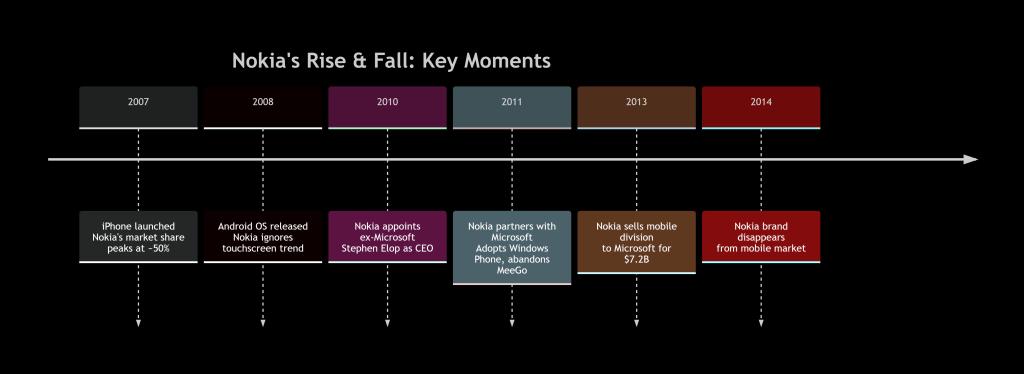
Timeline of Nokia’s Downfall
Phase 1: The Peak of Power (2006-2007)
2006: Nokia ships its 1 billionth phone
Market share: 48.7% globally
Revenue: €41 billion
Perception: Invincible market leader
Phase 2: The First Cracks (2007-2009)
June 2007: iPhone launches; Nokia dismisses it
October 2008: Android launches; Nokia ignores it
2009 Q4: Nokia’s smartphone market share drops to 38% (from 50% in 2007)
Internal crisis: First major layoffs (1,700 employees)
Phase 3: The Descent (2010-2011)
September 2010: Stephen Elop becomes CEO
February 2011: “Burning Platform” memo leaks
February 2011: Nokia announces partnership with Microsoft, abandons Symbian
Market share collapse: Drops to 15% by end of 2011
Phase 4: The Death Spiral (2012-2014)
2012: Windows Phone fails to gain traction (<3% market share)
2013 Q2: Nokia loses title of largest phone vendor after 14 years
September 2013: Microsoft acquires Nokia’s mobile division for $7.2 billion
2014: Nokia brand disappears from mobile phones
Chapter 4: Key Quotes That Define the Tragedy
From Leadership:
“We’re not in the smartphone business; we’re in the mobile phone business.” – Nokia Board Member, 2008
“The iPhone won’t make a dent in our market. It’s too expensive for normal people.” – Nokia Marketing Director, 2007
From Engineers:
“We had touchscreen prototypes in 2004, but management said ‘real phones have buttons.'” – Former Nokia R&D Lead
“Symbian wasn’t just outdated; it was actively hostile to modern development.” – Ex-Nokia Software Architect
The Infamous “Burning Platform” Memo Excerpts:
“We have multiple points of scorching heat that are fuelling a blazing fire around us… The first iPhone shipped in 2007, and we still don’t have a product that is close to their experience.” – Stephen Elop, 2011
Chapter 5: The Human Element – Cultural Anthropology of Failure
The Finnish Identity Crisis
Nokia wasn’t just a company; it was Finland’s national champion. At its peak, Nokia accounted for 4% of Finland’s GDP and 21% of its exports. This national significance created additional pressure and institutional inertia. The government couldn’t let Nokia fail, creating a “too big to fail” mentality that delayed necessary radical changes.
The Stockholm Syndrome of Success
Employees who joined Nokia during its golden era developed what organizational psychologists call “success-induced blindness.” Past achievements created cognitive filters that dismissed contradictory information. Even as market data showed declining sales, internal narratives focused on “temporary setbacks” rather than existential threats.
The Generational Divide
Younger engineers recognized the smartphone revolution, but lacked organizational power. A 2010 internal survey showed:
85% of engineers under 30 believed Nokia needed radical change
Only 23% of executives over 50 agreed
This generational disconnect meant innovative ideas never reached decision-makers.
Chapter 6: Comparative Analysis – Why Others Survived
Apple vs. Nokia: The Innovation Mindset
While Nokia focused on incremental improvement (more durable phones, better battery life), Apple pursued paradigm shifts. Apple’s organizational structure—small, focused teams with direct executive access—allowed rapid iteration that Nokia’s bureaucracy couldn’t match.
Samsung vs. Nokia: The Agile Response
Samsung’s key advantage wasn’t technological superiority but organizational agility. Where Nokia took years to approve new models, Samsung could launch multiple products simultaneously, rapidly learning from market feedback.
Microsoft’s Mobile Failure vs. Nokia’s
Interestingly, Microsoft also failed in mobile, but for different reasons. While Nokia suffered from technological lag, Microsoft suffered from strategic confusion—constantly changing direction between Windows Mobile, Windows Phone, and Windows 10 Mobile.
Chapter 7: The Aftermath and Legacy
What Happened to Nokia?
Mobile Division: Sold to Microsoft in 2014 (Microsoft wrote off $7.6 billion of the acquisition value in 2015)
Remaining Company: Focused on telecommunications infrastructure (Nokia Networks)
Brand Licensing: HMD Global now licenses the Nokia brand for smartphones
Current Status: Profitable but nowhere near former glory
The Human Cost
35,000+ employees lost jobs globally
Finland’s unemployment rose from 6% to 9% during Nokia’s collapse
Economic Impact: Finland’s GDP growth turned negative in 2012-2013
The Surprising Survivor: Nokia Technologies
One division survived relatively intact: Nokia Technologies, which manages the company’s patent portfolio. With 20,000+ patents, Nokia earns over €1.5 billion annually from licensing—a poignant reminder of its innovative past.
Chapter 8: Modern Business Lessons – Preventing Your Nokia Moment
Lesson 1: Cultivate Strategic Paranoia
“Success breeds complacency. Complacency breeds failure.” – Andy Grove, Intel
Modern companies must institutionalize “healthy paranoia”—regularly challenging assumptions, actively seeking disconfirming evidence, and rewarding employees who identify threats.
Lesson 2: Structure for Speed, Not Stability
Hierarchical structures optimized for stable markets fail in disruptive environments. Modern organizations need:
Small, autonomous teams
Rapid decision cycles (days, not months)
Direct communication channels bypassing bureaucracy
Lesson 3: Platforms Over Products
The Nokia-Apple contrast demonstrates the power shift from product excellence to ecosystem dominance. Modern businesses must think in terms of:
Network effects
Developer communities
Cross-platform integration
Lesson 4: Cultural Renewal as Strategic Imperative
Organizational culture isn’t a “soft” issue—it’s a strategic one. Companies must:
Measure cultural health quantitatively
Rotate leadership to prevent stagnation
Create psychological safety for dissent
Lesson 5: The Innovation Portfolio Approach
Relying on a single technology (like Symbian) creates existential risk. Successful modern companies maintain:
Core innovation (incremental improvements to existing products)
Adjacent innovation (expanding into related markets)
Transformational innovation (betting on new paradigms)
Chapter 9: The Philosophical Dimension – What Nokia Teaches Us About Progress
Nokia’s story represents more than a business failure; it illustrates fundamental truths about technological evolution and human psychology. The company fell victim to what historian Arnold Toynbee called “the idolization of an ephemeral technique.” Nokia worshiped its past success formula long after it had become obsolete.
The tragedy also demonstrates the pace of change acceleration. Nokia dominated mobile for 14 years (1996-2010). Apple has dominated smartphones for 16 years (2007-present). The next disruption will likely happen even faster.
Conclusion: The Eternal Vigilance of Innovation
Nokia’s collapse wasn’t inevitable. At multiple points between 2004 and 2010, different decisions could have changed the outcome. The real tragedy isn’t that Nokia failed, but that it had the resources, talent, and market position to succeed and still failed.
The ultimate lesson transcends business strategy: In a world of exponential change, adaptability isn’t an advantage—it’s a prerequisite for survival. Nokia’s story reminds us that no market position is secure, no technology permanent, and no success formula timeless.
As we enter an era of AI, quantum computing, and biotechnology, Nokia’s ghost whispers a warning to today’s tech giants: Complacency is the only fatal error. Innovation isn’t something you achieve; it’s something you maintain, daily, through relentless self-criticism and courageous adaptation.

