


Blog
Asia DRI Market 2026: Who Will Lead the Green Steel Era?
Asia Is Already at the Center of Global DRI.
But Its Next DRI Leader May Not Be the One You Expect.
Asia does not have a single DRI strategy. It has four distinct ones running in parallel.
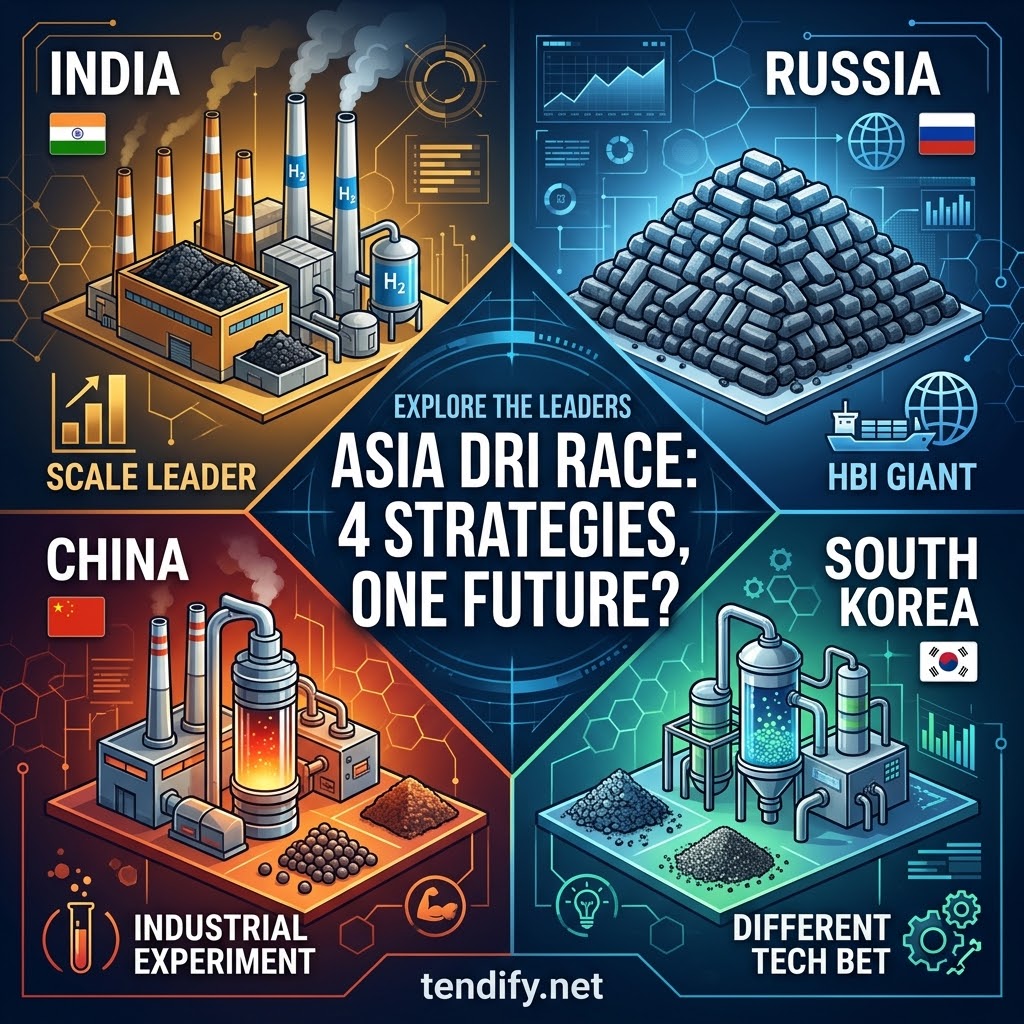
India already holds the production volume crown. Russia sits on the largest merchant HBI position. China is running industrial-scale experiments that expand feedstock flexibility. South Korea is betting on a fundamentally different process route. Each country is solving a different piece of the same problem: how to produce low-carbon metallic feedstock at competitive cost while securing ore, energy, technology, and scale.
Asia DRI Race 4 Strategies Shaping Green Iron Trade
The winner will not simply be the country that installs the most new capacity. It will be the one that can align those four variables under real commercial conditions. For traders, steel buyers, and bulk commodity operators moving iron units across Asia and into the Gulf, understanding these differences matters more than headline capacity numbers.
Why Asia Sits at the Center of Global DRI
Global DRI production remains concentrated. World Steel data for 2026 continue to show India as the clear volume leader month after month, with output frequently exceeding 5 million tonnes in peak months among surveyed producers. Asia Pacific accounts for more than half of global DRI output. The region’s steel demand trajectory, expanding electric-arc furnace capacity, and policy pressure on blast-furnace emissions keep the DRI conversation centered here.
Yet volume alone does not determine leadership in the next phase. Coal-based rotary kilns still dominate a large share of Asian DRI. Natural-gas shaft furnaces and emerging hydrogen routes operate under different economics and different feedstock requirements. The transition from today’s production base to tomorrow’s low-carbon metallic supply is where the real competition sits.
India — The Scale Leader Facing a Transformation Test
India does not need to prove it can produce DRI. It already produces more than any other country. The operational question is different: can the world’s largest DRI producer change how that DRI is made?
A substantial portion of Indian capacity remains coal-based rotary kiln. Gas-based shaft-furnace capacity exists but is smaller and more concentrated. Policy attention has shifted toward hydrogen. In 2026 a CSIR-IMMT-led consortium received approval for a 20-tonne-per-day 100% hydrogen DRI pilot, with government funding under the National Green Hydrogen Mission and completion targeted for 2029. Parallel work examines commercial-scale hydrogen-DRI hubs, including detailed techno-economic analysis for Andhra Pradesh that shows green-steel costs approaching conventional routes under favorable renewable and hydrogen pricing.
India’s structural advantages are clear. Domestic iron-ore availability is high. Scrap remains structurally scarce, so DRI retains a long-term role as EAF feedstock. Policy support for green hydrogen and coal-gasification pathways continues to expand. The constraint is the conversion cost and timeline of the existing coal-based base. Transitioning that base without destroying competitiveness is the real test of India’s next chapter.
For traders, this means Indian DRI availability will remain high in the near term, but the quality, carbon intensity, and pricing profile of that material will begin to diverge as new routes come online.
China — The Industrial Experiment Expanding Feedstock Options
China approaches the problem through industrial-scale testing rather than pure volume leadership in merchant DRI.
In 2026, China Baowu and Rio Tinto completed industrial-scale pelletisation and direct-reduction trials using pellets containing one-third Pilbara Blend mid-grade ore. The pellets were reduced in Baowu’s 1 Mt/y hydrogen-based shaft furnace. The resulting DRI was successfully converted into steel in both basic oxygen and electric smelting routes. The significance is not only the hydrogen step. It is the demonstration that mid-grade ore can serve as viable feedstock for hydrogen-based reduction when combined with appropriate downstream processing.
China’s industrial system gives it speed in scaling pilots into commercial configurations. Its ore-import relationships and domestic steel demand create a closed-loop testing environment few other countries can match. The open question is how quickly these successful trials translate into large-scale merchant or captive hydrogen-DRI capacity that competes on cost with existing routes.
For bulk traders and ore suppliers, the Chinese experiments matter because they expand the range of iron units that can enter the low-carbon steel value chain. Mid-grade material that once sat outside premium DR-grade specifications may gain new pathways.
Russia — The HBI Giant Already in Position
While much of the industry debates future capacity, Russia already holds a substantial merchant HBI position through Metalloinvest. The company operates integrated iron-ore, pellet, and metallized-product chains and has historically described itself as the world’s leading producer of merchant HBI. Additional HBI capacity has been under development, with projects aimed at further increasing output.
Russia starts from a different baseline. It does not need to prove large-scale HBI production works. The commercial questions are different: future reductant pathways (including partial hydrogen blending), market access under evolving trade conditions, and the ability to maintain cost competitiveness as other regions add capacity.
HBI’s logistics advantages—higher density, lower reactivity, and suitability for longer shipping routes—make it particularly relevant for cross-border trade into Asia and beyond. Operators already familiar with HBI logistics will watch Russian supply availability and pricing closely as new low-carbon projects elsewhere come online.
South Korea — The Different Technology Bet
South Korea is taking a distinct technological path. POSCO’s HyREX process uses fine iron ore in fluidized-bed reactors followed by electric smelting, rather than the conventional pellet-fed shaft furnace. Construction of the 300,000 t/y HyREX demonstration plant began with a target completion in 2028. The process is designed to handle fine ore directly, potentially reducing the need for extensive pelletising infrastructure.
This is a higher-risk, higher-differentiation strategy. If successful at commercial scale, HyREX could open feedstock flexibility that conventional shaft furnaces do not currently offer. The demonstration timeline and subsequent scale-up will determine whether the technology becomes a regional or global alternative.
For equipment suppliers, engineering firms, and fine-ore producers, the HyREX route represents a different set of technical requirements and potential new demand patterns.
Four Countries, Four Different Advantages
| Country | Est. Capacity & Targets | Primary Strength | Core Challenge | Near-Term Focus |
|---|---|---|---|---|
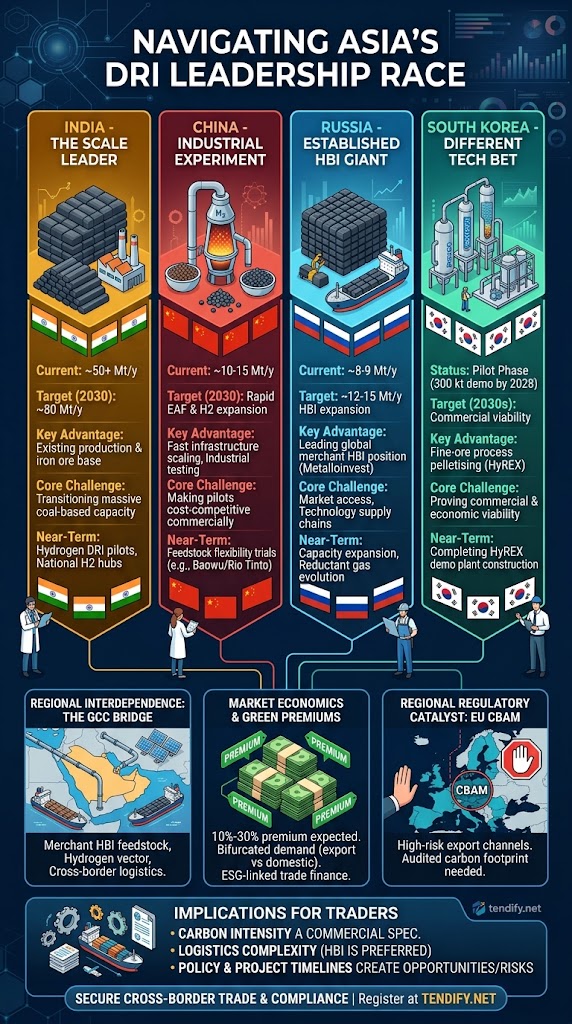
| 🇮🇳 India | ~50+ Mt/y Current Target: ~80 Mt/y by 2030 | Existing production scale & iron ore base | Transitioning massive coal-based capacity | Hydrogen DRI pilots + National Green Hydrogen Mission hubs |
| 🇨🇳 China | ~10-15 Mt/y Current Target: Rapid EAF & H2 expansion by 2030 | Industrial testing & fast-scaling infrastructure | Translating pilots into cost-competitive commercial capacity | Feedstock flexibility trials (Baowu 1 Mt/y shaft furnace) |
| 🇷🇺 Russia | ~8-9 Mt/y Current Target: ~12-15 Mt/y HBI expansion | Established global merchant HBI position (Metalloinvest) | Maintaining market access & technology supply chains | Capacity expansion + reductant gas evolution |
| 🇰🇷 South Korea | Pilot Phase 300 kt/y demo (2028) → Commercial by 2030s | Alternative fine-ore process technology (POSCO HyREX) | Proving commercial & economic viability of HyREX | Completing 300 kt demonstration plant construction by 2028 |
The competition is not a single race for the highest tonnage. It is a contest over which combination of ore access, energy cost and availability, technology maturity, and industrial scale can deliver the lowest total cost of low-carbon metallic units under real market conditions.
The Middle East & GCC Bridge: Fueling Asia’s DRI Ambitions
While Asia’s four industrial heavyweights drive regional technology and scale, none of them operate in isolation. Asia’s green-iron trajectory remains deeply tethered to the Middle East and GCC region—the world’s dominant hub for natural-gas-based Direct Reduced Iron (DRI) and Hot Briquetted Iron (HBI) production.
⚓ Merchant HBI Feedstock
Suppliers in Iran, Oman, Saudi Arabia, and the UAE serve as critical sources of high-grade merchant HBI, bridging Asia’s structural scrap and DR-grade pellet deficits.
⚡ The Transition Vector
Abundant natural gas reserves combined with ultra-low-cost solar power make the Gulf the most cost-effective testing ground for hydrogen-blended reduction pathways globally.
Key Takeaway for Traders: Asian DRI leadership relies on cross-border logistics routes originating in Middle Eastern ports. Securing long-term HBI off-take contracts and monitoring Gulf-to-Asia shipping corridors will be just as decisive as domestic capacity expansion in India or China.
What Will Actually Decide Leadership
Ore quality and availability remain foundational. High-grade DR pellet feed still commands premiums, but successful mid-grade trials expand the potential supply base. Energy cost and carbon intensity of the reductant will increasingly dominate operating economics. Technology maturity determines both capital intensity and operational reliability. Scale determines whether unit costs can compete with established blast-furnace and existing DRI routes.
In practice, the leader will be the jurisdiction that can simultaneously secure reliable high-quality or suitably prepared ore, deliver competitive low-carbon energy (or hydrogen), deploy proven or rapidly de-risked technology, and operate at volumes that attract offtake and financing. No single country currently holds an unassailable lead across all four variables.
The Economics of Green Premiums: Will Asian Buyers Pay the Margin?
Behind every technology roadmap lies a fundamental commercial reality: low-carbon metallic supply carries a cost delta. The central question for traders and capital providers is whether Asian steelmakers are willing—and financially equipped—to absorb a 10% to 30% “Green Premium” for low-emission DRI/HBI compared to conventional fossil-reduced feedstock.
📊 Two-Tier Market Bifurcated Premiums
Asian buyers servicing strict export markets (e.g., EU CBAM exposure) are increasingly paying green premiums to hedge regulatory tariffs. Domestic-focused buyers, however, remain price-sensitive, accepting premiums only when tied to superior iron grade or yields.
💳 Evolution of Trade Finance Structures
International trade desks are adapting Letters of Credit (LCs) and structured off-take agreements to include verifiable ESG metrics and carbon intensity certificates ($tCO_2/t$ metallized iron) directly as payment release triggers.
Commercial Insight: Green premiums will not be uniform across Asia. The early winners in trading green HBI will be those who construct multi-tier contract pricing—linking final delivered premiums to certified carbon offsets and verified scope 1/scope 2 emission intensity.
The EU CBAM Catalyst: Why Asian Producers Are Forced to Accelerate
The urgency behind Asia’s multi-billion-dollar DRI investments is not purely driven by voluntary sustainability goals; it is an existential hedge against trade barriers. Chief among these is the European Union’s Carbon Border Adjustment Mechanism (EU CBAM), which penalizes high-emission steel imports entering the European single market.
⚠️ High-Risk Export Channels
India, China, and South Korea maintain massive steel trade flows into Europe. Without replacing coal-based or blast-furnace routes with low-emission DRI/HBI, their downstream steel products face prohibitive CBAM tariffs, making them commercially uncompetitive.
📋 Embedded Carbon Accountability
CBAM mandates strict auditing of scope 1 and scope 2 emissions across the entire processing chain. Merely blending scrap is no longer enough; verifiable low-carbon metallics (DRI/HBI) are required to certify the final steel product’s footprint.
Strategic Imperative for Traders: Asian producers that successfully de-risk their DRI feedstock through hydrogen or natural gas pathways will secure European market share, while those lagging behind will be forced to redirect high-carbon output toward less regulated, lower-margin regional markets.
Implications for Cross-Border Traders and Supply-Chain Operators
For companies moving iron ore, pellets, DRI, HBI, or finished steel across Asia and into Gulf markets, several practical points stand out.
First, carbon intensity is becoming a commercial specification, not only a regulatory one. Buyers increasingly request emissions data alongside chemical analysis. Suppliers able to document lower-carbon pathways will differentiate.
Second, logistics complexity rises with product type. HBI ships more efficiently than conventional DRI. Fine-ore routes associated with alternative technologies create different handling and port requirements. Operators with experience in bulk mineral logistics and multi-modal routing hold an advantage.
Maritime Safety & Safety Regulations: Unlike passive commodities, DRI/HBI transport is governed strictly under the IMO IMSBC Code. Cold-molded DRI carries high re-oxidation and hydrogen-off-gassing risks during ocean transit, demanding inert gas purging. Hot Briquetted Iron (HBI), with its higher density, remains the preferred format for long-haul cross-border trade into Asian and Middle Eastern discharge ports.
Third, policy and project timelines create windows of opportunity and risk. Demonstration plants and early commercial hydrogen-DRI capacity will generate both new supply and new demand for specialized services—inspection, certification, specialized shipping, and financing structures.
Tools that help map trade flows, calculate landed costs, and manage documentation remain essential. Platforms that consolidate market visibility and compliance support can reduce friction when product specifications and regulatory requirements are evolving. One such operational environment is available at Platform.Tendify.Net for traders already managing multi-origin bulk movements.
Related operational guidance on container and bulk logistics optimization and regional trade cost structures can be found in existing resources covering end-to-end trade budgeting and multimodal routing in the Gulf corridor.
Related Trade Intelligence
India-China Trade Shift: Navigating the $76B Import Substitution
India Export Map: Navigating State Clusters and Logistics
Trading with Russia in 2026: Real Risks vs Hidden Wins
China’s Export Leadership: How Did It Scale to the Global Stage?
The Practical Question for Market Participants
Asia will remain the volume center of global DRI. The next phase of leadership will be decided by who can best integrate ore, energy, technology, and scale under commercial pressure. India brings unmatched existing capacity and policy momentum. China brings industrial testing speed and feedstock experimentation. Russia brings established HBI market position. South Korea brings a differentiated process bet.
For traders and industrial buyers, the useful posture is not to pick a single winner in advance. It is to maintain visibility across all four pathways, track which projects move from demonstration to reliable offtake, and structure contracts and logistics that can accommodate evolving product carbon profiles.
The market will reward those who treat DRI and HBI not as static commodities but as products whose specifications, origins, and emissions characteristics are actively changing.

