


المدونة
Quantum AI vs Trade Negotiations: The New Rules of the Game
The New Frontier of Strategic Trade Negotiations
The art and science of multilateral trade negotiations have entered a new era. Traditional game-theoretic models, while useful, often fall short when confronted with the complexity, uncertainty, and rapid evolution of real-world economic diplomacy. The convergence of quantum game theory and generative artificial intelligence now offers a powerful new lens through which negotiators, policymakers, and corporate strategists can model, simulate, and anticipate strategic behavior in high-stakes economic agreements. This is particularly relevant in regions like the Gulf, where energy security, trade corridors, and geopolitical interests intersect in increasingly sophisticated ways.
Quantum AI vs Trade Negotiations
This strategic analysis explores how quantum game theory and generative AI are transforming the modeling of multilateral trade negotiations. It provides a clear, accessible yet technically rigorous framework for understanding these emerging tools and their practical applications for governments and large enterprises engaged in complex economic diplomacy. The discussion remains strictly within the bounds of legitimate strategic foresight, decision science, and compliance-aware modeling.
Core Strategic Insight: Quantum game theory combined with generative AI allows decision-makers to move beyond classical assumptions of rational actors and perfect information. It enables more realistic modeling of uncertainty, entanglement of interests, and the simulation of thousands of potential negotiation outcomes — offering a decisive advantage in complex, multi-party economic negotiations.
Limitations of Classical Game Theory in Modern Trade Negotiations
Classical game theory has provided valuable insights into strategic interactions for decades. However, when applied to contemporary multilateral trade negotiations, several fundamental limitations become apparent:
- Assumption of perfect rationality often fails to capture cognitive biases, emotional factors, and domestic political constraints.
- Static payoff matrices struggle to represent the dynamic, evolving nature of negotiations where preferences shift over time.
- Difficulty modeling simultaneous moves, incomplete information, and the “entanglement” of issues across multiple domains (energy, security, technology, climate).
- Limited ability to simulate the impact of non-state actors, public opinion, and rapid technological change.
Classical Game Theory in Modern Trade Negotiations
These limitations are especially pronounced in regions characterized by overlapping interests, historical sensitivities, and high economic interdependence — such as the Gulf. Traditional models frequently produce oversimplified scenarios that fail to prepare negotiators for real-world complexity. For a broader view of strategic contract management in geopolitically sensitive environments, see Iran–US–Israel Tensions: Strategic Risks, War Scenarios, and Global Economic Consequences.
Classical vs Quantum Game Theory in Trade Negotiations: A Side-by-Side Comparison
While classical game theory assumes perfect rationality and independent strategies, quantum game theory better captures the uncertainty, simultaneous moves, and interconnected interests typical in multilateral trade talks.
| أسبكت | Classical Game Theory | Quantum Game Theory |
|---|---|---|
| Strategy Representation | Pure or mixed strategies (defect/cooperate) | Superposition of strategies + unitary operators |
| Information & Correlation | Independent or probabilistic | Entanglement enables non-local correlations |
| Nash Equilibrium in Prisoner’s Dilemma | Mutual defection (suboptimal) | Quantum strategies can reach Pareto-optimal cooperation |
| Suitability for Negotiations | Static payoff matrices | Dynamic modeling of entangled interests and uncertainty |
This comparison highlights why quantum game theory in trade negotiations provides a more realistic framework for complex, multi-party diplomacy, especially in regions like the Gulf where interests are highly interconnected.
Quantum Game Theory: A New Mathematical Language for Strategic Uncertainty
Quantum game theory extends classical game theory by incorporating principles from quantum mechanics — particularly superposition, entanglement, and measurement. In quantum games, players’ strategies can exist in superposition (multiple states simultaneously) until a decision is “measured” or finalized. Payoffs can be entangled, meaning the outcome for one player is intrinsically linked to the state of others in ways that classical probability cannot fully capture.

Classical Game Theory in Modern Trade Negotiations
This mathematical framework is particularly well-suited to modeling multilateral trade negotiations because:
- It naturally represents uncertainty and the simultaneous consideration of multiple strategic options.
- It models the entanglement of issues (e.g., energy security linked to technology transfer and climate commitments).
- It allows for non-classical correlations between players’ choices that better reflect real-world coalition dynamics and trust relationships.
When combined with generative AI, quantum-inspired models can simulate thousands of negotiation scenarios at high speed, identifying robust strategies that perform well across a wide range of possible opponent behaviors and external shocks. This capability represents a significant leap beyond traditional scenario planning.
Understanding Quantum Game Theory: Superposition, Entanglement and the EWL Protocol
Quantum game theory extends classical game theory by incorporating core principles of quantum mechanics — superposition, entanglement, و measurement. In a quantum game, players’ strategies are no longer limited to pure classical choices (cooperate or defect). Instead, a player’s strategy can exist in a superposition of multiple states simultaneously until the game is measured.
The most studied model is the Eisert–Wilkens–Lewenstein (EWL) protocol, which quantizes the famous Prisoner’s Dilemma. In the classical Prisoner’s Dilemma, rational players almost always defect, leading to a suboptimal Nash equilibrium. In the quantum version, players operate on entangled qubits using unitary operators. When the game reaches maximum entanglement, a new quantum strategy emerges that allows both players to achieve the Pareto-optimal outcome — effectively resolving the dilemma.
This quantum advantage arises because entanglement creates non-classical correlations: the payoff for one player becomes intrinsically linked to the other in ways classical probability cannot replicate. Such dynamics mirror real-world trade negotiations where issues like energy security, technology transfer, and climate commitments are deeply entangled.

SEO Tip: Add this image with proper alt text for better image search ranking on “quantum game theory prisoner’s dilemma”.
Generative AI as a Strategic Simulation Engine
Generative AI systems excel at creating realistic simulations of complex human and institutional behavior. When trained on historical negotiation data, public statements, economic indicators, and geopolitical context, these models can generate plausible responses from different parties under various hypothetical conditions.
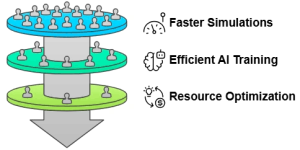
Generative AI as a Strategic Simulation Engine
In the context of trade negotiations, generative AI can:
- Simulate the likely reactions of multiple stakeholders to specific proposals
- Generate alternative wording and framing options for sensitive clauses
- Identify potential coalition formations and breaking points
- Model the domestic political constraints facing each negotiating party
When quantum game theory provides the mathematical structure and generative AI supplies rich behavioral simulation, the combined system offers unprecedented strategic foresight. Negotiators can test thousands of scenarios before entering the room, identify robust equilibria, and prepare contingency plans with far greater confidence. Related applications of AI in high-stakes decision environments are discussed in The Impact of Artificial Intelligence on Route Optimization and Carbon Emission Reduction.
How Quantum Game Theory and Generative AI Create a Powerful Hybrid System
Quantum game theory provides the mathematical backbone for modeling strategic uncertainty and entanglement, while Generative AI acts as a rich behavioral simulator. Together they form a next-generation strategic intelligence platform.
- Quantum models define the payoff structure and possible strategy spaces (including superposition and entanglement).
- Generative AI generates thousands of realistic opponent behaviors, domestic political constraints, and external shocks based on real-world data.
- Hybrid simulation runs variational quantum algorithms or quantum-inspired optimization to find robust equilibria that perform well under high uncertainty.
- Result: Negotiators receive not just one optimal strategy, but a range of resilient strategies with confidence intervals.
This combination is particularly powerful for long-cycle, multi-party negotiations such as those in the Gulf region, where energy, security, and economic interests are deeply entangled.
Application to Gulf Economic Agreements
The Gulf region presents an ideal test case for these advanced modeling techniques. Negotiations involving energy security, trade corridors, investment protection, and technology transfer are inherently multi-dimensional and characterized by high uncertainty. Quantum game theory combined with generative AI can help model:
- The strategic interplay between energy exporters and importers
- The impact of alternative infrastructure routing decisions
- The formation and stability of new economic partnerships
- The optimal sequencing of confidence-building measures
Such modeling does not replace human judgment but significantly enhances it by revealing non-intuitive strategic options and potential unintended consequences. For companies and governments engaged in Gulf economic initiatives, these tools offer a substantial advantage in preparation and scenario planning. Related risk management strategies for complex regional agreements are examined in Snapback Risk in the Iran-US-Israel Ceasefire: A Strategic Contract Management Guide for CEOs and Investors.
Real-World Use Cases in Gulf Economic Agreements
Here are concrete examples where quantum-AI negotiation modeling could deliver significant advantage:
- Energy-Technology Linkage: Modeling entangled strategies where OPEC+ production decisions are linked to technology transfer and investment in downstream industries.
- Trade Corridor Negotiations: Simulating multiple routing scenarios (e.g., IMEC vs Chinese Belt and Road extensions) and their impact on regional power balances.
- Climate-Energy Transition Deals: Finding robust equilibria in negotiations involving carbon border taxes, green hydrogen exports, and fossil fuel phase-down commitments.
- Multilateral Investment Protection: Modeling coalition stability among GCC countries, China, India, and Western partners in large infrastructure projects.
Implementation Roadmap for Organizations
Organizations seeking to incorporate quantum-inspired game theory and generative AI into their negotiation preparation can follow a phased approach:
Phase 1: Capability Assessment (Months 1–3)
Evaluate current negotiation preparation processes, data availability, and analytical capabilities. Identify high-value negotiation contexts where advanced modeling would deliver the greatest return.
Phase 2: Model Development and Training (Months 4–9)
Build or partner for custom models trained on relevant historical and contextual data. Validate models against known past outcomes.
Phase 3: Integration and Testing (Months 10–15)
Integrate modeling outputs into existing preparation workflows. Conduct controlled simulations and sensitivity analyses.
Phase 4: Live Application and Continuous Improvement (Year 2 onward)
Apply the system to live negotiation preparation. Establish feedback loops to continuously refine model accuracy and usefulness.
90-Day Quantum-AI Negotiation Readiness Checklist
Days 1–15: Foundation
- Assess current strategic foresight capabilities
- Identify priority negotiation contexts
- Assemble cross-functional modeling team
Days 16–45: Data and Model Building
- Compile relevant historical and contextual datasets
- Develop initial quantum game theory frameworks
- Train generative AI components on domain-specific scenarios
Days 46–75: Testing and Integration
- Run validation simulations against historical cases
- Integrate outputs into negotiation preparation workflows
- Train negotiators on interpreting model insights
Days 76–90: Refinement and Governance
- Establish feedback and continuous improvement mechanisms
- Develop governance protocols for responsible use of AI modeling
- Prepare documentation for internal audit and regulatory alignment
Recommended Tools and Technologies for Implementation
To start your quantum-AI negotiation capability, consider the following accessible tools:
- Quantum Programming: IBM Qiskit, Google Cirq, Xanadu Pennylane (for quantum-inspired algorithms)
- Generative AI Platforms: OpenAI GPT models, Anthropic Claude, or open-source Llama 3 fine-tuned on negotiation datasets
- Optimization & Simulation: Quantum-inspired solvers like D-Wave Ocean or classical libraries (Gurobi, CPLEX) with quantum annealing inspiration
- Data Integration: LangChain or LlamaIndex for connecting proprietary negotiation data with LLMs
Organizations do not need a full quantum computer — quantum-inspired algorithms running on classical GPUs often deliver 80-90% of the benefit today.
Current Limitations and Realistic Challenges
While promising, quantum-AI negotiation systems still face important constraints:
- Actual quantum hardware remains noisy and limited in scale (NISQ era).
- High-quality historical negotiation data is often scarce or classified.
- Model validation is challenging because real-world outcomes involve many unmodeled variables.
- Over-reliance on AI could reduce human intuition and creativity in diplomacy.
- Computational cost for large-scale entangled simulations can still be significant.
Therefore, the most successful implementations treat these tools as powerful decision-support systems rather than fully autonomous negotiators.
Ethical and Governance Considerations
The use of advanced AI and quantum-inspired modeling in diplomatic and commercial negotiations raises important ethical questions. Organizations should ensure transparency in how models are used, maintain human oversight for final decisions, and establish clear governance protocols that prevent misuse or over-reliance on automated insights.
Responsible deployment includes regular validation against real-world outcomes, bias detection in training data, and clear documentation of model assumptions and limitations. When used ethically and transparently, these tools can enhance rather than replace human judgment in complex negotiations.
Limitations and Challenges of Quantum Game Theory in Real-World Negotiations
Despite its promising advantages, applying quantum game theory combined with generative AI to trade negotiations faces several practical limitations in 2026:
- Hardware Constraints (NISQ Era): Current quantum computers are noisy and limited in qubit count. Most implementations today remain quantum-inspired algorithms running on classical hardware rather than full fault-tolerant quantum systems.
- Decoherence and Error Rates: Quantum states are fragile; environmental noise causes rapid decoherence, making long computations unreliable without sophisticated error correction.
- Scalability Issues: Simulating thousands of scenarios works well for simplified models, but scaling to highly complex multilateral negotiations with dozens of variables remains computationally expensive.
- Data Requirements: Generative AI components need high-quality, domain-specific historical negotiation data, which is often scarce or politically sensitive.
- Interpretability and Trust: Quantum outputs can be counter-intuitive. Decision-makers may hesitate to rely on “black-box” quantum-enhanced recommendations without clear explanations.
- Regulatory and Ethical Risks: Over-reliance on automated modeling could reduce human accountability in diplomatic processes.
Organizations should treat these tools as powerful augmentation rather than replacement for human judgment. Hybrid classical-quantum approaches currently offer the most realistic path forward.
Conclusion: A New Era of Strategic Foresight in Trade Diplomacy
The convergence of quantum game theory and generative artificial intelligence marks a significant evolution in how multilateral trade negotiations can be prepared and conducted. By moving beyond classical assumptions and embracing more sophisticated models of uncertainty and strategic interdependence, decision-makers gain powerful new capabilities for anticipation, preparation, and adaptive strategy formulation.
For governments and large enterprises engaged in complex economic diplomacy — particularly in strategically important regions such as the Gulf — these tools offer a meaningful advantage in an increasingly intricate global environment. The future belongs to those who combine human insight with advanced computational modeling while maintaining the highest standards of ethical governance and regulatory compliance.
As these technologies mature, they will likely become standard elements of high-stakes negotiation preparation. Organizations that begin building capabilities and governance frameworks today will be best positioned to navigate the strategic complexities of tomorrow’s economic landscape.
Platforms designed for advanced strategic modeling and compliant decision support provide essential infrastructure for responsible adoption of these powerful tools. Entities seeking to enhance their negotiation preparedness are encouraged to explore integrated solutions that combine cutting-edge analytics with rigorous governance and audit readiness.

