المدونة
2026 Bitumen Landed Cost Formula India: Stop Losing Margin to IGST
In 2026, India remains one of the world’s largest importers of bitumen, driven by massive infrastructure spending under programs like Bharatmala, PM Gati Shakti, and state-level road projects. Consumption hovered around 8.7–9 million metric tons (MT) in 2025–2026, with imports filling a significant portion of demand, especially for Viscosity Grade (VG) bitumen such as VG-10, VG-30, and VG-40. Major suppliers include Iran, the UAE, Saudi Arabia, and increasingly diversified sources from the Middle East and beyond.

Bitumen Landed Cost Formula India
For exporters, understanding the precise landed cost (also called the all-in or total cost to the Indian importer) is critical. This determines the maximum FOB or CIF price an importer can pay while maintaining viable margins. The landed cost formula incorporates the exporter’s base price, freight, insurance, customs valuation, Basic Customs Duty (BCD), Social Welfare Surcharge (SWS), and most importantly, Integrated Goods and Services Tax (IGST) at 18%.
In 2026, the standard duty structure for petroleum bitumen (HS Code 2713 20 00) is:
- Basic Customs Duty (BCD): 5% (effective rate via notifications, though the scheduled rate is higher in some references).
- Social Welfare Surcharge (SWS): 10% on the BCD amount.
- IGST: 18% applied on the cumulative value (CIF + BCD + SWS).
Additional costs include landing charges (typically 1% of CIF), port handling, clearing agent fees, inland transport, and compliance with new 2026 BIS quality standards (e.g., stricter penetration, softening point, and viscosity requirements). These can add 3–8% to the total landed cost.
IGST is the single largest tax component and a major profit-margin eroder. On a typical $450/MT CIF cargo, IGST alone can exceed $90–100/MT. Combined with BCD and SWS, total duties and taxes often reach 25–30% of the CIF value. This compresses importer margins and forces exporters to absorb part of the burden through lower FOB pricing, directly impacting exporter profitability.
This 5000+ word guide provides the exact formula, step-by-step calculations with real 2026 numbers, sensitivity analysis, port-specific comparisons (Kandla vs. Mumbai vs. others), shipment method differences (bulk tanker, bitutainer, drums), and actionable strategies to protect margins. It draws on current regulatory data, market trends, and practical exporter experiences.
Why Indian Jewelers Are Flocking to DMCC in 2026
1. India’s Bitumen Market in 2026: Demand Drivers and Import Dynamics
India’s road network expansion continues at pace. The country added thousands of kilometers of national highways annually, with bitumen demand tied closely to asphalt mixing for flexible pavements. In 2025, consumption reached approximately 8.74 million MT, up 4% year-on-year, though growth moderated from the 2023 peak due to funding constraints on new projects. 2026 projections show similar modest growth (3–5%), driven more by maintenance and rehabilitation than greenfield projects.
Domestic refiners (IOCL, BPCL, HPCL, and private players) produce a large share, but quality consistency, regional shortages, and price competitiveness keep imports vital, especially on the west coast. Kandla (Deendayal Port) dominates bitumen imports due to its liquid cargo infrastructure, deep draft, and proximity to key consuming states like Gujarat, Rajasthan, and Madhya Pradesh. Other key ports include Mumbai (JNPT/Nhava Sheva), Mundra, Chennai, and Paradip.

India’s Bitumen Market in 2026
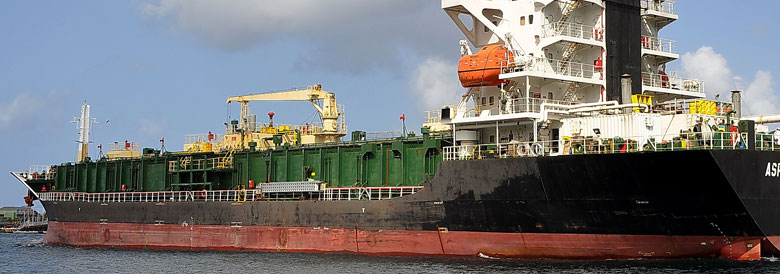
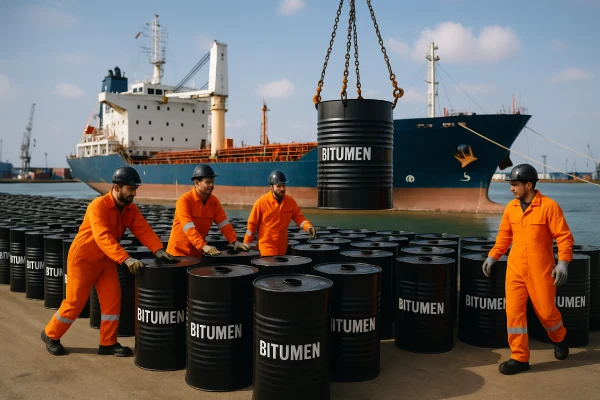
Imports primarily arrive in bulk tankers (most cost-effective), flexi-tanks/bitutainers, or steel drums. Bulk shipments benefit from lower per-ton freight and handling but require heated storage and specialized discharge facilities. New 2026 BIS quality standards (IS 73 for paving bitumen) emphasize performance grading, with stricter limits on impurities, ductility, and temperature susceptibility. Non-compliant cargoes face rejections or demurrage, adding hidden costs.
Top origins in recent years: Iran (price-competitive but subject to geopolitical risks and potential routing via UAE), UAE (re-export hub with better documentation), Saudi Arabia, and smaller volumes from Singapore, South Korea, and others. Freight from the Persian Gulf to west India typically ranges $25–45/MT in 2026, influenced by tanker availability, bunker prices, and Red Sea/Suez routing disruptions.
Rupee + Dirham = Millions Saved for Indian Traders
2. Regulatory Framework and HS Code Classification
The primary HS Code for petroleum bitumen is 2713 20 00 — “Petroleum bitumen”. Natural bitumen falls under 2714, but the vast majority of traded volumes are petroleum-derived.
Duty Structure (as of February 2026):
- Basic Customs Duty (BCD): Effective 5%.
- Social Welfare Surcharge: 10% of BCD.
- IGST: 18% on (CIF value + BCD + SWS).
- No additional CVD or specific cess in standard cases, though anti-dumping or safeguard duties can apply in specific scenarios (none broadly active for bitumen in early 2026).
Assessment Rules:
- Assessable value = CIF + Landing charges (generally 1% of CIF, though many calculations simplify to CIF for estimation).
- Duties are ad valorem (percentage of value).
- Importers can claim input tax credit (ITC) on IGST paid, which mitigates the cash flow impact but does not reduce the landed cost for pricing negotiations.
New 2026 quality standards require exporters to provide detailed test certificates (penetration, softening point, viscosity at 60°C, ductility, etc.). Failure to meet VG grading or new performance criteria can lead to customs holds, laboratory testing fees, and potential re-export costs.
Compliance also involves BIS certification for certain grades, phytosanitary/fumigation if applicable (rare for bitumen), and proper shipping documents (Bill of Lading, Certificate of Origin, Invoice, Packing List, Quality Certificate).
Mundra to Jebel Ali 2026: Bulk vs Container – Real Costs Revealed
3. The Landed Cost Formula: Step-by-Step Calculation
إن total landed cost per metric ton at an Indian port is the sum of all costs from the exporter’s facility to the importer’s warehouse or project site. The core formula is:
Landed Cost = CIF Value + Customs Duties & Taxes + Port & Handling Charges + Inland Transportation + Compliance & Miscellaneous Costs

The Landed Cost Formula
Detailed Breakdown and Formula
Step 1: Determine Base Value
- Ex-works or FOB price from exporter (e.g., $400/MT from Iran/UAE).
Step 2: Add Freight and Insurance → CIF
- Ocean freight: $25–45/MT (bulk tanker, Persian Gulf to Kandla/Mumbai).
- Insurance: 0.1–0.5% of (FOB + Freight), typically ~$1–3/MT.
- Example: FOB $400 + Freight $35 + Insurance $2 = CIF $437/MT.
Step 3: Calculate Customs Duties (on Assessable Value)
- Assessable Value (AV) ≈ CIF + 1% landing charge = $437 + $4.37 = $441.37/MT.
- BCD = 5% × AV = 0.05 × 441.37 = $22.07/MT.
- SWS = 10% × BCD = 0.10 × 22.07 = $2.21/MT.
- Value for IGST = AV + BCD + SWS = 441.37 + 22.07 + 2.21 = $465.65/MT.
- IGST = 18% × Value for IGST = 0.18 × 465.65 ≈ $83.82/MT.
- Total Customs Duties & Taxes = BCD + SWS + IGST = 22.07 + 2.21 + 83.82 = $108.10/MT.
Step 4: Add Other Port and Local Costs
- Port handling/wharfage: $8–15/MT (varies by port; Kandla often lower for bulk liquids).
- Customs clearing agent & documentation: $3–6/MT.
- Demurrage/detention risk buffer: $2–5/MT.
- Inland transport to depot or site: $15–40/MT (depending on distance; e.g., Kandla to Ahmedabad cheaper than to Delhi).
Step 5: Total Landed Cost
- In the example: CIF $437 + Duties $108.10 + Other port/local $25–40 = $570–585/MT at importer’s facility.
This landed cost must be compared against domestic refinery prices (often ₹48,000–51,000/MT or ~$570–610/MT) and the importer’s selling price to road contractors.
Impact of IGST: At 18%, IGST constitutes ~77% of the total duty burden in the example ($83.82 out of $108.10). It is the dominant factor. A 1% increase in effective duty rate can reduce importer willingness to pay by $4–6/MT at the FOB level, directly squeezing exporter margins.
Basmati Rice Hits Record Highs in Saudi – Profit Playbook
4. Sensitivity Analysis: How Duties Affect Profit Margins
Assume an exporter’s production + export overhead cost is $320/MT and target net margin is 15% ($48/MT profit), implying a desired FOB of $368/MT.

How Duties Affect Profit Margins
Scenario 1: Base Case (CIF $437, Duties $108)
- Importer’s maximum affordable FOB (to achieve their margin) might be $390–410/MT.
- Exporter realizes $380 FOB → Profit $60/MT (strong).
Scenario 2: Higher Freight ($50/MT) + Same Duties
- CIF rises to $452 → Duties rise to ~$111 → Landed cost higher.
- Importer pushes FOB down to $375 → Exporter profit drops to $55/MT.
Scenario 3: Hypothetical BCD Increase to 10% (or new duty layer)
- BCD $44.14, SWS $4.41, IGST ~$89 → Total duties ~$137.55.
- Landed cost jumps ~$29/MT → Importer demands $30–35 lower FOB.
- Exporter profit erodes by 50%+ or turns negative unless costs are cut.
IGST-Specific Impact:
- Because IGST is applied on the duty-inclusive value, it has a compounding effect. Every $1 increase in BCD raises the IGST base and adds ~$0.18 in extra IGST.
- For high-volume exporters (10,000 MT/month), a 2% effective duty increase can cost hundreds of thousands of dollars in lost revenue annually.
Port comparison:
- Kandla: Lower handling (~$8–12/MT), faster discharge for bulk, lower demurrage risk. Preferred for west coast.
- Mumbai/JNPT: Higher congestion, higher charges ($12–18/MT), but better connectivity to interior.
- Chennai/Paradip: Higher freight from Gulf, suitable for east coast projects.
Shipment method impact:
- Bulk tanker: Lowest cost/ton, but requires dedicated heated tanks.
- Bitutainers/Flexi-bags: $15–30/MT premium over bulk, easier for smaller buyers.
- Drums: Highest cost ($40–70/MT extra due to packaging, labor, disposal), used for remote or small-volume markets.
Bitumen Triangle 2026: Why These 3 Countries Control the Asphalt Game
5. Strategies to Mitigate Duty Impact and Protect Margins
- Optimize Origin and Routing: Load from UAE re-export hubs to reduce perceived risk and sometimes benefit from smoother documentation, though freight may rise $10–20/MT.
- Incoterms Negotiation: Offer CFR or CIF to major ports to control freight and build relationships, but calculate carefully. Many importers prefer FOB to manage their own logistics.
- Volume Commitments and Long-Term Contracts: Secure annual contracts with fixed or formula-based pricing (linked to crude benchmarks) to stabilize margins.
- Quality Premium: Supply bitumen exceeding 2026 BIS standards (e.g., polymer-modified or high-performance VG) to command $10–30/MT premium, offsetting duties.
- Port and Logistics Optimization: Route to Kandla for west-bound cargo. Partner with efficient freight forwarders and clearing agents to minimize demurrage.
- Hedging and Finance: Use currency hedges (USD-INR) and trade finance tools to protect against volatility.
- Value-Added Services: Provide technical support, application training, or joint testing to justify higher pricing.
- Explore FTAs: Limited direct benefit for bitumen, but indirect via UAE or other hubs.
- Digital Tools: Use platforms like Tendify’s India Duty Calculator to run real-time scenarios and share transparent landed cost breakdowns with buyers.
Strategies to Mitigate Duty Impact and Protect Margins
6. Case Studies
Case 1: Iranian Exporter to Kandla (Bulk, 5,000 MT Shipment) FOB Bandar Abbas $385/MT. Freight $32/MT. CIF ~$419. Duties ~$103. Landed ~$555/MT. Sold to importer at effective $395 FOB equivalent. Margin healthy due to low freight.
Case 2: Drum Shipment to Interior Buyer Higher packaging and inland costs push landed to $620+/MT. Exporter had to drop FOB significantly; margin compressed to single digits. Lesson: Reserve drums for niche, high-margin markets only.
Case 3: Impact of Geopolitical Routing Due to routing via UAE, freight rose $35/MT. Total landed increased $40/MT. Exporter absorbed $15/MT and passed $25/MT to buyer, reducing margin by 30%.
7. Risks and Outlook for 2026–2027
Key risks: Crude oil volatility (bitumen prices correlate strongly), INR depreciation (increases landed cost in rupee terms), policy changes (potential duty tweaks in future budgets), and new sustainability/ESG requirements (bio-bitumen blends gaining traction to reduce import dependence).
Positive outlook: Continued infrastructure push, potential duty rationalization on inputs, and growing demand for high-quality imported grades.
Saudi’s $164B Housing Surge: Export Smart Construction Materials Now
Conclusion and Recommendations
The landed cost formula for bitumen in Indian ports in 2026 is straightforward yet highly sensitive to IGST (18%) and compounding effects. Exporters who master the calculation, choose optimal ports and shipment methods, and maintain transparent communication with importers will protect and even expand margins.
Key Recommendations:
- Always run landed cost simulations before quoting.
- Prioritize Kandla for bulk west coast deliveries.
- Invest in quality certification to meet 2026 standards.
- Build long-term buyer relationships to share duty burdens fairly.
- Monitor budget announcements and use tools like duty calculators for agility.
By treating duties not as a fixed cost but as a variable to optimize around, exporters can turn the Indian market into a high-volume, profitable destination even in a high-tax environment.