


المدونة
Saudi Multimodal Logistics: Red Sea to Gulf in 48 Hours
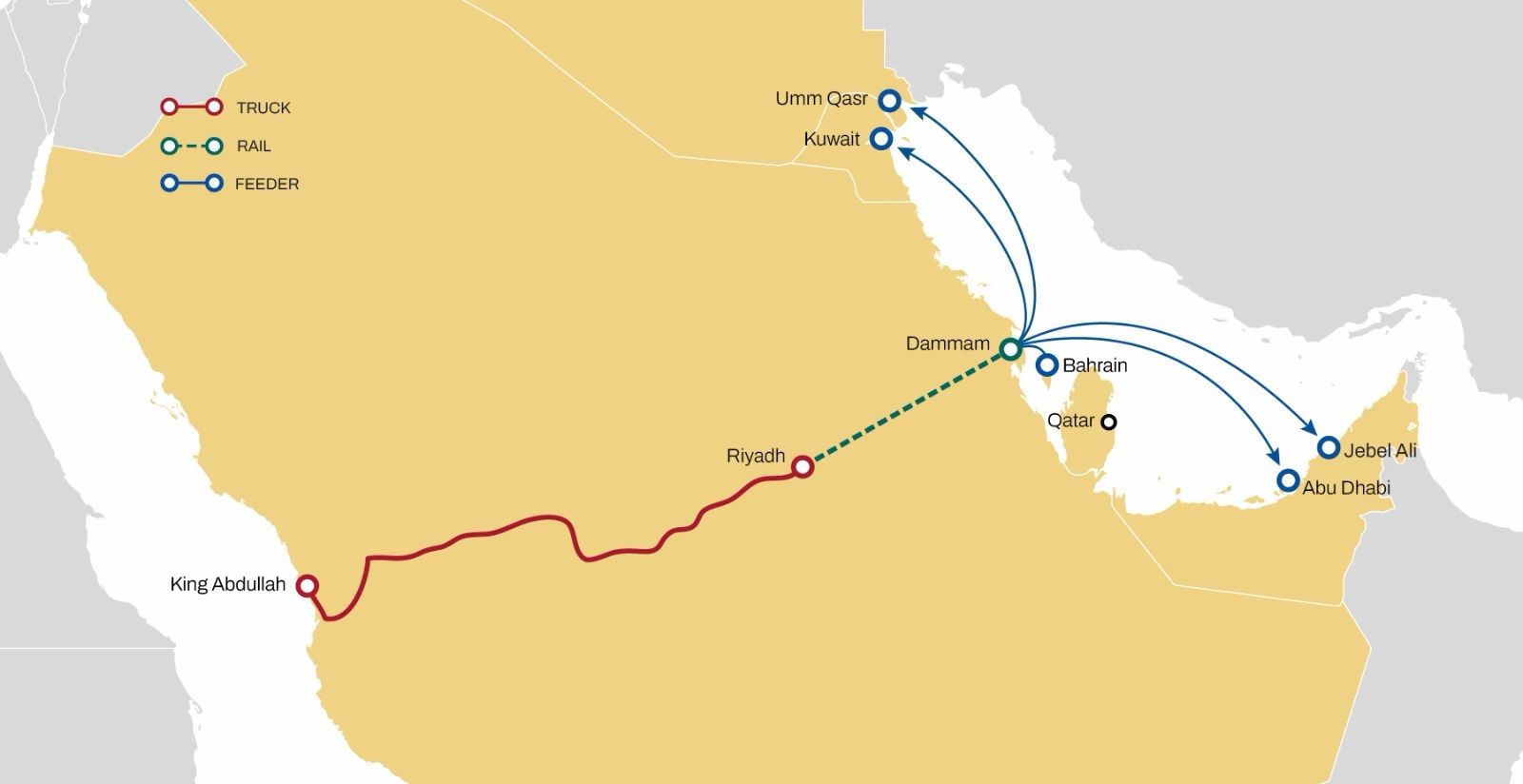
A container lands at King Abdullah Port on the Red Sea. Within hours it is cleared, moved inland by rail or road through Riyadh Dry Port, and arrives at King Abdulaziz Port in Dammam ready for feeder vessels serving Gulf destinations. That sequence is no longer theoretical. MSC Saudi, working with MAWANI, Saudi Arabia Railways (SAR), and ZATCA, has launched the Kingdom’s first fully integrated multimodal transshipment service linking the western Red Sea coast directly with the eastern Gulf coast.
The inaugural shipment has already completed the journey successfully. Operated by MEDLOG, the corridor combines road and rail connectivity via Riyadh Dry Port and delivers true door-to-door capability for transshipment cargo. For supply-chain managers moving goods between Asia, Europe, Africa, and the broader GCC, this is more than an incremental service. It is a structural upgrade to the region’s logistics backbone.
Why This Corridor Matters Now
Regional trade flows have faced repeated pressure from port congestion, shifting carrier schedules, and the need for alternative routings that avoid traditional maritime chokepoints. Importers and exporters operating across the GCC have long needed reliable inland options that turn Saudi Arabia’s dual-coast geography into an operational advantage rather than a distance penalty.

Saudi Multimodal Logistics
Operational assessments across the supply chain show that single-mode reliance—whether pure sea feeder or pure trucking—creates bottlenecks when volumes surge or when one gateway becomes constrained. The new corridor addresses that vulnerability by giving shippers genuine choice of entry port on the Red Sea side and a seamless transfer path to the Gulf side.
🌍 Geopolitical Strategic Context: Bypassing Red Sea & Bab al-Mandab Disruptions
The commercial launch of this Saudi transshipment corridor comes at a critical juncture for global shipping. Prolonged maritime insecurity in the southern Red Sea and the Bab al-Mandab Strait has forced major ocean carriers to reroute mainline Asia–Europe container vessels around the Cape of Good Hope, adding 10 to 14 days to transit schedules and driving up war-risk premiums and fuel surcharges across GCC trade lanes.
⚓ Dual-Chokepoint Avoidance Mechanism
By utilizing Red Sea entry ports (King Abdullah Port or Jeddah Islamic Port) and immediately transferring cargo via SAR rail to Dammam, shippers effectively bypass two high-risk maritime choke points simultaneously:
- Southern Red Sea & Bab al-Mandab: Vessels discharging on Saudi Arabia’s upper Red Sea coast avoid entering high-risk conflict zones in the southern strait.
- Strait of Hormuz: Cargo bound for eastern GCC markets (UAE, Qatar, Bahrain, Kuwait) moves securely via internal Saudi rail/road links to Gulf feeder terminals, mitigating vulnerability to Persian Gulf maritime escalation.
Supply Chain Resilience Impact: For regional trade networks, this land-bridge is not merely an alternative route—it functions as a vital national insurance policy, maintaining predictable inventory flows into major GCC commercial centers even during severe maritime crisis scenarios.
MAWANI’s broader Logistics Corridors Initiative and SAR’s expansion of freight routes provide the public-sector foundation. ZATCA’s role in streamlining customs procedures ensures the regulatory layer keeps pace with the physical movement of containers. The result is a coordinated ecosystem rather than a collection of disconnected legs.
How the Corridor Actually Works
The operational sequence is straightforward yet tightly integrated:
- Mainline vessels discharge at either King Abdullah Port or Jeddah Islamic Port on the Red Sea.
- Containers move inland via a combination of rail and road, centered on Riyadh Dry Port as the key intermediate node.
- From Riyadh, cargo continues to King Abdulaziz Port in Dammam.
- At Dammam, containers transfer to feeder vessels or continue by road for final delivery across the Kingdom or into neighboring GCC markets.
- MEDLOG coordinates the entire inland leg, including documentation, equipment, and door-to-door delivery options.
Transit times on the inland segment are measured in days rather than weeks. Indicative road distances from King Abdullah Port run approximately 946 km to Riyadh and 1,354 km to Dammam; from Jeddah the figures are slightly longer. Rail capacity on the Dammam–Riyadh corridor, already used for significant container volumes, adds scale and reduces road congestion.
Estimated Transit Times & Corridor Efficiency
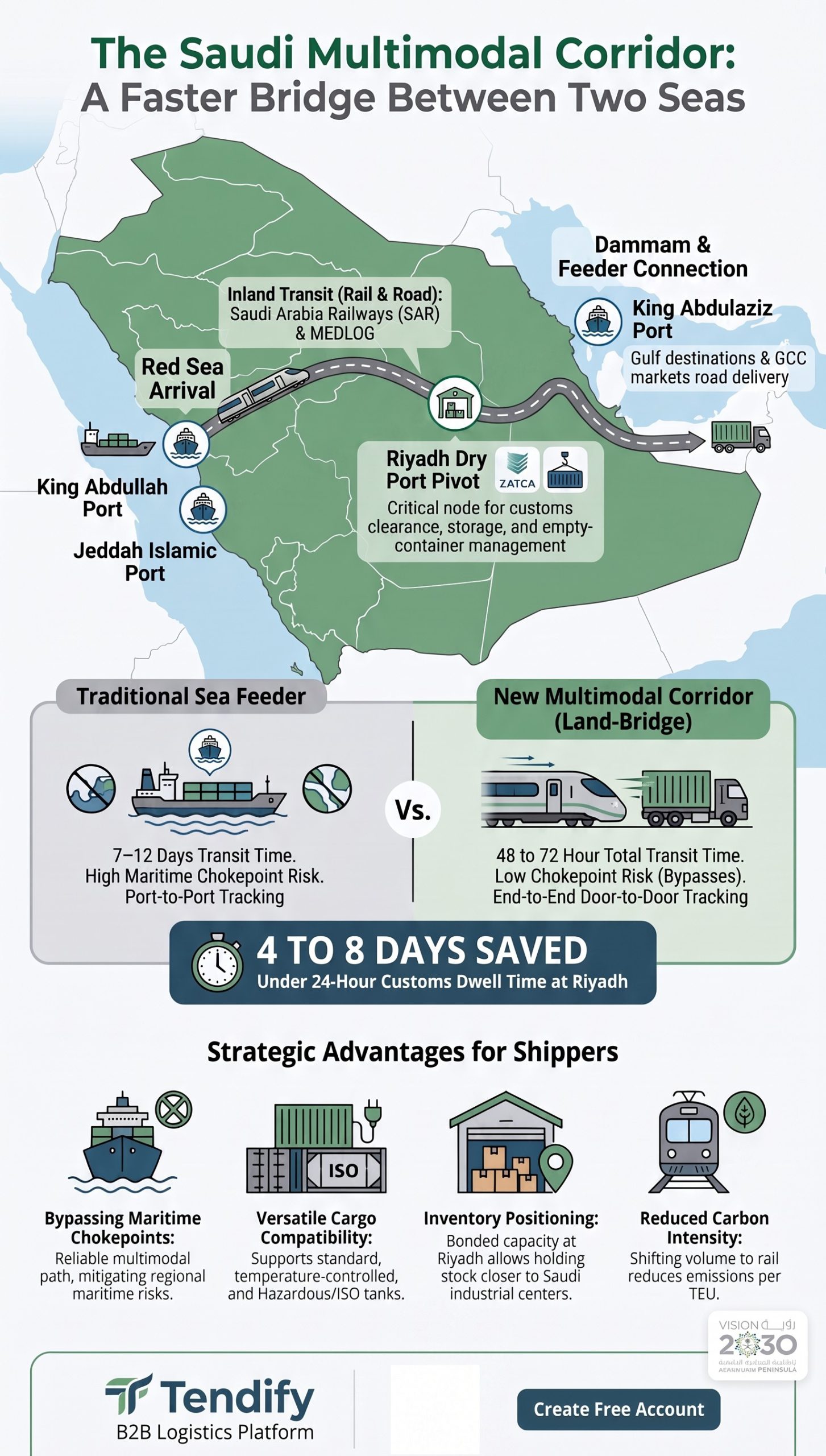
While sea-feeder routes routing around the Arabian Peninsula can take between 7 to 12 days depending on port calls and maritime congestion, the land-bridge multimodal corridor significantly compresses elapsed transit times:
- Total Inland Transit (Red Sea to Gulf Port): Estimated 48 to 72 hours end-to-end (including rail transfer and intermediate handling at Riyadh Dry Port).
- Direct Express Road Haulage: Approximately 24 to 36 hours driving/operating time between King Abdullah Port/Jeddah and Dammam.
- Pre-Cleared Customs Dwell Time: Accelerated ZATCA procedures target a reduction of terminal dwell times at Riyadh Dry Port to under 24 hours for bonded transshipment units.
⚖️ Cost vs. Time Trade-Off: Is the Multimodal Premium Worth It?
While opting for an integrated land-bridge corridor introduces an estimated 10% to 20% freight rate premium compared to traditional pure-ocean feeder services, commercial evaluation demonstrates a net financial advantage for high-value and time-sensitive supply chains.
The Bottom Line for CFOs & Supply Chain Leads: The accelerated 4 to 8-day time-to-market directly reduces inventory carrying costs (ICC) and eliminates costly port demurrage penalties. For high-value commodities, electronics, fast-moving consumer goods (FMCG), and urgent project cargo, the total cost of logistics (TCL) using the multimodal corridor is often lower overall despite the higher upfront freight rate.
Riyadh Dry Port functions as more than a transfer point. It offers bonded facilities, customs clearance, storage, and empty-container management. This inland capability shortens dwell times at the coastal ports and allows shippers to stage cargo closer to final markets or industrial zones.
MEDLOG’s existing infrastructure—including the MEDLOG 1 integrated logistics park at King Abdulaziz Port with over 100,000 square meters and capacity exceeding 300,000 TEUs annually—anchors the eastern end of the corridor. Similar investments on the western side further tighten the network.
Container Compatibility & Specialized Cargo Scope
While initial operational trials successfully established proof-of-concept using standard dry containers, full-scale commercial adoption relies heavily on handling diverse cargo profiles across the rail-road matrix. The corridor’s technical infrastructure is engineered to scale across multiple container categories:
- Temperature-Controlled Cargo (Reefer Units): Continuous cold-chain integrity is maintained through dedicated power-plug points at Riyadh Dry Port and mobile genset capacity on both rail platforms and long-haul trucks, serving pharmaceutical and food imports.
- Hazardous & Chemical Logistics (DG & ISO Tanks): Compliance frameworks managed via ZATCA and civil defense protocols allow movement of classified industrial chemicals, leveraging specialized handling capacity at MEDLOG logistics hubs.
- Heavy & Out-of-Gauge (OOG) Freight: Rail flatcars and heavy-lift road equipment are integrated into the booking matrix to support capital equipment and energy-sector project cargo.
Strategic Alignment with National Logistics Goals
The corridor sits squarely inside the National Transport and Logistics Strategy and Vision 2030 targets. Those strategies aim to raise the logistics sector’s contribution to GDP, expand port and rail capacity, improve the Kingdom’s ranking on the Logistics Performance Index, and position Saudi Arabia as a global hub connecting three continents.
Concrete infrastructure progress supports the ambition. Port capacity continues to expand across both coasts. Rail freight routes have multiplied, with SAR launching additional logistics corridors that link Gulf ports to central and northern regions and ultimately to Red Sea gateways. Free storage periods at Riyadh Dry Port have been extended in some cases to give operators more flexibility in managing inventory.
Saudi Multimodal Corridor Logistics
Private-sector participation has been decisive. Long-term partnerships between global carriers, terminal operators, and national authorities have produced dedicated logistics parks, specialized equipment, and digital tracking capabilities. The multimodal transshipment service is the latest expression of that collaboration.
Practical Benefits for B2B Shippers and Traders
For companies moving containers between Asia or Europe and GCC markets, the corridor changes several cost and risk variables:
- Port choice flexibility. Congestion or schedule disruption at one Red Sea gateway no longer forces a complete re-routing. Cargo can shift between King Abdullah Port and Jeddah Islamic Port while retaining the same inland corridor.
- Reduced exposure to maritime chokepoints. By converting a pure sea leg into a multimodal path, shippers gain an alternative that keeps goods moving even when traditional Gulf approaches face constraints.
- Door-to-door visibility. MEDLOG’s control of the inland segment, combined with GPS-enabled trucking and rail tracking, improves real-time status for both full and empty containers.
- Lower carbon intensity on high-volume lanes. Shifting a portion of volume from pure trucking to rail on the Dammam–Riyadh segment reduces emissions per TEU and eases pressure on the road network.
- Inventory positioning. Bonded capacity at Riyadh Dry Port allows importers to hold stock closer to industrial and consumer centers without tying up coastal terminal space.
Experiences from earlier intermodal expansions show that once rail and road capacity are reliably linked to customs processes, average transit reliability improves and demurrage exposure declines. The inaugural shipment on this corridor confirmed operational readiness; scaling will depend on consistent equipment availability and continued coordination among the four main partners.
📦 Incoterms® 2020 Selection Guide for Land-Bridge Trade
A frequent operational pitfall in multimodal logistics is using legacy maritime Incoterms (such as CIF, CFR, or FOB) for goods moving across combined sea, rail, and road segments. Under ICC guidelines, traditional sea terms transfer cost and risk strictly at the port of loading or vessel rail, creating legal ambiguity when cargo transfers inland to rail hubs like Riyadh Dry Port.
Contracting Checklist for B2B Buyers: Avoid using CIF Dammam when shipping via Red Sea land-bridge corridors. Instead, specify “DAP Riyadh Dry Port (Incoterms 2020)” in your Proforma Invoices and Purchase Orders. This ensures the ocean carrier’s multimodal contract fully extends risk liability through the rail link.
Operational Considerations and Execution Steps
Shippers evaluating the service should treat it as a managed multimodal product rather than a simple port-to-port booking.
🛡️ Legal Liability, Insurance & Incoterms Integration
Transitioning cargo across sea, rail, and road legs creates multi-jurisdictional liability complexity if relying on fragmented transport contracts. Under traditional unimodal documentation, handed-off risks between rail operators (SAR), port terminals (MAWANI), and ocean carriers frequently lead to disputed claims in the event of cargo damage, theft, or transit delays.
📜 Unified Carrier Liability via Combined Transport Bill of Lading (CTBL)
By issuing a single Multimodal Transport Document (MTD) أو Combined Transport Bill of Lading (CTBL) through MEDLOG as the sole Multimodal Transport Operator (MTO), door-to-door liability is fully unified. Shippers maintain a single point of recourse from origin port discharge all the way to destination delivery, eliminating liability gaps between sea feeder and inland rail segments.
🔒 Marine & Transit Cargo Insurance Efficiency
Standard ocean marine cargo insurance policies often require specific endorseable extensions for inland rail and road transit. A single-operator MTD simplifies marine risk underwriting, enabling B2B traders to secure comprehensive, seamless insurance coverage at lower premium rates due to continuous GPS asset-tracking and bonded custody transfer protocols.
🌐 Recommended Incoterms 2020 Adjustments
Traditional maritime terms like فوب أو CIF/CFR are ill-suited for intermodal land-bridges as risk transfers at the ship’s rail rather than inland nodes. Traders utilizing this corridor should adjust commercial contracts to intermodal-native terms:
- FCA (Free Carrier) – King Abdullah / Jeddah Port: Risk transfers once containers are handed over to MEDLOG at the Red Sea gateway.
- DAP (Delivered at Place) – Riyadh Dry Port / Dammam Hub: The seller manages end-to-end multimodal transport up to the designated inland bonded hub before import customs clearance.
- DPU (Delivered at Place Unloaded): Ideal for capital goods and project cargo requiring terminal offloading directly at inland industrial zones.
Pro Tip for Tendify Traders: Always verify that your Proforma Invoices and Letters of Credit (L/C) accept a “Multimodal / Combined Transport Bill of Lading” rather than requiring a traditional “Clean On-Board Ocean Bill of Lading” to prevent banking documentation mismatches during LC negotiation.
Key execution points include:
- Confirming whether carrier haulage or merchant haulage will be used for the inland leg.
- Aligning documentation so that ZATCA clearance can occur at the dry port or coastal terminal as required.
- Planning empty-container returns through the same corridor to maintain equipment balance.
- Coordinating with MEDLOG early for specialized cargo (reefer, ISO tanks, out-of-gauge) that benefits from the integrated logistics parks.
- Monitoring dwell times at Riyadh Dry Port and adjusting free-time agreements accordingly.
Capacity on the rail segment has grown through successive contracts between carriers and SAR. Road capacity remains robust but benefits from the diversion of containers onto rail. Both modes are designed to operate in parallel, giving operators the ability to switch according to volume spikes or equipment availability.
Broader Implications for GCC and Cross-Border Trade
The corridor strengthens Saudi Arabia’s role as a transit and distribution platform for the wider GCC. Cargo arriving on the Red Sea can reach Dammam and then continue by feeder to other regional ports, or move by road into neighboring markets. The same infrastructure supports export flows in the opposite direction—Saudi industrial production and re-exports moving westward toward Red Sea mainline services.
In regional supply-chain analysis, dual-coast connectivity reduces the single-point-of-failure risk that pure maritime networks carry. When one coast experiences elevated volumes or temporary constraints, the inland corridor provides a pressure-relief valve. That resilience is especially valuable for just-in-time manufacturing, retail distribution, and project cargo serving large-scale industrial developments.
Digital integration across MAWANI systems, SAR freight platforms, and ZATCA clearance processes further compresses administrative lead times. Pre-clearance capabilities and risk-based inspection models already in use at major ports become more powerful when the inland leg is fully visible and controlled.
⚠️ Operational Bottlenecks & Scaling Realities
While the successful inaugural transshipment validates the corridor’s operational framework, scaling container volumes from trial runs to high-density commercial operations presents several operational bottlenecks that supply chain leaders must factor into their routing models:
As Riyadh functions as both the primary consumption hub and the central transshipment clearing node, unexpected volume spikes during peak trading quarters (e.g., pre-Ramadan or Q4 retail surges) can stretch yard handling capacity and extend container dwell times.
Intermodal efficiency relies entirely on Saudi Arabia Railways (SAR) maintaining continuous locomotive and flatcar availability. Rapid shifts from sea to rail could create equipment imbalances between Red Sea discharge ports and inland hubs if empty container repositioning is not tightly managed.
While rail handles the heavy long-haul volume between Riyadh and coastal ports, final door-to-door delivery relies heavily on trucking fleets (MEDLOG). High diesel demand, driver allocation, and highway border clearance with neighboring GCC states remain active execution variables.
Mitigation Strategy: Shippers should establish Service Level Agreements (SLAs) with MEDLOG that include guaranteed rail slot allocations and pre-booked bonded storage windows at Riyadh Dry Port during peak seasonal windows.
Looking Ahead: Scaling the Network
The current service focuses on the core Red Sea–Riyadh–Dammam axis. Future expansion will likely incorporate additional SAR freight corridors, more dedicated rail slots, and deeper integration with logistics parks under development across the Kingdom. Investments already committed to container terminals, dry ports, and multimodal hubs create the physical foundation for higher volumes.
Carriers and logistics providers that embed this corridor into their standard product offerings will be able to quote more predictable end-to-end transit times and offer customers genuine routing options. For importers and exporters, the practical test will be consistency of equipment, reliability of rail schedules, and the continued alignment of customs procedures with the physical movement of cargo.
The successful inaugural shipment demonstrates that the operational model works. The next phase is volume growth and continuous refinement of the interfaces between sea, rail, road, and customs.
For companies building long-term supply-chain strategies in the region, understanding and utilizing this corridor is no longer optional. It is becoming a core capability for resilient, cost-effective movement of goods across one of the world’s most strategically located trade landmasses.
Platforms that aggregate real-time capacity, documentation support, and multimodal booking options can further reduce friction for mid-sized traders who lack dedicated logistics teams. Tools available through Platform.Tendify.Net illustrate how digital marketplaces can surface these corridor options alongside traditional ocean and air products, helping buyers and sellers match capacity with actual demand.
Related reading on the evolution of regional logistics includes analysis of Saudi port expansion strategies and the role of dry ports in inland clearance efficiency. See also coverage of rail freight network growth and multimodal best practices for GCC trade lanes at Secure Green Land Corridor: The New Saudi–Oman Supply Chain و Etihad Rail Abu Dhabi–Fujairah: Cutting GCC Logistics Costs
The Kingdom’s first integrated multimodal transshipment service is now live. The operational foundation is in place. The competitive advantage will belong to those who incorporate it systematically into their routing decisions and inventory strategies.
الأسئلة الشائعة (FAQ)
1. How much transit time do I save by using this multimodal corridor compared to pure sea routing?
By bypassing the traditional maritime route around the Arabian Peninsula, shippers save approximately 4 to 8 days. Total land-bridge transit between Red Sea ports (Jeddah/King Abdullah) and Dammam typically takes 48 to 72 hours, compared to 7–12 days on traditional ocean feeder services.
2. Where does customs clearance take place for transshipment cargo?
Under the integrated ZATCA framework, cargo can move under bonded transit directly from the coastal port of discharge to Riyadh Dry Port or the destination port in Dammam. Clearance procedures are streamlined through pre-clearance and risk-based inspection protocols, minimizing terminal dwell times.
3. Can cold-chain (Reefer) and hazardous cargo (DG/ISO tanks) utilize this rail-road service?
Yes. The corridor infrastructure includes power-plug points at Riyadh Dry Port and genset-equipped rail flatcars/trucks to maintain cold-chain integrity for temperature-sensitive goods. Hazardous materials (Dangerous Goods) and ISO tanks are supported subject to standard ZATCA and Saudi Civil Defense approvals.
4. Who manages the inland haulage leg and end-to-end documentation?
The inland movement—combining road haulage and Saudi Arabia Railways (SAR) rail capacity—is managed directly by MEDLOG. This single-operator arrangement provides shippers with unified documentation, equipment allocation, and continuous door-to-door tracking.
5. How can B2B traders quote and book capacity on this multimodal corridor via Tendify?
Traders and logistics managers can access real-time corridor options, compare multimodal timelines against traditional ocean feeder rates, and coordinate documentation directly through Platform.Tendify.Net.

