


المدونة
Secure Green Land Corridor: The New Saudi–Oman Supply Chain

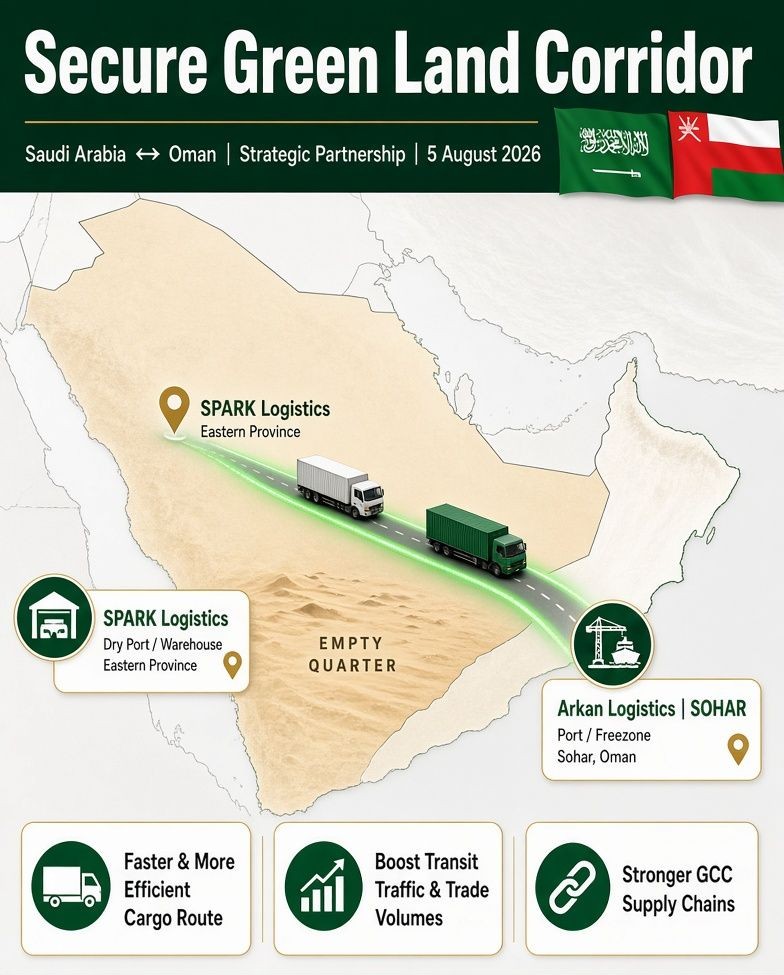
A single agreement signed in early August 2026 between two logistics operators turned an existing desert highway into an operational freight artery. Oman’s Arkan Logistics and Saudi Arabia’s SPARK Logistics formalized the Secure Green Land Corridor, activating commercial trucking across the Rub’ al Khali Highway. The route links Sohar Port and related Omani gateways on the Gulf of Oman and Arabian Sea to SPARK’s dry-port facilities in Saudi Arabia’s Eastern Province. The physical road already existed. The new layer is coordinated border processing, scheduled freight services, and the explicit intent to move higher volumes of commercial cargo while reducing dependence on longer maritime legs and third-country transit.
| Trade Route Metric | Traditional Path (via UAE Transit) | Direct Route (Secure Green Land Corridor) |
|---|---|---|
| Total Route Distance | Extended path (+800 km longer) | ~725 km (Direct cross-border connection) |
| Total Transit Duration | Extended transit with double border delays | 14 to 18 Hours Faster |
| Third-Country Tariffs & Fees | Subject to UAE transit tariffs & duplicate border duties | 100% Eliminated (Zero third-country transit fees) |
| Landed Cost Savings | Baseline benchmark | 20% to 30% Overall Cost Reduction |
Secure Green Land Corridor
The numbers attached to the underlying infrastructure remain striking. The Saudi section runs 564 km from the Batha–Haradh intersection to the Empty Quarter border post. Construction cost approximately $533 million. Crews logged more than 3.3 million work hours, deployed 750 pieces of heavy equipment selected for extreme desert conditions, removed roughly 150 million cubic meters of sand, placed 12 million cubic meters of sand-protection materials, and laid about one million cubic meters of asphalt. The full cross-border connection measures roughly 725 km when the Omani segment is included. Before this highway opened, every overland journey between the two countries had to transit the United Arab Emirates, adding distance, time, and an extra set of border formalities.
Operational assessments of regional supply chains show that the corridor now offers a measurable alternative for certain freight categories. Travel distance drops by hundreds of kilometers compared with the previous UAE-routed path. Transit time for suitable cargoes can fall by 14–18 hours under normal conditions. For shippers moving construction materials, fertilizers, foodstuffs, industrial goods, and project cargo, those hours translate into lower inventory carrying costs and more predictable delivery windows.
Strategic Update • August 2026
Commercial Operationalization Agreement Signed
In August 2026, a milestone commercial logistics agreement was formally signed between Oman’s Arkan Logistics and Saudi Arabia’s SPARK Logistics. This strategic partnership officially transforms the Rub’ al Khali Highway from a static physical highway infrastructure into a fully operational, commercial-grade freight corridor designed for streamlined cross-border trade.
Strategic Geography: Direct Access Beyond Traditional Maritime Gateways
The corridor’s primary strategic value lies in geography. Saudi Arabia gains a direct land connection to Omani ports that sit outside the most constrained sections of the Gulf. Sohar, Duqm, and Salalah provide access to the Gulf of Oman, the Arabian Sea, and the Indian Ocean. Goods arriving or departing these ports can move inland without relying solely on longer sea passages through narrower waterways. In periods of elevated maritime risk or congestion, this land option provides redundancy.
Primary Origins & Destined Freight Terminals
🇴🇲
Omani Maritime Gateways
Deep-water ports facing Gulf of Oman & Arabian Sea:
- Sohar Port: Primary industrial cargo & container hub
- Duqm Port: Strategic multi-purpose logistics gateway
- Salalah Port: Major transshipment terminal on Indian Ocean
🇸🇦
Saudi Arabia Destination
Inland logistics node in the Eastern Province:
Regional logistics analysis indicates that diversification of routes has become a standing operational priority rather than an emergency measure. Multiple Gulf states have developed parallel land and multimodal corridors in recent years. The Secure Green Land Corridor fits that pattern: it does not replace sea freight for bulk volumes, yet it creates a viable secondary path for time-sensitive, higher-value, or risk-averse shipments. Border facilities on both sides have been upgraded to handle commercial traffic more efficiently, with separate lanes and coordination protocols between customs authorities.
The route also supports passenger and pilgrimage flows. Citizens of both countries can travel by road for Umrah and Hajj or for leisure visits to destinations such as Dhofar and Salalah, reducing the previous reliance on air or multi-country overland itineraries.
Engineering Realities of Building Across the Empty Quarter
The Rub’ al Khali remains the largest continuous sand desert on the planet. Dunes shift under wind. Daytime temperatures regularly exceed 50 °C. Dust and extreme heat degrade ordinary machinery. The project team therefore selected equipment fitted with advanced cooling and filtration systems. Sand removal alone equaled the volume needed to fill tens of thousands of sports stadiums. Stabilization layers and protective barriers were essential to keep the finished roadway from being reburied.
Construction Breakdown: The 564 km Saudi Segment
564 km Total
319 km
Batha–Haradh Junction to Shaybah Oil Field
Constructed across dense desert terrain to establish vital access to Saudi Aramco’s strategic Shaybah hydrocarbon complex in the Empty Quarter.
246 km
Shaybah to the Oman Border Crossing (Ramlat Khilya)
Navigated extreme dune heights and shifting sand corridors to reach the Omani frontier, completing the direct cross-border infrastructure link.
Safety features include extensive road markings, reflective markers, lighting on critical sections, warning signage, and dedicated rest areas for trucks and lighter vehicles. These details matter for commercial operators. A corridor that cannot reliably support heavy trucking under summer conditions has limited practical value. Current operational feedback suggests the infrastructure is holding up under regular freight use, though capacity constraints and customs throughput remain the variables that determine whether volumes scale.
Commercial Impact and Cost Structure
Freight operators report tangible cost advantages when the corridor is used for appropriate cargoes. Elimination of third-country transit fees, shorter total distance, and reduced handling points lower the landed cost of goods moving between the two markets. Some assessments place potential savings in the range of 20–30 percent for selected routes compared with previous land options, though actual figures depend on cargo type, truck configuration, and border clearance speed.
Landed Cost Reduction via Direct Overland Route
Estimated Landed Cost Savings
Note for Supply Chain Planners: Actual percentage savings vary based on product classification, truck configuration, and clearance velocity at the Ramlat Khilya border post. High-value and time-sensitive project cargo experience the highest margin improvements.
Bilateral trade already showed growth after the highway opened. Recent periods of elevated maritime disruption produced further spikes in overland volumes, with fertilizers, building materials, food, pharmaceuticals, and heavy machinery among the leading categories. To support high-value and temperature-sensitive shipments through extreme climate conditions (+50 °C), cold chain logistics infrastructure and specialized refrigerated fleets have become crucial operational standards. Near the frontier, the development of the Dhahirah Special Economic Zone (SEZ) and strategic border logistics hubs positions the corridor to capture raw storage, repacking, value-added services, and customs-bonded processing.
Furthermore, seamless cross-border flows are increasingly supported by pre-arrival EDI integration and real-time data exchange between Oman’s Bayan and Saudi Arabia’s FASAH electronic customs portals, drastically reducing border queue times and dwell duration. Alignment with Saudi Vision 2030 and Oman Vision 2040 is explicit: both national strategies prioritize integrated logistics hubs, regional supply chain resilience, and diversified trade routes.
For B2B shippers the practical questions are straightforward. Which product categories clear the border fastest? What documentation and insurance requirements apply? How do seasonal heat and sand conditions affect transit reliability? Operators using the corridor recommend advance coordination with licensed carriers on both sides, confirmation of vehicle insurance coverage valid in both jurisdictions, and realistic buffer times for border processing during peak periods.
B2B Supply Chain Operational Checklist
Essential Pre-Dispatch & Border Protocols for Rub’ al Khali Corridor
Standard Protocol
STEP 1
Desert-Spec Fleet & Cold Chain Compliance
Partner exclusively with certified carriers utilizing heavy-duty trucks and specialized Cold Chain refrigerated units equipped with reinforced cooling systems, dust-filtration intakes, and real-time GPS temperature monitoring. Fleet specs must be certified for high-value, temperature-sensitive cargoes (foodstuffs, pharmaceuticals, and perishable goods) operating in extreme desert conditions (+50 °C).
STEP 2
Pre-Departure Customs Digital Filing
Execute pre-departure digital filing and automated Pre-arrival EDI (Electronic Data Interchange) processing for commercial invoices, packing lists, and certified Certificates of Origin (COO) through single-window customs portals (FASAH in KSA & Bayan in Oman). Synchronizing data before truck dispatch eliminates pre-clearance friction and minimizes vehicle dwell time at the border.
STEP 3
Cross-Border Multi-Jurisdiction Insurance Coverage
Verify that third-party liability and comprehensive cargo insurance policies extend full coverage across both Omani and Saudi territories (Orange Card extension or regional endorsements).
STEP 4
Border Processing Window Optimization
Schedule arrivals at the Ramlat Khilya / Rub’ al Khali border post during off-peak windows (early morning) to utilize dedicated commercial lanes and avoid peak passenger queue times.
Platforms that aggregate verified logistics providers and real-time route data can simplify carrier matching and documentation checks. One such resource is available at Platform.Tendify.Net for operators seeking structured access to regional capacity.
Broader Regional Logistics Implications
The Secure Green Land Corridor is one element in a wider reconfiguration of GCC land connectivity. Parallel initiatives linking other Gulf locations to Omani ports have emerged in response to the same underlying pressures: the need for route redundancy, faster inland distribution, and reduced single-point dependence on maritime chokepoints. Rail concepts and further multimodal links remain under discussion, but the existing highway already delivers usable capacity today.
From an operational standpoint, the corridor strengthens the case for treating the Arabian Peninsula as an integrated logistics space rather than a set of separate national markets. Goods can now move more directly between Saudi industrial and energy clusters and Omani deep-water ports facing the Indian Ocean. That connectivity supports both intra-GCC trade and longer-haul flows that use Omani gateways as entry or exit points for the wider region.
Challenges remain. Desert roads have finite capacity compared with major sea lanes. Customs and regulatory alignment must continue to improve if volumes are to scale without creating new bottlenecks. Sand control and pavement maintenance will require ongoing investment. Yet the engineering foundation is in place, the commercial agreements are active, and the strategic rationale is clear.
SFDA Approval Guide: Saudi Market Access & Customs Clearance
Practical Next Steps for Supply-Chain Teams
Teams evaluating the corridor should begin with a pilot shipment of non-critical cargo to map actual transit times, costs, and documentation friction. Compare the landed cost and reliability against existing sea or multi-country land options under current market conditions. Map the corridor against specific origin-destination pairs that benefit from Omani port access or Saudi inland distribution. Engage local partners early for insurance, permits, and border facilitation.
Related operational guidance on regional multimodal options and border efficiency appears in discussions of GCC logistics network design and of port-hinterland connectivity strategies. These resources sit within the broader analysis available at Free GCC Customs Duty Calculator & Exemption Guide.
The Secure Green Land Corridor does not eliminate maritime risk or replace high-volume sea freight. It does, however, give shippers a concrete, functioning alternative that shortens certain routes, removes a third-country transit requirement, and links Saudi industrial capacity more directly to open-ocean ports. In a region where route options are scarce and strategic, that combination carries lasting commercial weight.
Frequently Asked Questions
Oman–Saudi Secure Green Land Corridor FAQ
1. How much transit time does the Rub’ al Khali Highway save compared to the traditional UAE route?
+
Under normal operating conditions, the direct Oman–Saudi overland corridor reduces total transit time by 14 to 18 hours and shortens travel distance by approximately 800 km, bypasssing third-country transit and double-border formalities through the UAE.
2. What are the expected landed cost savings for B2B shippers?
+
Depending on cargo volume, truck specifications, and clearance efficiency, freight operators report estimated landed cost reductions of 20% to 30% due to eliminated third-country transit tariffs, decreased fuel consumption, and lower inventory holding costs.
3. What types of commercial cargo are best suited for this corridor?
+
Key commodity groups leveraging the route include construction materials, fertilizers, agricultural products, foodstuffs, pharmaceuticals, machinery, and time-sensitive project cargo connecting Omani deep-water ports (Sohar, Duqm, Salalah) to Saudi inland hubs like SPARK.
4. What documentation is required for pre-clearance at the border post?
+
Shippers must complete digital filings via single-window customs systems (FASAH in Saudi Arabia and Bayan in Oman), including commercial invoices, certified Certificates of Origin (COO), packing lists, and multi-jurisdictional fleet insurance valid across both nations.
Ready to Streamline Your GCC Cross-Border Freight?
Accelerate transit times, eliminate single-route vulnerabilities, and deploy cargo via verified regional capacity with end-to-end operational visibility.
Part 1
Strategic Geopolitics & Landed Cost
Executive Summary, Port Integration & Financial Models
Part 2
Cold Chain & Digital Customs
Thermal (+50°C) Engineering, Bayan/FASAH Integration
Part 3
HS Codes, EDI Errors & Appendix
Tariff Matrix, FASAH API Error Diagnostics & Emergency Kits

