


المدونة
Intra-BRICS B2B Trade: 2026 Summit Guide & Operational Playbook
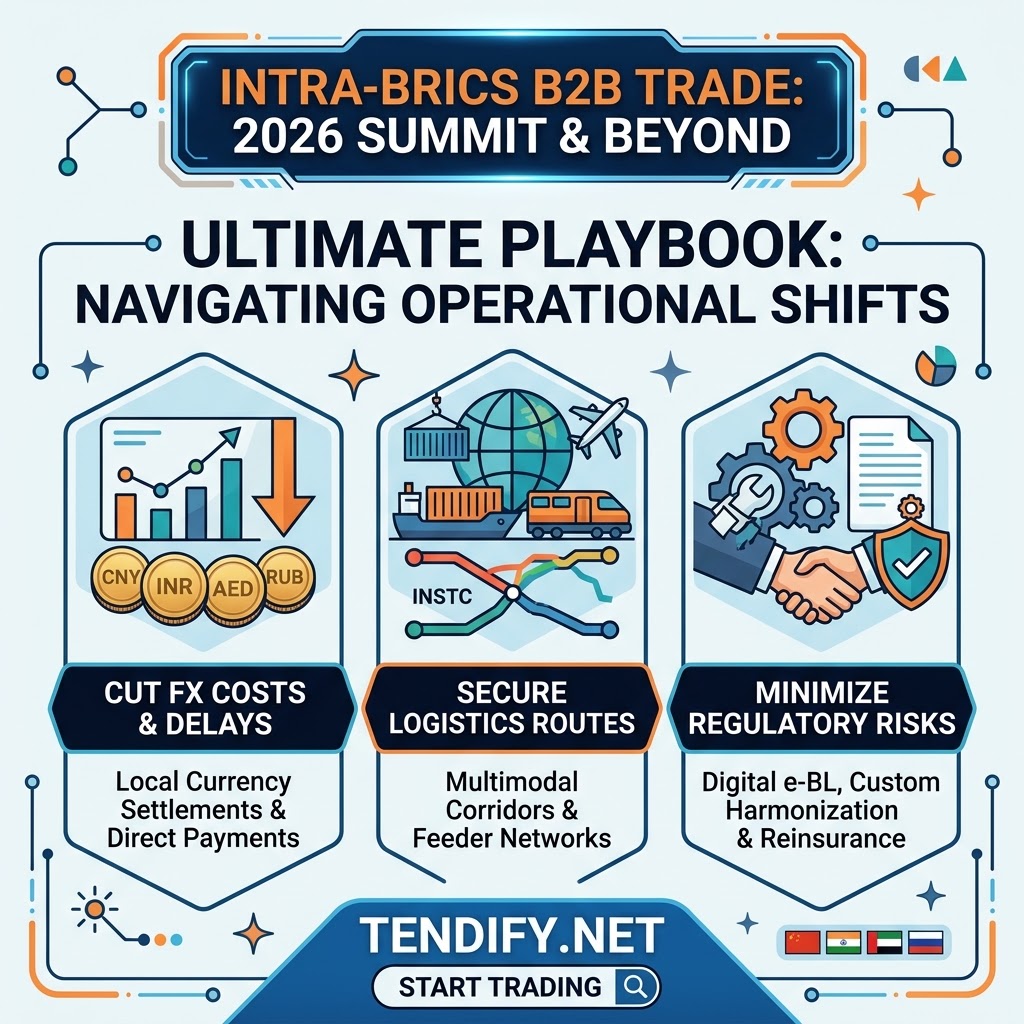
A container of industrial components sits at a Gulf port for an extra week while banks reconcile a dollar-denominated invoice through multiple correspondent accounts. Conversion fees, compliance checks and messaging delays quietly erode the margin. Multiply that friction across thousands of B2B shipments between BRICS markets and the annual cost becomes material. The 18th BRICS Summit in New Delhi on 12–13 September 2026 did not produce a single new currency or overnight revolution. What it delivered, through the unanimously adopted New Delhi Declaration, is a clearer operating framework for reducing exactly those frictions: practical local-currency settlement mechanisms, stronger emphasis on payment interoperability, expanded local-currency lending by the New Development Bank, and explicit pushback against unilateral tariffs that distort supply chains.
For traders, logistics managers and procurement teams operating across India, China, Brazil, Russia, South Africa and the expanded membership, the outcomes translate into concrete options rather than rhetoric. Settlement costs can come down. Alternative corridors gain political and financial support. Customs and tariff risk receives collective attention. The Business Forum that preceded the leaders’ meetings underscored the same priorities from the private-sector side—fintech linkages, energy and industrial supply chains, and faster documentation flows.
ملخص تنفيذي
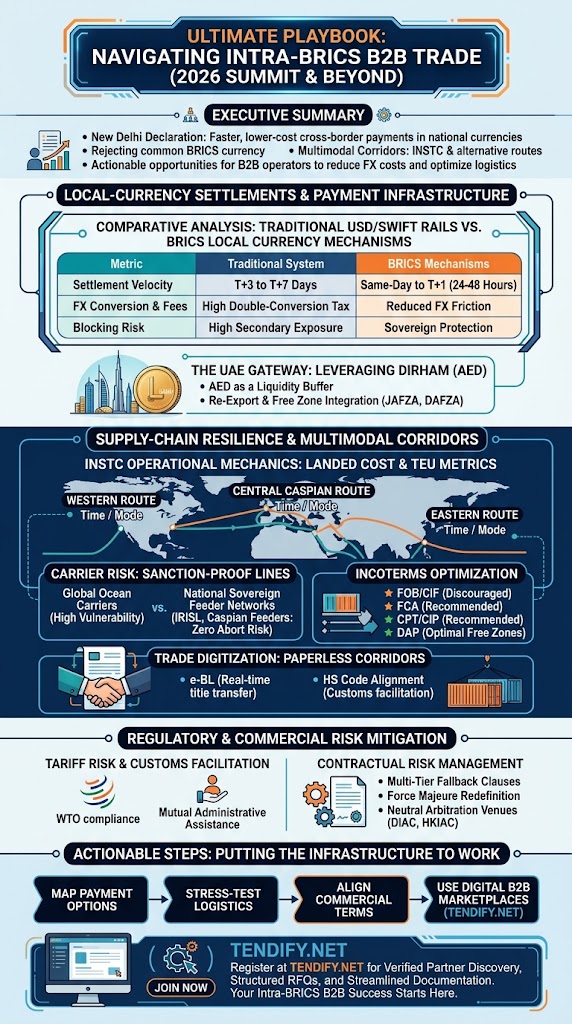
The New Delhi Declaration prioritises faster, lower-cost cross-border payments in national currencies while rejecting a common BRICS currency. The BRICS Payment Task Force continues technical work on interoperability of national systems; the New Development Bank is encouraged to scale local-currency financing. Unilateral tariffs and non-WTO-consistent trade measures face collective criticism. Transport and infrastructure cooperation is reinforced, supporting multimodal corridors that can shorten transit times between key markets. For B2B operators these shifts create near-term opportunities to reduce FX conversion costs, diversify payment rails, and align sourcing or sales strategies with emerging intra-BRICS trade preferences in energy, agriculture, industrial equipment and critical minerals. Action now centres on mapping counterparties to local-currency options, stress-testing logistics routes, and positioning for preferential treatment as facilitation measures mature.
Local-Currency Settlements and Payment Infrastructure: Cutting the Conversion Tax
The most commercially relevant section of the Declaration concerns payments. Leaders backed continued work by the BRICS Payment Task Force on mechanisms that make trade settlements and investments in local currencies faster, cheaper, more accessible and safer. They explicitly noted there is no one-size-fits-all approach. A single BRICS currency is off the table. What remains is incremental but practical: linking existing national payment and messaging systems, expanding bilateral local-currency arrangements, and giving the New Development Bank a stronger mandate for local-currency lending.
Intra-BRICS B2B Trade
Comparative Analysis: Traditional USD/SWIFT Rails vs. BRICS Local Currency Mechanisms
| Comparison Metric | Traditional Dollar / SWIFT System | BRICS Local Currency & Direct Messaging |
|---|---|---|
| Settlement Velocity | T+3 to T+7 Days Delayed by multiple intermediary US correspondent banks, time zone offsets, and manual compliance holds. | Same-Day to T+1 (24-48 Hours) Direct bilateral clearing between central/commercial banks via linked messaging rails (e.g., CIPS/SPFS/SFMS). |
| FX Conversion & Spread Fees | High Double-Conversion Tax (2.5% – 5.0%) Involves two currency swaps (Local Currency → USD → Target Currency) plus correspondent bank fees. | Reduced FX Friction (0.5% – 1.2%) Direct local-currency pairing (e.g., INR/AED or CNY/RUB) eliminates intermediate currency conversion spreads. |
| Sanction & Account Freeze Risk | High Secondary Exposure Subject to US OFAC jurisdiction, sudden clearing freezes, and unilateral sanctions enforcement along dollar corridors. | Sovereign Protection Insulated from third-country jurisdiction; transactions are governed solely by bilateral trade frameworks. |
| Trade Credit & Liquidity | Standard L/Cs via international banks, but increasingly restricted for emerging market B2B SMEs due to compliance tightening. | Backed by NDB local-currency lending credit lines and national Export Credit Agency (ECA) guarantee pools. |
| Integration Friction | Low setup effort (uses existing legacy SWIFT protocols), but high ongoing transaction and delay overhead. | Requires initial Nostro/Vostro account mapping and contract updates, but delivers long-term margin savings. |
Operational reality for a mid-sized exporter is straightforward. When an invoice can be settled in rupees against dirhams, or yuan against roubles, without routing every leg through a dollar correspondent bank, two costs fall: the spread on the double conversion and the compliance overhead of multiple jurisdictions. Bilateral local-currency settlement systems already operate between several pairs of members. The Task Force’s ongoing work focuses on making those systems more interoperable so that a payment initiated in one national rail can be recognised and settled in another with fewer intermediaries.
GCC & MENA Gateway
The UAE Gateway: Leveraging Dirham (AED) in Intra-BRICS Financial Clearing
The inclusion of the United Arab Emirates (UAE) into the expanded BRICS bloc fundamentally transforms regional trade settlement architecture. As the principal financial and logistics re-export hub for the GCC, South Asia, and Africa, Dubai provides the liquid intermediate currency corridor that bridges trade imbalances between major BRICS economies.
Because the UAE Dirham (AED) maintains high stability and wide regional acceptance, bilateral clearing arrangements using AED offset currency asymmetry between non-convertible or volatile local currencies.
Trading via Dubai free zones (e.g., JAFZA, DAFZA) allows international suppliers to bill in AED or INR/RMB directly, facilitating physical re-exporting while minimizing multi-jurisdictional withholding taxes.
Strategic Value for Tendify Buyers & Sellers: Procurement desks structuring deals across GCC-Eurasia-India axes should consider opening AED-denominated corporate accounts within UAE-based banking rails. Using AED as an intermediate settlement unit significantly mitigates FX conversion spreads while retaining full access to Middle Eastern re-export channels.
The New Development Bank’s role is equally concrete. By the end of 2025 the bank’s active portfolio showed roughly 29 percent local-currency financing. The Declaration encourages the institution to expand that share, diversify funding sources and support high-impact infrastructure and sustainable-development projects. For project-finance or long-term offtake contracts common in energy and industrial equipment, the ability to borrow or receive disbursements in the project currency reduces currency-mismatch risk that would otherwise be hedged at additional cost.
Messaging alternatives to traditional networks continue to mature. National systems already handle significant domestic volume. Linking them reduces reliance on any single global messaging platform and shortens the time between invoice issuance and confirmed receipt of funds. For B2B firms the near-term action is to map the top 10–15 counterparties by volume and currency, identify which pairs already have active local-currency channels, and open the necessary nostro or settlement accounts before the next contract cycle.
Supply-Chain Resilience and Multimodal Corridors
Logistics performance determines whether lower settlement costs actually improve landed cost. The Declaration reaffirms cooperation on sustainable and resilient transport infrastructure, including policy coordination, investment and capacity building. Leaders recognised the role of critical-mineral supply chains in energy security and industrial competitiveness and called for arrangements that support value addition and economic diversification rather than pure extraction.
Freight Economics
INSTC Operational Mechanics: Landed Cost & Multimodal TEU Metrics
For industrial procurement officers moving heavy machinery, raw chemicals, or agricultural bulk between India, the Persian Gulf, and Eurasia, high-level route comparisons are insufficient. Evaluating the International North-South Transport Corridor (INSTC) requires examining door-to-door landed costs, TEU freight rates, transshipment handoffs, and operational bottlenecks across its three primary routes.
Mumbai → Bandar Abbas → Astara → Azerbaijan → Russia
- Transit Time: ~18–22 Days
- Multimodal Modes: Sea + Rail/Truck
- Key Bottleneck: Border gauge changes & customs dwell time at Astara.
Mumbai → Bandar Anzali/Amirabad → Astrakhan/Olya
- Transit Time: ~15–19 Days
- Multimodal Modes: Sea + Caspian Feeder Vessel + Rail
- Key Bottleneck: Volga-Don canal draft limitations & winter icing.
Mumbai → Chabahar/B. Abbas → Turkmenistan/Uzbekistan → Russia
- Transit Time: ~16–20 Days
- Multimodal Modes: Deepwater Sea + Full Container Rail
- الميزة الرئيسية: Bypasses Caspian Sea transshipment delays.
Cost Impact Breakdown per TEU (vs. Suez Sea Route):
While traditional ocean freight via the Suez Canal averages 35–45 days from Nhava Sheva (India) to Saint Petersburg, the INSTC compresses total transit time to 18–25 days. Depending on seasonal Caspian vessel capacity and fuel surcharges, ocean-rail container rates along the INSTC yield a net 20% to 30% reduction in overall landed cost—primarily driven by reduced inventory carrying costs, lower marine insurance premiums along non-chokepoint routes, and shorter transit financing cycles.
Incoterms Optimization for Multimodal Intra-BRICS Corridors
Why legacy maritime terms (FOB/CIF) fail in rail-sea corridors like INSTC—and how transitioning to multimodal rules protects landed margins.
| Incoterm | Suitability Rating | Transfer of Risk & Responsibility | Operational Impact on Intra-BRICS Routes |
|---|---|---|---|
| FOB / CIF (Legacy Maritime) | High Risk / Discouraged | Risk transfers only when cargo is loaded onto the ocean vessel. Inapplicable to inland rail terminals or container yards. | Creates liability gaps during rail-to-sea transshipment (e.g., Bandar Abbas or Astrakhan). Buyers pay demurrage for delays caused prior to ocean loading. |
| FCA (Free Carrier) | Recommended (Exporters) | Risk transfers to the buyer upon handing over cargo to the first multimodal carrier at origin terminal or inland ICD. | Ideal for Eurasian rail and road origin points. Exporters clear export customs and eliminate transit liability before long-distance overland transport begins. |
| CPT / CIP (Carriage Paid To) | Recommended (Buyers) | Seller pays multimodal main freight to named destination, but risk transfers to buyer upon delivery to first carrier. | Enables buyers to negotiate bundled freight rates across complex INSTC/Caspian legs while keeping risk transfer early at the origin facility. |
| DAP (Delivered at Place) | Optimal for Free Zones | Seller assumes all risk and freight up to the final destination point, ready for unloading, excluding import customs clearance. | Highly effective for shipments entering re-export free zones (e.g., JAFZA Dubai or Bandar Anzali Free Zone) without triggering domestic import duties. |
Navigating Carrier Risk: Sanction-Proof Feeder & National Lines
Mitigating primary and secondary sanction bottlenecks along Persian Gulf, Caspian, and Eurasian corridors by shifting away from Western global carriers.
High Vulnerability to Secondary Sanctions: Highly sensitive to US OFAC and EU regulatory shifts. Sudden service cancellations, container re-issuances, and port-call suspensions frequently leave cargo stranded at transshipment hubs during geopolitical escalations.
Zero Service Abort Risk: Fully integrated within intra-BRICS trade agreements. State-backed lines and private Caspian vessel fleets operate outside Western jurisdiction, guaranteeing uninterrupted container availability and fixed schedule integrity.
For operators the implications are operational rather than geopolitical. Diversifying away from single-chokepoint maritime routes reduces exposure to insurance spikes, canal congestion or sudden capacity shortages. Multimodal combinations—sea to rail to inland terminal—can compress total door-to-door time when schedules are coordinated. Digital freight tools that provide real-time visibility become more valuable when transit involves multiple border crossings and mode changes. Firms that already run pilot consignments on these routes report that the primary bottlenecks remain documentation consistency and last-mile coordination rather than pure infrastructure capacity.
Trade Digitization
Paperless Corridors: Standardised e-BLs and Cross-Border Harmonisation
While rail and maritime infrastructure expanding across intra-BRICS corridors cuts physical transit days, administrative delays at border crossings continue to drain margins. Physical Bill of Lading (B/L) couriering, manual certificate of origin verification, and tariff classification discrepancies represent soft-cost friction. The New Delhi framework places increased emphasis on digital trade facilitation, aligning with global shifts toward paperless trade systems and cross-border document interoperability.
Transitioning from paper B/Ls to DCSA-compliant electronic alternatives eliminates courier wait times and document loss risks, enabling real-time title transfers while cargo is still en route across multimodal corridors.
Work toward mutual recognition of Harmonised System (HS) classifications and pre-arrival data exchange streamlines customs risk assessment, drastically reducing physical inspections for compliant B2B shipments.
Operational Integration via Tendify: B2B platforms like Tendify.net bridge this gap by enabling buyers and sellers to pre-structure digital documentation, verify standardized HS codes, and generate compliant commercial invoices directly within the sourcing workflow—minimizing administrative dwell time before shipment arrival.
Critical minerals and energy products feature prominently because demand for battery materials, copper, and specialised industrial inputs continues to grow inside BRICS markets. Aligning offtake contracts with corridor development timelines allows suppliers to lock in volume commitments that justify dedicated equipment or inventory positioning closer to demand centres.
Tariff Risk, Customs Facilitation and Market Access
The Declaration takes a clear position against unilateral tariffs and non-tariff measures that conflict with WTO rules. It links three strands: opposition to protectionism, resistance to climate-linked trade barriers that function as disguised restrictions, and support for restoring effective dispute settlement. For exporters of industrial goods, agricultural products and intermediate materials this language provides a political signal that can be referenced in commercial negotiations and risk assessments.
Customs cooperation received attention through ongoing work toward mutual administrative assistance agreements. Faster clearance, reduced inspection rates for trusted traders, and better advance-ruling mechanisms lower the soft costs that often exceed the formal duty itself. In practice, firms that invest in complete, accurate documentation and pre-arrival processing already capture most of the available speed advantage. The collective stance against unilateral measures reduces the probability of sudden duty spikes on intra-BRICS flows relative to third-country routes.
New export opportunities surface most clearly in three clusters: energy-related equipment and services, agricultural commodities and processed foods, and industrial machinery and components that support manufacturing expansion. Demand patterns inside the expanded membership favour suppliers who can combine competitive pricing with reliable delivery and local-currency invoicing options. The Business Forum highlighted exactly these sectors as priority areas for private-sector partnership.
Risk Mitigation
Trade Credit Guarantees and Reinsurance Networks: Bridging the L/C Gap
One of the most persistent operational hurdles for B2B trade across intra-BRICS corridors is the lack of standardized, cross-border Letter of Credit (L/C) mechanisms. While payment messaging rails reduce technical transfer friction, commercial counterparties still face payment default and cargo loss exposure. Discussions at the 18th Summit explicitly addressed this vacuum by emphasizing the role of national export credit agencies (ECAs) and the establishment of a joint BRICS Reinsurance Network.
Establishes shared reinsurance capacity to absorb maritime and transit risks along non-Western shipping lanes, mitigating reliance on traditional Western insurance syndicates.
ECAs are expanding bilateral credit guarantee facilities. This enables suppliers to extend open-account terms or deferred payments with institutional backing, directly substituting for conventional L/Cs.
Commercial Application for Tendify Users: Traders structuring open-account contracts or high-value equipment deliveries should actively inquire with regional ECAs (such as ECGC in India or SINOSURE in China) about cross-border policy eligibility. Combining local-currency settlement rails with ECA credit insurance effectively neutralizes both currency conversion overhead and counterparty default risk.
Legal Risk Management
Contractual Risk Mitigation: Managing Secondary Sanctions & Alternative Payment Networks
While utilizing alternative financial messaging platforms (such as CIPS or SPFS) and local-currency rails mitigates FX conversion costs, it introduces new compliance risks. B2B operators face secondary sanctions exposure, sudden clearing house disconnections, and currency illiquidity. Safeguarding cross-border transactions requires updating standard commercial contract clauses to account for payment system disruption without triggering breach of contract.
Contracts must explicitly specify primary and secondary payment rails (e.g., primary in CNY via CIPS, fallback to AED or INR via local correspondent accounts) to prevent default if a primary channel encounters regulatory friction.
Standard Force Majeure clauses should be updated to cover unilateral sanctions or banking freezes, defining them as temporary performance suspensions rather than default, granting parties time to re-route payments safely.
Actionable Legal Guidance for Tendify Traders: Ensure international sales agreements select neutral arbitration venues (such as DIAC in Dubai or HKIAC in Hong Kong) that recognize multi-currency settlements and alternative payment messaging systems. Structuring commercial contracts with built-in currency substitution rights neutralizes compliance shocks before shipments leave port.
Digital Infrastructure
B2B E-Marketplaces: Accelerating Direct Cross-Border Trade
Beyond intergovernmental frameworks and physical logistics, the New Delhi outcomes explicitly underline the necessity of digital economic integration. Traditional multi-layered broker networks, opaque price discovery, and manual buyer verification often delay cross-border deals across emerging markets. Digital B2B trade platforms are stepping into this space to democratize market access, linking manufacturers directly with international procurement teams while embedding modern compliance and settlement tooling into a unified workflow.
E-marketplaces collapse geographical distances by giving vetted suppliers instant visibility before verified global buyers, significantly shortening sales cycles for industrial components, energy equipment, and raw commodities.
Digital Request for Quotation (RFQ) tools allow buyers to explicitly request preferred trade terms—such as local-currency settlement, specific Incoterms, or corridor routing—ensuring commercial alignment before contract signature.
Connecting the Intra-BRICS Value Chain: Platforms like تينديفاي دوت نت operationalize these summit outcomes by serving as the digital infrastructure layer. By bringing verified suppliers and institutional buyers together in a structured marketplace, Tendify enables trade participants to capture new corridor opportunities, streamline documentation, and lower transactional friction in real time.
Actionable Steps for Buyers and Suppliers on Tendify and Beyond
Map payment options first. Identify counterparties in India, China, Brazil, Russia, South Africa, the UAE and other members where bilateral local-currency channels already function. Open the necessary settlement accounts and test small-value invoices. Track the BRICS Payment Task Force technical progress for broader interoperability signals.
Stress-test logistics. Run parallel cost and time comparisons between traditional maritime routes and multimodal alternatives for the highest-volume origin-destination pairs. Factor insurance differentials, demurrage exposure and inventory carrying cost. Position buffer stock or consolidate shipments where corridor reliability is still maturing.
Align commercial terms with emerging facilitation. Prefer contracts that allow local-currency settlement where available. Include clear force-majeure and payment-disruption language that anticipates residual messaging or banking friction. Monitor NDB project pipelines for equipment or service opportunities linked to infrastructure financed in local currencies.
Use digital platforms to surface counterparties efficiently. Buyers can issue RFQs specifying preferred settlement currency and delivery corridor. Suppliers can surface verified capacity and compliance documentation. Tools that already integrate HS classification, duty estimation and document generation reduce the administrative load of entering new markets. Platform.Tendify.Net provides one such environment where these elements can be managed in a single workflow without replacing existing banking or freight relationships.
Track policy signals without over-reacting. The Declaration’s language on tariffs and payments is directional. Implementation will vary by bilateral pair and by the speed of technical work. Firms that treat the outcomes as an expanded menu of options rather than a sudden regime change will capture the upside while managing residual risk.
Positioning for the Next Cycle
The New Delhi outcomes do not eliminate the dollar or replace established global payment networks. They expand the set of workable alternatives for trade among a group of economies that together account for a rising share of global demand and production. Settlement costs can fall for firms willing to operationalise local-currency channels. Logistics options broaden for those who invest in multimodal visibility and documentation discipline. Tariff and customs risk becomes more predictable inside the bloc relative to purely third-country routes.
The competitive edge will belong to operators who treat these developments as process improvements rather than geopolitical statements. Test the payment rails. Pilot the corridors. Update contract templates. Build the internal capability to move volume quickly when a new bilateral facility or corridor schedule becomes reliable. The window between declaration and widespread commercial adoption is measured in quarters, not years. Firms that use the interval to refine operations will be ready when counterparties begin specifying local-currency or corridor preferences as standard terms.
Operationalise Intra-BRICS Trade Opportunities on Tendify
The infrastructure established by the New Delhi outcomes is active now. Commercial advantage belongs to procurement and export leaders who transition from traditional friction to streamlined digital workflows.

