


المدونة
Al-Haditha Border: Your Complete B2B Jordan-Saudi Freight Guide
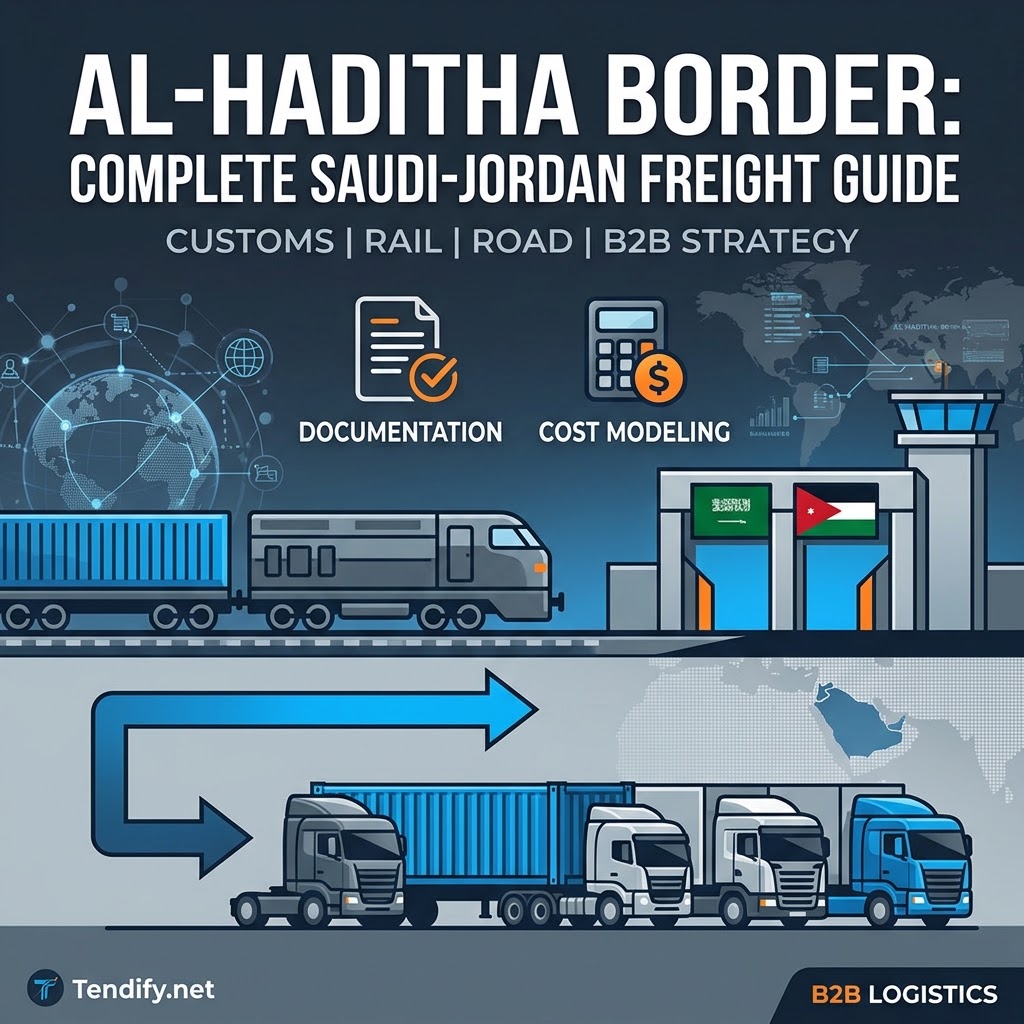
A single truck queue stretching several kilometers at dawn tells the story better than any policy paper. At the Al-Haditha–Al-Omari crossing, commercial vehicles move continuously between Saudi Arabia and Jordan, carrying everything from petrochemicals and building materials to consumer goods and transit cargo headed toward the Levant and beyond. This is no longer a peripheral checkpoint. It has become one of the most operationally significant land gateways in the regional supply-chain map.
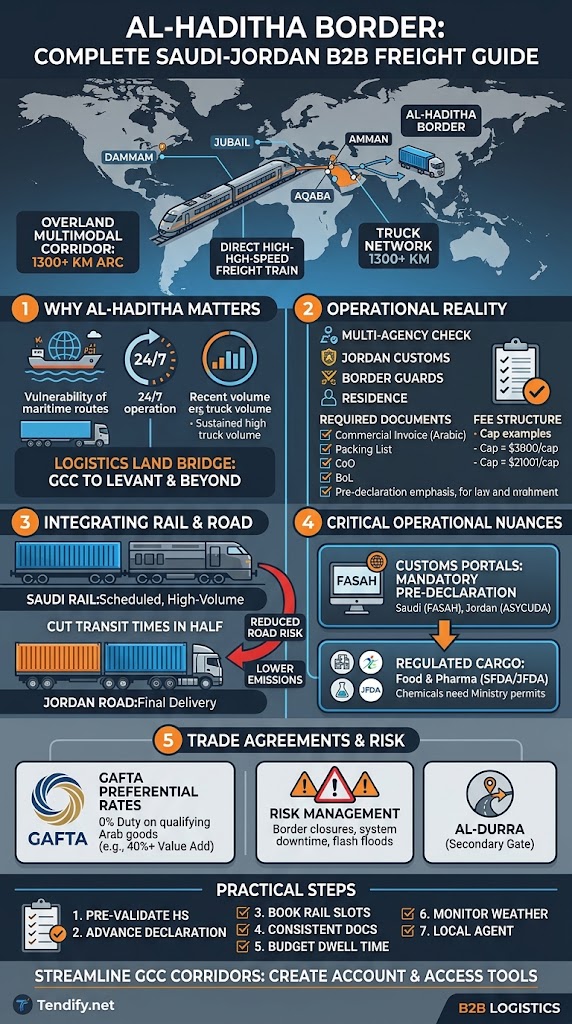
The crossing sits at the northern end of a 1,300-plus kilometer overland arc that begins in the UAE and runs through Saudi territory before reaching Jordan. In March 2026, Saudi Arabia Railways activated a dedicated freight corridor linking the Eastern Province ports of Dammam and Jubail directly to Al-Haditha. Trains on this route carry more than 400 containers each and cut transit times roughly in half compared with pure road movement. The rail line ends at the border; trucks take over for the final leg into Jordan and onward. The combination has turned Al-Haditha into a high-volume transfer node rather than a simple bilateral gate.
For B2B operators shipping between the Gulf and northern markets, or using Jordan as a transit platform toward Turkey and European gateways, understanding how this corridor actually functions determines cost, reliability, and risk exposure.
Why Al-Haditha Matters More Than Ever
Maritime chokepoints remain vulnerable. Overland options that avoid them have gained structural importance. Al-Haditha functions as the primary Saudi–Jordan freight interface. On the Jordanian side it is known as Al-Omari; on the Saudi side it is Al-Haditha. The facility operates 24 hours a day with dedicated lanes for commercial trucks, passenger vehicles, and buses.
Al-Haditha Border:
Recent capacity data show sustained volume. In the first six weeks of 2025 alone, more than 25,000 trucks entered Jordan and nearly 24,000 exited through the crossing. Daily averages hover around 400 commercial vehicles when both directions are combined, with clear peaks during high-demand seasons. Infrastructure upgrades on both sides have improved inspection throughput and digital processing, yet congestion still occurs when documentation is incomplete or when multiple agencies coordinate on restricted cargoes.
The corridor’s strategic value extends beyond bilateral trade. Goods arriving by sea at Eastern Province ports can now move by rail to the border, cross into Jordan, and continue north by road toward Amman, Aqaba, or the Syrian frontier at Nasib–Jaber. From there, further connections open toward Mediterranean ports or the Turkish network. This sequence forms a practical land bridge that complements, and in some cases substitutes for, longer maritime routings.
Saudi Arabia’s National Transport and Logistics Strategy and Vision 2030 targets treat this northern link as a core element of the Kingdom’s ambition to become a global logistics hub. The rail activation in 2026 is the most concrete recent step: it removes thousands of long-haul truck journeys from Saudi highways, improves safety, lowers emissions, and creates a higher-capacity feed into the border.
Operational Reality at the Crossing
Clearance procedures remain multi-agency. On the Jordanian side, the Jordan Customs Department leads cargo inspection and declaration processing. Border Guards handle vehicle and security control, while the Directorate of Borders and Residence manages immigration. Required documents typically include a commercial invoice (Arabic translation often required), packing list, certificate of origin, bill of lading or equivalent, and any product-specific certificates such as phytosanitary or health documents. Restricted or controlled goods trigger additional licenses and inspections.
Fees on the Jordanian side include standard customs statement stamps and a service fee calculated as a percentage of declared value, subject to minimum and maximum caps. Saudi procedures emphasize electronic pre-declaration and risk-based selectivity. Both sides have invested in scanning equipment and digital systems, yet the physical hand-off of documents and the need for physical inspection of certain loads still create friction points.
Experienced operators treat pre-clearance as non-negotiable. Incomplete or inconsistent paperwork is the most common cause of multi-hour or multi-day delays. Peak periods—particularly summer travel seasons and major construction or procurement cycles—amplify pressure on lanes. Weather events, especially flash flooding in the surrounding desert terrain, can temporarily restrict access roads.
For transit cargo not destined for Jordanian consumption, proper transit documentation and guarantees are essential. Failure to maintain clean transit status can convert a simple through movement into a full import declaration with attendant duties and delays.
Integrating Rail and Road: The New Multimodal Equation
The 2026 rail corridor changes the economics of the final Saudi leg. Previously, containers arriving at King Abdulaziz Port in Dammam or the Jubail complex moved almost exclusively by truck across the full distance to the border. Rail now offers a scheduled, higher-volume alternative for the long haul. Once at Al-Haditha, containers transfer to road for the Jordanian segment.
This multimodal sequence reduces overall transit time, lowers per-unit road wear and accident risk, and provides more predictable capacity during periods of truck-driver shortages or fuel-price spikes. Return flows are also supported: cargo originating in Jordan or further north can move south by road to the border and then by rail to Eastern Province ports for onward maritime export.
Operators evaluating this route should model three cost components separately: maritime or origin inland cost to the Eastern ports, rail segment to Al-Haditha, and final road leg plus border charges into Jordan. The rail portion’s time and cost advantage becomes decisive for full container loads and for time-sensitive industrial cargoes. Less-than-container or highly specialized loads may still favor pure road movement for flexibility.
Practical Steps for Reliable Crossings
Successful users of the corridor follow a consistent operating rhythm.
- Pre-validate HS classification and any product-specific restrictions with both Saudi and Jordanian authorities well before shipment. Misclassification remains a frequent source of secondary inspection.
- Complete electronic declarations and obtain any required import or transit licenses in advance. On the Jordanian side, Arabic documentation for invoices is routinely requested.
- Coordinate with the rail operator or freight forwarder for booking slots on the Dammam/Jubail–Al-Haditha service if using the rail leg. Capacity is expanding, but peak demand still requires advance reservation.
- Maintain a complete, consistent document package: commercial invoice, packing list, certificate of origin, transport document, and any certificates of analysis or conformity. Digital copies should match physical originals exactly.
- Budget realistic dwell time at the border. Even with 24/7 operations, complex or high-value loads can require several hours of inspection and inter-agency coordination.
- Monitor weather and seasonal traffic patterns. Flash-flood risk exists in the desert approaches; high summer passenger volumes can spill over into commercial lanes.
- Establish relationships with reliable local agents or logistics providers who maintain physical presence at the crossing. Local knowledge of daily operational nuances often prevents avoidable holds.
These steps are not theoretical. Operators who treat Al-Haditha as a routine bilateral gate without preparation routinely absorb demurrage-equivalent costs and schedule slippage. Those who treat it as a high-volume multimodal transfer node with disciplined documentation and pre-clearance consistently achieve smoother throughput.
Cost Drivers and Risk Factors Specific to This Corridor
Beyond standard freight rates, several variables determine total landed cost and reliability.
Border processing fees and potential storage charges during inspection form a visible layer. Less visible but often larger are the opportunity costs of delayed arrival at the next distribution point or production site. Currency of documentation and accuracy of declared values directly affect inspection intensity; under- or over-valuation invites deeper scrutiny.
Security and insurance considerations differ from pure maritime routes. Overland movement through Saudi territory and into Jordan carries different risk profiles, including road safety and the need for appropriate cargo insurance covering the full multimodal chain. Drivers and equipment must meet both countries’ regulatory requirements for commercial vehicles.
Capacity constraints remain real. The rail corridor adds significant volume, yet the final road and border segments still depend on physical infrastructure and staffing. Sudden surges—whether from diverted maritime cargo or seasonal demand—can create temporary backlogs.
For companies managing ongoing programs rather than one-off shipments, establishing framework agreements with multimodal providers and maintaining standing documentation templates reduces friction on each successive movement.
Positioning the Corridor Within Broader Regional Networks
Al-Haditha does not exist in isolation. It forms the southern entry to Jordan’s internal road spine (Desert Highway and Highway 35) that continues north toward Amman and the Syrian frontier. From there, connections open toward Mediterranean outlets or further into Turkish networks. Saudi Arabia’s broader logistics-corridor program simultaneously develops Red Sea gateways and internal rail links, creating alternative paths that can feed the same northern border or divert cargo westward.
For GCC-based exporters and importers, the practical implication is greater route optionality. Cargo that once depended exclusively on maritime legs through the Gulf or Red Sea can now incorporate a competitive overland segment when conditions favor it. The reverse also holds: northern producers and traders gain more reliable access to Eastern Province ports and the wider GCC market.
Trade data between Saudi Arabia and Jordan already reflect deepening commercial ties. Non-oil flows, including plastics, chemicals, food products, and industrial inputs, move in both directions. The improved physical connectivity supports further growth in these categories and in transit volumes that never enter Jordanian consumption.
Tools and Operational Support for Corridor Users
Accurate HS classification, duty estimation, and documentation preparation remain foundational. Specialized calculators and checklist generators help reduce errors before cargo reaches the border. For teams managing multiple concurrent shipments, centralized visibility into status, documentation completeness, and expected clearance windows prevents last-minute surprises.
Platforms that aggregate trade utilities—tariff tools, document builders, and logistics intelligence—allow operators to standardize processes across corridors rather than reinventing procedures for each border. One such resource set is available through Platform.Tendify.Net, where users can access classification aids and cost estimators that support planning for routes including the Saudi–Jordan land link.
Internal operational playbooks should capture the specific requirements of Al-Haditha: document formats accepted on each side, typical inspection triggers, preferred agents, and escalation contacts. Updating these playbooks after every significant movement builds institutional knowledge that reduces reliance on individual memory.
الأسئلة الشائعة (FAQ)
What is the primary operational advantage of the Al-Haditha–Al-Omari rail connection?
+
Do Arab-origin goods pay customs duties at the Saudi–Jordan border?
+
Which digital platforms are mandatory for pre-clearance on this corridor?
+
What secondary route is available if Al-Haditha experiences severe delays?
+
Are specialized permits required for shipping petrochemicals or HAZMAT cargo?
+
Looking Ahead: Capacity, Digitization, and Competitive Advantage
Further gains will come from continued digitization of declarations, expanded rail capacity, and better coordination of pre-clearance between the two customs administrations. Jordan’s own logistics infrastructure investments—particularly any future rail extension northward from the border—would compound the value of the Saudi rail feed. Harmonization of data standards and mutual recognition of certain certificates would shorten physical inspection times.
Companies that master the current multimodal sequence already enjoy a measurable advantage in transit time and cost predictability relative to competitors still dependent on longer or more congested alternatives. Those advantages compound when the same operators maintain disciplined documentation practices and maintain relationships on both sides of the border.
The Al-Haditha corridor is no longer an experimental alternative. It is an active, high-volume land bridge whose capacity and reliability continue to improve. For B2B supply-chain teams moving goods between the Gulf, the Levant, and European markets, treating it as a core routing option rather than a contingency path is now a practical necessity.
Operators who invest the time to understand its procedures, integrate the new rail leg into their planning models, and maintain rigorous pre-clearance discipline will move cargo more predictably and at lower total cost than those who approach the border reactively. In a regional logistics environment still adjusting to maritime disruptions and shifting demand patterns, that operational edge translates directly into commercial resilience.

