


المدونة
How Gulf Sovereign Funds Are Rewiring AI, Ports, and Supply Chains for 2026 Trade
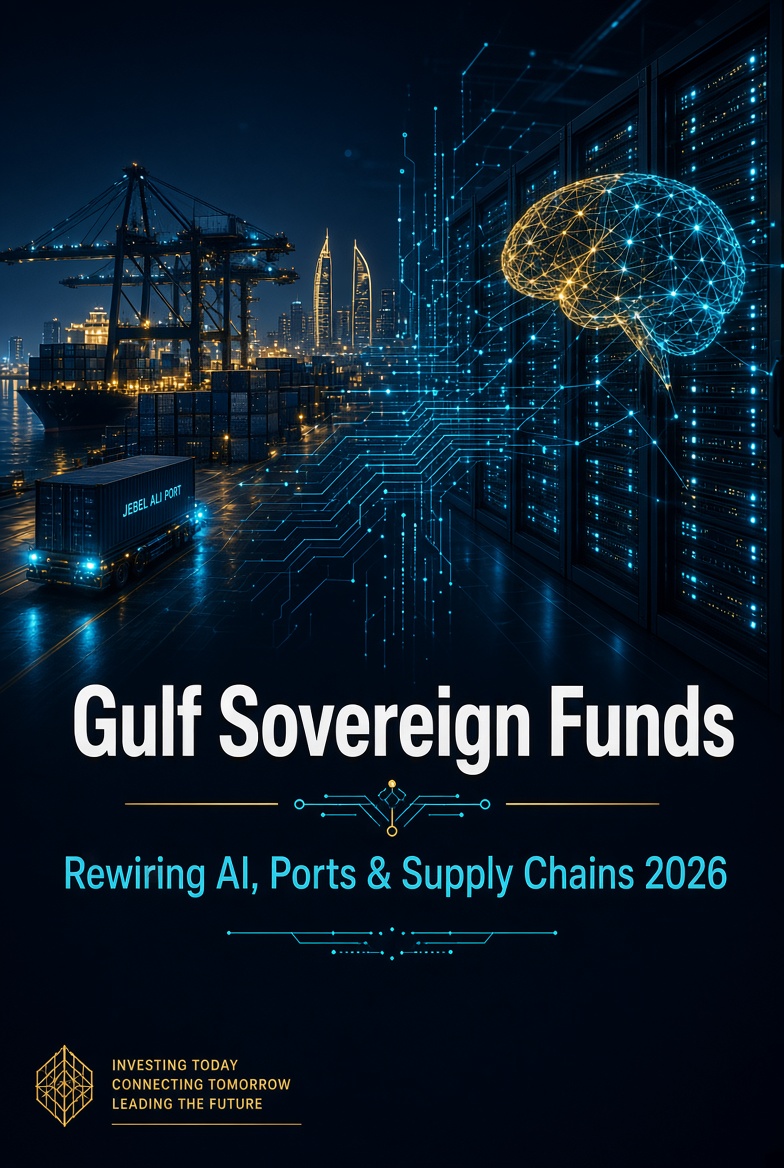
A container arrives at Jebel Ali. The gate system already knows the cargo. Risk scoring finished hours earlier. An autonomous vehicle moves it to the yard while the declaration sits in a digital twin. Clearance happens without a single paper handover.
This is no longer a pilot. It is the operational direction set by the region’s largest capital pools.
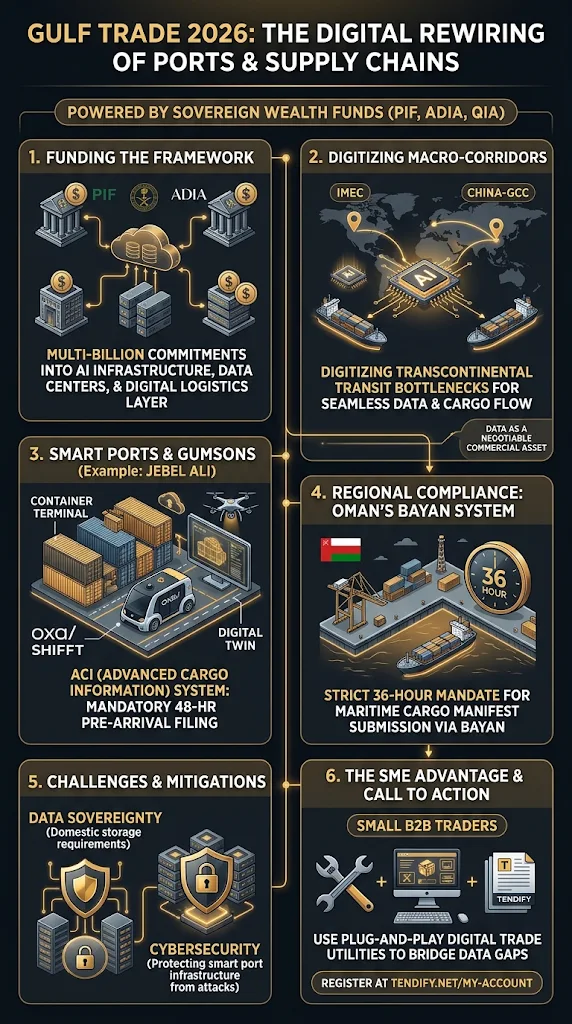
Abu Dhabi Investment Authority and Saudi Arabia’s Public Investment Fund are directing multi-billion-dollar commitments into artificial intelligence infrastructure, data centers, and the digital layer of logistics. The same capital is funding the automation of customs processes and terminal operations that traders use every day. The result is a tighter, faster, more data-driven trade environment across the Gulf.
Gulf Sovereign Funds Are Rewiring AI, Ports, and Supply Chains for 2026 Trade
For B2B operators moving goods through the UAE, Saudi Arabia, and Qatar, these investments change the cost of delay, the value of clean data, and the competitive edge of early digital readiness.
The Capital Behind the Shift
PIF has made AI infrastructure a core pillar. Through HUMAIN, launched in 2025, the fund is building full-stack capacity: next-generation data centers, high-performance computing, advanced models, and applied solutions. In late 2026 Aramco closed a transaction that gave it a 49 percent stake while PIF retained 51 percent. Aramco contributed key AI assets plus approximately SAR 9.9 billion ($2.6 billion) in cash during 2026. The stated target is 3 gigawatts of AI data-center capacity by 2030.
Additional financing followed quickly. Saudi Arabia’s National Infrastructure Fund signed facilities worth up to $667 million with HUMAIN to support GPU deployment (roughly 25 MW of IT load) and the substations, transmission, and grid connections needed for future expansion up to 1 GW. These moves sit inside PIF’s broader 2026–2030 strategy of deepening private-sector participation and building technology-enabled domestic ecosystems. Parallel initiatives such as the Tawrid platform for supply-chain financing show the fund treating liquidity and logistics resilience as linked priorities.
ADIA has taken a complementary but distinct path. The authority raised its private-equity target allocation and has repeatedly flagged AI, digitization of business processes, and supply-chain reconfiguration as structural themes. Infrastructure teams have backed data-center platforms and logistics assets, including commitments linked to Asian data-center expansion and logistics operators that serve e-commerce and AI-related demand. Real-estate and infrastructure capital is increasingly directed toward digital and logistics infrastructure rather than traditional property alone.
Qatar has pursued a more selective but still substantial approach. Through vehicles linked to the Qatar Investment Authority and entities such as Qai, capital is flowing into shared digital infrastructure, computing capacity, and partnerships that accelerate national AI programs. The emphasis sits on infrastructure, talent, and measured collaboration with global technology providers.
Collectively these funds are not simply buying exposure to the AI boom. They are building the physical and digital substrate that will process, store, and move the data generated by regional trade.
Beyond Regional Borders: The Missing Macro-Corridors (IMEC & China-GCC)
While the core infrastructure investments firmly anchor regional supply chains within the Gulf, their strategic significance scales globally. The artificial intelligence and automated logistics hubs being built in the UAE, Saudi Arabia, and Qatar are not operating in a vacuum—they serve as the vital digital and physical control towers for multi-continental trade corridors.
Notably, the integration of these AI-driven systems bridges critical gaps in major trans-national networks, specifically the India-Middle East-Europe Economic Corridor (IMEC) and the high-volume China-GCC trade axes. Sovereign capital is effectively digitizing the bottlenecks of transcontinental transit, ensuring that data and cargo flow seamlessly from Asian manufacturing hubs through Gulf maritime chokepoints to European markets.
Data as a Negotiable Commercial Asset
These investments mean that trade data is rapidly transforming into a negotiable commercial asset. When customs and port authorities run automated risk engines on your manifests, the quality of your data directly dictates your speed, cost, and predictability—transitioning compliance from a routine administrative chore into a formidable competitive advantage.
From Data Centers to the Quayside: What Changes for Ports and Customs
The most visible translation of this capital into daily operations is occurring at Jebel Ali and connected Gulf terminals.
DP World has become the first strategic partner of SHIFFT, the autonomous logistics venture established by Dubai Future Foundation with technology from Oxa. Work begins at Jebel Ali, where more than 900 vehicles currently handle inter-terminal container movements and transfers between quay, yard, and gate. The program covers vehicle integration, autonomous driving, safety frameworks, fleet orchestration, traffic management, digital twins, and performance monitoring. Systems are designed to operate in mixed environments that still contain manned equipment. The longer-term intention is to extend proven solutions across DP World’s global network of more than 60 ports and terminals.
Earlier phases of AI-driven terminal automation at Jebel Ali have already targeted yard management, gate processes, and vessel operations, with reported gains in turnaround times and yard utilization. The autonomous vehicle layer now being tested extends that logic from the crane to the final internal movement.
Customs processes are moving in parallel. Dubai Customs has mandated the Advance Cargo Information system for inbound maritime shipments to Jebel Ali. Shipmasters, agents, and authorized parties must submit cargo manifest data, master bills, and house bills electronically before arrival. Deadlines scale with voyage length—from a few hours for ultra-short regional routes to 48 hours for long-haul voyages. A companion classification guide covers hundreds of origin ports. A grace period allows operators to align systems, after which non-compliance carries clear operational and financial consequences.
These steps sit inside a wider regional pattern. Electronic pre-arrival data, risk engines that evaluate HS classification, permits, valuation, and security lists, and automated green-lane clearance are becoming standard. Clean, timely data increasingly determines whether cargo moves or sits.
The same logic is appearing in overland corridors. Digital seals, continuous monitoring, and pre-cleared transit models reduce intermediate stops for compliant shipments moving between UAE and Saudi facilities. The physical border becomes less of a bottleneck when the data layer has already done the heavy work.
Oman’s Bayan System: The 36-Hour Pre-Arrival Mandate
While major attention often centers on UAE maritime hubs, trade routes extending into Oman operate under an equally rigorous and distinct compliance clock. Since May 3, 2026, Omani customs enforcement has tightened requirements for all inbound maritime cargo moving through regional ports.
Under the electronic “Bayan” system framework, all shipping agents and freight forwarders are legally mandated to submit complete cargo manifests at least 36 hours prior to vessel arrival at any Omani port.
For B2B operators routing goods through or to Oman, this precise benchmark sets an immediate operational rule. Failing to meet the 36-hour window triggers automated compliance flags, operational holds, and financial penalties. Incorporating Bayan’s pre-arrival timeline into standard shipping schedules is now essential to avoiding unnecessary demurrage across Omani gateways.
Container Clearance at Jebel Ali: Traditional vs. 2026 ACI Standard
- Paper Submission: Manifest and HS codes submitted upon or shortly before vessel berthing.
- Manual Risk Assessment: Customs evaluations run post-arrival, causing physical inspection holds at the gate.
- Manned Internal Transit: Drivers queue for yard assignment, creating bottlenecks during peak hours.
- Clearance Timeline: 48 to 72+ hours total dwell time, with high risk of demurrage and storage fees.
- Pre-Arrival Data: Complete 12-digit HS codes and digital manifests filed 48 hours prior to arrival.
- Automated Risk Scoring: AI engines clear low-risk cargo (Green Lane) while the vessel is still at sea.
- Autonomous Yard Dispatch: Oxa/SHIFFT vehicles automatically route containers directly from quay to gate.
- Clearance Timeline: Seamless, paperless release in under 6 to 12 hours from touchdown.
Key Takeaway: The time saving is not achieved by faster cranes, but by moving the entire documentation layer 48 hours upstream into the digital twin.
Cybersecurity & Data Sovereignty: The Cost of Hyper-Connectivity
As the entire customs clearance, logistics network, and supply chain ecosystem migrate to cloud platforms and AI-driven control towers, a critical operational reality emerges: data residency and systemic vulnerability. Moving goods digitally means that trade secrets, shipping manifests, and financial transactions are increasingly exposed to new vectors of cyber risk.
Both the UAE and Saudi Arabia have enforced strict national regulations regarding data sovereignty, requiring sensitive trade and operational data to be stored and processed within domestic data centers. For multinational B2B traders, navigating compliance across these distinct regulatory frameworks requires rigorous governance to avoid cross-border data leakage or regulatory penalties.
Furthermore, port infrastructure is now a high-stakes cyber target. When autonomous terminal operations (like those at Jebel Ali) rely entirely on AI orchestration and connected IoT networks, a security breach is no longer just an IT glitch—it is a physical disruption that can halt port throughput in hours. Securing the digital infrastructure is just as important as building it.
Why This Matters for Cross-Border B2B Operators
Operational assessments across Gulf supply chains show a consistent pattern: the highest friction and cost now sit in documentation quality, data latency, and the gap between physical movement and digital readiness. Sovereign capital is systematically closing that gap from the infrastructure side.
Traders who treat electronic manifests, accurate 10- or 12-digit national tariff codes, permit matching, and pre-arrival filing as core operating disciplines will capture most of the efficiency gains. Those who continue to rely on last-minute paper or incomplete data will face more frequent red-lane inspections, storage charges, and schedule disruption.
The practical implications are concrete:
- Vessel and gate turnaround times compress when risk scoring and yard planning run on complete pre-arrival data.
- Autonomous and semi-autonomous internal transport reduces variability in container dwell times.
- Supply-chain financing products become more accessible when the underlying trade data is structured, verified, and time-stamped.
- Predictive tools for congestion, demurrage risk, and alternative routing gain accuracy once port and customs systems publish higher-quality real-time signals.
The capital being deployed by ADIA, PIF, and related vehicles accelerates these outcomes. Data-center capacity lowers the cost of running the AI models that power risk engines and digital twins. Grid and power investments remove one of the classic constraints on large-scale compute. Partnerships with global technology providers bring mature software stacks into regional operating environments.
For firms already using structured trade workflows, the next step is tighter integration between their own systems and the emerging port and customs platforms. HS classification tools, duty calculators, documentation generators, and cost models become more valuable when they feed clean data into the same pipelines that customs and terminal operators now require.
Building Operational Advantage in the New Environment
Regional evaluations of high-performing traders reveal several recurring practices.
First, treat data quality as a commercial asset rather than a compliance chore. Maintain master data for products, suppliers, and routes that already carries the correct national tariff lines, permit references, and valuation support. Update it continuously rather than rebuilding declarations from scratch for each shipment.
Second, shift filing as far upstream as possible. Pre-arrival information submitted early and accurately is the single highest-leverage action available to most operators. The new ACI timelines at Jebel Ali simply formalize a discipline that leading firms already apply.
Third, map the full cost of friction. Demurrage, detention, inspection holds, and missed connections rarely appear as a single line item. When measured end-to-end they often exceed the headline freight rate. Digital readiness is the most reliable lever for reducing that hidden cost.
Fourth, use the expanding suite of digital trade tools to close internal gaps. Platforms that combine HS search, cost modeling, documentation generation, and compliance checklists allow smaller teams to operate at the data standard now expected by automated customs engines. Tools available through the Tendify ecosystem, including the electronic-manifest and related compliance resources, illustrate how these capabilities can be embedded into daily workflows without requiring large internal IT projects.
Finally, monitor the infrastructure layer itself. Announcements around new data-center capacity, autonomous vehicle pilots, and financing platforms signal where the next efficiency gains will appear. Operators who track these developments can adjust routes, partners, and processes ahead of the broader market.
Bridging the Gap: How Smaller B2B Traders Adapt Without Heavy IT Budgets
While sovereign funds and port giants like DP World command massive budgets for autonomous yards and custom AI models, independent B2B traders, regional importers, and smaller suppliers often face a daunting question: How do we meet these hyper-digital customs standards without an enterprise IT department?
The reality is that compliance doesn’t require custom software development. Smaller operators can leverage plug-and-play digital trade utilities that instantly bridge the data gap. By utilizing cloud-native tools—such as automated HS classification search engines, dynamic duty calculators, and structured compliance checklists—SMEs can achieve the exact data rigor demanded by modern customs engines like Jebel Ali’s ACI system.
Platforms like تينديفاي are built precisely for this transition, offering free and accessible web-based resources that allow lean trading teams to generate error-free documentation, verify tariff lines, and streamline pre-arrival filing. In the 2026 trade landscape, digital readiness is no longer reserved for multinational giants—it is an accessible operating standard for any agile trader equipped with the right digital toolkit.
The Strategic Horizon
Gulf sovereign funds are converting hydrocarbon wealth into ownership of the digital infrastructure that will process the next generation of trade. The investments in AI compute, data centers, autonomous logistics, and digital customs are not isolated technology projects. They form a coherent system designed to raise the throughput, predictability, and resilience of regional supply chains.
For B2B traders the message is practical. The operating environment is becoming more data-intensive and less forgiving of incomplete information. The same capital that funds the data centers and the autonomous vehicles is simultaneously raising the performance bar for every declaration, every seal, and every gate transaction.
Firms that align their internal processes with this direction—clean master data, early electronic filing, integrated digital tools, and continuous measurement of friction costs—will move goods faster and at lower total cost. Those that treat the changes as optional compliance updates will find the gap widening.
The ports and the capital are already moving. The remaining variable is how quickly individual operators close the distance between their current practices and the new standard.
To secure faster, safer, and more predictable trade flows across the Gulf and beyond, register and equip your operations with the structured tools and market access available at https://tendify.net/my-account/. The infrastructure is being built. The advantage belongs to those who use it.

