


المدونة
Africa Tech Market Analysis: A B2B Guide to 5 Distinct Regions
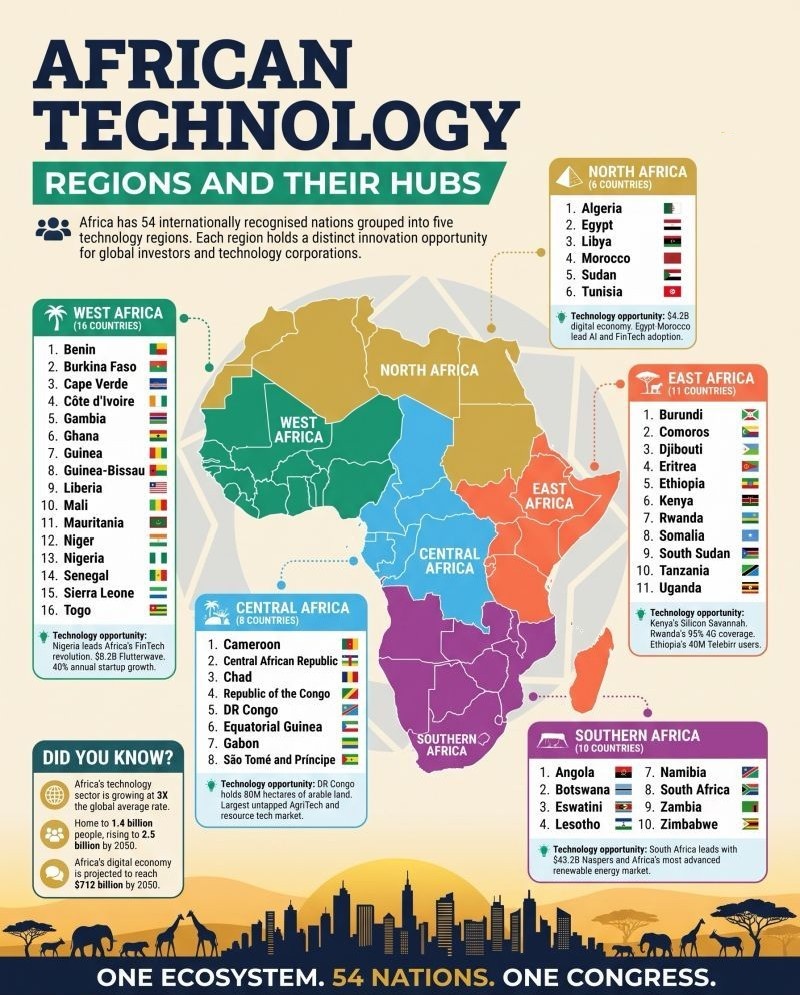
Africa’s technology sector is expanding at three times the global average rate. This growth is not uniform across a single continent-wide market. Instead, it unfolds across five distinct technology regions, each presenting unique innovation opportunities, infrastructure maturity levels, and entry points for international businesses.
For companies engaged in cross-border trade, digital supply chain solutions, fintech, or enterprise software, understanding these regional differences determines success or failure. Treating Africa as one monolithic opportunity leads to mismatched strategies, delayed market entry, and lost revenue. The winners align their offerings—whether payments platforms, AgriTech tools, logistics software, or renewable energy systems—with the specific strengths and needs of each region.
Africa Tech Market
With a population of 1.4 billion today projected to reach 2.5 billion by 2050 and a digital economy expected to hit $712 billion, the timing for strategic engagement has never been stronger. This guide breaks down the five technology regions of Africa, their key hubs, growth drivers, and practical pathways for B2B players to capture value in 2026 and beyond.
Why Regional Precision Beats a Generic “Africa Strategy”
Operational experience across emerging markets shows that success hinges on matching product capabilities to regional realities. A payments solution optimized for mobile money penetration thrives in West Africa’s fintech corridors but requires different adaptations for Southern Africa’s more mature banking infrastructure. Similarly, connectivity-dependent SaaS performs best in East Africa’s digitally advanced ecosystems, while resource and AgriTech solutions find their strongest demand in Central Africa’s vast untapped potential.
This regional approach reduces entry risks, accelerates time-to-revenue, and builds defensible positions. It also aligns with broader supply chain trends: businesses seeking diversified sourcing, new distribution channels, or technology-enabled trade routes increasingly view these regions as strategic complements to established GCC and Asian corridors.
West Africa: The FinTech Engine Driving Continental Innovation
West Africa, encompassing 16 countries, stands as the continent’s premier fintech powerhouse. Nigeria anchors this region with a vibrant startup ecosystem where companies like Flutterwave have achieved multi-billion dollar valuations. Annual startup growth rates hover around 40%, fueled by a young, mobile-first population and widespread adoption of digital financial services.
Key Opportunities for B2B Traders and Tech Providers:
- Cross-Border Payments and Trade Finance: High demand for solutions that reduce remittance costs and streamline B2B settlements in volatile currency environments.
- E-Commerce Enablement: Tools supporting last-mile logistics and digital marketplaces for SMEs moving goods across ECOWAS borders.
- Mobile-First Supply Chain Visibility: Platforms integrating with local mobile money systems for real-time tracking in fragmented logistics networks.
Practical entry steps include partnering with local fintech leaders, obtaining necessary regulatory approvals through bodies like Nigeria’s Central Bank, and piloting solutions in high-volume trade lanes such as Lagos to Accra corridors. Data from operational deployments indicates that solutions addressing currency conversion friction and compliance can achieve rapid adoption, often within 6-9 months of localized rollout.
For global traders, West Africa offers gateways for technology exports alongside traditional commodities. Companies supplying warehouse optimization software or digital freight tools find receptive markets among rapidly scaling distributors.
North Africa: Digital Economy Momentum with Strong AI and FinTech Adoption
North Africa comprises 6 countries, including Egypt, Morocco, and Tunisia. The region boasts a digital economy valued at approximately $4.2 billion, with notable progress in AI integration and fintech adoption. Egypt and Morocco serve as primary hubs, leveraging strategic geography, improving infrastructure, and government digital transformation initiatives.
Strategic Advantages for International Businesses:
- Enterprise Software and AI Solutions: Growing demand from government and private sectors modernizing operations in logistics, manufacturing, and services.
- FinTech Infrastructure: Opportunities in digital banking, insurance tech (InsurTech), and trade facilitation platforms.
- Nearshoring for European Supply Chains: Proximity to Europe combined with tech talent pools makes the region attractive for technology-enabled manufacturing and export hubs.
Businesses entering North Africa benefit from established free zone frameworks and bilateral trade agreements that facilitate technology transfers. Focus on compliance with local data regulations and integration with regional payment rails yields faster ROI. Case studies from similar markets demonstrate that AI-powered predictive analytics for port operations or customs clearance can reduce processing times by 30-40%.
East Africa: The Digitally Connected Growth Corridor
East Africa, with 11 countries, represents one of the most digitally advanced regions on the continent. Kenya’s Silicon Savannah has become a global reference point for innovation, while Rwanda achieves 95% 4G coverage and Ethiopia boasts 40 million users on its Telebirr mobile money platform. This connectivity backbone supports scalable technology deployment at speed.
High-Potential Sectors for B2B Engagement:
- Connectivity-Dependent Services: Cloud solutions, IoT for supply chain monitoring, and remote collaboration tools.
- AgriTech and Digital Commerce: Platforms linking smallholder farmers to regional and international markets.
- HealthTech and EdTech Extensions: Solutions that extend into broader enterprise ecosystems.
A proven tactic involves starting with pilot programs in Nairobi or Kigali, leveraging high digital literacy rates to gather feedback before scaling across the corridor. For traders, East Africa serves as an ideal testing ground for blockchain-based traceability systems, particularly for agricultural exports destined for GCC and European markets.
Central Africa: The Untapped AgriTech and Resource-Tech Frontier
Central Africa includes 8 countries, with the Democratic Republic of Congo (DRC) holding immense potential through its 80 million hectares of arable land and rich natural resources. While infrastructure challenges persist, this region offers first-mover advantages for technology providers addressing AgriTech, mining tech, and resource management.
Key Levers for Value Creation:
- Precision Agriculture Tools: Drones, soil monitoring sensors, and market linkage platforms to unlock productivity.
- Resource-Tech Integration: Solutions for sustainable extraction, supply chain transparency, and compliance in mining operations.
- Basic Infrastructure Enablement: Off-grid power solutions combined with digital logistics for remote areas.
Success here requires patient capital and hybrid models that combine technology with on-ground capacity building. Companies that invest in localized training and partnerships with regional cooperatives report stronger long-term adoption and reduced operational friction.
Southern Africa: The Mature Base with Advanced Enterprise Capabilities
Southern Africa, spanning 10 countries, provides the continent’s most developed technology ecosystem. South Africa leads with major players like Naspers and a sophisticated renewable energy market. This maturity translates into demand for high-end enterprise solutions and integration services.
Priority Opportunities:
- Renewable Energy Tech: Software and hardware supporting the region’s leadership in green energy transitions.
- Advanced Logistics and Supply Chain Platforms: ERP integrations, predictive maintenance, and multimodal optimization tools.
- Financial Services Technology: Sophisticated fintech for corporate treasury, risk management, and cross-border investment flows.
Southern Africa often serves as a regional headquarters for pan-African expansion. Its regulatory clarity and established financial systems lower barriers for larger technology deployments. Traders benefit from efficient ports and rail networks enhanced by digital overlays for better visibility.
Cross-Cutting Trends Shaping Africa’s Technology Landscape in 2026

Cross-Cutting Trends Shaping Africa’s Technology
Several macro forces amplify opportunities across all regions:
- Mobile Money and Digital Identity: Foundational layers enabling broader fintech and e-commerce adoption.
- Sustainability Imperatives: Demand for ESG-compliant technologies, particularly in mining, agriculture, and logistics.
- Talent and Infrastructure Investments: Growing tech hubs producing skilled developers and improving broadband access.
- Policy Support: National digital economy strategies and continental initiatives like AfCFTA facilitating intra-African trade.
Strategic Focus: Operationalizing the AfCFTA via Technology
While the African Continental Free Trade Area (AfCFTA) establishes the regulatory framework for a unified market, technology serves as the primary execution layer. For B2B traders, international operators, and platform users, the true value of AfCFTA lies in how digital tools bridge the gap between policy and daily cross-border supply chain operations.
- Harmonized Customs & HS Codes: Unified digital trade desks eliminate paperwork friction by automatically matching localized product descriptions with standardized international HS code matrices.
- Tariff Liberalization Trackers: Real-time compliance dashboards enable automated tracking of dynamic tariff reductions across all 5 distinct technology regions.
- Risk Mitigation Architecture: Integrating algorithmic compliance checks into the customs clearance workflow reduces transit delays and significantly lowers transactional counterparty risks.
For B2B operators, these trends translate into demand for integrated platforms that combine trade documentation, compliance checking, payment rails, and logistics coordination.
Practical Framework for Market Entry and Scaling
Step 1: Regional Assessment Evaluate your core offering against regional maturity matrices. Use tools like HS code classifiers and tariff calculators to map product fit.
Regulatory Risk: HS Code Alignment & Dual-Use Compliance
Navigating Africa’s tech corridors requires strict compliance with trade classification. Because the continent heavily imports advanced hardware while exporting critical raw materials (particularly from Central and Southern Africa’s rich mineral sectors), border operations frequently trigger severe delays due to misclassified Harmonized System (HS) Codes and unverified Dual-Use Goods (technology with both commercial and military applications).
Advanced telecommunications gear, encrypted IoT sensors for mining, and high-precision AgriTech drones are routinely flagged at regional customs chokepoints. Failure to map these early against international sanctions databases and regional restrictions results in seized cargo and compounding port demurrage fees.
- Granular HS Mapping: Never rely on global 6-digit HS code generalizations; always verify the destination country’s specific 8 or 10-digit tariff schedules.
- Dual-Use Pre-Screening: Embed automated screening matrixes within your supply chain software to identify restricted tech components before cross-border logistics dispatch.
Step 2: Partnership Models Prioritize local joint ventures or distribution agreements over solo entry. This accelerates regulatory navigation and cultural adaptation.
Step 3: Technology Stack Alignment Deploy modular solutions that allow region-specific customizations while maintaining central oversight. Cloud architectures with edge computing capabilities perform particularly well.
SaaS & FinTech Blindspot: Continental Data Localization
For enterprise software, SaaS, and FinTech operators, cross-border deployment hinges on strict data compliance. Africa is experiencing a massive shift toward sovereign infrastructure. Regulatory frameworks across Southern Africa (anchored by the Protection of Personal Information Act – POPIA) and emerging mandates in North Africa enforce strict Data Localization laws that prevent sensitive financial or personal consumer data from leaving national borders.
A centralized, offshore cloud database is no longer viable for regional expansion. FinTech platforms and supply-chain ecosystems must adopt hybrid cloud models, routing metadata through central nodes while maintaining localized instances for core user data to guarantee sovereignty compliance.
- POPIA & Sovereign Storage: Ensure South African operations leverage regional data centers (such as AWS Cape Town/Johannesburg zones) to keep regulated personal data on-shore.
- Interoperable Privacy Layers: Design your application’s data layer with modular compliance tokens, allowing quick adaptation to disparate regional cross-border data transfer protocols.
Step 4: Risk Mitigation Incorporate geopolitical monitoring, currency hedging tools, and multi-modal logistics planning. Digital escrow mechanisms and compliance dashboards reduce transaction friction significantly.
Financial Execution: Mitigating Currency Friction & Settlement Risks
Local currency volatility and dollar liquidity shortages represent a persistent friction point across Africa’s tech and trade corridors. To safeguard margins, sophisticated B2B operators are moving away from traditional correspondent banking networks, instead leveraging continent-wide financial rails and advanced escrow architecture to guarantee transactional flow.
The deployment of the Pan-African Payment and Settlement System (PAPSS) allows cross-border commercial transactions to be settled instantly in local currencies, bypassing the costly and delayed third-party currency conversion (e.g., USD or EUR). Concurrently, digital B2B Escrow Services & Trust Accounts ensure counterparty trust, locking funds securely until verifiable shipping milestones or performance metrics are cleared.
- PAPSS Routing: Whenever possible, route intra-continental trade settlements through PAPSS-compliant commercial banks to minimize foreign exchange exposure and transaction fees.
- Milestone-Based Escrow: Mitigate counterparty risk in unfamiliar corridors by integrating algorithmic escrow accounts that auto-release multi-currency trade payments based on custom digital documentation checks.
Step 5: Measurement and Iteration Track KPIs such as customer acquisition cost, time-to-first-transaction, and supply chain efficiency gains. Data-driven adjustments enable faster scaling.
Businesses leveraging platforms for trade intelligence often report 25-40% improvements in operational efficiency within the first year. For example, integrating market pulse analytics helps identify demand spikes in specific corridors before competitors react.
Comparative Overview of Africa’s Technology Regions
| Region | Primary Tech Focus | Dominant FinTech Rail | Primary Customs & Regulatory Challenge | B2B Entry Advantage |
|---|---|---|---|---|
| West Africa | Payments, Mobile Commerce | Mobile Money, Wallets (Flutterwave, OPay) | ECOWAS tariff anomalies & volatile currency FX spread | High SME density, rapid digital payments adoption |
| North Africa | AI, Enterprise Software | Digital Banking & Instant Cards (Fawry) | Strict cross-border capital controls & data localization | Proximity to Europe, established industrial free zones |
| East Africa | AgriTech, IoT, SaaS | M-Pesa, Telebirr & Unified QR Rails | Overlapping regional blocs (EAC vs. COMESA rules) | High 4G/5G connectivity & deep tech-literate talent |
| Central Africa | AgriTech, Mining Tech | Hybrid Cash-to-Digital, PAPSS Pilots | Dual-use goods clearance & fragmented mineral supply chains | First-mover advantage in massive raw material frontiers |
| Southern Africa | Renewables, Advanced Logistics | Sophisticated EFT Corporate Treasury & Banking | Strict compliance with South African POPIA data sovereignty | Mature physical infrastructure & stable legal framework |
Building Resilient Supply Chains Through Regional Technology Integration
The convergence of technology adoption and trade creates powerful flywheel effects. Digital freight forwarders, for instance, reduce coordination costs in multimodal routes spanning West African ports to Southern African distribution centers. Similarly, AI-driven demand forecasting helps align production in North Africa with consumption patterns across East Africa.
Geoeconomic Link: The GCC-Africa Logistics Corridors
The technological integration of Africa’s regional markets does not stop at the continent’s coastlines. A major macro driver is the massive influx of capital from the Gulf Cooperation Council (GCC). Led by multi-billion dollar sovereign investments from the UAE and Saudi Arabia into Red Sea ports, East African maritime gateways, and North African digital free zones, the GCC is actively cementing its role as Africa’s primary logistics and financing bridge to global markets.
For international traders operating out of GCC hubs like Dubai or Riyadh, East Africa (via the Red Sea corridor) and North Africa act as natural logistical extensions. Gulf-backed investments in smart port automation and tracking infrastructure are turning these regional entry points into highly predictable, tech-enabled supply chains.
- Maritime Hub Synergy: Aligning digital freight documentation with GCC-managed port systems (such as DP World’s continental network) accelerates multi-modal transit and customs clearance.
- Inter-Regional Capital Flows: Utilizing Middle Eastern trade finance platforms and digital escrow services bypasses traditional European banking friction, cutting B2B settlement cycles in half.
For companies already active in GCC markets, Africa’s technology regions offer natural extensions. Shared cultural and business ties facilitate smoother knowledge transfer, while complementary strengths—such as African raw materials feeding GCC processing—strengthen overall chain resilience.
Internal resources on related topics include practical guides to cross-border logistics optimization and strategies for digital networking in emerging markets.
Overcoming Common Operational Challenges
- Regulatory Fragmentation: Harmonize approaches using pan-African frameworks while addressing country-specific requirements.
- Infrastructure Gaps: Deploy hybrid offline-online solutions and invest in local last-mile partners.
- Talent Acquisition: Combine remote expertise with on-ground training programs.
- Currency and Payment Risks: Utilize multi-currency platforms and escrow services to build trust.
Real-world implementations show that addressing these proactively through integrated technology stacks yields compounding returns.
The Strategic Imperative for 2026 and Beyond
Africa’s technology sector growth is not a distant forecast but a present-day operational reality reshaping global value chains. Companies that develop nuanced, region-specific strategies position themselves to capture significant upside in both technology deployment and facilitated trade.
Whether expanding digital trade tools, sourcing innovative solutions, or building new supplier networks, the five regions offer differentiated pathways. The most successful operators treat this as a portfolio approach—balancing quick wins in mature hubs with longer-term bets in high-potential frontiers.
Platform.Tendify.Net provides practical utilities such as duty calculators and trade explorers that support informed decision-making in these dynamic markets.
The opportunity is clear: match your capabilities to the right African technology region, execute with operational precision, and build lasting advantage in one of the world’s most promising growth stories.
Ready to streamline your cross-border operations and access new markets with greater confidence? Register today at https://tendify.net/my-account/ to unlock tools and insights designed for efficient global trade execution.

