


المدونة
20 Documents Used in Export & Import
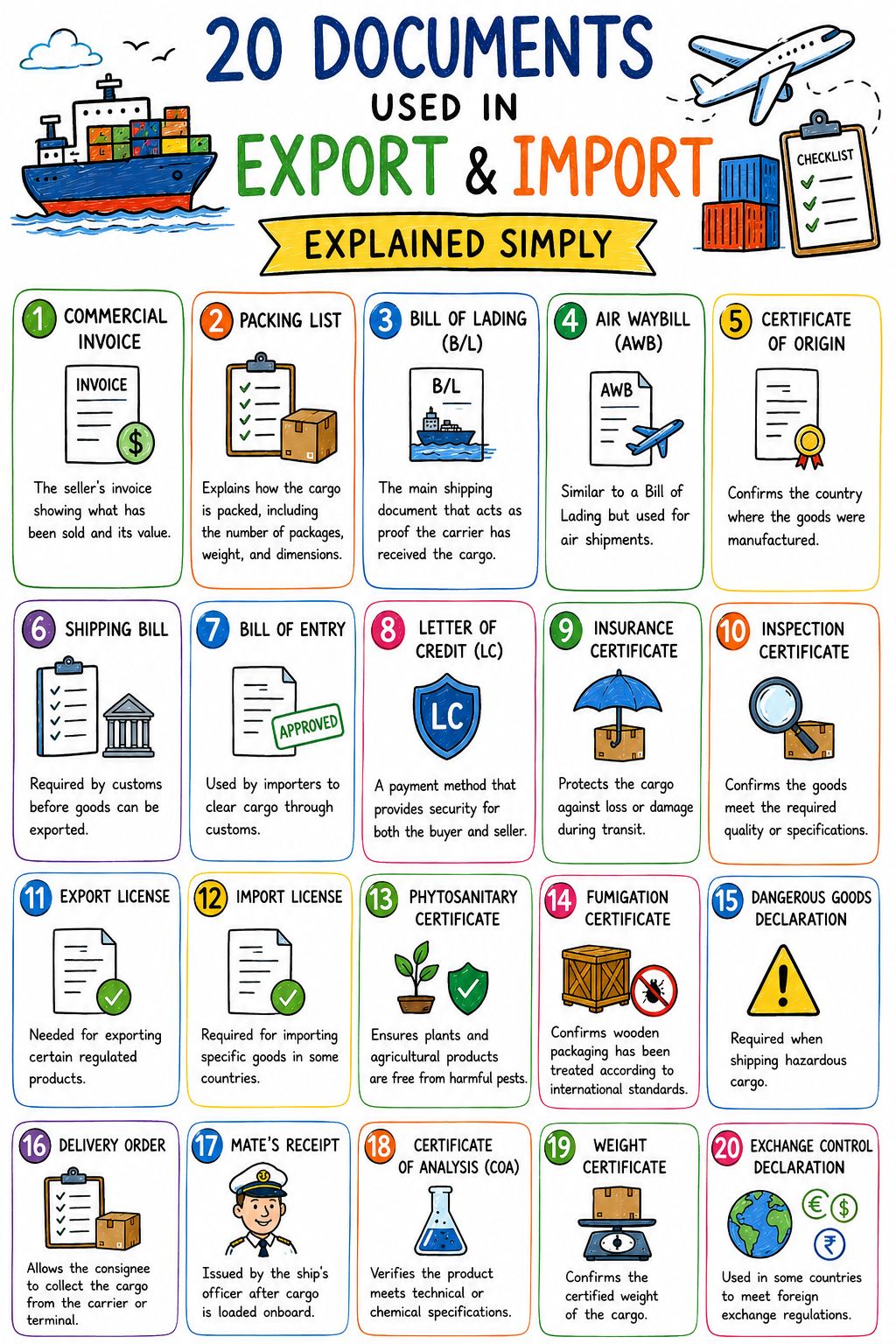
In cross-border B2B trade, especially across dynamic GCC and MENA markets, a single missing or mismatched document can halt a multi-million-dollar shipment at customs, trigger penalties, or erode trust in high-stakes deals. Operational teams that master documentation move faster, pay less in delays and fees, and build stronger supplier-buyer relationships.

20 Documents Used in Export & Import
This guide breaks down the 20 most critical documents every trader, logistics coordinator, and compliance officer needs in 2026. It includes practical explanations, real-world GCC applications, step-by-step preparation tips, and common pitfalls that cost businesses thousands in demurrage or rejected shipments.
Why Documentation Mastery Separates Top Performers in GCC Trade
GCC ports like Jebel Ali and King Abdullah Port process enormous volumes with increasingly digital systems. Yet discrepancies remain a leading cause of delays. Accurate paperwork directly impacts clearance speed, duty calculations, payment security, and eligibility for incentives under frameworks like Saudi Vision 2030 or UAE re-export advantages.
Strong documentation practices reduce risks in volatile markets, support ESG compliance, and enable smoother multimodal operations from sea to land corridors in the region.
Core Commercial Documents: The Foundation of Every Deal

Core Commercial Documents: The Foundation of Every Deal
1. Commercial Invoice
This is the primary financial and legal record of the transaction. It details the seller, buyer, goods description (with HS codes), quantity, unit price, total value, Incoterms, and payment terms.
Preparation Tips: Align exactly with the purchase order and packing list. Include country of origin and any applicable VAT/GCC tax references. For UAE or Saudi imports, precise valuation prevents customs re-assessment.
⚠️ Strategic 2026 Transit Risk Warning
Incoterms Precision in Red Sea & Gulf of Aden Corridors
Given ongoing maritime transit volatility across the Red Sea and Gulf of Aden, vague Incoterms references on your Commercial Invoice or Bill of Lading are a massive liability. Shifting from Group C (e.g., CIF, CFR—where the seller pays freight but risk transfers at the loading port) to Group D (e.g., DAP, DPU—where risk stays with the seller until destination) changes who absorbs the catastrophic costs of rerouting, war risk insurance premiums, or cargo strandings. Clearly stipulate the exact geographic point of risk transfer and align your cargo insurance certificates line-by-line to prevent devastating legal standoffs between buyers and suppliers.
2. Proforma Invoice
A preliminary quote used for negotiations, LC applications, or import permits. It mirrors the commercial invoice but is non-binding until confirmed.
GCC Insight: Essential for pre-approvals in regulated sectors like construction materials or food imports.
3. Packing List
A detailed inventory of contents per package, including weights (net/gross), dimensions, marks, and packaging type. It supports loading, customs inspection, and insurance claims.
نصيحة محترف: Use it alongside the commercial invoice for container optimization—tools like Tendify’s 3D container planner can help visualize loads.
4. Certificate of Origin (CoO)
Proves the country of manufacture, critical for preferential tariffs, rules of origin compliance, and market access.
Regional Note: Non-preferential and preferential versions matter in GCC free zones and for re-exports.
Transport and Logistics Documents: Moving Goods Efficiently
5. Bill of Lading (B/L) – Ocean
The contract of carriage, receipt of goods, and document of title. Negotiable (order) or non-negotiable (straight) versions apply.
2026 Legal & Tech Mandate: The Move to eBL
Electronic Bills of Lading (eBLs) are no longer just an operational preference; they are legally backed by the widespread regional adoption of the UNCITRAL Model Law on Electronic Transferable Records (MLETR) across Abu Dhabi Global Market (ADGM) and Dubai jurisdictions. When preparing ocean documents, top performers align with FITalliance standards (backed by DCSA, BIMCO, and ICC) to achieve instant, friction-free title transfers at hubs like Jebel Ali and Khalifa Port, removing days of courier dependency.
6. Air Waybill (AWB)
For air freight—non-negotiable, serves as receipt and contract. Faster but higher cost for time-sensitive cargo.
7. Sea Waybill or Multimodal Transport Document
Alternatives to traditional B/L for non-title transfers, speeding up release without original documents.
8. Shipper’s Letter of Instruction (SLI)
Instructions to the freight forwarder covering routing, documentation, and special handling.
9. Mate’s Receipt
Initial acknowledgment by the ship’s officer; converted to B/L. Key for bulk or breakbulk in GCC ports.
Delivery Order (D/O) & Electronic Warehouse Receipt (EWR)
The Delivery Order acts as the final authority for cargo release from the ocean carrier to the importer or their customs broker. In modern trade logistics, this paper-heavy handoff has shifted entirely to automated, instant digital releases.
GCC Port Automation Mandate
In smart regional hubs like Dubai Trade (Mirsal II) and King Abdullah Port, the delivery order process is 100% digitized. Physical counter visits are replaced by blockchain-backed tokens and automated clearing. Failing to secure your digital D/O or Electronic Warehouse Receipt prior to vessel arrival triggers immediate terminal delays and compounding quay storage fees.
Cross-Border Land Freight
TIR Carnet / Regional Land Manifest (Bayan)
For cross-border trucking and multimodal corridors connecting the UAE, Oman, and Saudi Arabia, land-specific transit documents are indispensable. The international TIR Carnet allows customs-sealed vehicles to cross regional borders without repetitive, time-consuming inspections. Locally, this is supplemented by digital cross-border manifests like Saudi Arabia’s Bayan system for overland freight tracking.
Corridor Efficiency: Overland transit times between Jebel Ali and Riyadh can stretch from 48 hours to a week if land manifests or TIR declarations contain weight mismatches. Ensure the truck license plate, driver details, and axle-load declarations exactly match your regional customs sub-filings.
Compliance and Regulatory Documents: Navigating Borders Smoothly

Compliance and Regulatory Documents: Navigating Borders Smoothly
10. Shipping Bill / Export Declaration
Required for export clearance, declares goods details to customs authorities.
11. Bill of Entry
Importer’s declaration for customs clearance and duty assessment.
12. Certificate of Analysis (COA) / Inspection Certificate
Verifies quality, specifications, or conformity (e.g., for chemicals, food, or construction materials in Saudi SABER or UAE standards).
KSA Market Crucial
SABER Certificate of Conformity (CoC) / GeMS
For enterprises targeting Saudi Arabia, the SABER Certificate of Conformity (CoC) is an absolute prerequisites—not just an optional inspection note. Operating via the electronic GeMS/SABER platform, this document strictly enforces compliance with SASO technical regulations. Without a valid, product-specific electronic CoC linked to the customs manifest, cleared access at Saudi borders is completely blocked for regulated goods.
2026 Strategic Insight: Seamless integration with Saudi Arabia’s FASAH (Single Window) system means that customs validation happens automatically. Always ensure your product registration and certificate issuance on SABER match your Commercial Invoice line-by-line before the vessel berths.
UAE Market Mandatory
MoIAT Product Conformity / ECAS Certificate
Issued by the UAE Ministry of Industry and Advanced Technology (MoIAT), this compliance certificate is mandatory for an expanding list of regulated products entering the Emirates. Operating primarily through the Emirates Conformity Assessment Scheme (ECAS) and EQM (Emirates Quality Mark), it verifies that goods meet strict national safety and environmental benchmarks before they can legally clear customs or be distributed.
Logistics Checkpoint: MoIAT clearance is tightly bound to Dubai Trade (Mirsal II) and other emirate-level single windows. Failure to upload the active MoIAT conformity approval during the pre-clearance phase triggers automated holds, severe port storage fees, or mandatory re-exportation.
13. Phytosanitary Certificate
For agricultural and plant products—confirms freedom from pests. Critical for GCC food imports.
Halal Certificate
A mandatory document for the import of meat, poultry, food products, and increasingly cosmetics into Islamic markets. It verifies that the products have been processed, manufactured, and packaged in strict compliance with Islamic dietary laws and hygienic standards.
GCC Strict Compliance & Accreditation
The GCC region enforces some of the world’s most stringent Halal regulations. For Saudi Arabia, certificates must be issued by bodies accredited directly by the Saudi Food and Drug Authority (SFDA). For the UAE, compliance is overseen by the Ministry of Industry and Advanced Technology (MoIAT). Unaccredited certificates will lead to immediate shipment rejection at the port of entry.
Hub & Re-Export
Free Zone Customs Declaration & Transfer Documentation
Given that massive hubs like Jebel Ali Free Zone (JAFZA) drive regional trade, specific Free Zone Documentation—such as the Customs Bill for Free Zone Exits or an official Transfer of Ownership—is critical. These specialized declarations track cargo moving between free zones, into the local GCC mainland, or during transit, ensuring traders correctly claim duties and VAT exemptions.
Tax & Tariff Compliance: To maintain zero-rated corporate or customs tax status during re-exports, your cross-border paper trail must perfectly align. A missing Free Zone transit declaration or an unvalidated gate pass can instantly trigger unexpected mainland duties.
Bonded Warehouse Documentation & Ownership Transfer
When goods enter a designated bonded zone without paying immediate customs duties, specialized documentation is required to manage storage, cargo splitting (de-consolidation), and ownership transfer while the shipment remains under customs control.
Jebel Ali & Free Zone Re-Export Edge
A major share of the GCC’s re-export trade operates through bonded storage in hubs like جافزا. Moving or selling goods inside these zones requires a Customs Bonded Transfer Declaration or an official Delivery Order for Bonded Cargo. Accurate line-item validation prevents regional customs from treating the transfer as a mainland entry, preserving your duty-exempt and VAT-free status during high-stakes cross-border trade.
14. Fumigation Certificate
For wooden packaging—ensures ISPM 15 compliance to prevent rejection.
15. Dangerous Goods Declaration (DGD)
Mandatory for hazardous materials, with proper UN numbers, classes, and packaging.
16. Insurance Certificate
Details coverage under cargo insurance (often Institute Cargo Clauses). Align with Incoterms responsibility.
17. Export/Import License or Permit
For controlled goods (e.g., dual-use, certain chemicals, or food items).
Financial and Payment Documents: Securing Transactions
18. Letter of Credit (LC) and Related Documents
Traditionally the bedrock of high-value cross-border trade, a Letter of Credit (LC) is a bank-issued guarantee ensuring payment transfers once compliant shipping documents are presented. While still prevalent for large-scale bulk commodities, traditional LCs are slow, expensive, and administratively heavy.
In 2026, forward-thinking enterprises are bypassing legacy banking delays by adopting Documentary Digital Escrow systems and the Tokenization of Real-World Trade Assets (RWA). By linking digital bills of lading (eBLs) and conformity certificates directly to smart contracts, funds are instantly and securely released upon automated verification of customs checkpoints. This eliminates weeks of bank discrepancies, slash transaction costs, and accelerates liquidity across the GCC supply chain.
19. Weight Certificate / Other Supporting Certificates
Confirms cargo weight for freight calculations or compliance.
20. Delivery Order / Release Note
Authorizes cargo pickup from the carrier or terminal after clearance.
Step-by-Step Process: From Quote to Delivery
- Pre-Shipment: Issue Proforma → Negotiate → Prepare Commercial Invoice & Packing List → Secure LC or payment terms.
- Booking & Loading: SLI to forwarder → Obtain Mate’s Receipt → Prepare transport document (B/L or AWB).
- Customs & Compliance: File Shipping Bill/Entry → Attach CoO, licenses, certificates.
- Post-Shipment: Exchange documents for payment → Handle delivery order and final release.
Digital Shift in 2026: Platforms supporting e-documents and single windows reduce paper handling. Always verify requirements with destination customs (e.g., FASAH in Saudi or UAE systems).
المزالق الشائعة وكيفية تجنبها
- Discrepancies: Even minor mismatches (weights, descriptions) cause holds. Use checklists and cross-verification.
- Late or Missing Originals: For negotiable B/Ls, plan courier timing or switch to eBLs/seawaybills.
- Incorrect Valuation/HS Codes: Leads to under/over-invoicing risks and penalties. Leverage accurate classification tools.
- Ignoring Regional Nuances: GCC rules on VAT, SABER, or re-export documentation vary—tailor per corridor (UAE-Saudi land, sea to India, etc.).
- Sustainability/Compliance Gaps: Increasing focus on ESG certificates and green logistics proofs.
Comparison Table: Key Documents by Shipment Type
| المستند | الشحن البحري | Air Freight | Bulk/Commodity | Compliance Focus |
|---|---|---|---|---|
| الفاتورة التجارية | أساسي | أساسي | أساسي | Valuation & Duties |
| Bill of Lading | الأساسيات | غير متاح | الحرجة | Title & Carriage |
| Air Waybill | غير متاح | الأساسيات | غير متاح | Fast Release |
| شهادة المنشأ | Usually | Often | عالية | Tariffs & Preferences |
| Phytosanitary | For Agro | For Agro | غير متاح | Food Safety |
| Insurance Cert | موصى به | موصى به | أساسي | Risk Mitigation |
Building an Internal Documentation Playbook
Top teams maintain digital templates, version control, and training. Integrate with CRM and logistics tools for automated generation and checks. Regular audits against latest regulations keep operations resilient.
For advanced calculators, HS code search, proforma builders, or container optimization that streamline these processes, explore targeted tools within the ecosystem at Platform.Tendify.Net. They integrate practically into daily workflows without overcomplication.
Related Resources for Deeper Execution
- Mastering Incoterms Selection for GCC Shipments
- Reducing Customs Delays in Regional Ports
- Escrow and Secure Payments in B2B Trade
Take Control of Your Trade Operations
Mastering these 20 documents transforms documentation from a bottleneck into a competitive edge—faster clearances, lower costs, and more reliable partnerships across GCC and international corridors. Consistent application builds operational resilience in an evolving trade landscape.
To facilitate, secure, and accelerate your processes with integrated tools and a growing network, register today at https://tendify.net/my-account/ and start streamlining your cross-border workflows.

