


المدونة
EUDR Coffee Compliance Guide & Free PDF Templates

A mid-sized green coffee importer in the Gulf clears a container of unroasted beans at a major European port in early 2027. The paperwork looks clean. Geolocation polygons sit in the file. A due diligence statement (DDS) reference number is attached. Then the roaster down the chain processes the beans and places roasted coffee on the EU market under a different CN code. Suddenly the question lands: who carries which obligations under the EU Deforestation Regulation (EUDR)? The answer has shifted, and the shift matters for every operator moving coffee through cross-border supply chains.
The European Commission’s targeted corrigendum to its EUDR Frequently Asked Questions, issued after engagement with industry bodies, redraws the line between traders and downstream operators for coffee. When green coffee is processed and the resulting product enters the EU market under a different CN code, the company performing that processing is classified as a downstream operator rather than a trader. The Commission uses roasting as the primary illustration: the move from CN 0901 11 00 (green, non-decaffeinated) to 0901 21 00 (roasted, non-decaffeinated). The same logic extends to other processing steps that produce a change in HS or CN commodity code, including decaffeination.
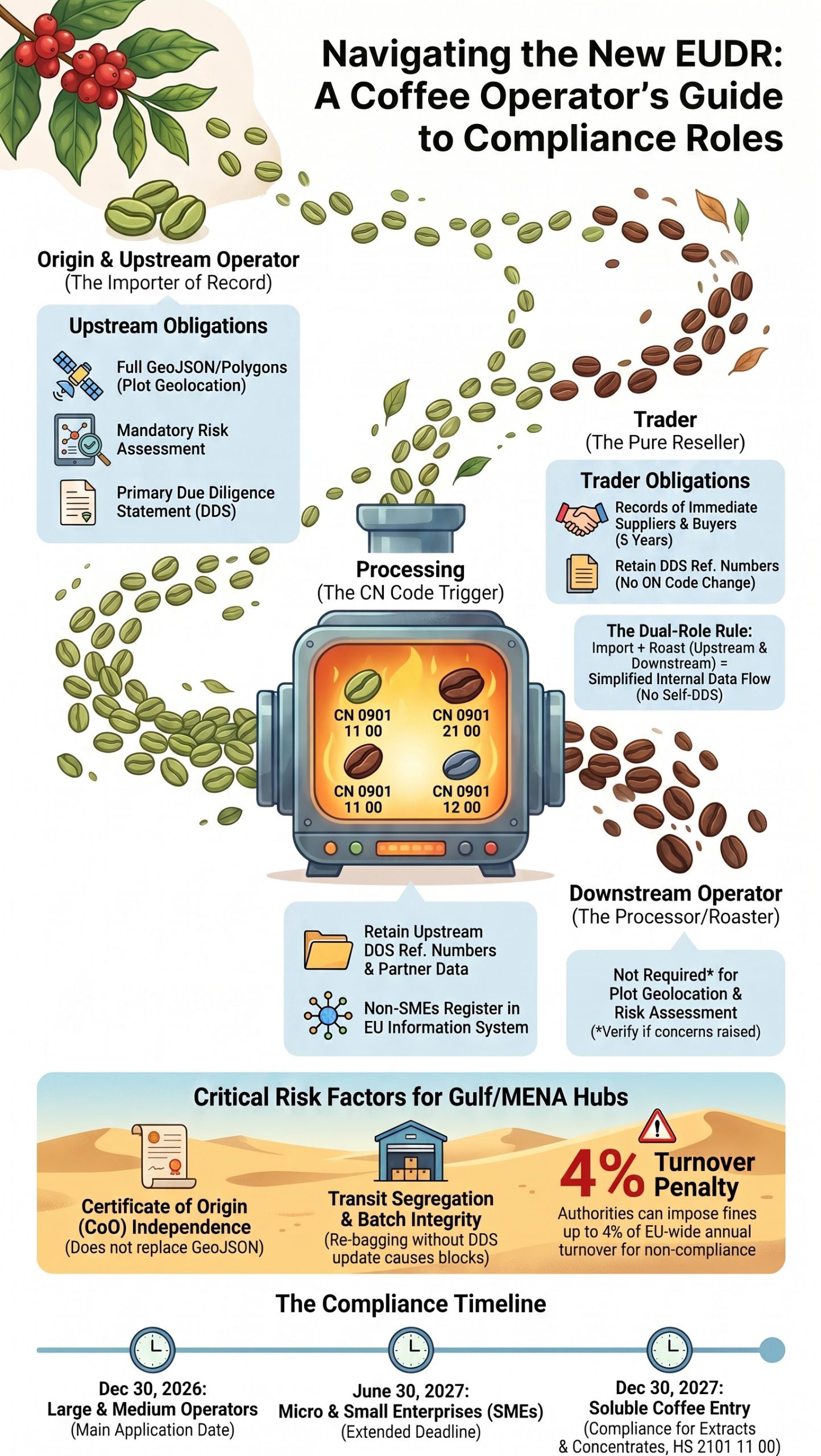
Coffee Operator Guide to EUDR
This clarification arrives as the main application dates approach. Large and medium operators face obligations from 30 December 2026. Most micro and small operators outside the wood sector have until 30 June 2027. Soluble coffee (HS 2101 11 00) has been brought into scope through a delegated act, with compliance required from 30 December 2027. For businesses handling coffee across the Gulf, MENA, and into the European market, the distinction between roles is no longer academic. It determines who files a full DDS, who simply retains reference numbers, and who faces verification exposure when a substantiated concern arises.
Understanding the Three Core Roles Under the Revised EUDR
The regulation now works with a clearer separation of responsibilities.
Operators (upstream)
are the first natural or legal persons who place a relevant product on the EU market or export it from the Union, excluding downstream operators. For most coffee flows this is the importer of record at the point of first entry. They must collect plot-level geolocation data, conduct risk assessment against the 31 December 2020 deforestation cut-off, verify legality under the laws of the country of production, and submit a full DDS into the EU Information System before the product can be released.
Downstream operators
place on the market or export relevant products that have been made using other relevant products already covered by a DDS or simplified declaration. Processing that changes the CN code listed in Annex I triggers this status. Roasting and certain forms of further processing fall into this category under the updated FAQ. Downstream operators do not repeat the full upstream due diligence. Their core duties are lighter: collect and retain information on direct business partners (name, postal address, email—standard commercial data already present on invoices) and, when they sit immediately after an upstream operator, retain the DDS reference number(s). Non-SME downstream operators must also register in the Information System and respond to substantiated concerns.
Traders
make relevant products available on the market without changing the Annex I CN/HS code in a way that creates a new relevant product. Pure resellers of the same green or roasted coffee, without further transformation that alters the regulated code, typically remain traders. Their obligations mirror those of downstream operators in most practical respects under the simplified regime.
A single legal entity can hold both operator and downstream operator roles in the same supply chain. When the roles coincide inside one company, the firm does not need to communicate the DDS reference number further downstream. This removes an earlier point of friction for integrated roasting and trading houses.
Why the CN Code Change Matters for Coffee Processing
Annex I of the EUDR lists coffee under the broad heading 0901. Sub-codes exist for green versus roasted and for decaffeinated versus non-decaffeinated. Earlier interpretations treated the entire 0901 family as continuous, so a roaster receiving already-placed green coffee was often viewed as a trader. The corrigendum adjusts this for cases where the processing produces a product under a different CN code that is still within scope. The roasting example is explicit. The same reasoning applies to decaffeination when the resulting code changes.
Practical consequence: an EU-based or EU-importing company that buys green coffee already covered by a DDS and then roasts it for sale or export becomes a downstream operator. It does not file a new full DDS. It records the upstream reference number and keeps partner data. If the same company had imported the green coffee itself, it would first act as upstream operator and then, after roasting, as downstream operator for the roasted product. The dual-role rule simplifies internal communication of the reference numbers.
Soluble coffee follows a different timeline. Once the delegated act takes effect, extracts and concentrates under 2101 11 00 enter the scope. Processors converting roasted or green coffee into soluble form will need to map their position carefully against the new code and the later compliance date.
Step-by-Step Classification for Your Coffee Operation
- Identify the exact CN/HS code of the product at the moment it is placed on the EU market or exported.
- Determine whether any prior relevant product in the chain was already covered by a DDS or simplified declaration.
- Check whether your activity produces a change in the digits listed in Annex I.
- Confirm whether you are the first actor placing that specific relevant product on the market.
- Apply the dual-role rule if the same entity both imports and processes.
- Record the outcome in an internal role matrix that links each product line, supplier, and customer to the corresponding obligations.
Operational assessments across Gulf re-export hubs show that many traders who previously treated roasting as a pure trading activity now need to update their compliance matrices. The cost of misclassification is not theoretical. Customs authorities and competent authorities can request evidence of role determination during checks. Penalties for non-compliance can reach 4 % of EU-wide turnover.
Obligations Matrix for Coffee Supply Chain Actors
Upstream operators must:
- Collect geolocation polygons or plot coordinates for every production unit.
- Perform risk assessment covering deforestation after 31 December 2020 and legality under origin-country law.
- Mitigate any non-negligible risk before submission.
- File the DDS and obtain the reference number.
- Keep all supporting documentation for five years.
- Communicate necessary information downstream.
Downstream operators must:
- Collect and retain direct partner data (name, address, email).
- When they are the first downstream actor, retain the upstream DDS reference number(s).
- Register in the Information System if non-SME.
- Verify due diligence was exercised if a substantiated concern is raised; stop placing or exporting if verification fails.
- Maintain records for five years.
Traders follow the same practical retention and registration rules as downstream operators. SME traders enjoy lighter record-keeping focused mainly on supplier and customer identity plus reference numbers where received.
Micro and small primary operators established in low-risk countries benefit from a simplified one-time declaration using a postal address in place of full geolocation in certain cases. Coffee origins classified as standard risk do not receive this relief.
Practical Workflow for Cross-Border Coffee Flows into the EU
Map every shipment against the roles before booking ocean or air freight. Contracts should allocate who acts as importer of record. Under DDP the seller often retains the upstream operator role; under DAP or FCA the EU buyer typically assumes it. Ambiguity at this stage creates shipment holds.
Use existing commercial invoices to capture partner data. No new data fields are required beyond what professional trading already generates. Store DDS reference numbers in the same digital folder as the commercial invoice, bill of lading, and certificate of origin. Five-year retention is mandatory; cloud systems with audit trails reduce retrieval risk.
For Gulf-based re-exporters handling coffee that will later enter the EU after further processing, the classification of the first EU placer becomes critical. If the coffee is simply stored or transhipped without processing that changes the Annex I code, the original importer remains the upstream operator. If roasting or soluble conversion occurs inside the Union, the processor takes the downstream role.
For Middle Eastern trading houses using free zones in the Gulf (such as JAFZA, KIZAD, or Salalah) as re-export staging points, separating customs documentation from EUDR compliance data is critical to avoid transit clearance delays:
- Certificate of Origin (CoO) Independence: Issuing a regional Non-Preferential CoO or Re-Export Certificate from a GCC Chamber of Commerce does not alter or invalidate the primary plot-level geolocation data bound to the original upstream DDS.
- Transit Segregation & Batch Integrity: Green coffee held in bonded GCC warehouses for re-export to the EU must maintain strict batch traceability. Re-bagging or blending lots from different origins without updating the underlying DDS reference matrix will trigger compliance blocks at European ports of entry.
- DDS Chain Preservation: Ensure that the original upstream DDS reference number and supporting GeoJSON metadata travel alongside the commercial invoice and Certificate of Re-Export through the entire transit corridor.
Satellite verification tools and farm-mapping platforms have matured. Many origin suppliers now deliver GeoJSON files as standard. Importers should test a sample of polygons against available deforestation layers before the first 2026 shipments. Early testing surfaces gaps while there is still time to remediate or switch suppliers.
Afghanistan Transit Trade: The Ultimate Logistics & Compliance Guide
Risk Points That Still Trip Up Experienced Traders
Geolocation data that covers only the cooperative headquarters instead of individual plots will fail scrutiny. Aggregated farm data is accepted only when the regulation’s rules for smallholders are met and the risk assessment supports it.
Mixing lots from different plots after the first DDS is filed can break the chain of reference numbers. Clear lot segregation and batch tracking remain essential.
Substantiated concerns can arrive from NGOs, competitors, or authorities. Non-SME downstream operators and traders must investigate. Failure to stop non-compliant product after an unresolved concern creates liability.
Soluble coffee processors should treat 2027 as a hard deadline and begin mapping their green and roasted inputs now. The addition of 2101 11 00 closes a previous gap that allowed some deforestation-linked product to enter through the soluble channel.
Building an Internal EUDR Coffee Protocol
Create a one-page decision tree for every coffee SKU: green, roasted, decaffeinated, soluble. Link each node to the responsible role, the required documents, and the retention location. Train commercial, logistics, and finance teams on the tree. Run a quarterly audit of open shipments against the tree.
Align Incoterms and payment terms with the role allocation. Where the upstream operator is outside the EU, ensure the EU-based party has contractual rights to receive the DDS reference number and supporting data before the goods leave origin.
For traders using free-zone or bonded facilities in the Gulf as staging points, document that the coffee has not yet been placed on the EU market. Placement occurs at the moment of customs clearance into free circulation inside the Union or at the point of export from the Union.
Data and Documentation Checklist for 2026 Shipments
- Confirmed CN code at point of placement
- Upstream DDS reference number (or confirmation that the company itself is upstream)
- Geolocation file (GeoJSON or equivalent) for every plot
- Risk assessment summary with deforestation and legality conclusions
- Partner identity records for the previous and next actors in the chain
- Evidence of five-year retention system
- Registration confirmation in the EU Information System (non-SME)
Tools that automate HS/CN classification and generate compliant commercial documents reduce the administrative load. Many traders already rely on structured platforms for tariff and documentation work; extending those systems to hold DDS references is a logical next step. One such environment is available at Platform.Tendify.Net for operators who need a single workspace for trade documentation and compliance tracking.
Vietnam Coffee Exports: B2B Sourcing Guide & 2026 Market Outlook
📥 Downloadable EUDR Coffee Compliance Guides (PDF)
Practical toolkits, contract clauses, and logistics guides for trade compliance officers.
The EUDR Coffee Compliance Checklist & Role Matrix
Decision tree for EUDR roles, GeoJSON precision criteria, and 5-year data retention matrix.
EUDR Trade Contract Clauses & Incoterms Framework
Model legal clauses, DDP vs. DAP risk alignment, and customs detention protocols.
GCC Coffee Re-Export & Transit Guide
JAFZA/KEZAD warehouse lot segregation, CoO mapping, and 6-state tariff model.
Looking Ahead: Enforcement Reality in 2027 and Beyond
Competent authorities will prioritise high-volume coffee flows and operators with complex multi-origin supply chains. Random checks and risk-based audits will increase after the first full year of application. Companies that can produce a clean role matrix, complete reference-number trail, and plot-level data within hours will clear faster and face fewer holds.
The corrigendum improves predictability. It aligns the legal classification with the commercial reality of roasting and further processing. Businesses that update their internal classifications now avoid the scramble that will hit those still operating under the pre-corrigendum understanding.
Cross-border coffee trade into the EU remains viable and, for many Gulf and MENA operators, strategically attractive. The operators who treat the role distinction as a core commercial process rather than a late-stage compliance add-on will move product with fewer interruptions and stronger buyer relationships.
For related practical guidance on classifying products under complex tariff structures, see the HS Code classification resources on the Tendify blog. For end-to-end cost modelling of coffee shipments that now include compliance overhead, the trade cost analysis tools provide useful benchmarks. Both sit under the main blog directory at tendify.net/blog.
The window between now and the December 2026 application date is the period in which systems can still be tested with real shipments under lower pressure. Use it. Map every product line, assign every role, and lock the documentation flow. The market will reward those who arrive prepared.
When the first containers of the new regime move, the traders and processors who already know whether they stand as upstream operator, downstream operator, or trader will clear while others are still debating the FAQ. That operational clarity is now the competitive edge in EU-bound coffee trade.

