


المدونة
Fujairah & Red Sea Rerouting: Analyzing the UAE 66% Export Surge and Saudi Arabia’s US Delivery Blank

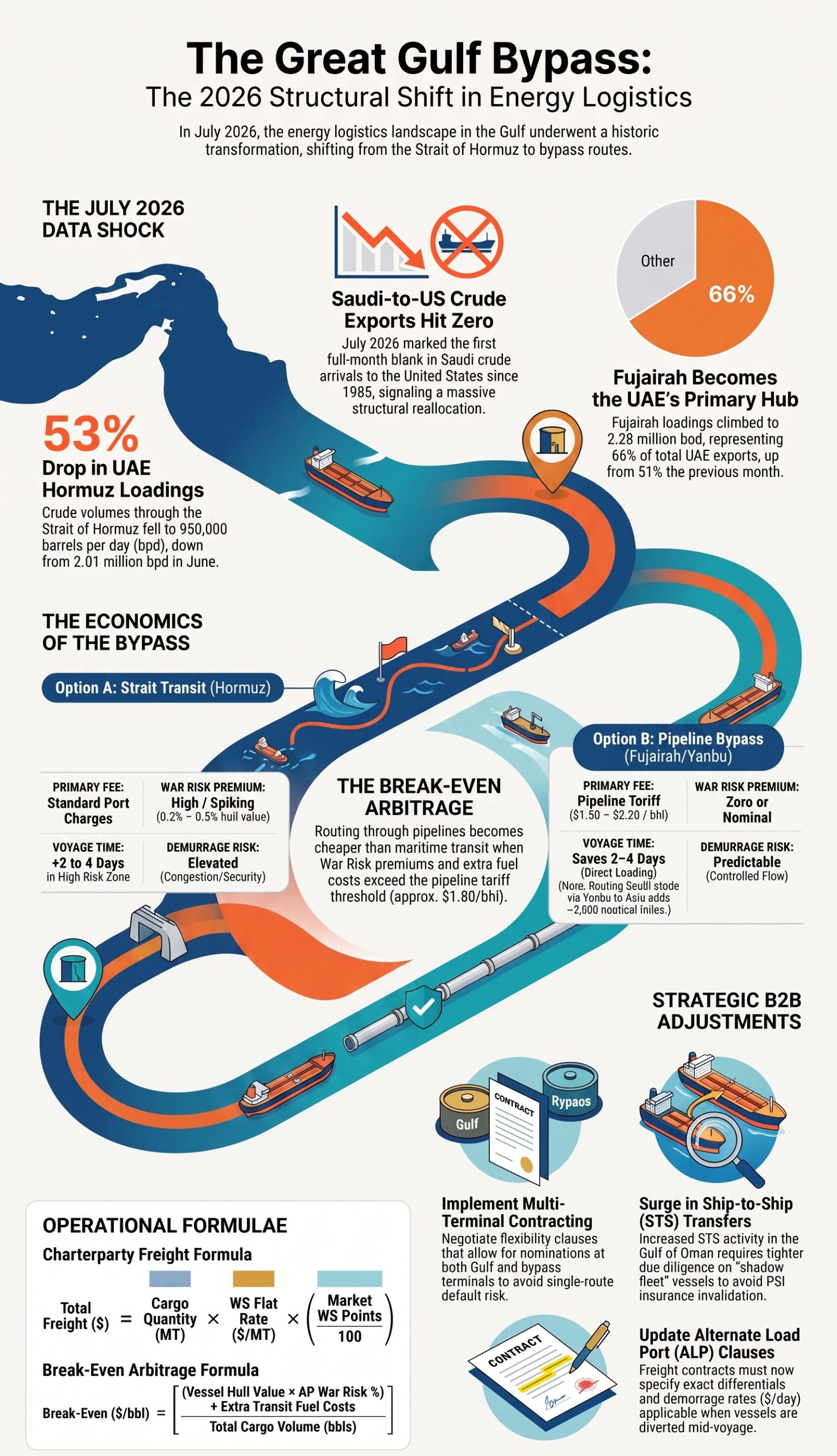
In July 2026, two data points landed with unusual force on energy and logistics desks across the Gulf. UAE crude loadings through the Strait of Hormuz dropped nearly 53 percent to 950,000 barrels per day. At the same time, volumes moving through Fujairah on the Gulf of Oman climbed, pushing that terminal’s share of total UAE exports to roughly 66 percent. Parallel figures from the United States showed Saudi crude arrivals at zero for the entire month—the first full-month blank since 1985. Kpler tracking indicated those US-bound volumes could recover toward 300,000 barrels per day in the following period, yet the zero itself remains a structural signal.
The Great Gulf Bypass Overview
These are not isolated shipping statistics. They mark a visible acceleration in how Gulf producers manage chokepoint exposure, insurance costs, and customer geography. For B2B operators—freight forwarders, traders, terminal operators, and industrial buyers—the numbers translate directly into route choices, demurrage risk, inventory buffers, and contract design. Operational reviews of recent Gulf loadings show the same pattern repeating: infrastructure that once served as contingency is becoming primary capacity, and long-standing trade corridors are being stress-tested in real time.
UAE Export Realignment: From Hormuz Dependency to Fujairah Primacy
The UAE’s July shift was decisive. Shipments via the strait fell from approximately 2.01 million barrels per day in June to 950,000 barrels per day. Fujairah loadings rose to about 2.28 million barrels per day, lifting the terminal’s contribution from 51 percent to 66 percent of national exports. Overall UAE crude and condensate exports averaged 3.46 million barrels per day, roughly 20 percent lower month-on-month, yet the composition changed more than the headline total.

Fujairah
The physical enabler is the Habshan-Fujairah pipeline. Designed with roughly 1.5 million barrels per day of capacity (with headroom in some configurations), the line moves crude from Abu Dhabi’s fields to the east-coast terminal without entering the Strait of Hormuz. Fujairah sits outside that waterway entirely, on the Gulf of Oman. That geographic fact converts into lower war-risk premiums, shorter exposure windows for tankers, and greater scheduling reliability when regional tensions rise.
Experiences drawn from recent tanker programming reveal several operational consequences:
- Charterers increasingly treat Fujairah as the default loading option rather than a secondary outlet. This compresses the window for last-minute voyage deviations and raises the value of firm berth nominations.
- Storage utilization around Fujairah has become a more active variable. Operators with access to the Mandous underground facility or commercial tanks gain flexibility to time liftings against freight and price signals.
- STS (ship-to-ship) activity in the Gulf of Oman has increased as a bridging mechanism when pipeline throughput or terminal slots tighten. These transfers add complexity to bills of lading, insurance declarations, and quality sampling protocols.
For logistics teams, the practical outcome is a re-weighting of contingency plans. Routes that once assumed free transit through the strait now carry explicit risk premiums and longer transit-time buffers. Firms that maintain dual-loading capability—Gulf terminals plus Fujairah—retain more negotiating leverage with both producers and receivers. Those locked into single-route exposure face higher demurrage probability and tighter cash-flow cycles when scheduling windows compress.
The same infrastructure that protects export continuity also reshapes regional bunkering and product flows. Fujairah’s role as a bunker hub recovered in July after a sharp June contraction, illustrating how crude rerouting and refined-product activity often move together. Traders monitoring both crude and bunker markets gain earlier signals of capacity stress than those watching only one segment.
Freight Mechanics: Ton-Mile Demand & Worldscale Dynamics
Shifting load points from inside the Arabian Gulf (Ras Tanura / Mina Al Ahmadi) to Fujairah or Yanbu fundamentally recalibrates global shipping economics by altering overall Ton-Mile Demand and chartering metrics across VLCC and Suezmax segments.
Loading at Fujairah saves ~2-4 steaming days per round trip by bypassing the Strait of Hormuz. Conversely, routing Saudi crude via Yanbu (Red Sea) to Asia adds ~2,500 nautical miles around the Arabian Peninsula, expanding global Ton-Mile demand and tightening effective VLCC supply.
Spot fixtures for VLCCs (~270k mt) and Suezmaxes (~130k mt) react immediately to alternative load port nominations. Freight costs scale directly via published Worldscale Flat Rates adjusted for actual market points (WS Points).
Total Freight ($) = Cargo Quantity (MT) × WS Flat Rate ($/MT) × (Market WS Points / 100)
*Where WS Flat Rate is updated annually by the Worldscale Association based on standard vessel bunker, canal, and port costs for the specific route (e.g., TD3C AG-to-China vs. Red Sea-to-China).
Contracts must incorporate clear Alternate Load Port (ALP) clauses specifying the exact freight differentials and demurrage rates ($/day pro-rata) applicable when a vessel is diverted from Hormuz ports to Fujairah or Yanbu mid-voyage.
Saudi Arabia’s US Export Blank: A 40-Year First and the Asia Pivot
Saudi crude deliveries to the United States registered zero across all weeks of July 2026. Occasional zero weeks have occurred before; a complete monthly blank had not been recorded since 1985. Earlier in 2026, US refiners had been taking more than 800,000 barrels per day of Saudi grades in some periods. The abrupt stop forced rapid substitution. Venezuelan volumes into the United States rose sharply, while domestic light crude and other Atlantic Basin supplies filled remaining gaps.
Saudi Arabia’s US Export Blank
Kpler forecasts pointed to a rebound toward 300,000 barrels per day in the subsequent month. Even that recovery would leave volumes well below earlier-year peaks. The deeper story is destination reallocation. A substantial share of Saudi exports has already been redirected through the East-West pipeline to Yanbu on the Red Sea. In recent periods, Yanbu has accounted for a majority of Saudi loadings, allowing the kingdom to reduce reliance on Gulf terminals exposed to Hormuz transit risk. That pipeline-to-Red Sea option changes voyage economics for cargoes heading to Asia or Europe and alters the competitive position of Ras Tanura and other Gulf ports.
From a B2B perspective, the zero-month carries several lasting implications:
- Refinery slate flexibility in the United States has been tested and expanded. Buyers who diversified crude sources earlier absorbed the disruption with less margin erosion. Those still heavily weighted toward a single Middle East supplier faced steeper replacement costs and quality adjustment challenges.
- Asian refiners, particularly in China and India, absorbed a larger share of available Saudi barrels. Longer-haul voyages increase freight demand for VLCCs and raise the importance of accurate arrival-window management at Asian discharge ports.
- Payment and financing structures are adjusting. Letters of credit and open-account terms that assumed predictable Gulf loading windows now incorporate wider force-majeure language and alternative performance metrics tied to pipeline or Red Sea liftings.
Market participants tracking these flows report that the combination of reduced US offtake and elevated Asian demand is reinforcing existing price differentials between grades and destinations. Traders with access to real-time tanker tracking and terminal nomination data can position more effectively than those relying on lagging monthly averages.
Downstream Impact: Bunkering & Refined Product Realignment
While crude rerouting dominates headline risk, the structural shifts across Fujairah and Red Sea corridors hit downstream product flows, crack spreads, and regional refining margins with equal force.
As the region’s premier bunkering hub, Fujairah’s shifting crude allocations directly influence commercial availability and storage economics for refined products, including middle distillates (Gasoil, Jet Fuel) and heavy fuel oil.
Saudi Arabia’s modern refining complexes at Jubail and Yanbu play an expanding role in supplying diesel and gasoil to European buyers. Rerouting feedstocks changes regional refinery run rates and alters regional crack spreads.
Traders and product buyers must evaluate crude transit decisions together with refined-product availability. Rerouting alters product yield profiles and creates localized freight tightness across clean product tankers.
Logistics and Supply-Chain Consequences Across the GCC
Both developments accelerate structural changes already visible in Gulf logistics. Chokepoint risk is no longer an abstract scenario; it is a recurring operational variable. Companies that treat route diversity as a core capability rather than an emergency measure are better positioned.
Key operational adjustments observed in recent cycles include:
- Multi-terminal contracting. Buyers and sellers increasingly negotiate flexibility clauses that allow nomination of either Gulf or Fujairah/Yanbu loading points within defined volume and quality parameters. Rigid single-terminal contracts carry higher default risk.
- Insurance and war-risk layering. Premiums for Hormuz-transiting voyages have fluctuated sharply. Operators who pre-agree war-risk coverage tiers or maintain standing policies for both Hormuz and non-Hormuz routes reduce last-minute cost spikes.
- Inventory and storage strategy. Working inventories held outside the most exposed waterways provide buffer against delayed liftings. Fujairah and certain Red Sea storage options have gained relative value for this reason.
- Demurrage and detention discipline. Compressed schedules increase the probability of laytime overruns. Clear documentation of berth readiness, notice of readiness procedures, and weather or security-related exclusions becomes more critical. Detailed guidance on these cost drivers appears in practical analyses of GCC port operations.
- Documentation and compliance velocity. Faster shifts between terminals require tighter coordination of certificates of origin, bills of lading, and quality certificates. Digital document workflows reduce the lag that can strand cargoes when physical routes change mid-voyage.
Regulatory Exposure: Shadow Fleets, STS Risks & P&I Club Scrutiny
The marked surge in Ship-to-Ship (STS) transfers off Fujairah and across the Gulf of Oman has elevated regulatory scrutiny. Maritime authorities and International Group of P&I Clubs (Protection & Indemnity) increasingly scrutinize offshore transfers to prevent sanction evasion via non-compliant “shadow fleet” vessels.
Insurers strictly enforce AIS transmission tracking (“dark activity” monitoring) and oil spill liability coverage during STS operations. Unsanctioned transfers risk immediate invalidation of P&I insurance policies mid-voyage.
Offshore transfers carry substantially higher legal exposure than direct terminal loadings. Off-takers face elevated risks of secondary sanctions, vessel detention, or cargo seizures if origin chain documentation is incomplete.
- Verify unbroken AIS historical logs for both daughter and mother vessels prior to STS initiation.
- Require explicit Certificate of Origin (COO) and STS Location Logs validated by port authorities.
- Include strict contractual indemnities for sanction non-compliance and unannounced vessel substitution in Bills of Lading.
Cross-border traders moving non-oil commodities through the same ports feel secondary effects. Container and bulk vessel schedules can be displaced when crude tankers dominate berth allocations. Firms that monitor both energy and general cargo berth utilization gain earlier warning of congestion.
Risk Management Frameworks for Energy-Exposed Trade
Operational assessments of recent Gulf cycles point to a small set of high-leverage practices:
- Maintain parallel commercial relationships with producers capable of loading at both Hormuz-exposed and bypass terminals.
- Build freight contracts that include explicit options for alternative load ports and corresponding freight differentials.
- Track pipeline utilization rates and storage inventories at Fujairah and Yanbu as leading indicators, not lagging confirmation.
- Stress-test cash-flow models against 10–20 day loading delays and corresponding demurrage exposure.
- Align payment terms with actual route risk rather than historical averages. Escrow or structured trade-finance instruments can reduce counterparty risk when transit times become less predictable.
These practices are not theoretical. They reflect adjustments already visible among operators who maintained continuity of supply while competitors faced force-majeure claims or lost offtake.
For deeper examination of related cost-control levers, see practical treatments of demurrage and detention management in UAE and Saudi ports, as well as structured approaches to re-export setups that leverage free-zone and bonded facilities. Parallel analysis of multimodal options and last-mile considerations in the broader Gulf region further supports resilient network design.
Financial Trade-Off: Pipeline Tariffs vs. Strait Transit & War Risk
Bypassing the Strait of Hormuz via the Habshan-Fujairah or Saudi East-West pipeline is not cost-free. Traders and charterers must weigh additional Pipeline Throughput Tariffs against volatile Additional Premium War Risk Insurance (AP WR) incurred when transiting sensitive maritime chokepoints.
| Cost Vector | Option A: Strait Transit (Hormuz) | Option B: Pipeline Bypass (Fujairah / Yanbu) |
|---|---|---|
| Primary Fee | Standard Terminal Port Charges | Pipeline Tariff (~$1.50 – $2.20 / bbl) |
| War Risk Premium (AP) | High / Spiking (0.2% – 0.5% Hull Value) | Zero or Nominal Base Rate |
| Steaming & Voyage Time | +2 to 4 Days Transit in High-Risk Zone | Saves 2–4 Days (Direct Gulf of Oman / Red Sea Loading) |
| Demurrage Risk Exposure | Elevated (Strait congestion & security delays) | Predictable (Controlled pipeline throughput) |
Break-Even Point ($/bbl) = [ (Vessel Hull Value × AP War Risk %) + Extra Transit Fuel Costs ] ÷ Total Cargo Volume (bbls)
*When elevated War Risk premiums exceed the pipeline tariff threshold (~$1.80/bbl on a standard VLCC carrying 2M barrels), routing crude through Fujairah or Yanbu becomes cheaper in absolute dollars, beyond just being safer.
Logistics managers must evaluate pipeline tariffs not as a net cost increase, but as a fixed-rate hedge against unpredictable maritime insurance spikes and costly demurrage days.
Automotive Landed Cost: China to GCC Import Guide
GCC Energy Logistics & Risk Toolkits
Access Tendify’s specialized operational guides and quantitative models to optimize your maritime chartering, insurance exposure, and compliance protocols across GCC trade corridors.
Looking Ahead: Infrastructure as Strategy
The July data crystallize a longer trend. Gulf producers are converting contingency infrastructure into primary capacity. The Habshan-Fujairah pipeline and the East-West pipeline to Yanbu are no longer occasional backups; they are integral to export programming. Buyers and logistics providers that treat this shift as permanent will design contracts, inventories, and financing around it. Those still operating on pre-disruption assumptions face repeated margin and reliability surprises.
Energy flows remain the most visible signal, yet the same logic applies across bulk commodities, project cargo, and high-value industrial goods moving through the same waterways and terminals. Route diversity, documentation speed, and contractual flexibility are now competitive differentiators rather than optional upgrades.
Operators seeking to compress decision cycles and improve visibility across these variables can evaluate the suite of trade utilities and market-intelligence tools available through Platform.Tendify.Net. The platform’s calculators, document builders, and real-time market signals are designed to support exactly the kind of operational adjustments described above.
The reconfiguration of GCC energy export routes is not a temporary reaction. It is an ongoing redesign of how risk, cost, and reliability are allocated across the supply chain. Firms that map their exposure, update their contracts, and build parallel capacity will treat the next set of monthly figures as confirmation rather than disruption. Those that delay the mapping exercise will continue to absorb the cost of lag.

