


المدونة
KFC Drops Pepsi: B2B Supply Chain & $500M Revenue Impact
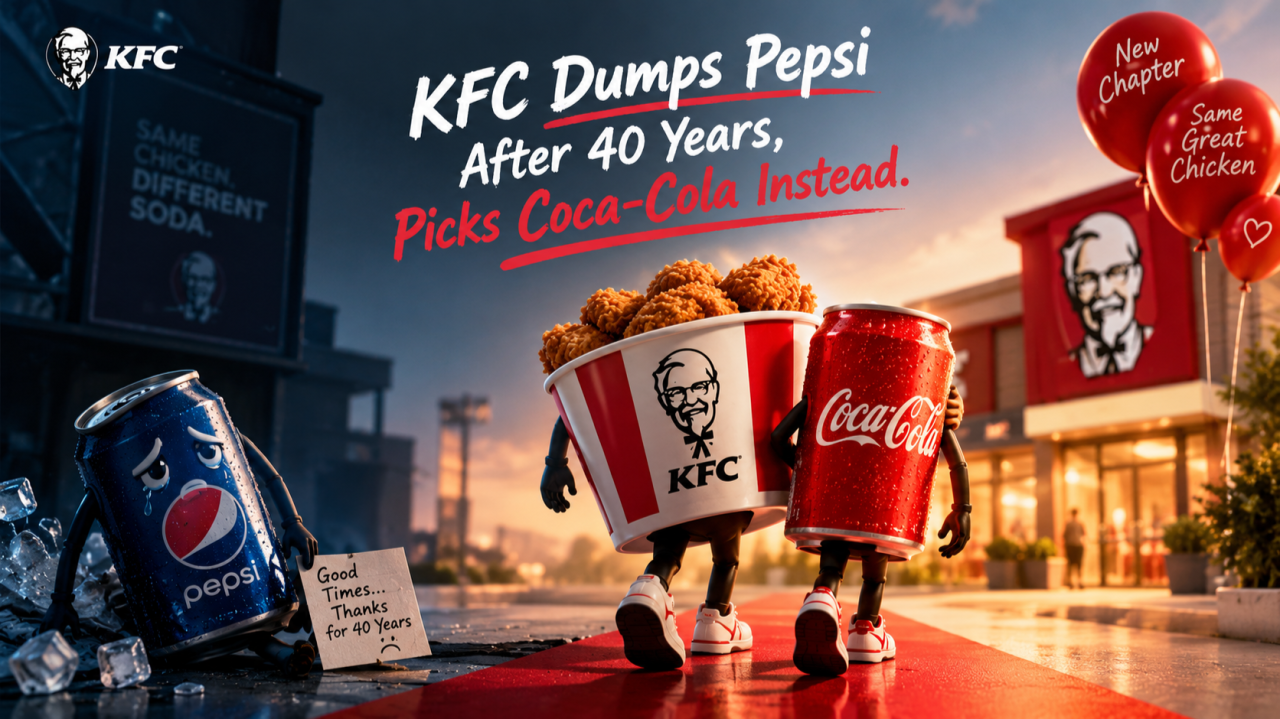
When a 40-year beverage partnership ends, the numbers travel fast. In mid-October 2026, KFC announced it would replace PepsiCo products with Coca-Cola across its roughly 3,700 U.S. restaurants, beginning January 2027 and completing the switch by spring. Bank of America analysts quickly put the annual sales at stake near $500 million—approximately 3 percent of Pepsi Beverages North America’s concentrate sales. The same analysis suggested a corresponding lift of about 2.5 percent for Coca-Cola’s North American concentrate business.
Those figures capture only the visible layer. For operators who manage exclusive supplier relationships, multi-year volume commitments, or foodservice distribution networks, the real story sits deeper. A single channel decision by a quick-service giant ripples through logistics planning, volume-discount structures, brand equity in high-visibility locations, and the risk calculus of every procurement team that has ever signed a long-term exclusive deal.
KFC Drops Pepsi: B2B Supply Chain & $500M Revenue Impact
This article examines the transaction through the lens of supply-chain and B2B operators. It quantifies the direct P&L impact, unpacks the less visible brand and channel risks, places the timing against a soft North American consumer environment, and extracts practical lessons for anyone negotiating exclusive contracts, dual-sourcing strategies, or foodservice logistics in 2026 and beyond.
The Direct Financial Hit: Concentrates, Volumes, and Margin Math
Beverage concentrate is high-margin product. When a restaurant chain of KFC’s scale changes suppliers, the volume moves almost overnight once the fountain equipment is swapped. Bank of America’s $500 million estimate reflects the annualized concentrate and finished-goods sales historically flowing through KFC’s U.S. system. Because concentrate carries elevated gross margins relative to packaged soft drinks sold in retail, the profit impact on PepsiCo is larger than a comparable revenue loss in grocery channels would imply.
Concentrate vs. Packaged Retail: The High-Margin Economics of Beverage Syrup
Understanding why losing a foodservice account hurts PepsiCo more than a retail grocery client requires examining beverage unit economics. In retail channels (cans and PET bottles), beverage manufacturers absorb heavy cost-of-goods-sold (COGS) items: aluminum, plastic resin, secondary packaging, carbonation, and the freight cost of shipping heavy water weight across distribution networks. As a result, packaged retail beverages typically yield gross margins in the range of 40% to 50%.
By contrast, fountain syrup concentrate is a pure margin engine, often commanding gross margins exceeding 70% to 80%. The manufacturer sells highly concentrated syrup in lightweight Bag-in-Box (BIB) containers, completely offloading the expense of water, carbonation (CO2), final packaging, and localized mixing onto the restaurant operator at the point of sale.
Financial Takeaway: Volume loss is not created equal. Losing $500 million in foodservice concentrate sales extracts disproportionately higher bottom-line profit than losing an equivalent dollar amount in supermarket retail cases, due to the extreme asset-light nature of syrup logistics.
On the winning side, Coca-Cola gains not only the concentrate volume but also the associated equipment placement, promotional rights, and data visibility inside thousands of high-traffic locations. Foodservice accounts deliver two advantages retail rarely matches: captive consumption (the drink is ordered with the meal) and brand presence at the point of decision. Losing or gaining that presence changes the competitive map more than pure volume numbers suggest.
PepsiCo retains the international KFC business and recently renewed agreements covering Taco Bell and KFC’s overseas restaurants. That continuity softens the blow, yet the U.S. foodservice channel remains one of the most profitable and brand-visible segments of the beverage industry. The loss therefore registers as both a revenue event and a strategic signal.
The Enterprise Bundling Dilemma: Unpacking Yum! Brands & Rebate Structures
Enterprise procurement contracts with multi-brand holding companies like Yum! Brands rarely operate in isolation. Historically, PepsiCo leveraged bundled pricing structures across KFC, Taco Bell, and Pizza Hut. By combining system-wide beverage volume across thousands of aggregate locations, Yum! Brands secured tiered volume rebates and favorable concentrate pricing that benefited all three chains.
Decoupling KFC’s ~3,700 U.S. restaurants from PepsiCo’s domestic portfolio disrupts these cross-brand rebate mechanics. While Taco Bell remains deeply integrated with PepsiCo—driven by co-branded product alignment like Baja Blast (Mountain Dew)—the removal of KFC’s massive gallonage shrinks total domestic baseline volume. From a commercial structuring perspective, this shift forces both sides to recalibrate rebate thresholds, marketing co-op allocations, and unit pricing for the remaining PepsiCo-supplied units within the Yum! ecosystem.
Commercial Lesson for B2B Procurement: Beware of cross-collateralized rebate tiers. When enterprise buyers sever one branch of a bundled supply agreement, the loss of aggregate volume can trigger price escalations or lower rebate yields across remaining product lines unless unbundling clauses and standalone pricing protections were established in the master service agreement.
Why the Foodservice Channel Matters More Than Retail
Retail soft-drink sales are measured in cases and market share points. Foodservice sales are measured in daily consumer interactions. Every time a customer orders a meal and a drink at KFC, the beverage brand receives free, high-frequency exposure. Over decades that exposure compounds into habit and preference. When the brand disappears from the cup, the interaction vanishes with it.
Analysts at Jefferies correctly identified the larger risk for PepsiCo: the loss of brand interaction and public perception. A longstanding customer switching suppliers raises questions about whether other historically stable accounts are now open for competition. In an industry where exclusive fountain contracts can lock in volume for five to ten years, the first high-profile defection can change negotiation dynamics across the board.
For supply-chain and procurement teams, the lesson is straightforward. Channel concentration risk is not limited to raw-material suppliers. It also applies to the customers who deliver the highest-margin, highest-visibility volume. An exclusive foodservice contract that looks like a fortress can become a single point of failure if the counterparty’s strategic priorities shift.
Macro Timing: Soft Demand Meets Strategic Realignment
The switch arrives at a difficult moment for PepsiCo’s North American beverage business. Recent quarterly results showed volume pressure in the domestic beverage unit while the snacks portfolio faced its own margin challenges. Consumers continue to navigate elevated prices and selective discretionary spending. In that environment, every high-margin account carries extra weight.
KFC, for its part, framed the move as part of a broader “Kentucky Fried Comeback.” Menu modernization, operational upgrades, and a refreshed beverage platform are intended to give customers additional reasons to choose the brand. Pairing the chicken offering with Coca-Cola’s portfolio opens possibilities for new combinations, limited-time flavors, and joint marketing that were constrained under the previous arrangement.
From a procurement perspective, the timing illustrates a classic tension. Long-term exclusive contracts provide volume certainty and favorable pricing for the supplier. They also reduce flexibility for the buyer when consumer preferences, competitive dynamics, or internal turnaround plans require a different partner. The longer the exclusivity period and the higher the volume commitment, the greater the switching cost—and the greater the incentive for the buyer to reassess when conditions change.
PepsiCo’s Counter-Strategy: Absorbing the $500M Gap Beyond U.S. Fountains
While losing KFC’s U.S. fountain footprint creates a clear short-term headwind, PepsiCo’s diversified corporate structure provides strategic hedges that Coca-Cola lacks. To offset the $500 million top-line gap and defend operating margins, PepsiCo is positioned to pivot across three core levers:
- Frito-Lay & Food Portfolio Synergy: Unlike its pure-play beverage rival, PepsiCo generates massive high-margin revenue from snacks (Lay’s, Doritos, Cheetos). Cross-subsidizing growth through dual-category retail promotions and expanding savory snack distribution in non-traditional QSR channels offers immediate margin protection.
- International KFC Continuity & High-Growth Markets: PepsiCo retains its exclusive partnership with KFC across overseas territories and continues to back Taco Bell globally. Accelerating volume growth in emerging markets—where per-capita beverage consumption is expanding faster than in saturated North American markets—helps cushion domestic losses.
- RTD & Retail Grocery Focus: Reallocating commercial capital toward Ready-to-Drink (RTD) channels, direct-to-consumer digital platforms, and high-margin functional beverages (Gatorade, energy portfolio) allows PepsiCo to capture direct consumer spend outside traditional restaurant fountain taps.
Strategic Takeaway: Corporate portfolio diversification serves as the ultimate risk mitigation tool. When a major account in a single channel defaults or switches partners, having strong adjacent product lines (like snacks) prevents a single procurement loss from destabilizing overall enterprise performance.
Ripple Effects Across Logistics and Commercial Terms
A change of this scale does not stop at the fountain head. Fountain equipment must be swapped or reconfigured. Existing inventory of branded cups, lids, and marketing materials becomes obsolete. Delivery schedules and warehouse slots that were optimized for one supplier’s product mix must be recalibrated. Volume-based discounts and promotional funds that were negotiated under the old contract disappear, forcing both parties to re-price related business.
Exclusive contracts often bundle logistics advantages—dedicated delivery windows, preferred carrier rates, or co-located inventory. When the exclusivity ends, those operational efficiencies may disappear as well. The new supplier must build equivalent density and reliability, which takes time and capital. In the interim, service levels can dip and costs can rise for the restaurant operator.
For third-party logistics providers and beverage distributors, the switch creates both risk and opportunity. Routes that previously carried high volumes of one brand must be rebalanced. New equipment installation creates short-term project work. Over the longer term, the winning supplier may consolidate more volume onto preferred carriers, altering lane density and pricing power.
Retooling Bottlenecks: The Hardware Logistics Behind Fountain Conversions
Swapping beverage partners across roughly 3,700 locations within a compressed multi-month window represents a massive hardware deployment challenge. A fountain system transition is far more complex than updating branding; it requires uninstalling legacy PepsiCo dispensers, installing Coca-Cola Freestyle or multi-valve units, re-plumbing high-pressure syrup lines, integrating CO2 carbonation tanks, and recalibrating water filtration hardware to match exact flavor specifications.
Executing this nationwide retrofit introduces acute supply chain constraints: component lead times for specialized valves and pumps, certified field technician availability, and reverse logistics for decommissioned equipment. If equipment lead times slip or technician scheduling falters, store-level downtime directly impacts sales revenue and customer experience during peak service windows.
Supply Chain Takeaway: Treat hardware swap-outs as critical-path infrastructure projects. Enterprise transitions require phased rollouts aligned with regional 3PL capacity, pre-staged inventory buffers for specialized fittings, and strict SLA agreements with installation teams to eliminate operational downtime during supplier cutovers.
Lessons for B2B Operators Managing Exclusive Relationships
The KFC–PepsiCo separation offers several transferable insights for any company that relies on large exclusive or near-exclusive customer or supplier relationships.
1. Map concentration risk beyond the top line.
Track not only the percentage of revenue or volume tied to a single counterparty, but also the margin contribution, brand exposure value, and operational dependencies (equipment, packaging, joint marketing funds). A 3 percent concentrate volume loss can translate into a larger profit and strategic impact.
2. Build contractual flexibility without sacrificing commercial terms.
Modern exclusive agreements increasingly include performance reviews, volume re-openers, and exit windows tied to mutual key performance indicators. Pure perpetual exclusivity is becoming rarer in sophisticated foodservice and industrial contracts for good reason.
3. Maintain dual-sourcing capability even when one partner dominates.
Complete dual-sourcing is expensive. Partial dual-sourcing—qualifying a second supplier for a minority share of volume—preserves switching options and strengthens negotiating leverage. The cost of readiness is often lower than the cost of an unplanned transition.
4. Treat brand equity in the channel as a measurable asset.
When a beverage brand disappears from thousands of restaurant cups, the lost impressions have a quantifiable value. Procurement and commercial teams should attempt to assign that value when evaluating contract renewals or competitive bids.
5. Align logistics planning with commercial contract cycles.
Equipment changeovers, inventory run-downs, and carrier reallocation should be planned years in advance of potential contract end dates. Waiting until the announcement creates avoidable cost and service disruption.
Operators who already manage complex cross-border supply chains can apply the same discipline. Tools that surface alternative suppliers, model landed costs under different volume scenarios, and track contractual milestones reduce the chance that a major account shift becomes a crisis. Platforms designed for B2B trade visibility, such as those available through Platform.Tendify.Net, can help procurement teams maintain real-time awareness of concentration risk and alternative sourcing options without adding headcount.
The table simplifies a more complex reality. Actual profit impact depends on the margin structure of concentrate versus finished goods, the cost of transition, and any offsetting volume gains or losses elsewhere in each company’s portfolio. Still, the directional effects are clear.
Looking Ahead: What This Signals for 2027 and Beyond
Exclusive foodservice contracts will continue to exist because both buyers and sellers value the certainty and the marketing partnership they enable. The KFC decision does not end the model. It does, however, raise the bar for the commercial and operational terms required to keep those contracts stable.
Buyers will demand clearer performance metrics, more frequent review points, and greater flexibility to respond to shifting consumer tastes. Suppliers will need to demonstrate continuous innovation and service reliability to justify locking in volume. Logistics providers and distributors will be expected to support faster, cleaner transitions when contracts do change.
For companies operating in competitive, high-visibility channels—whether quick-service restaurants, hotels, or institutional foodservice—the episode is a reminder that even the longest relationships can reset. The operators who treat exclusivity as a managed risk rather than a permanent entitlement will be better positioned when the next major account comes up for renewal.
In the months ahead, attention will turn to execution. Can Coca-Cola install equipment and train staff across thousands of locations without disrupting service? Will PepsiCo offset the volume loss through gains at other chains or through its international KFC footprint? How will franchisees manage the short-term cost of changeover? Those operational questions will determine whether the strategic narrative of 2026 becomes a lasting advantage or a temporary disruption.
The broader takeaway for supply-chain and procurement leaders is timeless: concentration risk is rarely visible until the day it becomes urgent. Mapping it early, contracting with flexibility, and maintaining ready alternatives remain the most reliable defenses.
The Franchisee Factor: CapEx, Transition Friction, and Buy-In Realities
A critical operational layer often overlooked in national beverage shifts is the structural tension between corporate franchisors and independent franchisees. The vast majority of KFC’s ~3,700 U.S. locations are operator-owned rather than corporate-held. While corporate headquarters negotiates overarching master agreements, the tactical execution—swapping fountain dispensers, retraining staff, re-establishing local supply lines, and managing short-term inventory write-offs—falls squarely on the individual franchisee.
For these independent operators, changing suppliers introduces direct capital expenditure (CapEx) and operational friction. Transitioning fountain infrastructure across thousands of sites requires coordinated site visits, water quality recalibrations, and local health code compliance checks, often creating temporary service disruptions.
Key Strategic Takeaway: Secure franchise association alignment early. When enterprise brands switch exclusive partners, franchisor-negotiated vendor allowances, equipment subsidy packages, and operational transition funds (often provided by the winning supplier, Coca-Cola) are essential to mitigate franchisee friction and prevent localized execution bottlenecks.
For teams looking to stress-test their own exclusive contracts, model alternative supplier scenarios, or tighten documentation around volume commitments and exit provisions, practical resources on contract structure and logistics risk are available across the Tendify knowledge base, including detailed guidance on export documentation checklists و Incoterms selection for complex shipments. Additional analysis of payment security and commercial terms can be found in discussions of escrow alternatives to traditional letters of credit.
The companies that treat the KFC–PepsiCo shift as a case study rather than a one-off news event will extract the most value. In an environment where consumer preferences and competitive dynamics can shift faster than multi-year contracts, resilience is no longer optional—it is the baseline requirement for sustained performance.
Ready to Strengthen Your Commercial & Logistics Frameworks?
Mitigate supply chain concentration risk, streamline cross-border documentation, and leverage real-time B2B trade intelligence designed for modern procurement leaders.
Concentration Risk Modeling
Automated Trade Documentation
Cross-Border Execution Tools
Join thousands of B2B operators optimizing their commercial operations on Tendify.

