


المدونة
UAE Corporate Tax Small Business Relief: Do You Qualify for 0% Tax?

A mainland trading company with AED 2.7 million in annual revenue just closed its books for the year. Under the standard corporate tax rules it would face a 9% charge on taxable income above AED 375,000. Instead, because it stays under the revenue ceiling and elects the available relief, its taxable income is treated as zero for the period. Compliance collapses to a simplified return. Cash that would have gone to tax stays inside the business for inventory, freight contracts, or market expansion.
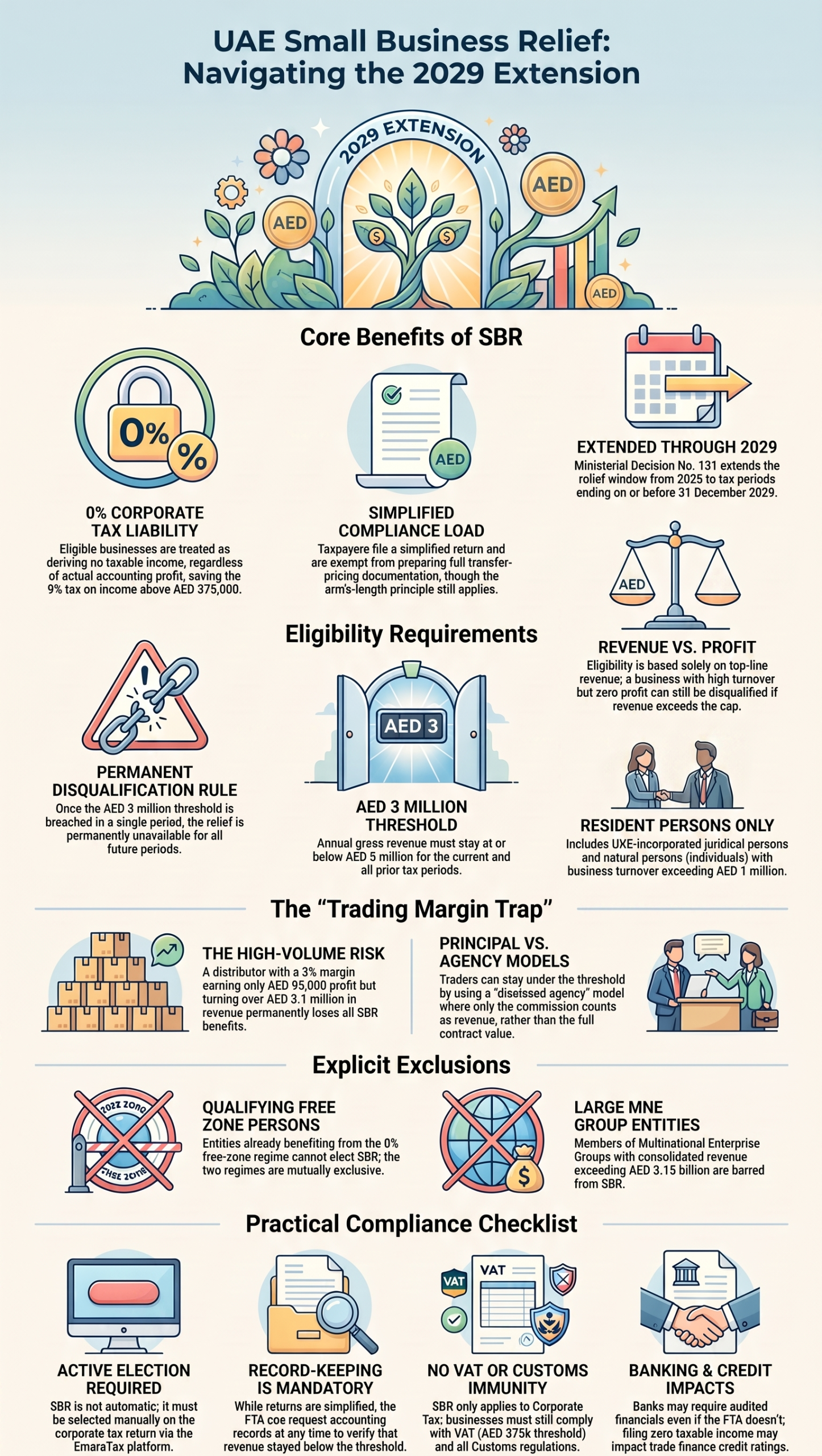
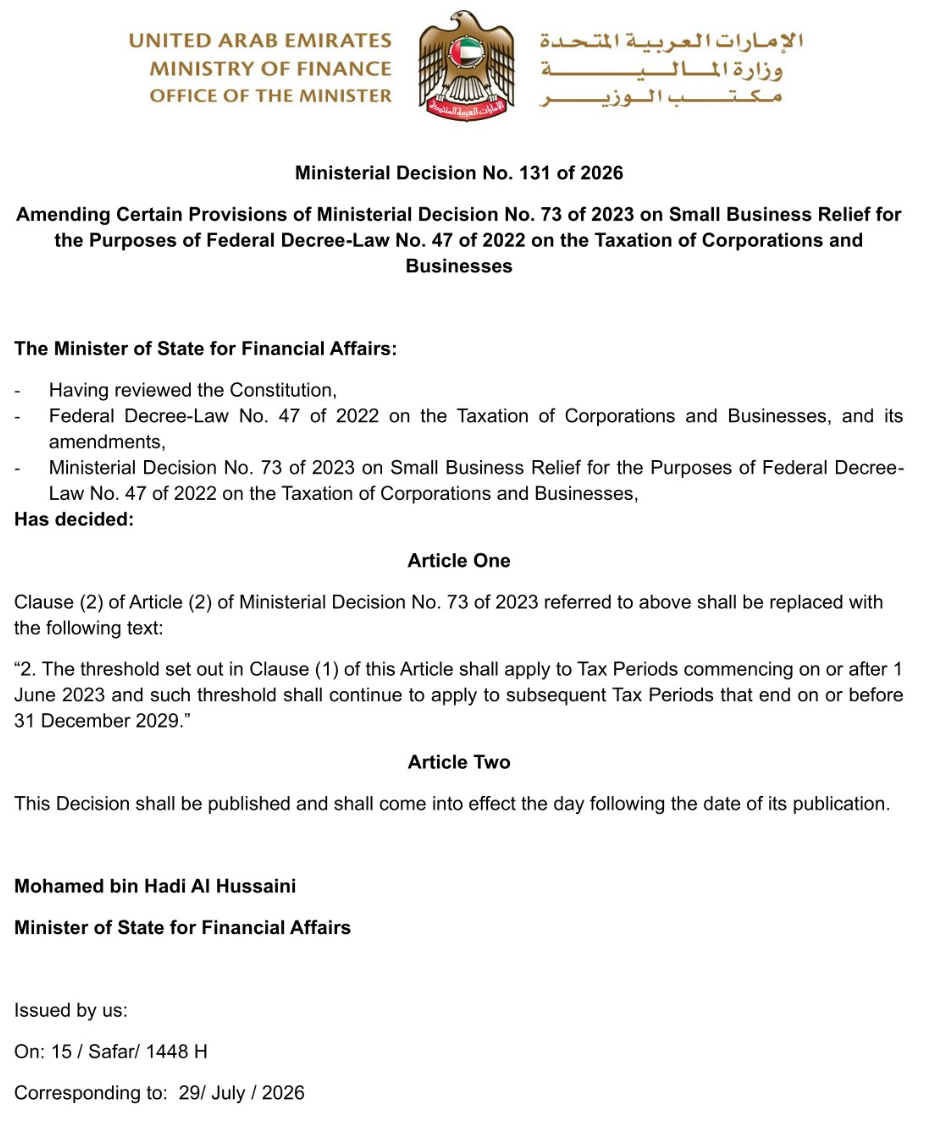
That outcome is now available for tax periods ending on or before 31 December 2029. Ministerial Decision No. 131, issued by the UAE Ministry of Finance, extends the Small Business Relief window that had been scheduled to close after periods ending 31 December 2026. The AED 3 million revenue threshold remains unchanged. For operators building supply-chain positions, agency networks, or light manufacturing footprints across the GCC and wider MENA region, the extra three years of predictability change planning horizons.
The Core Mechanism Under Article 21
Federal Decree-Law No. 47 of 2022 introduced corporate tax at 0% on taxable income up to AED 375,000 and 9% on the excess. Article 21 creates a separate elective regime for smaller resident persons. When the conditions are met and the election is made, the taxable person is treated as having derived no taxable income for that tax period. Corporate tax liability is therefore nil, regardless of actual accounting profit.
UAE Small Business Relief Guide
The relief also lightens the compliance load. Eligible taxpayers file a simplified return rather than a full computation and are not required to prepare transfer-pricing documentation (though the arm’s-length principle still applies to related-party transactions). Record-keeping obligations remain in force; the Federal Tax Authority can still request evidence that revenue never exceeded the threshold.
Ministerial Decision No. 73 of 2023 originally set the revenue threshold at AED 3 million and limited the relief to tax periods ending on or before 31 December 2026. Decision 131 simply replaces that end date with 31 December 2029 while leaving every other condition intact. Revenue continues to be measured according to accounting standards accepted in the UAE, and the test is applied to the current period and every prior period covered by the relief.
Financial Impact Analysis: Standard Tax vs. Small Business Relief
Practical comparison for a mainland trading entity generating AED 2.8 Million in gross revenue with an annual taxable profit of AED 400,000.
| Financial Metric | Standard Tax Regime (0% / 9%) | Small Business Relief (SBR) |
|---|---|---|
| Gross Annual Revenue | AED 2,800,000 | AED 2,800,000 (Under AED 3M) |
| Accounting Profit | AED 400,000 | AED 400,000 |
| Taxable Income Threshold Exemption | First AED 375,000 @ 0% | Treated as Zero Taxable Income |
| Taxable Amount @ 9% | AED 25,000 (Excess over 375k) | AED 0 |
| Final Corporate Tax Payable | AED 2,250 | AED 0 |
| Transfer Pricing Disclosure | Full TP Documentation Required | Exempt (Arm’s Length applies) |
| Compliance Complexity | Standard Tax Return | Simplified Tax Return |
Takeaway: While the direct tax savings in this profit scenario is AED 2,250, the primary value of SBR lies in avoiding complex transfer pricing documentation, lowering accounting overhead, and streamlining annual filings on EmaraTax.
Who Qualifies
Eligibility rests on four simultaneous requirements:
- The person must be a Resident Person for corporate tax purposes — a juridical person incorporated or effectively managed and controlled in the UAE, or a natural person conducting a licensed business or business activity in the UAE.
- Revenue in the relevant tax period must not exceed AED 3,000,000.
- Revenue in every previous tax period to which the relief could have applied must also have stayed at or below AED 3,000,000. Once the threshold is breached in any single period, the relief is permanently unavailable for all subsequent periods, even if revenue later falls.
- The person must not fall into the two excluded categories listed below.
Big relief for UAE SMEs — Small Business Relief extended to 2029
Revenue, not profit, is the sole metric. A trading company that turns over AED 2.9 million with thin margins remains eligible; a high-margin consultancy that crosses AED 3.1 million does not.
Natural persons are within scope only to the extent their business or business-activity turnover exceeds the separate AED 1 million registration threshold that applies to individuals. Once registered, the AED 3 million Small Business Relief test becomes available on the same terms.
The Trading Margin Trap: High Volume vs. Low Margin
For general trading entities and B2B order-fulfillment operators, the AED 3 million threshold presents a unique operational hurdle. Because Corporate Tax rules evaluate gross top-line turnover rather than net profit, high-volume traders operating on thin profit margins can unintentionally breach the ceiling after moving just a few bulk container shipments.
Practical Scenario: A physical commodity distributor working on a 3% net margin turnover generates AED 3.1 million in gross revenue from just 2 or 3 high-value trade cycles. Despite earning a modest profit of under AED 95,000, the business permanently loses Small Business Relief eligibility for all future periods—forcing full 9% corporate tax compliance and transfer-pricing obligations.
Trading operations must actively evaluate order structures, agency vs. principal roles, and contract handovers to ensure top-line turnover accurately reflects their operational model before crossing the irrecoverable threshold.
Explicit Exclusions
Two groups are barred regardless of their local revenue:
- Qualifying Free Zone Persons. Entities that already benefit from the 0% rate on qualifying income under the free-zone regime cannot elect Small Business Relief. The two regimes are mutually exclusive by design.
- Constituent entities of Multinational Enterprise Groups whose consolidated group revenue meets or exceeds the Country-by-Country Reporting threshold (AED 3.15 billion). Even a small UAE subsidiary of a large global group is excluded.
UAE Corporate Tax Small Business Relief
Tax groups are tested on a consolidated basis. If the group’s combined revenue exceeds AED 3 million, no member can claim the relief.
Why the Extension Matters for Cross-Border Operations
Small and medium-sized enterprises form the bulk of the UAE’s commercial fabric and contribute a substantial share of non-oil GDP. The original 2026 sunset risked forcing many of these operators into full compliance just as they were still scaling logistics networks, securing distribution agreements, or establishing regional headquarters functions. Extending the window to 2029 gives founders and foreign investors three additional years of cash-flow certainty and lower administrative overhead.
For a cross-border trader or service provider, the practical effects include:
- Ability to reinvest the cash that would otherwise leave as tax into working capital, warehouse capacity, or digital systems that improve shipment visibility.
- Reduced need for complex tax provisioning during early growth phases when margins are still being optimised.
- Clearer financial modelling for lenders and equity partners who evaluate multi-year projections in the GCC and MENA corridors.
- Simplified internal reporting when the UAE entity sits inside a larger regional structure that itself remains below the multinational threshold.
The relief does not eliminate the obligation to register for corporate tax or to file a return. It simply changes the content of that return and the resulting liability.
Practical Steps to Claim the Relief
Election is made on the corporate tax return itself through the EmaraTax platform. It is not automatic. For each eligible tax period the taxpayer must actively select the Small Business Relief option.
Key operational points:
- Confirm that revenue has never exceeded AED 3 million in any prior period covered by the regime. Maintain the underlying accounting records that support this assertion; the FTA can request them.
- Ensure the entity is a Resident Person and is not a Qualifying Free Zone Person or part of a reportable multinational group.
- File the simplified return by the statutory deadline (normally nine months after the end of the tax period). Late filing still attracts penalties even when tax payable is zero.
- Continue to apply the arm’s-length principle to any related-party transactions, even though full transfer-pricing documentation is not required under the relief.
- Track the permanent nature of a threshold breach. A one-time spike above AED 3 million closes the door permanently.
Businesses with non-calendar financial years must map the 31 December 2029 cut-off carefully against their own period-end dates.
Critical Deadlines: Mandatory Tax Registration & AED 10,000 Penalty
A costly misconception among SMEs is that a zero-tax liability under Small Business Relief removes the obligation to register for Corporate Tax. This is incorrect. The relief applies only to the calculation of taxable income, not to the administrative obligation of registration.
The Penalty: Failing to submit your Corporate Tax registration application to the FTA within your prescribed timeline (based on your license issuance month) triggers an automatic administrative penalty of AED 10,000 (under Cabinet Decision No. 75 of 2023)—even if your final tax payable is zero.
Banking Compliance & Credit Facilities: The Operational Trade-Off
While electing Small Business Relief provides immediate cash-flow advantages by setting taxable income to zero, trading companies must consider its indirect impact on banking relationships and supplier credit lines in the UAE.
- Bank Compliance Reviews: UAE financial institutions inspect tax filings during annual Account Maintenance Reviews (KYC/AML). Returns filed under SBR report zero taxable income, which can trigger additional compliance inquiries if bank account turnover sharply diverges from tax disclosures.
- Trade Finance & Credit Limits: Securing Letters of Credit (LCs), bank guarantees, or supplier credit limits typically requires showing clear, auditable profitability. Relying on simplified SBR returns without fully audited management accounts can lower your credit rating with trade counterparties and lenders.
Strategic Advice: Traders planning to leverage trade finance or scale international supplier networks should maintain full management accounts and audited financials—even when claiming SBR—to satisfy banking partners.
Interaction with the Standard 0%/9% Regime and Free-Zone Rules
Outside the Small Business Relief election, every taxable person still benefits from the 0% band on the first AED 375,000 of taxable income. The relief is therefore most valuable for profitable businesses whose taxable income would otherwise push them into the 9% band, or for those seeking the simplified compliance path.
Free-zone entities that meet Qualifying Free Zone Person conditions already enjoy 0% on qualifying income. They cannot stack Small Business Relief on top. Non-qualifying free-zone income falls under the ordinary 9% rules (subject to the AED 375,000 threshold). Mainland entities and non-qualifying free-zone persons are the primary constituency for the extended relief.
Losses incurred in a period for which Small Business Relief is elected cannot be carried forward. Taxpayers with significant start-up losses may therefore prefer to forgo the election in early years so that those losses remain available against future taxable income once the relief window closes or the revenue threshold is exceeded.
Strategic Clarity: Voluntary Forfeiture vs. Permanent Threshold Breach
Voluntary Non-Election (Re-electable): Deciding not to elect Small Business Relief in a specific period—for instance, to utilize carried-forward tax losses—does not permanently disqualify the business. Provided top-line revenue has never exceeded AED 3,000,000 in the current or any previous period, the taxpayer retains the right to re-elect SBR in subsequent tax periods through 2029.
Threshold Breach (Permanent Disqualification): Conversely, if gross revenue exceeds AED 3,000,000 in any single tax period, SBR eligibility is permanently revoked for all future periods covered by the regime, even if revenue subsequently drops back below the AED 3M mark.
Record-Keeping and Audit Readiness
Even though the return is simplified, the underlying obligation to maintain accurate books and records is unchanged. Revenue must be supportable under accepted UAE accounting standards. In the event of an FTA review, the taxpayer must be able to demonstrate that the AED 3 million ceiling was never breached across all relevant periods. Digital invoicing, bank reconciliations, and contract files that substantiate turnover are the practical backbone of that defence.
Audit Requirements: Are Audited Financial Statements Mandatory?
Under Federal Tax Authority (FTA) rules, qualifying resident entities electing Small Business Relief are not required to submit audited financial statements solely for Corporate Tax compliance. However, businesses must maintain accurate accounting records to substantiate that top-line revenue remained at or below AED 3 million across all active periods.
Key Exceptions to Note:
- Free Zone Authority Regulations: Specific licensing authorities across UAE Free Zones mandate audited financial statements as part of annual trade license renewal, independent of FTA requirements.
- Banking & Credit Facilities: Financial institutions frequently demand audited financials during account compliance reviews, credit facility approvals, or trade finance line renewals.
Practical Takeaway: While SBR eliminates the tax-driven audit burden, companies must check their specific jurisdiction and banking covenants before opting out of annual audits.
For multi-entity regional groups that remain below the multinational threshold, consistent revenue tracking across UAE entities becomes essential. Platform tools that consolidate commercial data from suppliers, freight forwarders, and distribution partners can reduce the administrative friction of preparing these records. In this context, solutions available through Platform.Tendify.Net can help operators maintain the transaction-level visibility needed for both commercial control and tax-support documentation.
Strategic Planning Horizon Through 2029
The extension does not make the relief permanent. Operators should model two scenarios: continued eligibility under the AED 3 million ceiling through 2029, and the transition to the ordinary 0%/9% regime thereafter. Decisions about entity structure, inter-company pricing, and the timing of revenue recognition can all affect future eligibility.
Businesses approaching the threshold may consider whether to accelerate or defer certain contracts, but any artificial arrangement that has the main purpose of obtaining a tax advantage risks challenge under the general anti-abuse rules. Substance and commercial rationale remain the safest foundation.
For foreign investors evaluating a first UAE foothold, the extended relief lowers the near-term cost of establishing a resident trading or service entity. Combined with the absence of personal income tax and the continued availability of free-zone incentives for qualifying activities, the UAE retains a competitive overall package relative to many peer jurisdictions in the region.
Supply Chain Structuring: Agency vs. Principal Models for B2B Networks
Because Small Business Relief thresholds are measured strictly against gross revenue rather than gross margin, regional supply-chain operators must carefully structure their commercial contracts before expanding distribution networks across the GCC and MENA corridors.
1. Principal Trading vs. Commission Agency Models
A distributor buying goods at AED 2.8 million and reselling at AED 3.1 million recognizes the full AED 3.1 million top-line turnover—permanently losing SBR status. Conversely, structuring operations under a disclosed agency or commission-based model ensures only the net agency fee (e.g., 5% commission = AED 155,000) counts toward top-line revenue, preserving the AED 3M relief window through 2029.
2. Decentralized Entity Sourcing & Flow Control
Cross-border supply chains can route non-UAE fulfillment directly through overseas suppliers, reserving the UAE resident entity strictly for regional facilitation, IP licensing, or local market agency fees without artificially inflating local gross turnover.
Operational Alignment: Maintaining transaction-level visibility across regional suppliers, logistics contractors, and buyers is critical to supporting agency structures during FTA audits. Digital B2B trade infrastructure available through تينديفاي دوت نت enables trading houses to maintain clean, auditable contract trails and operational separation across cross-border trade flows.
Common Pitfalls Observed in Practice
Operational experience shows several recurring issues:
- Treating the relief as automatic rather than elective.
- Measuring profit instead of revenue against the AED 3 million line.
- Overlooking a prior-period breach that permanently disqualifies the entity.
- Assuming free-zone status automatically blocks or grants the relief without checking Qualifying Free Zone Person conditions.
- Failing to maintain contemporaneous records that can later prove the revenue history.
Each of these is avoidable with disciplined tracking from the first tax period.
Critical Compliance Warning: General Anti-Abuse Rules (GAAR)
Artificial Business Splitting & Article 50: Artificially dividing a single business activity across multiple entities solely to keep each company’s annual revenue under the AED 3,000,000 ceiling directly violates Article 50 (General Anti-Abuse Rules) of Federal Decree-Law No. 47 of 2022.
Where the Federal Tax Authority (FTA) determines that a transaction or arrangement was entered into without a valid commercial rationale and aimed primarily at securing Small Business Relief, it holds statutory powers to disregard the arrangement, aggregate corporate revenues, retroactively deny SBR benefits, and apply severe administrative penalties.
Critical Distinction: Corporate Tax Relief vs. VAT & Customs Duties
A common and costly misconception among cross-border traders is assuming that electing Corporate Tax Small Business Relief (SBR) grants immunity from other federal tax obligations. SBR applies exclusively to UAE Corporate Income Tax and provides no exemptions from Value Added Tax (VAT) or Customs duties.
- VAT Registration & Filing: The mandatory VAT registration threshold remains unchanged at AED 375,000. Electing SBR for Corporate Tax does not alter your statutory obligation to register for VAT, issue tax invoices, and submit periodic VAT returns via EmaraTax.
- Customs Clearance & Tariff Liabilities: SBR has zero impact on UAE Customs regulations. Import/export customs duties, inspection clearance procedures, and cargo declaration requirements remain fully enforceable regardless of your Corporate Tax liability status.
Operational Note: Failure to maintain separate VAT and Customs compliance while operating under Corporate Tax SBR can trigger severe statutory penalties from the Federal Tax Authority (FTA).
الأسئلة الشائعة (FAQ)
Comprehensive guide to UAE Corporate Tax Small Business Relief (SBR) through 2029
1. Is Small Business Relief (SBR) granted automatically by the FTA?
+
No, SBR is strictly elective. Eligible taxpayers must actively elect to claim Small Business Relief within their annual Corporate Tax return submitted via the EmaraTax portal for each relevant tax period.
2. What happens if my annual revenue reaches AED 3,000,001?
+
Exceeding the AED 3,000,000 top-line revenue limit in any tax period permanently revokes your SBR eligibility for that period and all subsequent periods through 2029. Future earnings will be subject to standard Corporate Tax rates (0% up to AED 375k, 9% on excess).
3. Is the threshold evaluated on gross revenue or net profit?
+
The AED 3 Million threshold applies exclusively to gross top-line revenue (turnover), not net profit. Even if your net margin is minimal or zero, exceeding AED 3M in total sales disqualifies the entity from claiming SBR.
4. Do Free Zone companies qualify for Small Business Relief?
+
Qualifying Free Zone Persons (QFZPs) benefiting from the 0% regime on qualifying income are explicitly barred from electing SBR. However, non-qualifying Free Zone entities operating as standard resident tax subjects can elect SBR if their revenue stays under AED 3M.
5. Do I still need to register for Corporate Tax if I qualify for SBR?
+
Yes. All resident judicial entities in the UAE must register for Corporate Tax. Failing to submit your registration application within the FTA-mandated timeframe triggers an administrative penalty of AED 10,000.
6. Can tax losses be carried forward while using Small Business Relief?
+
No. Any tax losses incurred during a period in which Small Business Relief is elected cannot be carried forward to offset taxable income in future periods.
7. If I choose not to elect SBR in Year 1, can I elect it in Year 2?
+
Yes. Voluntary non-election (e.g., to preserve tax losses) does not disqualify you for future years. As long as your gross revenue has never exceeded AED 3M in any current or prior period, you can elect SBR in subsequent years up to 2029.
8. Are Transfer Pricing rules applicable under Small Business Relief?
+
While taxpayers claiming SBR are exempt from preparing formal Transfer Pricing documentation (Master File / Local File), transactions with Related Parties and Connected Persons must still adhere to the Arm’s Length Principle.
9. Can I split my business into two companies to stay under AED 3 Million?
+
No. Artificially splitting operations without a legitimate commercial reason violates Article 50 (General Anti-Abuse Rules – GAAR). The FTA has statutory powers to aggregate revenues, revoke SBR status, and levy severe penalties.
10. Does Small Business Relief exempt my business from VAT?
+
No. Corporate Tax SBR and Value Added Tax (VAT) are completely separate regimes. Mandatory VAT registration remains at AED 375,000, and VAT filing requirements are unaffected by your Corporate Tax SBR status.
11. How does SBR impact my bank account and credit lines in the UAE?
+
Filing zero taxable income returns under SBR can prompt additional review during bank KYC reviews or credit applications. Maintaining proper, audited management accounts is highly recommended if you intend to secure trade finance, LCs, or commercial loans.
12. Are audited financial statements mandatory to claim SBR?
+
The FTA does not require audited financials solely for SBR compliance (accurate books are sufficient). However, specific licensing authorities or banking covenants may still mandate annual audited financials.
13. How does SBR apply to Multinational Enterprise (MNE) Groups?
+
Entities that are part of an MNE Group subject to Country-by-Country Reporting (consolidated group revenue of AED 3.15 Billion or more) are explicitly excluded from Small Business Relief, regardless of their local UAE turnover.
14. How do B2B traders avoid the “Trading Margin Trap”?
+
Traders operating on thin margins can avoid artificially inflating gross revenue by structuring contracts under a disclosed commission agency model rather than principal trading, ensuring only net commission fees count toward the AED 3M revenue limit.
15. What are the key record-keeping obligations under SBR?
+
Taxpayers must maintain financial records, invoices, bank statements, and contracts for at least 7 years to substantiate to the FTA that gross revenue remained below AED 3 Million across all relevant tax periods.
16. What happens after the SBR extension expires on December 31, 2029?
+
Unless the Ministry of Finance issues a further extension, all entities previously claiming SBR will transition to the standard Corporate Tax regime starting from financial periods ending after December 31, 2029 (0% up to AED 375,000 and 9% on excess).
Looking Ahead
The decision to extend Small Business Relief until the end of 2029 signals continued policy support for the SME layer that underpins much of the UAE’s non-oil economy and its role as a regional trade and logistics hub. For companies whose revenue remains comfortably below AED 3 million, the practical result is three extra years of zero corporate tax liability and lighter compliance, provided the election is made correctly each period.
Operators that combine careful revenue monitoring with clean commercial documentation will be best placed to use the full window. Those already near the threshold should begin modelling the post-2029 landscape now, so that any necessary structural adjustments can be executed with commercial rather than purely tax-driven timing.
For businesses navigating the intersection of corporate tax rules, free-zone options, and regional supply-chain structures, reliable commercial platforms that keep transaction data organised reduce both operational friction and compliance risk. Registration at Register on Tendify.net provides access to tools designed to support exactly that kind of cross-border operational clarity.
Further reading on related topics within the same commercial ecosystem includes guidance on mainland versus free-zone structuring considerations and practical steps for corporate tax registration and first-return preparation, available through the Tendify blog resources at Dubai Food Import Guide: FIRS, Zad, and Customs Clearance و How to Find Reliable Bulk Shipping Partners from Iran to the UAE.

